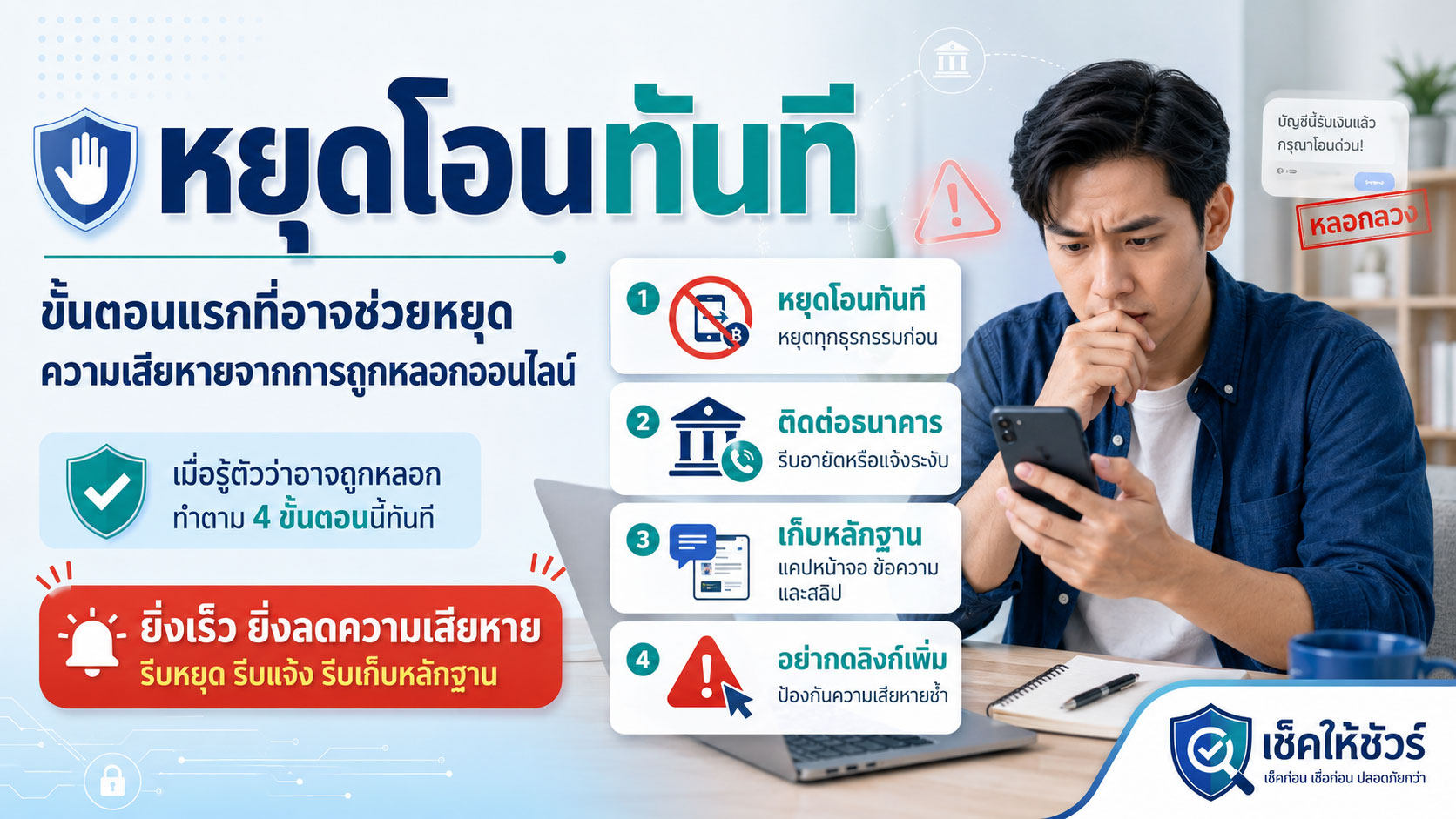
หลายคนไม่ได้เสียเงินทั้งหมดตั้งแต่การโอนครั้งแรก
แต่ความเสียหายมักเริ่มบานปลายหลังจากนั้น
เมื่อมิจฉาชีพเริ่มพูดว่า…
“โอนอีกนิดเดียวก็ถอนได้แล้ว”
“ต้องจ่ายค่าธรรมเนียมก่อน”
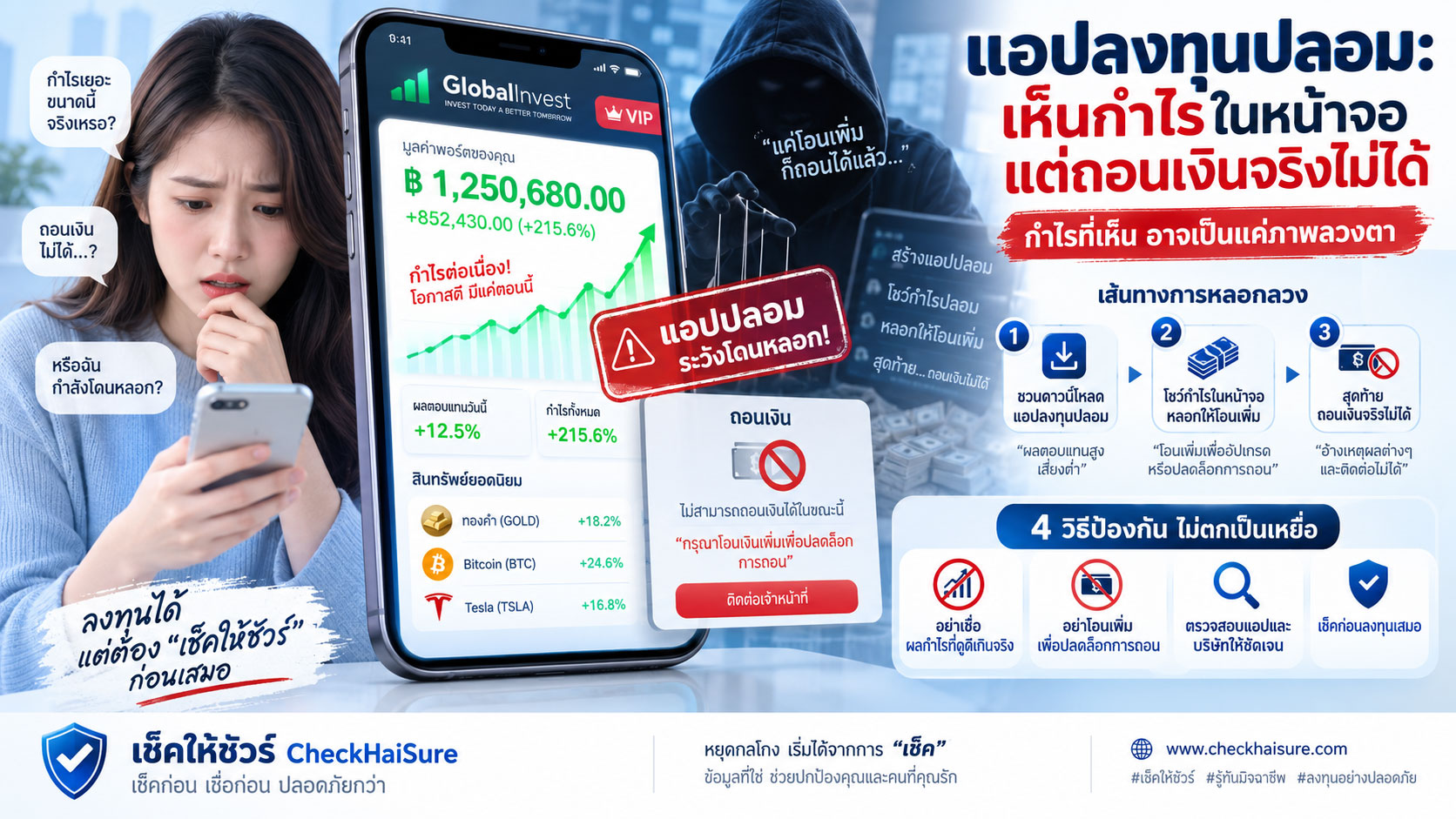
“ระบบล็อกบัญชี ต้องเติมเงินเพื่อปลดล็อก”
“ถ้าไม่โอนตอนนี้ ยอดก่อนหน้าจะหายไปทั้งหมด”
“นี่เป็นขั้นตอนสุดท้ายจริงๆ”
คำพูดเหล่านี้ไม่ได้ถูกออกแบบมาเพื่ออธิบายเหตุผล
แต่ถูกออกแบบมาเพื่อทำให้คุณ กลัว เสียดาย รีบ และไม่กล้าหยุด
ดังนั้น หากคุณเริ่มรู้สึกว่าเรื่องนี้แปลก ไม่มั่นใจ หรือเริ่มถูกเร่งให้โอนเงินเพิ่ม สิ่งแรกที่ควรทำไม่ใช่การพยายามพิสูจน์ว่าตัวเองยังไม่ถูกหลอก
แต่คือการ หยุดโอนทันที
ทำไม “หยุดโอนทันที” จึงสำคัญกว่าที่คิด
เมื่อเราอยู่ในสถานการณ์ที่เกี่ยวกับเงิน ความหวัง ความกลัว หรือความกดดัน สมองของเรามักไม่ได้ตัดสินใจด้วยความนิ่งเท่าปกติ
โดยเฉพาะในเคสหลอกลวงออนไลน์ มิจฉาชีพมักไม่ได้ใช้แค่ข้อมูลปลอม แต่ใช้ “จังหวะทางอารมณ์” เข้ามาควบคุมการตัดสินใจของเรา
เขาอาจทำให้เรารู้สึกว่า ถ้าไม่โอนต่อ เงินก้อนเดิมจะหายไป
เขาอาจทำให้เราคิดว่า เรามาไกลเกินกว่าจะถอย
เขาอาจทำให้เรากลัวว่า ถ้าไม่ทำตาม จะมีปัญหาทางกฎหมาย
หรือเขาอาจทำให้เรารู้สึกผิดว่า เป็นเพราะเราทำรายการไม่ครบเอง
แต่ความจริงคือ
การหยุดโอน ไม่ได้แปลว่าคุณยอมแพ้
การหยุดโอน คือการหยุดไม่ให้ความเสียหายเพิ่มขึ้น
ยิ่งหยุดเร็วเท่าไร โอกาสในการตั้งหลัก ตรวจสอบ รวบรวมหลักฐาน และขอความช่วยเหลือก็ยิ่งมากขึ้นเท่านั้น
หลายกลโกงไม่ได้จบที่ยอดแรก แต่จบเมื่อเหยื่อหยุดโอน
ในหลายกรณี มิจฉาชีพจะเริ่มจากยอดเงินที่ดูไม่สูงมาก เพื่อให้เหยื่อรู้สึกว่า “ลองดูก็ได้” หรือ “ไม่น่ามีอะไรเสียหาย”
จากนั้นจึงค่อยๆ เพิ่มเงื่อนไข เช่น
ต้องจ่ายค่าภาษี
ต้องจ่ายค่าปลดล็อกบัญชี
ต้องเติมเงินเพื่อเพิ่มเครดิต
ต้องโอนยืนยันตัวตน
ต้องชำระค่าประกัน
ต้องจ่ายค่าธรรมเนียมถอนเงิน
ต้องโอนเพื่อรักษาสิทธิ์
ต้องชำระยอดค้างก่อนถึงจะได้เงินคืน
เมื่อเหยื่อเริ่มโอนแล้ว มิจฉาชีพจะพยายามทำให้เหยื่อรู้สึกว่า “ถ้าหยุดตอนนี้ เงินที่จ่ายไปก่อนหน้าจะสูญเปล่า”
นี่คือกับดักทางความคิดที่อันตรายมาก
เพราะแทนที่เราจะตัดสินใจจากความเสี่ยงในปัจจุบัน เรากลับตัดสินใจจากความเสียดายในอดีต
แต่เงินที่โอนไปแล้วคือสิ่งที่ต้องตามแก้ไข
ส่วนเงินที่ยังไม่โอน คือสิ่งที่เรายังปกป้องได้
สัญญาณที่ควรหยุดโอนทันที
คุณไม่จำเป็นต้องรอให้แน่ใจ 100% ว่านี่คือมิจฉาชีพ
เพียงแค่มีสัญญาณบางอย่าง ก็เพียงพอแล้วที่จะหยุดและตรวจสอบก่อน
เช่น มีคนเร่งให้โอนเงินภายในเวลาจำกัด
มีการอ้างว่าต้องโอนเพิ่มก่อนถึงจะได้เงินคืน
มีการให้โอนเข้าบัญชีบุคคลที่ไม่เกี่ยวข้องกับชื่อร้าน บริษัท หรือหน่วยงาน
มีการเปลี่ยนบัญชีรับเงินหลายครั้ง
มีการห้ามบอกคนอื่น
มีการขู่ให้กลัว
มีการชวนให้ติดตั้งแอปแปลกๆ
มีการอ้างว่าเป็นเจ้าหน้าที่ แต่ติดต่อผ่านช่องทางส่วนตัว
มีการให้โอนเพื่อยืนยันตัวตน
มีการใช้คำว่า “ขั้นตอนสุดท้าย” ซ้ำหลายครั้ง
ถ้าคุณเจอสัญญาณเหล่านี้ อย่าเพิ่งพยายามโต้เถียงกับอีกฝ่าย
อย่าเพิ่งส่งหลักฐานส่วนตัวเพิ่ม
อย่าเพิ่งกดลิงก์
และที่สำคัญที่สุดคือ อย่าโอนเพิ่ม
สิ่งที่ควรทำทันทีหลังหยุดโอน
หลังจากหยุดโอนแล้ว สิ่งที่ควรทำต่อคือการตั้งหลักอย่างเป็นขั้นตอน
อันดับแรก ให้หยุดคุยในจังหวะที่ถูกกดดันก่อน ไม่จำเป็นต้องรีบตอบ ไม่จำเป็นต้องรีบอธิบาย และไม่จำเป็นต้องขอโทษอีกฝ่ายที่ยังไม่โอนต่อ
จากนั้นให้เก็บหลักฐานทั้งหมดไว้ เช่น สลิปโอนเงิน เลขบัญชี ชื่อบัญชี เบอร์โทรศัพท์ ลิงก์ เว็บไซต์ รูปโปรไฟล์ แชท ข้อความเสียง และรายละเอียดเวลาที่เกิดเหตุ
ต่อมาให้ตรวจสอบข้อมูลผ่านแหล่งที่น่าเชื่อถือ หรือสอบถามคนใกล้ตัวที่ไว้ใจได้ อย่าตัดสินใจคนเดียวในขณะที่ยังรู้สึกกลัวหรือเสียดาย
หากมีการโอนเงินไปแล้ว ควรรีบติดต่อธนาคารของคุณเพื่อแจ้งเหตุและขอคำแนะนำตามขั้นตอนของธนาคาร รวมถึงพิจารณาแจ้งความหรือดำเนินการตามช่องทางที่เกี่ยวข้อง
ที่สำคัญ อย่ากลับไปโอนเพิ่มเพียงเพราะอีกฝ่ายบอกว่าจะช่วยคืนเงินให้ เพราะในหลายกรณี การอ้างว่าจะคืนเงิน คือวิธีหลอกให้เหยื่อเสียเงินเพิ่มอีกครั้ง
อย่าปล่อยให้คำว่า “อีกนิดเดียว” ทำให้เสียมากกว่าเดิม
หนึ่งในประโยคที่อันตรายที่สุดในการหลอกลวงออนไลน์คือ
“อีกนิดเดียวก็จบแล้ว”
เพราะประโยคนี้ทำให้คนจำนวนมากตัดสินใจโอนต่อ ทั้งที่ในใจเริ่มรู้แล้วว่าเรื่องนี้ไม่ปกติ
ความจริงคือ ถ้าเป็นบริการจริง ธุรกรรมจริง หรือหน่วยงานจริง ควรสามารถอธิบายขั้นตอนอย่างโปร่งใส ตรวจสอบได้ และไม่ควรใช้ความกลัวหรือความเร่งด่วนมาบังคับให้คุณโอนเงินเพิ่มอย่างต่อเนื่อง
ถ้าคุณเริ่มรู้สึกว่า ยิ่งทำตาม ยิ่งต้องจ่าย
ยิ่งถาม ยิ่งถูกเร่ง
ยิ่งสงสัย ยิ่งถูกขู่
นั่นอาจไม่ใช่ขั้นตอนปกติ
แต่นั่นอาจเป็นสัญญาณว่าคุณควรหยุดทันที
การหยุดโอนไม่ใช่เรื่องน่าอาย
หลายคนลังเลที่จะหยุด เพราะรู้สึกว่า “ถ้าหยุดตอนนี้ แปลว่าเราถูกหลอกแล้วใช่ไหม”
แต่การยอมรับว่ามีบางอย่างผิดปกติ ไม่ใช่ความล้มเหลว
มันคือการปกป้องตัวเอง
คนที่ถูกหลอกไม่ได้แปลว่าเป็นคนโง่
หลายครั้งมิจฉาชีพเตรียมบทสนทนา เตรียมเอกสารปลอม เตรียมเว็บไซต์ปลอม และเตรียมวิธีสร้างความน่าเชื่อถือมาอย่างเป็นระบบ
ดังนั้น สิ่งที่สำคัญที่สุดไม่ใช่การโทษตัวเอง
แต่คือการหยุดความเสียหายให้เร็วที่สุด
ก่อนโอนครั้งต่อไป ลองถามตัวเอง 5 ข้อนี้
ก่อนตัดสินใจโอนเงินเพิ่ม ลองหยุดสักครู่แล้วถามตัวเองว่า
ฉันกำลังถูกเร่งให้ตัดสินใจหรือไม่
อีกฝ่ายอธิบายเหตุผลชัดเจนและตรวจสอบได้จริงหรือไม่
บัญชีที่ให้โอนมีความเกี่ยวข้องกับชื่อร้าน บริษัท หรือหน่วยงานจริงหรือไม่
ถ้าฉันไม่โอนตอนนี้ จะมีเหตุผลสมจริงแค่ไหนที่เงินก่อนหน้าจะหายไป
ฉันได้ปรึกษาคนที่ไว้ใจได้แล้วหรือยัง
ถ้าคำตอบทำให้คุณรู้สึกไม่มั่นใจ
คำตอบที่ปลอดภัยที่สุดในตอนนั้นคือ
หยุดก่อน อย่าเพิ่งโอน
สรุป: เงินที่ยังไม่โอน คือเงินที่ยังปกป้องได้
เมื่อสงสัยว่ากำลังถูกหลอก สิ่งที่ควรทำทันทีคือหยุดโอน ไม่ใช่โอนต่อเพื่อพิสูจน์ว่าเรื่องนั้นเป็นจริง
เพราะมิจฉาชีพมักต้องการให้เราตัดสินใจในช่วงที่กำลังกลัว เสียดาย หรือหวังว่าจะได้เงินคืน
จำไว้ว่า
หยุดโอนทันที ไม่ได้แปลว่าคุณแพ้
หยุดโอนทันที คือการดึงตัวเองกลับมาอยู่ในจุดที่คิด ตรวจสอบ และขอความช่วยเหลือได้
หากคุณยังไม่แน่ใจว่าเลขบัญชี เบอร์โทร ลิงก์ หรือร้านค้าออนไลน์ที่พบมีความเสี่ยงหรือไม่ คุณสามารถนำข้อมูลมาตรวจสอบกับ CheckHaiSure ก่อนตัดสินใจโอนเงินครั้งต่อไป
หยุดก่อนหนึ่งนาที
อาจช่วยป้องกันความเสียหายที่ตามมาอีกมากกว่าที่คิด
Stop Transferring Money Immediately: The First Step That Can Help Limit the Damage from Online Scams
Many people do not lose all their money from the first transfer.
The damage often grows after that, when scammers begin saying things like:
“Just one more transfer and you can withdraw your money.”
“You need to pay the fee first.”
“Your account is locked. You must add more money to unlock it.”
“If you don’t transfer now, the previous amount will be lost.”
“This is truly the final step.”
These words are not designed to explain anything clearly.
They are designed to make you feel afraid, pressured, rushed, and unable to stop.
So if you start feeling that something is strange, uncertain, or you are being pushed to transfer more money, the first thing you should do is not to prove that you are not being scammed.
The first thing you should do is:
Stop transferring money immediately.
Why “Stop Transferring Money Immediately” Matters More Than You Think
When we are dealing with money, hope, fear, or pressure, our minds may not make decisions as calmly as usual.
In many online scam cases, scammers do not rely only on fake information. They also use emotional pressure to control your decision-making.
They may make you feel that if you do not transfer more, the money you already paid will be gone.
They may make you think that you have come too far to stop now.
They may make you afraid that you will face legal trouble if you do not follow their instructions.
Or they may make you feel that the problem is your fault because you did not complete the required steps.
But the truth is simple:
Stopping the transfer does not mean you are giving up.
Stopping the transfer means you are preventing the damage from getting worse.
The sooner you stop, the more time and opportunity you have to think clearly, verify the situation, collect evidence, and seek help.
Many Scams Do Not End with the First Payment — They End When the Victim Stops Paying
In many cases, scammers begin with a small amount to make the victim feel that it is worth trying or that the risk is not too serious.
After that, they gradually add more conditions, such as:
A tax payment
An account unlocking fee
A credit top-up
An identity verification transfer
An insurance fee
A withdrawal processing fee
A payment to keep your benefits active
A settlement of an outstanding balance before your money can be released
Once the victim has already transferred money, the scammer tries to make them feel that stopping now would make all previous payments a waste.
This is a dangerous mental trap.
Instead of deciding based on the current risk, we begin deciding based on the money we already lost.
But the money that has already been transferred is something you need to deal with carefully.
The money you have not transferred yet is still something you can protect.
Warning Signs That You Should Stop Transferring Money Immediately
You do not need to be 100% sure that something is a scam before you stop.
Even a few warning signs are enough reason to pause and check first.
For example:
Someone pressures you to transfer money within a short time.
You are told to pay more before you can receive your money back.
You are asked to transfer money to a personal account that does not match the shop, company, or organization.
The receiving bank account keeps changing.
You are told not to tell anyone.
You are threatened or made to feel afraid.
You are asked to install an unfamiliar app.
Someone claims to be an official but contacts you through a personal account.
You are asked to transfer money to verify your identity.
The phrase “final step” is used repeatedly.
If you notice these signs, do not rush to argue with the other person.
Do not send more personal information.
Do not click suspicious links.
Most importantly:
Do not transfer more money.
What You Should Do Right After You Stop Transferring
After you stop transferring money, the next step is to regain control calmly and carefully.
First, step away from the pressure. You do not need to reply immediately. You do not need to explain yourself. You do not need to apologize for not transferring more money.
Then, collect all available evidence, such as transfer slips, bank account numbers, account names, phone numbers, links, websites, profile pictures, chat messages, voice messages, and the timeline of what happened.
Next, verify the information through reliable sources or talk to someone you trust. Try not to make decisions alone while you are still feeling afraid, confused, or regretful.
If you have already transferred money, contact your bank as soon as possible to report the incident and ask for guidance. You may also consider filing a report through the proper official channels.
Most importantly, do not transfer more money just because the other person says they can help you get your money back.
In many cases, the promise of a refund is simply another way to make the victim lose even more money.
Do Not Let the Words “Just a Little More” Lead to a Bigger Loss
One of the most dangerous phrases in online scams is:
“Just a little more and it will be finished.”
This phrase causes many people to continue transferring money, even when they already feel that something is not right.
In reality, a legitimate service, transaction, company, or official process should be able to explain its steps clearly and transparently. It should also be verifiable. It should not rely on fear, urgency, or repeated pressure to force you to keep transferring money.
If you feel that the more you follow the instructions, the more you have to pay,
the more you ask questions, the more you are pressured,
or the more you hesitate, the more you are threatened,
then it may not be a normal process.
It may be a sign that you should stop immediately.
Stopping the Transfer Is Not Something to Be Ashamed Of
Many people hesitate to stop because they feel that stopping means admitting they have been scammed.
But recognizing that something is wrong is not a failure.
It is self-protection.
Being scammed does not mean someone is foolish. Many scammers prepare fake conversations, fake documents, fake websites, fake profiles, and convincing stories in a very organized way.
So the most important thing is not to blame yourself.
The most important thing is to stop the damage as early as possible.
Before You Make the Next Transfer, Ask Yourself These 5 Questions
Before transferring more money, pause for a moment and ask yourself:
Am I being rushed to make a decision?
Can the other person clearly explain the reason, and can I verify it?
Does the receiving bank account truly match the shop, company, or organization?
If I do not transfer now, is it really reasonable that my previous money will disappear?
Have I spoken with someone I trust before making this decision?
If your answers make you feel uncertain, the safest answer at that moment is:
Stop first. Do not transfer yet.
Conclusion: Money You Have Not Transferred Yet Is Money You Can Still Protect
When you suspect that you may be dealing with an online scam, the first thing to do is stop transferring money.
Do not continue transferring money just to prove that the situation is real.
Scammers often want you to make decisions when you are afraid, regretful, pressured, or hoping to recover what you already lost.
Remember:
Stopping the transfer does not mean you have lost.
Stopping the transfer means you are giving yourself the chance to think, verify, and get help.
If you are unsure whether a bank account number, phone number, link, or online shop may be risky, you can check the information with CheckHaiSure before making your next transfer.
Pausing for just one minute could help prevent much greater damage later.

Leave a Reply
You must be logged in to post a comment.