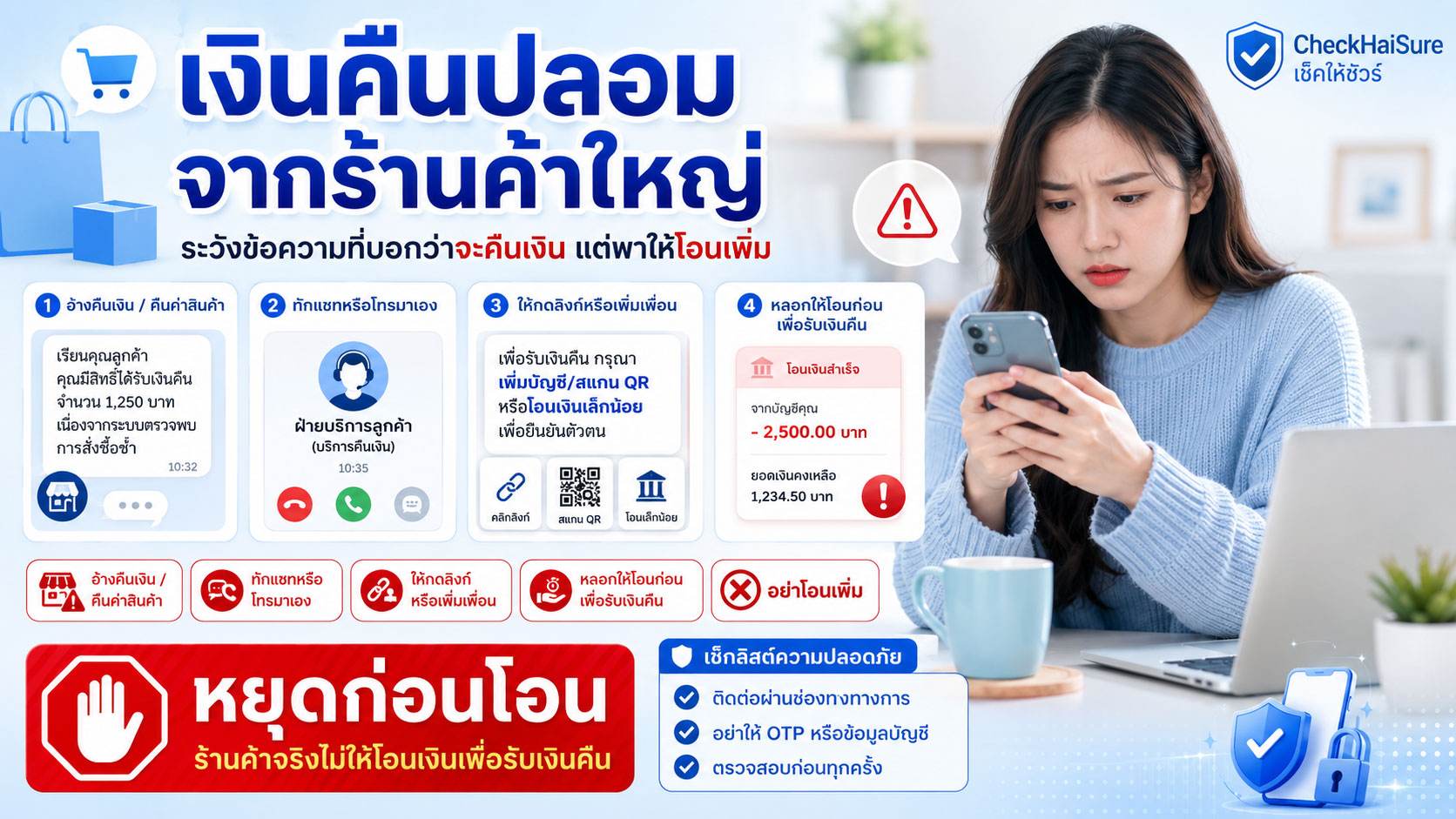
“คุณได้รับสิทธิ์คืนเงิน”
“คำสั่งซื้อของคุณมีปัญหา ร้านค้าจะคืนเงินให้”
“ระบบพบว่าคุณชำระเงินเกิน กรุณายืนยันบัญชีเพื่อรับเงินคืน”
“มีรายการคืนเงินจากแคมเปญของร้านค้าใหญ่ กรุณาทำรายการภายในวันนี้”
ถ้าได้รับข้อความหรือสายโทรศัพท์ลักษณะนี้ หลายคนอาจไม่ได้คิดถึงคำว่า “มิจฉาชีพ” เป็นอันดับแรก
เพราะคำว่า “ได้เงินคืน” ฟังดูเหมือนข่าวดี
โดยเฉพาะถ้าเราเคยสั่งของออนไลน์จริง เคยรอพัสดุจริง เคยขอคืนสินค้า หรือเคยเจอปัญหากับร้านค้าออนไลน์มาก่อน
มิจฉาชีพจึงใช้จุดนี้เป็นช่องทาง
เขาไม่ได้เริ่มจากการขอเงินทันที
แต่เริ่มจากการบอกว่าจะ “คืนเงิน” ให้เรา
ทำให้เรารู้สึกว่าเราเป็นฝ่ายได้รับประโยชน์ ไม่ใช่ฝ่ายกำลังเสี่ยงเสียเงิน
และเมื่อความระวังลดลง เขาจึงค่อยพาเราไปสู่ขั้นตอนที่อันตรายกว่า
กดลิงก์
กรอกข้อมูล
ส่งเอกสาร
ให้รหัส OTP
เพิ่ม LINE
ติดตั้งแอป
เปิดแอปธนาคาร
หรือโอนเงินเพิ่มเพื่อ “ปลดล็อก” การคืนเงิน
จำไว้ว่า
การคืนเงินจริง ไม่ควรเริ่มด้วยการให้เราโอนเงินเพิ่ม
ทำไมคำว่า “เงินคืน” ถึงทำให้คนเชื่อง่าย
เวลามีคนบอกว่าเราจะได้เงินคืน สมองเรามักรู้สึกว่ากำลังแก้ปัญหา ไม่ใช่กำลังเข้าสู่ความเสี่ยง
ถ้าเคยซื้อของแล้วไม่ได้ของ
เคยได้ของไม่ตรงปก
เคยจ่ายเงินซ้ำ
เคยยกเลิกคำสั่งซื้อ
เคยรอคืนเงินจากร้านค้า
หรือเคยมีรายการที่ไม่มั่นใจในแอป
คำว่า “คืนเงิน” จะทำให้เราสนใจทันที
ยิ่งถ้าอีกฝ่ายอ้างชื่อร้านค้าใหญ่ แพลตฟอร์มช้อปปิ้งชื่อดัง บริษัทขนส่ง หรือแบรนด์ที่เราคุ้นเคย เราอาจรู้สึกว่าเรื่องนี้เป็นไปได้
มิจฉาชีพจึงไม่จำเป็นต้องสร้างเรื่องใหม่ทั้งหมด
เขาแค่เอาเรื่องที่คนทั่วไปเจอบ่อยอยู่แล้วมาใส่ความเร่งด่วน
“ต้องยืนยันภายในวันนี้”
“ถ้าไม่ทำตอนนี้ สิทธิ์คืนเงินจะหมดอายุ”
“ระบบจะปิดรอบคืนเงินในอีกไม่กี่นาที”
“เจ้าหน้าที่จะช่วยทำรายการให้เดี๋ยวนี้”
เมื่อเราอยากได้เงินคืนและกลัวเสียสิทธิ์ เราอาจรีบทำตามโดยยังไม่ทันตรวจสอบ
กลโกงมักเริ่มจากช่องทางที่ดูคุ้นเคย
เงินคืนปลอมอาจมาได้หลายช่องทาง
บางครั้งมาเป็น SMS
บางครั้งมาเป็นแชท
บางครั้งมาใน LINE
บางครั้งมาใน inbox ของเพจปลอม
บางครั้งมาเป็นอีเมล
บางครั้งมีคนโทรมาโดยตรง
บางครั้งมาในรูปแบบโฆษณาหรือหน้าเว็บที่ดูเหมือนร้านค้าใหญ่
และบางครั้งมาเป็นคอมเมนต์หรือข้อความใต้โพสต์ที่อ้างว่า “ติดต่อรับเงินคืนได้ที่นี่”
ข้อความอาจดูคล้ายจริงมาก
มีชื่อร้านค้า
มีโลโก้
มีเลขคำสั่งซื้อ
มีข้อความขอโทษ
มีคำว่า refund
มีคำว่า compensation
มีคำว่า cashback
มีคำว่า claim
หรือมีลิงก์ที่ดูเหมือนเกี่ยวกับร้านค้านั้น
แต่ความเหมือน ไม่ใช่หลักฐานว่าจริง
โลโก้สามารถคัดลอกได้
ชื่อร้านค้าสามารถแอบอ้างได้
หน้าเว็บสามารถทำให้คล้ายของจริงได้
และข้อความที่ดูเป็นระบบอัตโนมัติ ก็อาจถูกเขียนขึ้นเพื่อหลอกให้เรากดลิงก์
เงินคืนปลอมมักพาเราไปทำอะไร
จุดอันตรายของกลโกงนี้คือ มันไม่ได้จบที่การแจ้งว่าได้เงินคืน
แต่มักมี “ขั้นตอนต่อไป” ที่ทำให้เราเสียเงินหรือข้อมูล
เช่น
ให้กดลิงก์เพื่อรับเงินคืน
ให้กรอกชื่อ นามสกุล เบอร์โทร เลขบัตรประชาชน หรือข้อมูลบัญชี
ให้กรอกข้อมูลบัตรเครดิตหรือบัตรเดบิต
ให้เข้าสู่ระบบด้วยบัญชีร้านค้าออนไลน์
ให้เพิ่ม LINE เจ้าหน้าที่
ให้ส่งรูปบัตรประชาชน
ให้ส่งหน้าสมุดบัญชี
ให้ยืนยันรหัส OTP
ให้ติดตั้งแอปเพื่อทำรายการคืนเงิน
ให้แชร์หน้าจอ
ให้เปิดแอปธนาคารระหว่างคุยกับเจ้าหน้าที่
ให้โอนเงินจำนวนเล็กน้อยเพื่อยืนยันบัญชี
ให้โอนค่าธรรมเนียมก่อนรับเงินคืน
หรือให้โอนเงินเพิ่มเพราะบอกว่าระบบคืนเงินผิดพลาด
ถ้าเริ่มจาก “จะคืนเงินให้” แต่สุดท้ายกลายเป็น “ให้เราโอนเงินออกไป” ให้ถือว่าน่าสงสัยทันที
คำว่า “โอนยืนยัน” คือกับดักที่ควรระวัง
หนึ่งในประโยคที่พบบ่อยคือ
“ต้องโอนยืนยันบัญชีก่อน”
“โอนมาเล็กน้อยเพื่อยืนยันตัวตน”
“ระบบต้องตรวจสอบว่าบัญชีนี้เป็นของคุณจริง”
“โอนแล้วระบบจะคืนกลับพร้อมเงินชดเชย”
“ต้องมียอดหมุนเวียนก่อน ถึงจะถอนเงินคืนได้”
คำพูดเหล่านี้ทำให้หลายคนคิดว่าเป็นขั้นตอนชั่วคราว
โดยเฉพาะถ้าจำนวนเงินรอบแรกไม่มาก
บางคนคิดว่า “แค่ไม่กี่ร้อยบาท ลองทำดูก็ได้”
แต่เมื่อโอนไปแล้ว มิจฉาชีพอาจบอกว่าทำรายการผิด ต้องโอนเพิ่ม
บอกว่าระบบค้าง ต้องปลดล็อก
บอกว่าบัญชีถูกอายัดชั่วคราว ต้องจ่ายค่าธรรมเนียม
บอกว่ารหัสผิด ต้องทำรายการใหม่
หรือบอกว่าเงินก้อนใหญ่รออยู่ แต่ต้องเติมยอดให้ครบก่อน
จากเงินจำนวนเล็กน้อย อาจกลายเป็นหลายพัน หลายหมื่น หรือมากกว่านั้น
การคืนเงินจริงไม่ควรใช้วิธีให้ลูกค้าโอนเงินไปก่อนเพื่อรับเงินคืน
ถ้าต้องจ่ายเพิ่มเพื่อได้เงินคืน ให้หยุดและตรวจสอบทันที
ระวังลิงก์ปลอมที่ทำเหมือนหน้าเว็บร้านค้าใหญ่
บางครั้งมิจฉาชีพไม่ได้โทรมาขอข้อมูลโดยตรง
แต่ส่งลิงก์ให้เราเข้าไปทำรายการเอง
หน้าเว็บอาจดูเหมือนของร้านค้าใหญ่หรือแพลตฟอร์มชื่อดัง
มีสีคล้ายกัน
มีโลโก้คล้ายกัน
มีเมนูเหมือนกัน
มีช่องให้กรอกข้อมูล
มีปุ่มรับเงินคืน
มีช่องแชทเจ้าหน้าที่
หรือมีข้อความว่า “ระบบคืนเงินอัตโนมัติ”
เมื่อเข้าไปแล้ว อาจให้กรอกข้อมูลสำคัญ เช่น เบอร์โทร รหัสผ่าน เลขบัตร เลขบัญชี หรือ OTP
บางเว็บอาจพาไปสู่การติดตั้งแอป
บางเว็บอาจหลอกให้สแกน QR Code
บางเว็บอาจทำให้เราคิดว่ากำลังยืนยันตัวตน แต่จริงๆ แล้วกำลังมอบข้อมูลให้คนอื่น
ก่อนกดลิงก์ใดๆ ให้ถามตัวเองก่อนว่า
เราเข้ามาจากแอปหรือเว็บไซต์ทางการของร้านเองหรือไม่
ลิงก์นี้มาจากช่องทางที่เชื่อถือได้หรือเปล่า
ชื่อเว็บไซต์สะกดถูกหรือไม่
ทำไมต้องกรอกข้อมูลมากกว่าปกติ
ทำไมต้องให้ OTP
และทำไมการรับเงินคืนถึงต้องรีบขนาดนี้
ถ้าไม่แน่ใจ ให้ปิดหน้านั้น แล้วเข้าแอปหรือเว็บไซต์ทางการด้วยตัวเอง
อย่ากลับไปกดลิงก์เดิม
เพจปลอมของร้านค้าใหญ่ทำให้คนสับสนได้มาก
อีกกรณีที่เจอบ่อยคือเพจปลอม
มิจฉาชีพอาจสร้างเพจที่ใช้ชื่อคล้ายร้านค้าใหญ่ ใส่โลโก้ ใส่รูปสินค้า และโพสต์เหมือนเพจจริง
บางเพจอาจยิงโฆษณา
บางเพจอาจใช้คำว่า Official
บางเพจอาจมีผู้ติดตามจำนวนหนึ่ง
บางเพจอาจมีรีวิวปลอม
บางเพจอาจตอบแชทเร็วมาก
และบางเพจอาจอ้างว่ามีฝ่าย refund แยกต่างหาก
เมื่อคนเข้าไปถามเรื่องสินค้า การคืนเงิน หรือปัญหาการสั่งซื้อ เพจปลอมอาจรีบเสนอให้ช่วย
“แจ้งเลขคำสั่งซื้อได้เลยค่ะ”
“ลูกค้าได้รับสิทธิ์คืนเงินนะคะ”
“แอดมินช่วยดำเนินการให้ได้ค่ะ”
“รบกวนกดลิงก์นี้เพื่อยืนยันบัญชีรับเงินคืน”
ความอันตรายคือ คนที่กำลังมีปัญหากับคำสั่งซื้อจริงอาจคิดว่าเจอช่องทางช่วยเหลือแล้ว
แต่ถ้าเพจนั้นไม่ใช่เพจจริง ปัญหาที่ต้องการแก้อาจกลายเป็นปัญหาใหม่
ก่อนคุยเรื่องเงินกับเพจใดๆ ควรตรวจสอบว่าเป็นเพจทางการจริงหรือไม่ ผ่านเว็บไซต์หรือแอปหลักของร้านค้านั้น ไม่ใช่ดูแค่ชื่อ โลโก้ หรือจำนวนผู้ติดตาม
“ได้เงินคืนมากกว่าที่จ่าย” ก็อาจเป็นสัญญาณหลอก
บางข้อความอาจบอกว่า
“คุณได้รับเงินคืนพร้อมเงินชดเชย”
“ร้านค้าชดเชยให้เป็นพิเศษ”
“ได้รับ cashback เพิ่ม”
“ได้รับคูปองเงินสดพร้อมโอนเข้าบัญชี”
“ระบบคืนเงินเกิน ต้องให้คุณยืนยัน”
คำเหล่านี้ทำให้เงินคืนดูน่าสนใจกว่าเดิม
จากเดิมที่แค่แก้ปัญหา กลายเป็นเหมือนได้กำไรเล็กๆ
แต่ถ้าเงินคืนดูดีเกินเหตุ หรือมากกว่าที่สมควรได้รับ ควรระวัง
มิจฉาชีพอาจใช้เงินจำนวนที่น่าดึงดูดเพื่อให้เราลดความสงสัย
หรือใช้คำว่า “เงินคืนเกิน” เพื่อหลอกให้เราโอนเงินกลับ
เช่น บอกว่าระบบโอนเกิน ต้องให้คุณคืนส่วนต่าง
หรือบอกว่าต้องโอนเงินเพื่อปรับยอดให้ระบบถูกต้อง
หรือให้ทำธุรกรรมซ้ำเพื่อแก้ยอดผิดพลาด
ถ้ารายการคืนเงินเริ่มซับซ้อนเกินกว่าการคืนเงินปกติ ให้หยุดก่อน
การคืนเงินจากร้านค้าหรือแพลตฟอร์มจริงควรตรวจสอบได้ในระบบหลัก ไม่ใช่จัดการผ่านแชทส่วนตัวที่เร่งให้โอนเงินไปมา
อย่าให้ความอยากแก้ปัญหาทำให้เปิดข้อมูลส่วนตัว
คนที่เจอปัญหาคำสั่งซื้อ มักอยากจบเรื่องให้เร็ว
อยากได้เงินคืน
อยากให้ร้านค้ารับผิดชอบ
อยากให้มีเจ้าหน้าที่ช่วย
อยากรู้ว่าจะได้คืนเมื่อไร
และอยากหยุดเสียเวลา
มิจฉาชีพเข้าใจความรู้สึกนี้ดี
เขาจึงแสดงตัวเป็นคนช่วยเหลือ
พูดดี
ตอบเร็ว
เรียกเราว่าลูกค้า
บอกว่าจะดำเนินการให้ทันที
และทำเหมือนทุกอย่างกำลังเข้าสู่ระบบ
แต่ในระหว่างนั้น อาจค่อยๆ ขอข้อมูลเพิ่ม
จากเลขคำสั่งซื้อ
ไปเป็นเบอร์โทร
ไปเป็นเลขบัญชี
ไปเป็นรูปบัตรประชาชน
ไปเป็น OTP
ไปเป็นการแชร์หน้าจอ
ไปเป็นการติดตั้งแอป
และสุดท้ายอาจพาไปถึงการโอนเงิน
อย่าให้ความรีบแก้ปัญหาทำให้เราเปิดข้อมูลเกินจำเป็น
ถ้าเป็นการคืนเงินจริง ร้านค้าหรือแพลตฟอร์มควรดำเนินการผ่านระบบทางการที่เราตรวจสอบได้
ไม่ควรให้ส่งข้อมูลสำคัญในแชทส่วนตัวกับเพจหรือบัญชีที่ยังไม่มั่นใจ
ถ้าได้รับข้อความคืนเงิน ควรตรวจสอบอย่างไร
ถ้าได้รับ SMS แชท อีเมล หรือสายที่บอกว่าจะคืนเงิน ให้เริ่มจากการหยุดก่อน
อย่ากดลิงก์ทันที
อย่าโทรกลับเบอร์ในข้อความทันที
อย่าเพิ่ม LINE ที่ส่งมา
อย่าให้ OTP
อย่าส่งเอกสารส่วนตัว
อย่าติดตั้งแอป
อย่าเปิดแอปธนาคารระหว่างคุยกับคนที่ติดต่อมา
และอย่าโอนเงินเพื่อรับเงินคืน
จากนั้นให้เข้าแอปหรือเว็บไซต์ทางการของร้านค้าหรือแพลตฟอร์มด้วยตัวเอง
ตรวจสอบประวัติคำสั่งซื้อ
ดูสถานะการคืนเงินในระบบ
ติดต่อฝ่ายบริการลูกค้าผ่านช่องทางที่ระบุในแอปหรือเว็บไซต์หลัก
ตรวจสอบชื่อเพจหรือบัญชีที่ติดต่อมาว่าเป็นของจริงหรือไม่
และหากเป็นอีเมล ให้ดูผู้ส่งและอย่ากดไฟล์แนบที่ไม่น่าไว้ใจ
หลักง่ายๆ คือ อย่าเริ่มจากลิงก์ที่เขาส่งมา
ให้เริ่มจากช่องทางที่คุณเปิดเอง
ถ้าเจ้าหน้าที่บอกว่าจะช่วย แต่ขอ OTP ให้หยุดทันที
OTP เป็นหนึ่งในข้อมูลที่อันตรายที่สุดในการถูกหลอก
บางคนเข้าใจผิดว่า OTP เป็นแค่รหัสยืนยันว่าเราเป็นเจ้าของเบอร์
แต่จริงๆ แล้ว OTP อาจถูกใช้ยืนยันธุรกรรม เข้าบัญชี เปลี่ยนข้อมูล หรืออนุมัติรายการบางอย่างได้
ถ้าคนที่อ้างว่าเป็นเจ้าหน้าที่ขอ OTP โดยบอกว่า
“เพื่อยืนยันการคืนเงิน”
“เพื่อยืนยันบัญชีรับเงิน”
“เพื่อยกเลิกรายการผิดพลาด”
“เพื่อปลดล็อกระบบ”
“เพื่อให้เงินคืนเข้าบัญชี”
ให้หยุดทันที
เจ้าหน้าที่จริงไม่ควรถาม OTP จากคุณ
OTP คือกุญแจ ไม่ใช่ข้อมูลสำหรับบอกคนอื่น
ถ้าการคืนเงินต้องใช้ OTP ที่คุณต้องอ่านให้คนปลายสายฟัง นั่นคือสัญญาณอันตราย
ถ้าเผลอกดลิงก์หรือโอนเงินไปแล้ว
ถ้าคุณเผลอกดลิงก์ กรอกข้อมูล ส่งเอกสาร ให้ OTP ติดตั้งแอป หรือโอนเงินไปแล้ว ให้หยุดทันทีที่รู้ตัว
อย่าโอนเพิ่ม
อย่าคุยต่อเพราะเขาบอกว่าจะช่วยแก้รายการให้
อย่าลบแชท
อย่าลบ SMS
อย่าลบสลิป
อย่าปิดบังเพราะอาย
ให้เก็บหลักฐาน เช่น ข้อความ ลิงก์ เบอร์โทร ชื่อเพจ บัญชี LINE อีเมล หน้าเว็บ เลขบัญชีปลายทาง ชื่อบัญชี สลิปโอนเงิน และเวลาที่เกิดเหตุ
ถ้ามีการโอนเงินหรือให้ข้อมูลธนาคาร ให้ติดต่อธนาคารผ่านช่องทางทางการโดยเร็ว
ถ้าให้รหัสผ่านหรือข้อมูลบัญชี ให้เปลี่ยนรหัสผ่านจากอุปกรณ์ที่ปลอดภัย
ถ้าติดตั้งแอปที่น่าสงสัย ให้หยุดใช้ธุรกรรมสำคัญบนเครื่องนั้นก่อน ตรวจสอบแอปและสิทธิ์ที่อนุญาต และขอความช่วยเหลือจากคนที่ไว้ใจได้หรือผู้เชี่ยวชาญ
จากนั้นแจ้งเหตุผ่านหน่วยงานหรือแพลตฟอร์มที่เกี่ยวข้อง
สิ่งสำคัญคืออย่ากลับไปเชื่อคนเดิม เพราะเขาอาจหลอกซ้ำด้วยคำว่า “แก้รายการคืนเงิน” หรือ “ช่วยดึงเงินกลับ”
ครอบครัวควรรู้ว่า “คืนเงิน” ก็เป็นเหยื่อล่อได้
หลายคนเตือนกันว่า อย่าเชื่อเรื่องถูกรางวัล อย่าเชื่อเรื่องลงทุนกำไรสูง
แต่ควรเพิ่มอีกประโยคหนึ่งคือ
“อย่าเชื่อเรื่องคืนเงินง่ายๆ ถ้าต้องกดลิงก์ ให้ OTP หรือต้องโอนเงินก่อน”
โดยเฉพาะกับคนในบ้านที่ซื้อของออนไลน์บ่อย หรือผู้สูงอายุที่อาจไม่คุ้นกับระบบคืนเงินของแต่ละแพลตฟอร์ม
ควรคุยกันไว้ว่า
ถ้ามีข้อความบอกว่าจะคืนเงิน ให้ตรวจสอบในแอปหลักก่อน
ถ้ามีคนขอ OTP ให้ไม่ให้
ถ้ามีคนให้โอนเงินเพื่อรับเงินคืน ให้หยุด
ถ้ามีคนให้เพิ่ม LINE เจ้าหน้าที่ ให้ตรวจสอบก่อน
ถ้ามีลิงก์แปลกๆ ให้ไม่กด
และถ้าไม่แน่ใจ ให้ถามคนในบ้านก่อน
บางครั้งการเตือนล่วงหน้าเพียงไม่กี่ประโยค อาจช่วยให้คนในครอบครัวไม่ตกอยู่ในสถานการณ์ที่ถูกกดดันคนเดียว
ประโยคที่ควรจำ: ถ้าจะคืนเงิน แต่ให้เราโอนก่อน ให้สงสัยไว้ก่อน
ถ้าต้องจำประโยคเดียวจากบทความนี้ ขอให้จำว่า
ถ้าจะคืนเงิน แต่ให้เราโอนก่อน ให้สงสัยไว้ก่อน
การคืนเงินควรเป็นเงินที่กลับมาหาเรา
ไม่ใช่เงินที่เราต้องโอนออกไปเพิ่มเรื่อยๆ
ถ้ามีคนบอกว่าต้องโอนยืนยัน ให้ระวัง
ถ้ามีคนบอกว่าต้องจ่ายค่าธรรมเนียมก่อนรับเงินคืน ให้หยุด
ถ้ามีคนบอกว่าต้องให้ OTP เพื่อรับเงินคืน ให้ปฏิเสธ
ถ้ามีคนบอกว่าต้องติดตั้งแอปเพื่อให้เจ้าหน้าที่ทำคืนเงินให้ ให้ตรวจสอบ
ถ้ามีคนบอกว่าต้องทำทันที ไม่อย่างนั้นสิทธิ์หมดอายุ ให้ช้าลงและคิดก่อน
เงินคืนจริงไม่ควรทำให้เราต้องเสียเงินมากกว่าเดิม
สรุป: ข่าวดีเรื่องเงินคืน อาจกลายเป็นกับดักถ้าเรารีบเกินไป
เงินคืนปลอมจากร้านค้าใหญ่เป็นกลโกงที่อันตราย เพราะมันเริ่มจากสิ่งที่ดูเป็นประโยชน์กับเรา
แทนที่จะบอกให้เราจ่ายเงินทันที มิจฉาชีพบอกว่าจะคืนเงินให้
แทนที่จะทำให้เรารู้สึกเสียเปรียบ เขาทำให้เรารู้สึกว่ากำลังได้สิทธิ์
แทนที่จะขู่ตั้งแต่แรก เขาอาจเริ่มด้วยการช่วยเหลือ
แต่เมื่อเราหลงเชื่อ เขาอาจพาเราไปสู่การกดลิงก์ ให้ข้อมูล ให้ OTP ติดตั้งแอป แชร์หน้าจอ หรือโอนเงินเพิ่ม
ดังนั้น ถ้าได้รับข้อความหรือสายเรื่องเงินคืนจากร้านค้าใหญ่ ให้หยุดก่อนเสมอ
ตรวจสอบในแอปหรือเว็บไซต์ทางการด้วยตัวเอง
อย่ากดลิงก์จาก SMS หรือแชทที่ไม่น่าไว้ใจ
อย่าให้ OTP
อย่าส่งข้อมูลส่วนตัวเกินจำเป็น
อย่าติดตั้งแอปตามคำแนะนำของคนที่ติดต่อมา
และอย่าโอนเงินเพื่อรับเงินคืน
เพราะเงินคืนที่แท้จริงควรช่วยแก้ปัญหา
ไม่ใช่สร้างความเสียหายเพิ่ม
Fake Refunds from Big Stores: Be Careful When a Message Says You Will Get Money Back but Leads You to Transfer More
“You are eligible for a refund.”
“There is a problem with your order. The store will refund you.”
“Our system found that you overpaid. Please verify your account to receive the refund.”
“There is a refund from a big store campaign. Please complete the process today.”
If you receive a message or phone call like this, many people may not think of the word “scam” first.
Because “getting a refund” sounds like good news.
Especially if you have actually shopped online, waited for a parcel, requested a return, or had a problem with an online store before.
Scammers use this exact situation as an opening.
They do not start by asking for money right away.
They start by saying they will “refund” you.
This makes you feel like you are the one receiving a benefit, not the one at risk of losing money.
And once your guard is down, they slowly lead you to more dangerous steps.
Clicking a link
Entering information
Sending documents
Sharing an OTP
Adding a LINE account
Installing an app
Opening your banking app
Or transferring more money to “unlock” the refund
Remember this:
A real refund should not begin with you transferring more money.
Why the Word “Refund” Makes People Believe More Easily
When someone says we will get money back, our mind often feels like we are solving a problem, not entering a risky situation.
If you have ever ordered something and did not receive it,
received the wrong product,
paid twice,
cancelled an order,
waited for a refund,
or noticed a transaction in an app that you were unsure about,
the word “refund” can immediately catch your attention.
And if the other person claims to represent a big store, a well-known shopping platform, a delivery company, or a brand you recognize, the situation may feel possible.
Scammers do not always need to invent a completely new story.
They simply take something many people already experience and add urgency to it.
“You must confirm this today.”
“If you do not complete it now, the refund will expire.”
“The refund system will close in a few minutes.”
“Our staff will help you complete the process right now.”
When you want your money back and are afraid of losing the chance, you may act quickly before checking properly.
The Scam Often Starts from a Familiar-Looking Channel
Fake refund messages can come through many channels.
Sometimes through SMS.
Sometimes through chat.
Sometimes through LINE.
Sometimes through the inbox of a fake page.
Sometimes through email.
Sometimes through a direct phone call.
Sometimes through an ad or website that looks like a big store.
And sometimes through a comment or message under a post saying, “Contact here to receive your refund.”
The message may look very convincing.
It may include a store name,
a logo,
an order number,
an apology message,
the word “refund,”
the word “compensation,”
the word “cashback,”
the word “claim,”
or a link that appears to be related to that store.
But looking similar is not proof that it is real.
Logos can be copied.
Store names can be impersonated.
Web pages can be made to look like real ones.
And messages that look automated may be written simply to trick you into clicking a link.
What Fake Refund Scams Usually Lead You to Do
The dangerous part of this scam is that it does not end with the refund message.
There is usually a “next step” that can cause you to lose money or expose sensitive information.
For example, they may ask you to:
Click a link to receive the refund
Enter your full name, phone number, national ID number, or bank account details
Enter debit or credit card information
Log in to your online shopping account
Add an officer or support account on LINE
Send a photo of your ID card
Send a photo of your bankbook or account page
Confirm an OTP
Install an app to process the refund
Share your screen
Open your banking app while speaking with support staff
Transfer a small amount to verify your account
Pay a fee before receiving the refund
Or transfer more money because they claim the refund system made an error
If the conversation begins with “we will refund you” but ends with “you need to transfer money out,” treat it as suspicious immediately.
“Transfer to Verify” Is a Trap to Watch Out For
One common phrase is:
“You need to transfer money to verify the account first.”
“Please transfer a small amount to confirm your identity.”
“The system needs to check that this account really belongs to you.”
“After you transfer, the system will return it together with the compensation.”
“You need account activity before the refund can be withdrawn.”
These words make the payment feel temporary.
Especially if the first amount is small.
Some people may think, “It is only a few hundred baht. I can try.”
But once the first transfer is made, scammers may say there was an error and ask you to transfer more.
They may say the system is stuck and needs to be unlocked.
They may say your account is temporarily frozen and a fee is required.
They may say the code was wrong and the transaction must be repeated.
Or they may say a larger refund is waiting, but you must top up the balance first.
A small amount can quickly become thousands, tens of thousands, or more.
A real refund should not require customers to transfer money first in order to receive money back.
If you must pay more to receive a refund, stop and verify immediately.
Beware of Fake Links That Look Like Big Store Websites
Sometimes scammers do not ask for information directly over the phone.
Instead, they send a link and ask you to complete the process yourself.
The website may look like a major store or well-known shopping platform.
It may use similar colors.
A similar logo.
A similar menu layout.
Input fields.
A refund button.
A customer support chat box.
Or a message saying “automatic refund system.”
Once you enter, the page may ask for sensitive information such as your phone number, password, card number, account number, or OTP.
Some websites may lead you to install an app.
Some may trick you into scanning a QR code.
Some may make you think you are verifying your identity, when in reality you are giving information to someone else.
Before clicking any link, ask yourself:
Did I open this from the official app or website myself?
Did this link come from a trustworthy channel?
Is the website name spelled correctly?
Why is it asking for more information than usual?
Why does it need an OTP?
And why is the refund process so urgent?
If you are unsure, close the page and open the official app or website yourself.
Do not go back to the same link.
Fake Pages of Big Stores Can Be Very Confusing
Another common case is a fake page.
Scammers may create a page using a name similar to a big store, add a logo, use product photos, and post content that looks like the real page.
Some fake pages may run ads.
Some may use the word “Official.”
Some may have a number of followers.
Some may include fake reviews.
Some may reply very quickly.
And some may claim that there is a separate refund department.
When people ask about a product, refund, or order issue, the fake page may quickly offer help.
“Please provide your order number.”
“You are eligible for a refund.”
“Our admin can help process this for you.”
“Please click this link to verify your refund account.”
The danger is that someone who is already having a real order problem may believe they have found a support channel.
But if the page is not real, the problem they wanted to solve may become a new problem.
Before discussing money with any page, check whether it is truly the official page through the store’s main website or app. Do not rely only on the name, logo, or follower count.
“You Will Get More Than You Paid” Can Also Be a Warning Sign
Some messages may say:
“You will receive a refund plus compensation.”
“The store is giving you special compensation.”
“You have received extra cashback.”
“You have received a cash coupon that will be transferred to your account.”
“The system refunded too much, so you must verify.”
These words make the refund sound more attractive.
What began as problem solving becomes something that feels like a small profit.
But if the refund looks too good or is more than what you should reasonably receive, be careful.
Scammers may use an attractive amount to reduce your suspicion.
Or they may use the idea of an “over-refund” to trick you into transferring money back.
For example, they may say the system sent too much and you must return the difference.
Or they may say you need to transfer money to correct the balance.
Or they may ask you to repeat a transaction to fix an error.
If the refund process becomes more complicated than a normal refund should be, stop first.
A real refund from a store or platform should be verifiable in the main system, not handled through private chat that pressures you to transfer money back and forth.
Do Not Let the Desire to Fix a Problem Make You Reveal Personal Information
People who have order problems usually want the issue to end quickly.
They want their money back.
They want the store to take responsibility.
They want a support person to help.
They want to know when the refund will arrive.
And they want to stop wasting time.
Scammers understand this feeling well.
So they present themselves as helpful people.
They speak politely.
Reply quickly.
Call you “customer.”
Say they will process it immediately.
And make it feel like everything is going through the system.
But while doing that, they may slowly ask for more information.
From an order number
to a phone number
to a bank account number
to a photo of your ID card
to an OTP
to screen sharing
to installing an app
and finally to transferring money
Do not let the rush to solve the issue push you into sharing more information than necessary.
If it is a real refund, the store or platform should process it through official systems that you can verify.
It should not require you to send sensitive information in a private chat with a page or account you are not sure about.
How to Check a Refund Message Safely
If you receive an SMS, chat message, email, or phone call saying you will get a refund, start by pausing.
Do not click the link immediately.
Do not call back the number in the message immediately.
Do not add the LINE account they send.
Do not share an OTP.
Do not send personal documents.
Do not install an app.
Do not open your banking app while talking to the person who contacted you.
And do not transfer money in order to receive a refund.
Then open the store or platform’s official app or website yourself.
Check your order history.
Check the refund status in the system.
Contact customer service through channels listed in the official app or website.
Check whether the page or account that contacted you is real.
And if it is an email, check the sender carefully and avoid opening suspicious attachments.
A simple rule is:
Do not start from the link they sent you.
Start from the channel you open yourself.
If Support Staff Ask for an OTP, Stop Immediately
OTP is one of the most dangerous pieces of information in a scam.
Some people misunderstand OTP as just a code to confirm that they own the phone number.
But in reality, an OTP may be used to confirm transactions, access accounts, change information, or approve certain actions.
If someone claiming to be support staff asks for your OTP and says:
“To confirm the refund.”
“To verify the receiving account.”
“To cancel the wrong transaction.”
“To unlock the system.”
“To allow the refund to enter your account.”
Stop immediately.
Real support staff should not ask for your OTP.
An OTP is a key, not information to tell someone else.
If a refund requires you to read an OTP to someone on the phone, that is a serious warning sign.
If You Already Clicked a Link or Transferred Money
If you already clicked a link, entered information, sent documents, shared an OTP, installed an app, or transferred money, stop immediately once you realize something is wrong.
Do not transfer more.
Do not continue the conversation because they say they can fix the transaction.
Do not delete chat messages.
Do not delete SMS messages.
Do not delete transfer slips.
Do not hide what happened because you feel embarrassed.
Save evidence such as messages, links, phone numbers, page names, LINE accounts, email addresses, website pages, destination bank accounts, account names, transfer slips, and the time of the incident.
If money or bank information is involved, contact your bank through official channels as soon as possible.
If you shared a password or account information, change the password from a safe device.
If you installed a suspicious app, stop using that device for important transactions first, check the apps and permissions, and ask someone you trust or a knowledgeable person for help.
Then report the incident to the relevant platform or authority.
Most importantly, do not trust the same person again. They may try to scam you a second time by saying they can “fix the refund transaction” or “recover the money.”
Families Should Know That “Refunds” Can Also Be Used as Bait
Many people warn each other not to believe prize scams or high-return investment scams.
But another sentence should be added:
“Do not easily believe refund messages if they require you to click a link, share an OTP, or transfer money first.”
This is especially important for family members who shop online often or elderly relatives who may not be familiar with each platform’s refund process.
Families can agree on simple rules:
If a message says there will be a refund, check the official app first.
If someone asks for an OTP, do not give it.
If someone asks you to transfer money to receive a refund, stop.
If someone asks you to add a LINE support account, verify first.
If there is a strange link, do not click it.
And if you are unsure, ask someone in the family before doing anything.
A few simple warnings in advance may help a family member avoid being pressured alone.
A Sentence to Remember: If They Say They Will Refund You but Ask You to Transfer First, Be Suspicious
If you remember only one sentence from this article, remember this:
If they say they will refund you but ask you to transfer first, be suspicious.
A refund should be money coming back to you.
Not money you must keep sending out.
If someone says you must transfer money to verify, be careful.
If someone says you must pay a fee before receiving the refund, stop.
If someone says you must provide an OTP to receive the refund, refuse.
If someone says you must install an app so support staff can process the refund, verify first.
If someone says you must do it immediately or the refund will expire, slow down and think.
A real refund should not make you lose more money than before.
Conclusion: Good News About a Refund Can Become a Trap If You Rush
Fake refunds from big stores are dangerous because they begin with something that seems beneficial to you.
Instead of asking you to pay immediately, scammers say they will return money to you.
Instead of making you feel disadvantaged, they make you feel eligible.
Instead of threatening you from the start, they may begin by acting helpful.
But once you believe them, they may lead you to click a link, share information, provide an OTP, install an app, share your screen, or transfer more money.
So if you receive a message or call about a refund from a big store, always pause first.
Check through the official app or website yourself.
Do not click links from suspicious SMS or chat messages.
Do not share an OTP.
Do not send personal information beyond what is necessary.
Do not install apps based on instructions from someone who contacted you.
And do not transfer money to receive a refund.
A real refund should help solve a problem.
It should not create more damage.

Leave a Reply
You must be logged in to post a comment.