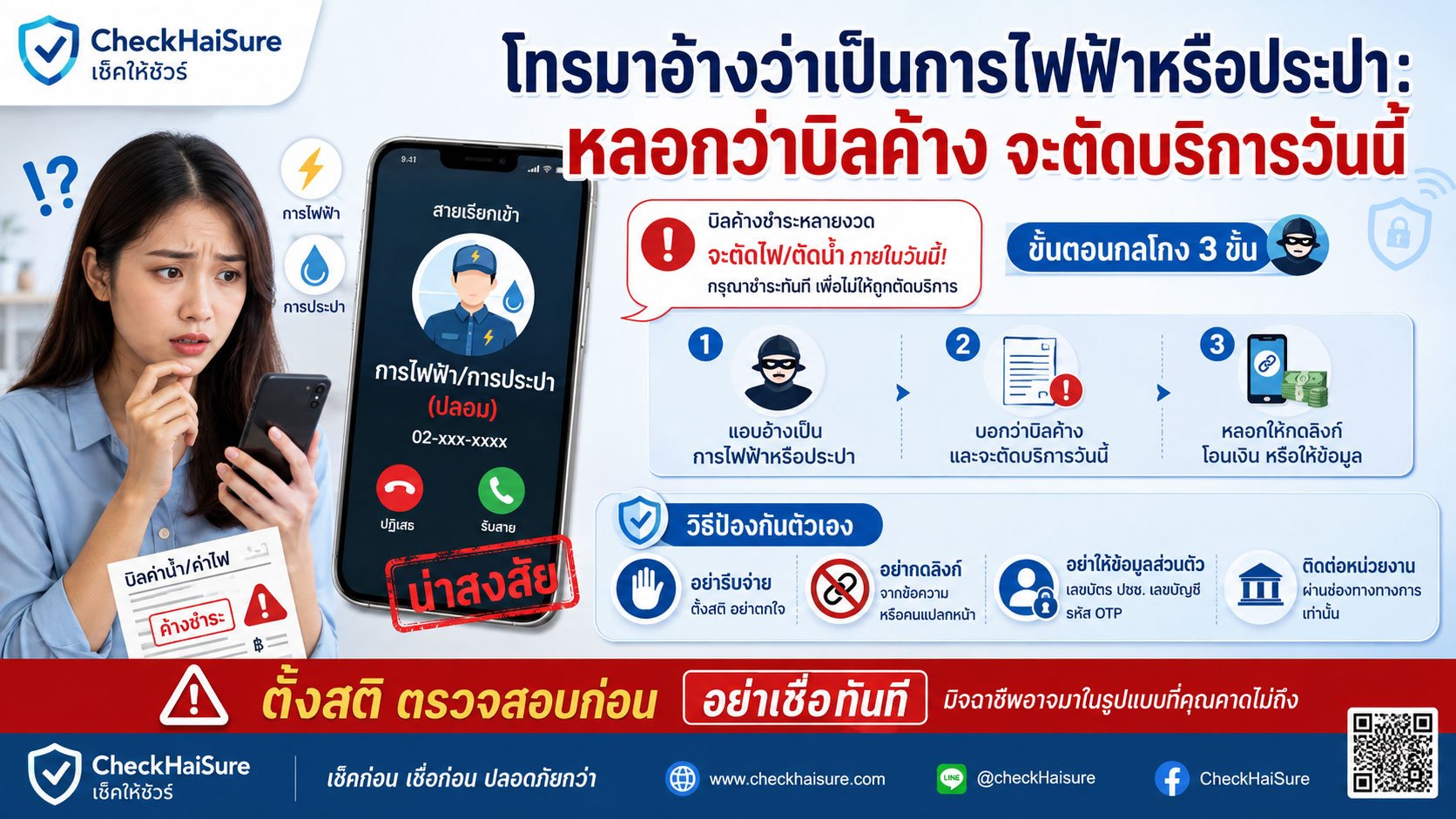
“บ้านคุณมียอดค้างชำระค่าไฟ”
“ระบบแจ้งว่าจะตัดไฟวันนี้ หากไม่ชำระภายใน 30 นาที”
“ค่าน้ำของคุณค้างอยู่ ต้องรีบจ่ายก่อนเจ้าหน้าที่ออกตัด”
“ถ้าไม่อยากถูกระงับบริการ ให้โอนเงินเข้าบัญชีนี้ก่อน”
“ชำระผ่านลิงก์นี้ได้เลย ระบบจะยกเลิกการตัดทันที”
ถ้าได้รับสายแบบนี้ หลายคนอาจตกใจทันที
เพราะไฟฟ้าและน้ำประปาไม่ใช่เรื่องไกลตัว
มันคือสิ่งที่ต้องใช้ทุกวัน
ใช้ทำอาหาร
ใช้อาบน้ำ
ใช้ทำงาน
ใช้ดูแลลูกหลาน
ใช้เปิดแอร์ เปิดพัดลม เปิดไฟ
ใช้กับร้านค้า เครื่องมือ หรืออุปกรณ์จำเป็นในบ้าน
แค่คิดว่าบ้านจะถูกตัดไฟหรือตัดน้ำวันนี้ หลายคนก็เริ่มกังวลแล้ว
ยิ่งถ้าเป็นบ้านที่มีผู้สูงอายุ เด็กเล็ก คนป่วย ร้านค้า หรือคนทำงานจากบ้าน ความกังวลจะยิ่งมากขึ้น
มิจฉาชีพจึงใช้เรื่อง “บิลค้าง” “จะตัดบริการวันนี้” หรือ “ต้องชำระด่วน” มาเร่งให้เรารีบโอนเงินก่อนตรวจสอบ
บางครั้งเขาอาจอ้างว่าเป็นการไฟฟ้า
อ้างว่าเป็นประปา
อ้างว่าเป็นเจ้าหน้าที่ฝ่ายบัญชี
อ้างว่าเป็นฝ่ายเร่งรัดชำระเงิน
อ้างว่าเป็นช่างที่จะเข้าตัดบริการ
หรือส่งลิงก์ปลอมให้ชำระเงินทันที
ฟังดูเหมือนเรื่องจริงและเร่งด่วน
แต่ถ้าเราจ่ายผิดช่องทาง เงินอาจไม่ได้ไปชำระบิล
แต่อาจไปเข้าบัญชีของมิจฉาชีพแทน
จำไว้ว่า
บิลค้างจริง ต้องตรวจสอบกับช่องทางทางการ ไม่ใช่โอนตามบัญชีที่คนปลายสายส่งมา
ทำไมกลโกงนี้ถึงทำให้คนรีบจ่าย
เพราะไม่มีใครอยากถูกตัดไฟหรือตัดน้ำ
บางคนอาจไม่ได้อยู่บ้านตอนนั้น
บางคนจำไม่ได้ว่าจ่ายบิลแล้วหรือยัง
บางคนให้คนในบ้านช่วยจ่ายหลายคน
บางคนมีหลายบ้าน หลายมิเตอร์
บางคนเพิ่งย้ายบ้าน
บางคนมีร้านค้าและกลัวเสียรายได้
บางคนกลัวคนในบ้านเดือดร้อน
บางคนคิดว่า “ยอดไม่กี่ร้อย รีบจ่ายให้จบก่อนดีกว่า”
มิจฉาชีพเข้าใจความคิดนี้ดี
เขาจึงไม่จำเป็นต้องหลอกด้วยยอดเงินก้อนใหญ่เสมอไป
บางครั้งยอดที่เรียกอาจดูสมจริง เช่น 386 บาท 742 บาท 1,280 บาท หรือ 2,450 บาท
ไม่มากเกินไปจนเราสงสัย
แต่ก็มากพอที่จะได้เงินจากหลายคน
และเร่งพอให้เราไม่ทันตรวจสอบ
นี่คือจุดที่อันตราย
เพราะความคิดว่า “จ่ายไปก่อน เดี๋ยวค่อยเช็ก” อาจทำให้เราเสียเงินจริงให้กับบิลที่ไม่มีอยู่จริง
คำว่า “จะตัดวันนี้” คือเครื่องมือกดดัน
มิจฉาชีพมักใช้เวลามากดดัน
“เจ้าหน้าที่กำลังออกพื้นที่”
“ระบบขึ้นรายการตัดบริการแล้ว”
“ต้องชำระก่อนบ่ายสาม”
“ถ้าเกินเวลานี้จะยกเลิกไม่ได้”
“ถ้าเจ้าหน้าที่ตัดแล้ว ต้องเสียค่าต่อกลับเพิ่ม”
คำพูดเหล่านี้ทำให้คนฟังรู้สึกว่าไม่มีเวลา
จากเดิมที่ควรเปิดแอปเช็ก
กลายเป็นรีบถามเลขบัญชี
จากเดิมที่ควรโทรหาหน่วยงานจริง
กลายเป็นรีบกดลิงก์
จากเดิมที่ควรดูบิลเก่า
กลายเป็นรีบโอนเงิน
จากเดิมที่ควรปรึกษาคนในบ้าน
กลายเป็นตัดสินใจคนเดียวในสาย
ต้องจำไว้ว่า ความเร่งด่วนไม่ใช่หลักฐานว่าเรื่องจริง
บางครั้งความเร่งด่วนคือสัญญาณว่าเขาไม่อยากให้เราได้คิด
ถ้าเขาไม่ยอมให้คุณวางสายไปตรวจสอบ ให้ยิ่งต้องวางสาย
จาก “บิลค้าง” ไปสู่ “ลิงก์ชำระเงินปลอม”
บางสายอาจไม่ได้ขอให้โอนเข้าบัญชีโดยตรง
แต่ส่งลิงก์มาให้กด
อาจบอกว่าเป็นลิงก์สำหรับ
ตรวจสอบยอดค้าง
ชำระบิลด่วน
ยกเลิกการตัดไฟ
ยกเลิกการตัดน้ำ
อัปเดตข้อมูลผู้ใช้ไฟ
ยืนยันเจ้าของมิเตอร์
หรือรับส่วนลดค่าบริการ
ลิงก์อาจดูคล้ายเว็บไซต์จริง
มีโลโก้
มีสีคล้ายหน่วยงาน
มีช่องให้กรอกเลขผู้ใช้ไฟหรือผู้ใช้น้ำ
มีช่องให้กรอกชื่อ เบอร์โทร เลขบัตรประชาชน
หรือให้ใส่ข้อมูลบัตรเครดิต บัญชีธนาคาร และ OTP
แต่ถ้าเป็นเว็บปลอม ข้อมูลที่กรอกอาจถูกส่งให้มิจฉาชีพทันที
อย่ากดลิงก์ที่คนปลายสายส่งมา
ถ้าต้องการตรวจสอบ ให้เข้าแอป เว็บไซต์ หรือช่องทางทางการด้วยตัวเอง
อย่าให้คนที่โทรมาเอง เป็นคนพาเราไปยังหน้าชำระเงินที่เขาเตรียมไว้
ระวังบัญชีรับเงินที่ไม่ใช่ชื่อหน่วยงานจริง
หากคนปลายสายให้โอนเงิน ต้องดูบัญชีปลายทางทันที
ถ้าบอกว่าเป็นค่าไฟหรือค่าน้ำ แต่บัญชีรับเงินเป็นชื่อบุคคลธรรมดา ให้หยุดก่อน
เช่น
ชื่อบัญชีเป็นชื่อคนทั่วไป
ชื่อบัญชีไม่ตรงกับหน่วยงาน
ชื่อบัญชีเป็นบริษัทแปลกๆ
ชื่อบัญชีไม่เกี่ยวกับไฟฟ้าหรือประปา
หรือบอกว่าเป็นบัญชีของเจ้าหน้าที่ ช่าง ฝ่ายบัญชี หรือบัญชีรับเรื่องด่วน
มิจฉาชีพอาจอธิบายว่า
“บัญชีนี้ใช้รับชำระเคสด่วน”
“โอนเข้าบัญชีเจ้าหน้าที่ก่อน ระบบจะอัปเดตให้”
“บัญชีหลักปิดปรับปรุง”
“จ่ายช่องทางนี้จะยกเลิกการตัดได้เร็วกว่า”
“โอนแล้วส่งสลิปมา เดี๋ยวเจ้าหน้าที่ปลดล็อกให้”
อย่าเชื่อทันที
การชำระค่าสาธารณูปโภคควรทำผ่านช่องทางที่ตรวจสอบได้ ไม่ใช่โอนเข้าบัญชีส่วนตัวของใครบางคนเพราะเขาบอกว่าด่วน
บางสายอาจอ้างเลขบ้าน เลขมิเตอร์ หรือชื่อเราได้
สิ่งที่ทำให้หลายคนเชื่อ คือคนปลายสายอาจพูดข้อมูลบางอย่างถูก
เช่น ชื่อเรา
เบอร์โทร
ที่อยู่บางส่วน
เขตพื้นที่
เลขบ้าน
หรือข้อมูลที่ฟังดูเหมือนเกี่ยวกับมิเตอร์
แต่การที่เขารู้ข้อมูลบางส่วน ไม่ได้แปลว่าเขาเป็นเจ้าหน้าที่จริง
ข้อมูลบางอย่างอาจมาจากเอกสารที่เคยหลุด
พัสดุ
ใบแจ้งหนี้เก่า
ฐานข้อมูลที่รั่ว
ข้อมูลออนไลน์
หรือการเดาและถามนำในสาย
บางครั้งเขาอาจไม่ได้รู้จริง แต่ใช้วิธีพูดกว้างๆ ให้เราตอบเติมเอง
เช่น
“บ้านคุณอยู่แถว…ใช่ไหม”
“บิลรอบล่าสุดยังไม่ชำระนะครับ”
“เลขผู้ใช้ไฟลงท้ายประมาณนี้ไหม”
“มีคนในบ้านเคยค้างชำระหรือเปล่า”
ถ้าเราตอบรายละเอียดไปเรื่อยๆ เขาอาจใช้ข้อมูลจากปากเราเองทำให้เรื่องดูน่าเชื่อขึ้น
อย่าให้ข้อมูลเพิ่มเพื่อพิสูจน์ว่าเขาเป็นใคร
คนที่ต้องพิสูจน์ตัวตนคือคนที่โทรมา ไม่ใช่เรา
อย่ากลัวจนยอมให้ข้อมูลส่วนตัว
บางสายอาจเริ่มจากบิลค้าง แต่ค่อยๆ ขอข้อมูลเพิ่มเติม
เช่น
เลขบัตรประชาชน
วันเดือนปีเกิด
เลขหลังบัตรประชาชน
ข้อมูลบัญชีธนาคาร
ข้อมูลบัตรเครดิต
เลขมิเตอร์
รูปบิล
รูปบัตรประชาชน
หรือ OTP
เขาอาจอ้างว่าใช้เพื่อ
ตรวจสอบเจ้าของมิเตอร์
ยืนยันสิทธิ์ไม่ให้ตัดบริการ
แก้ไขข้อมูลผู้ชำระ
ปลดล็อกระบบ
คืนเงินส่วนต่าง
หรือลบยอดค้างผิดพลาด
แต่ถ้าคุณยังไม่ได้ตรวจสอบว่าเขาเป็นเจ้าหน้าที่จริง อย่าให้ข้อมูลสำคัญ
โดยเฉพาะ OTP
ไม่มีเหตุผลที่คนปลายสายควรขอ OTP จากเราเพื่อชำระบิลหรือยกเลิกการตัดบริการ
OTP คือกุญแจ ไม่ใช่รหัสสำหรับป้องกันการตัดไฟหรือตัดน้ำ
สัญญาณเตือนของสายการไฟฟ้าหรือประปาปลอม
ถ้ามีคนโทรมาอ้างว่าเป็นการไฟฟ้าหรือประปา ให้ระวังเป็นพิเศษเมื่อมีพฤติกรรมเหล่านี้
บอกว่ามีบิลค้าง แต่ไม่ให้ข้อมูลชัดเจน
เร่งว่าจะตัดไฟหรือตัดน้ำวันนี้
บอกว่าต้องชำระภายในไม่กี่นาที
ไม่ยอมให้คุณวางสายไปตรวจสอบเอง
ให้โอนเงินเข้าบัญชีบุคคล
ส่งลิงก์ให้กดชำระเงิน
ขอข้อมูลบัตรเครดิต
ขอเลขบัตรประชาชนเต็ม
ขอ OTP หรือรหัสยืนยัน
ให้เพิ่ม LINE เจ้าหน้าที่
บอกว่าบัญชีหลักใช้ไม่ได้ชั่วคราว
บอกว่าต้องจ่ายผ่านช่องทางพิเศษเท่านั้น
ขู่ว่าจะมีค่าปรับหรือค่าต่อกลับเพิ่มถ้าไม่จ่ายทันที
บอกว่าเจ้าหน้าที่กำลังเดินทางมาตัดบริการแล้ว
หรืออ้างว่าถ้าไม่ทำตามตอนนี้จะยกเลิกการตัดไม่ได้
ถ้ามีหลายข้อในนี้ ให้หยุดก่อน
อย่าโอนเงิน
อย่าให้ข้อมูล
อย่าให้ OTP
อย่ากดลิงก์
อย่าเพิ่ม LINE
และอย่าตัดสินใจเพราะกลัวไฟหรือน้ำถูกตัดทันที
ถ้าไม่แน่ใจว่าค้างชำระจริงหรือไม่ ควรตรวจสอบอย่างไร
วิธีที่ปลอดภัยคือวางสาย แล้วตรวจสอบด้วยตัวเอง
เริ่มจากช่องทางที่คุณมั่นใจว่าเป็นทางการ เช่น
แอปของผู้ให้บริการ
เว็บไซต์ทางการ
ใบแจ้งหนี้เดิม
ช่องทางชำระเงินที่เคยใช้เป็นประจำ
Call Center ที่ค้นหาเองจากแหล่งที่เชื่อถือได้
หรือสำนักงานบริการใกล้บ้าน
อย่าใช้เบอร์ที่คนปลายสายให้มา
อย่าใช้ลิงก์ที่เขาส่งมา
อย่าใช้ QR Code ที่เขาส่งมาในแชท
อย่าเพิ่ม LINE ที่เขาบอกว่าเป็นเจ้าหน้าที่
และอย่าตัดสินจากสลิปหรือเอกสารที่เขาส่งมาอย่างเดียว
ถ้าเป็นยอดค้างจริง ควรตรวจสอบผ่านระบบจริงได้
ถ้าเป็นการหลอกลวง การหยุดเช็กก่อนโอนจะช่วยป้องกันความเสียหายได้มาก
ถ้าเขาอ้างว่าจะมีเจ้าหน้าที่มาตัดจริง ควรทำอย่างไร
บางคนอาจกลัวมากเมื่อปลายสายบอกว่า “เจ้าหน้าที่กำลังออกพื้นที่”
แต่ถึงแม้เขาพูดแบบนั้น ก็ยังควรตรวจสอบก่อน
คุณสามารถถามข้อมูลพื้นฐาน เช่น
หมายเลขผู้ใช้บริการคืออะไร
มียอดค้างรอบไหน
ยอดเงินเท่าไร
ชำระล่าสุดเมื่อใด
ติดต่อจากหน่วยงานใด
มีช่องทางตรวจสอบทางการหรือไม่
สามารถโทรกลับผ่าน Call Center ทางการได้ไหม
จากนั้นวางสาย
อย่าอยู่ในสายเพราะเขาบอกว่าต้องรอระบบ
อย่าโอนเพราะเขาบอกว่าช่างใกล้ถึงแล้ว
อย่ากดลิงก์เพราะเขาบอกว่าต้องยกเลิกการตัดในระบบ
เรื่องสำคัญควรตรวจสอบได้ ไม่ใช่ต้องเชื่อเพียงเพราะคนปลายสายพูดว่า “กำลังจะตัดแล้ว”
ระวังการหลอกผู้สูงอายุหรือคนที่อยู่บ้านคนเดียว
กลโกงนี้มักได้ผลกับคนที่อยู่บ้านและรับสายเป็นประจำ
โดยเฉพาะผู้สูงอายุหรือคนที่ดูแลบ้าน
เพราะเมื่อได้ยินว่าบ้านจะถูกตัดไฟหรือน้ำ อาจตกใจและไม่อยากให้คนในบ้านเดือดร้อน
มิจฉาชีพอาจพูดให้รู้สึกผิด
“ถ้าไม่จ่าย บ้านจะไม่มีไฟใช้”
“คนในบ้านจะเดือดร้อนนะครับ”
“เจ้าหน้าที่ตัดแล้วต้องเสียค่าต่อกลับ”
“ถ้าเป็นบ้านผู้สูงอายุยิ่งควรรีบจ่าย”
คำพูดเหล่านี้ทำให้คนฟังรู้สึกว่าต้องรับผิดชอบทันที
ควรคุยกับคนในบ้านไว้ล่วงหน้าว่า
ถ้ามีคนโทรมาบอกว่าจะตัดไฟหรือน้ำ อย่าโอนทันที
ให้โทรหาคนในบ้านก่อน
ให้ตรวจบิลก่อน
ให้ใช้ช่องทางชำระเดิม
และห้ามโอนเข้าบัญชีบุคคล
ข้อตกลงแบบนี้ช่วยให้คนที่อยู่บ้านไม่ต้องตัดสินใจคนเดียวตอนกำลังตกใจ
ถ้าเป็นร้านค้า ยิ่งต้องระวังความเร่งด่วน
ร้านค้า ร้านอาหาร ร้านเสริมสวย คลินิก หรือธุรกิจเล็กๆ อาจกลัวการถูกตัดไฟหรือน้ำมากเป็นพิเศษ
เพราะถ้าบริการหยุด อาจกระทบลูกค้าและรายได้ทันที
มิจฉาชีพอาจใช้จุดนี้กดดัน
“ถ้าตัดแล้วร้านจะเปิดไม่ได้”
“จ่ายตอนนี้จะยกเลิกการตัดได้ทัน”
“เจ้าหน้าที่กำลังจะเข้าไปที่หน้าร้าน”
“ถ้าเกินเวลา ต้องรอเปิดระบบใหม่วันถัดไป”
เจ้าของกิจการหรือพนักงานอาจรีบจ่ายเพื่อไม่ให้ร้านมีปัญหา
แต่ธุรกิจยิ่งต้องมีขั้นตอนตรวจสอบ
ควรมีคนรับผิดชอบเรื่องบิลชัดเจน
มีช่องทางชำระเงินประจำ
มีหลักฐานการชำระ
มีวิธีเช็กยอดกับผู้ให้บริการ
และไม่ให้พนักงานโอนเงินตามสายโทรศัพท์โดยไม่ตรวจสอบ
ความเร่งด่วนไม่ควรทำให้เงินธุรกิจไหลออกไปยังบัญชีที่ตรวจสอบไม่ได้
ถ้าเผลอโอนเงินไปแล้ว
ถ้าเผลอโอนเงินไปแล้ว ให้หยุดทันที
อย่าโอนเพิ่ม
มิจฉาชีพอาจบอกว่า
“ยังเหลือค่าปลดล็อก”
“ต้องจ่ายค่าระบบเพิ่ม”
“ต้องโอนค่าต่อกลับก่อน”
“ยอดแรกเป็นแค่ค่าระงับการตัด”
“ถ้าไม่จ่ายต่อ ระบบจะไม่ยกเลิก”
อย่าเชื่อทันที
ให้วางสาย แล้วตรวจสอบกับผู้ให้บริการจริงผ่านช่องทางทางการ
เก็บหลักฐานทั้งหมด เช่น
เบอร์โทร
ชื่อที่อีกฝ่ายใช้
ชื่อหน่วยงานที่ถูกอ้าง
แชท
SMS
ลิงก์
QR Code
เลขบัญชีปลายทาง
ชื่อบัญชี
สลิปโอนเงิน
จำนวนเงิน
วันและเวลา
และคำพูดที่ใช้เร่งหรือขู่
จากนั้นติดต่อธนาคารผ่านช่องทางทางการโดยเร็ว
และแจ้งเหตุผ่านช่องทางที่เกี่ยวข้อง
อย่าลบหลักฐานเพราะคิดว่ายอดเงินไม่มาก
แม้ยอดเงินดูเล็ก แต่หลักฐานอาจช่วยป้องกันไม่ให้คนอื่นถูกหลอกซ้ำได้
คุยกับคนในบ้านเรื่องบิลค้างปลอม
หัวข้อนี้ควรคุยกันในบ้านไว้ก่อน
เพราะค่าไฟและค่าน้ำเกี่ยวข้องกับทุกคน
อาจตั้งกติกาง่ายๆ เช่น
ถ้ามีคนโทรมาบอกว่าบิลค้าง ให้ไม่โอนทันที
ต้องตรวจสอบในแอปหรือใบแจ้งหนี้ก่อน
ถ้าโทรมาบอกว่าจะตัดวันนี้ ให้โทรเช็กกับช่องทางทางการเอง
ถ้าให้โอนเข้าบัญชีบุคคล ให้หยุด
ถ้าส่งลิงก์ให้กดชำระเงิน ให้ไม่กด
ถ้าขอ OTP ให้ไม่ให้
ถ้าให้เพิ่ม LINE เจ้าหน้าที่ ให้ไม่เพิ่ม
ถ้าไม่แน่ใจ ให้โทรหาคนในบ้านก่อน
และควรกำหนดให้ชัดว่าใครเป็นคนดูแลการจ่ายบิลของบ้าน
ถ้าทุกคนรู้ขั้นตอน จะลดโอกาสที่ใครคนหนึ่งจะถูกเร่งให้จ่ายผิดช่องทาง
อย่าโทษตัวเองถ้าคุณตกใจเรื่องจะถูกตัดไฟหรือน้ำ
ถ้าคุณเคยได้รับสายแบบนี้แล้วตกใจ นั่นไม่ใช่เรื่องแปลก
เพราะไฟฟ้าและน้ำประปาเป็นสิ่งจำเป็น
ไม่มีใครอยากให้บ้านมืด
ไม่มีใครอยากไม่มีน้ำใช้
ไม่มีใครอยากให้ผู้สูงอายุหรือลูกหลานเดือดร้อน
ไม่มีร้านค้าไหนอยากหยุดขายเพราะบริการถูกตัด
และไม่มีใครอยากเสียค่าปรับหรือค่าต่อกลับโดยไม่จำเป็น
มิจฉาชีพเลือกใช้เรื่องนี้เพราะรู้ว่าคนจำนวนมากจะรีบแก้ปัญหาก่อนตรวจสอบ
สิ่งสำคัญไม่ใช่การไม่เคยตกใจ
แต่คือเมื่อตกใจแล้ว ให้หยุดก่อน
ไม่โอนทันที
ไม่กดลิงก์
ไม่ให้ OTP
ไม่เพิ่ม LINE
ไม่ใช้บัญชีที่คนปลายสายส่งมา
และไม่ปล่อยให้คำว่า “วันนี้” ทำให้เราลืมใช้ช่องทางทางการ
ประโยคที่ควรจำ: บิลค้างจริง ต้องตรวจสอบกับช่องทางทางการ
ถ้าต้องจำประโยคเดียวจากบทความนี้ ขอให้จำว่า
บิลค้างจริง ต้องตรวจสอบกับช่องทางทางการ ไม่ใช่โอนตามบัญชีที่คนปลายสายส่งมา
ถ้าค้างจริง ระบบทางการควรตรวจสอบได้
ถ้าต้องชำระจริง ควรมีช่องทางจ่ายที่เชื่อถือได้
ถ้ามีการแจ้งเตือนจริง ควรตรวจสอบซ้ำได้จากแหล่งที่ไม่ใช่คนปลายสาย
ถ้าให้โอนเข้าบัญชีบุคคล ให้หยุดก่อน
ถ้าส่งลิงก์มาให้จ่ายด่วน ให้ระวัง
ถ้าขอ OTP ให้ไม่ให้
ถ้าไม่ยอมให้วางสายไปตรวจสอบ ให้ยิ่งต้องวางสาย
สรุป: อย่าให้ความกลัวถูกตัดไฟหรือน้ำ พาเราไปจ่ายบิลปลอม
กลโกงการไฟฟ้าหรือประปาปลอมอันตราย เพราะมันใช้เรื่องจำเป็นในชีวิตประจำวันมาทำให้เราตกใจ
ทำให้กลัวบ้านไม่มีไฟ
กลัวบ้านไม่มีน้ำ
กลัวคนในบ้านเดือดร้อน
กลัวร้านค้าหยุดให้บริการ
กลัวเสียค่าปรับ
และกลัวว่าแก้ไม่ทันถ้าไม่จ่ายเดี๋ยวนั้น
แต่สิ่งที่ควรทำคือหยุดก่อน
อย่าโอนเงินทันที
อย่ากดลิงก์
อย่าให้ OTP
อย่าให้ข้อมูลบัตร
อย่าเพิ่ม LINE เจ้าหน้าที่
อย่าโอนเข้าบัญชีบุคคล
อย่าตัดสินใจเพราะเขาบอกว่าจะตัดวันนี้
ให้วางสาย แล้วตรวจสอบยอดค้างผ่านแอป เว็บไซต์ ใบแจ้งหนี้ Call Center หรือสำนักงานบริการทางการด้วยตัวเอง
ถ้าเป็นบิลจริง ยังจ่ายได้ผ่านช่องทางจริง
แต่ถ้าเป็นมิจฉาชีพ การหยุดเช็กก่อนจ่าย อาจช่วยไม่ให้ค่าไฟค่าน้ำปลอมกลายเป็นเงินที่หายไปจริง
A Call Claims to Be from the Electricity or Water Utility: Beware of Fake Overdue Bills and Threats to Disconnect Service Today
“Your home has an overdue electricity bill.”
“The system shows your power will be disconnected today if payment is not made within 30 minutes.”
“Your water bill is overdue. You need to pay before the technician proceeds.”
“If you do not want your service suspended, transfer the money to this account first.”
“You can pay through this link, and the system will cancel the disconnection immediately.”
If you receive a call like this, many people may panic right away.
Electricity and water are not small matters.
They are things we use every day.
For cooking.
For bathing.
For working.
For caring for children or elderly family members.
For lights, fans, air conditioning, appliances, shops, tools, and essential devices at home.
Just thinking that your home could lose power or water today is enough to make many people anxious.
And if the household has elderly people, small children, sick family members, a small business, or someone working from home, the pressure becomes even stronger.
Scammers know this very well.
That is why they use words like “overdue bill,” “service will be disconnected today,” or “urgent payment required” to pressure people into transferring money before checking.
They may claim to be from the electricity provider.
They may claim to be from the water utility.
They may say they are from the billing department.
They may pretend to be a debt collection officer.
They may pretend to be a technician assigned to disconnect the service.
Or they may send a fake payment link for you to pay immediately.
It may sound real and urgent.
But if you pay through the wrong channel, the money may not pay your bill at all.
It may go directly to scammers.
Remember this:
A real overdue utility bill should be checked through official channels, not paid through an account sent by someone on the phone.
Why This Scam Makes People Pay Quickly
No one wants their electricity or water disconnected.
Some people may not be at home at the time.
Some may not remember whether the bill has already been paid.
Some households have more than one person handling payments.
Some people manage several homes or meters.
Some have recently moved.
Some run a shop and fear losing income.
Some worry that family members at home will be affected.
Some think, “It is only a few hundred baht. I should just pay quickly and deal with it later.”
Scammers understand this thinking.
They do not always need to ask for a large amount.
Sometimes the amount may look realistic, such as 386 baht, 742 baht, 1,280 baht, or 2,450 baht.
Not so high that you immediately become suspicious.
But enough to make money from many victims.
And urgent enough that you may not stop to check.
That is the dangerous point.
The thought “I will pay first and check later” can turn into real money lost for a bill that never existed.
“Disconnection Today” Is a Pressure Tool
Scammers often use time pressure.
“The technician is already on the way.”
“The system has already marked your account for disconnection.”
“You must pay before 3 p.m.”
“After this time, the disconnection cannot be cancelled.”
“If the technician disconnects it, you will have to pay an additional reconnection fee.”
These words make you feel as if there is no time.
Instead of opening the official app to check, you may ask for the account number.
Instead of calling the real provider, you may click the link.
Instead of looking at your old bill, you may transfer money.
Instead of asking someone at home, you may decide alone during the call.
Urgency is not proof that the issue is real.
Sometimes urgency is a warning sign that the caller does not want you to think.
If the caller refuses to let you hang up and verify, that is even more reason to hang up.
From “Overdue Bill” to a Fake Payment Link
Some scammers may not directly ask you to transfer money to a bank account.
Instead, they may send a link.
They may say the link is for:
Checking your outstanding balance
Making urgent bill payment
Cancelling electricity disconnection
Cancelling water disconnection
Updating customer information
Confirming meter ownership
Or receiving a service discount
The link may look similar to a real website.
It may have a logo.
It may use colors similar to the real provider.
It may ask for your customer number or meter number.
It may ask for your name, phone number, national ID number, card details, bank account information, or OTP.
But if the website is fake, the information you enter may go straight to scammers.
Do not click payment links sent by someone who called you first.
If you need to check your bill, use the official app, official website, or official payment channel yourself.
Do not let the person who called you lead you to a payment page they prepared.
Be Careful If the Receiving Account Is Not Under the Real Utility Provider
If the caller asks you to transfer money, check the destination account immediately.
If they claim it is for electricity or water, but the receiving account is under an individual’s name, stop first.
For example:
The account name is an ordinary person’s name.
The account name does not match the utility provider.
The account name belongs to an unfamiliar company.
The account name has nothing to do with electricity or water.
Or the caller says it is a technician’s account, staff account, billing department account, or urgent case account.
Scammers may explain it by saying:
“This account is used for urgent payments.”
“Transfer to the staff account first, and the system will update it.”
“The main account is temporarily unavailable.”
“This channel cancels disconnection faster.”
“Transfer and send the slip. The officer will unlock the system.”
Do not believe this immediately.
Utility payments should be made through verifiable channels, not to someone’s personal bank account because a caller says it is urgent.
Some Callers May Know Your Name, Address, or Meter Details
One reason people believe these calls is that the caller may know some information.
They may know your name.
Phone number.
Part of your address.
Area.
House number.
Or details that sound related to your meter.
But knowing some information does not prove they are real staff.
Some information may come from leaked documents, parcels, old bills, leaked databases, online sources, or guesses during the call.
Sometimes the caller may not know much at all, but uses vague questions to make you fill in the details.
For example:
“Your home is around this area, correct?”
“The latest bill has not been paid yet, right?”
“Does your customer number end with something like this?”
“Has anyone in the house missed a payment before?”
If you keep answering, the caller may use your own words to make the story sound more believable.
Do not provide more details to prove who they are.
The person who must prove their identity is the caller, not you.
Do Not Let Fear Make You Share Personal Information
Some calls begin with an overdue bill, then slowly move toward asking for more information.
For example:
National ID number
Date of birth
Back-of-ID number
Bank account information
Credit card information
Meter number
A photo of the bill
A photo of your ID card
Or OTP
They may claim this is needed to:
Confirm meter ownership
Prevent disconnection
Update payer information
Unlock the system
Refund overpayment
Or remove an incorrect overdue balance
But if you have not verified that the caller is real, do not share sensitive information.
Especially OTP.
There is no good reason for a caller to ask for your OTP in order to pay a utility bill or cancel disconnection.
An OTP is a key, not a code to prevent electricity or water disconnection.
Warning Signs of Fake Electricity or Water Utility Calls
If someone calls claiming to be from an electricity or water provider, be especially careful if they do any of the following:
They say you have an overdue bill but provide unclear details.
They rush you by saying electricity or water will be disconnected today.
They say you must pay within a few minutes.
They refuse to let you hang up and check by yourself.
They ask you to transfer money to a personal account.
They send a payment link.
They ask for credit card information.
They ask for your full national ID number.
They ask for an OTP or verification code.
They ask you to add a LINE officer.
They say the main payment account is temporarily unavailable.
They say you must pay through a special channel only.
They threaten extra fines or reconnection fees if you do not pay immediately.
They say a technician is already on the way.
Or they claim that if you do not follow their instructions now, the disconnection cannot be cancelled.
If several of these signs appear, stop first.
Do not transfer money.
Do not share information.
Do not provide OTPs.
Do not click links.
Do not add LINE.
And do not decide only because you fear your power or water will be cut immediately.
What Should You Do If You Are Not Sure Whether the Bill Is Really Overdue?
The safest step is to hang up and check by yourself.
Start with channels you know are official, such as:
The provider’s official app
The official website
A previous bill
The payment channel you normally use
The official call center number you find from a trusted source
Or a nearby service office
Do not use the number given by the caller.
Do not use the link they send.
Do not use a QR code sent in chat.
Do not add the LINE account they claim is official.
And do not decide based only on a slip, document, or screenshot they send.
If the overdue balance is real, it should be visible through the real system.
If it is a scam, stopping to verify before paying can prevent damage.
If They Say a Technician Is Coming to Disconnect the Service
Some people panic when the caller says, “The technician is already on the way.”
Even then, you should still verify first.
You can ask basic questions such as:
What is the customer number?
Which billing cycle is overdue?
What is the exact amount?
When was the last payment made?
Which office is contacting me?
Is there an official channel to verify this?
Can I call back through the official call center?
Then hang up.
Do not stay on the line because they say you must wait for the system.
Do not transfer money because they say the technician is almost there.
Do not click a link because they say you must cancel the disconnection in the system.
A serious issue should be verifiable.
You should not have to believe it only because someone says, “It is about to be disconnected.”
Be Extra Careful with Elderly Family Members or People at Home Alone
This scam often works on people who are at home and answer calls regularly.
Especially elderly family members or people responsible for the house.
When they hear that electricity or water may be disconnected, they may panic and want to prevent trouble for everyone at home.
Scammers may use guilt:
“If you do not pay, the house will have no electricity.”
“Your family will be affected.”
“If the technician disconnects it, you will need to pay more to reconnect.”
“If there are elderly people at home, you should pay quickly.”
These words can make someone feel responsible and pressured.
It is worth discussing a rule at home:
If someone calls saying electricity or water will be disconnected, do not pay immediately.
Call someone in the family first.
Check the bill first.
Use the usual payment channel.
And never transfer to a personal account.
A simple family agreement can help the person at home avoid deciding alone while under pressure.
Small Businesses Should Be Even More Careful with Urgency
Shops, restaurants, salons, clinics, and small businesses may be especially afraid of losing electricity or water.
If service stops, customers and income may be affected immediately.
Scammers may use this pressure:
“If it is disconnected, your shop cannot open.”
“Pay now and we can cancel the disconnection in time.”
“The technician is arriving at your shop.”
“If you miss the deadline, the system may not be restored until tomorrow.”
A business owner or employee may rush to pay to avoid disruption.
But businesses need verification procedures even more.
There should be a clear person responsible for bills.
A regular payment channel.
Payment records.
A way to check balances with the provider.
And a rule that staff should not transfer money based only on a phone call.
Urgency should not make business money flow into an unverifiable account.
If You Already Transferred Money
If you already transferred money, stop immediately.
Do not transfer more.
Scammers may say:
“There is still an unlocking fee.”
“You need to pay an additional system fee.”
“You need to pay a reconnection fee first.”
“The first payment only paused the disconnection.”
“If you do not continue, the system will not cancel it.”
Do not believe this immediately.
Hang up and verify with the real provider through official channels.
Save all evidence, such as:
Phone number
Name used by the caller
Organization name they claimed
Chat messages
SMS messages
Links
QR code
Destination account number
Account name
Transfer slip
Amount
Date and time
And words used to pressure or threaten you
Then contact your bank through official channels as soon as possible.
Report the incident through relevant channels.
Do not delete evidence just because the amount was small.
Even a small amount can help identify patterns and prevent others from being scammed.
Talk with Your Family About Fake Overdue Bills
This is a good topic to discuss at home.
Electricity and water bills affect everyone.
You can set simple rules:
If someone calls saying a bill is overdue, do not transfer immediately.
Check the official app or bill first.
If they say service will be disconnected today, verify through the official channel yourself.
If they ask for payment to a personal account, stop.
If they send a payment link, do not click it.
If they ask for an OTP, do not provide it.
If they ask you to add a LINE officer, do not add it.
If you are unsure, call someone in the family first.
It also helps to make clear who in the household is responsible for paying utility bills.
When everyone knows the process, it is harder for one person to be rushed into paying through the wrong channel.
Do Not Blame Yourself If You Panic About Electricity or Water Disconnection
If you have ever received this kind of call and panicked, that is understandable.
Electricity and water are essential.
No one wants a dark home.
No one wants to be without water.
No one wants elderly family members or children to be affected.
No shop wants to stop operating because service is disconnected.
And no one wants to pay extra fines or reconnection fees unnecessarily.
Scammers use this topic because they know many people will try to fix the problem before checking.
The important point is not to never panic.
The important point is to stop when you feel panic.
Do not transfer immediately.
Do not click links.
Do not provide OTPs.
Do not add LINE.
Do not use the account sent by the caller.
And do not let the word “today” make you forget official channels.
A Sentence to Remember: A Real Overdue Bill Should Be Checked Through Official Channels
If you remember only one sentence from this article, remember this:
A real overdue utility bill should be checked through official channels, not paid through an account sent by someone on the phone.
If the bill is really overdue, the official system should show it.
If payment is truly needed, there should be a trusted payment channel.
If the warning is real, you should be able to verify it from a source other than the caller.
If they ask you to transfer to a personal account, stop first.
If they send an urgent payment link, be careful.
If they ask for an OTP, do not provide it.
If they refuse to let you hang up and verify, that is even more reason to hang up.
Conclusion: Do Not Let Fear of Disconnection Make You Pay a Fake Bill
Fake electricity and water utility scams are dangerous because they use essential services to create fear.
They make you fear losing electricity.
They make you fear losing water.
They make you worry about your family.
They make shop owners fear business disruption.
They make you fear fines or reconnection fees.
And they make you feel that if you do not pay immediately, it will be too late.
But the safest first step is to stop.
Do not transfer money immediately.
Do not click links.
Do not provide OTPs.
Do not share card information.
Do not add a LINE officer.
Do not transfer to a personal account.
Do not decide only because the caller says service will be disconnected today.
Hang up and check the balance through the official app, website, bill, call center, or service office yourself.
If the bill is real, you can still pay through real channels.
But if it is a scam, stopping to check before paying may prevent a fake electricity or water bill from becoming real money lost.

Leave a Reply
You must be logged in to post a comment.