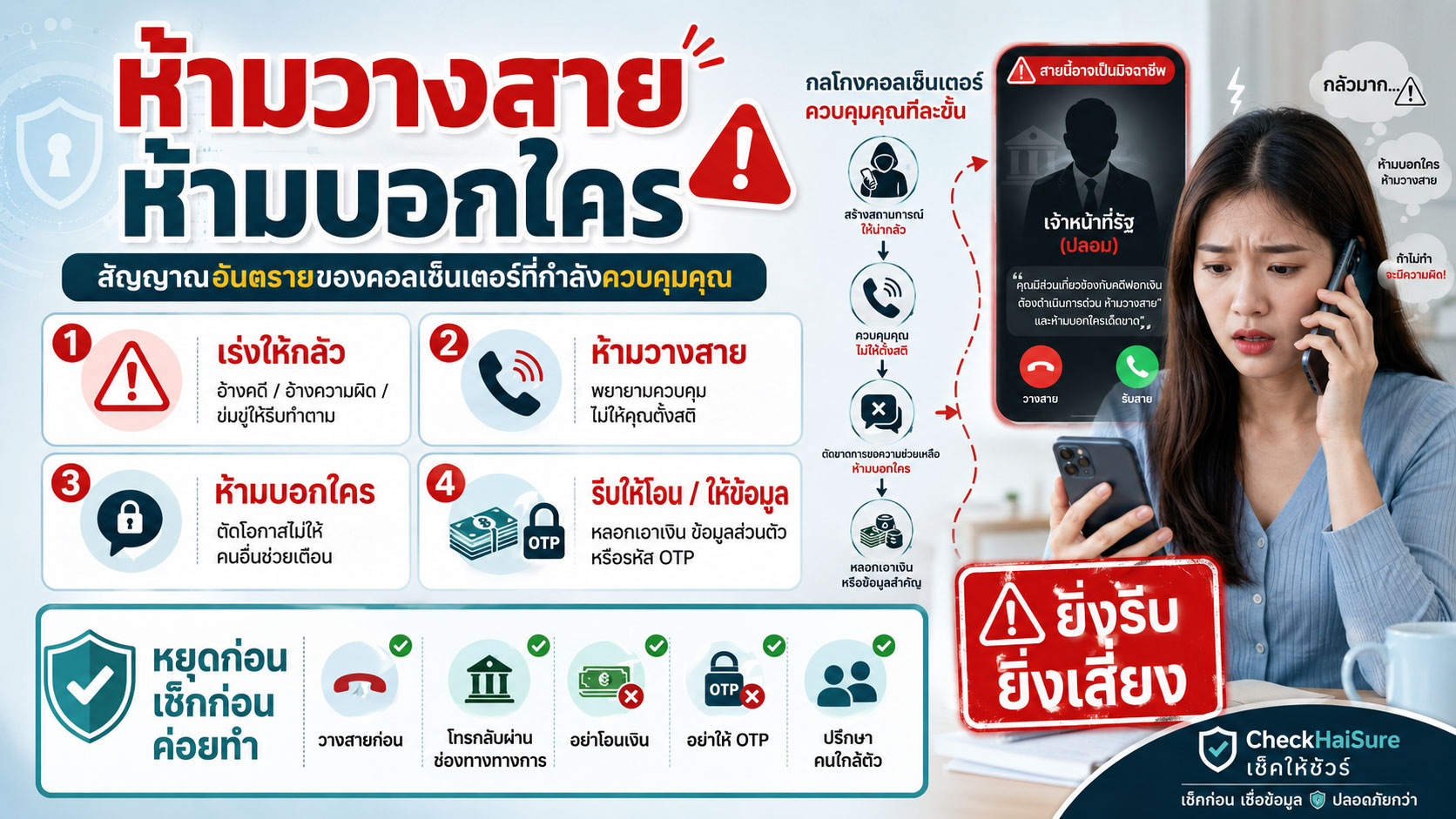
“ห้ามวางสายนะคะ”
“อย่าเพิ่งบอกใคร”
“เรื่องนี้เป็นความลับ”
“ถ้าวางสาย ระบบจะถือว่าคุณไม่ให้ความร่วมมือ”
“ถ้าคุยกับคนอื่น อาจทำให้คดีเสียหาย”
ประโยคเหล่านี้อาจฟังเหมือนคำเตือนจากเจ้าหน้าที่
แต่ในหลายกรณี มันคือสัญญาณอันตรายว่า คนปลายสายกำลังพยายามควบคุมคุณ
เพราะมิจฉาชีพรู้ดีว่า ถ้าคุณวางสาย คุณจะมีเวลาคิด
ถ้าคุณบอกคนในบ้าน คุณอาจได้คำเตือน
ถ้าคุณโทรหาธนาคารเอง คุณอาจรู้ว่าไม่มีรายการผิดปกติ
ถ้าคุณติดต่อสถานีตำรวจจริง คุณอาจรู้ว่าไม่มีคดีอย่างที่เขาพูด
ถ้าคุณค้นหาข้อมูล คุณอาจเจอบทความเตือนภัยที่เหมือนกับสิ่งที่กำลังเกิดขึ้น
ดังนั้น สิ่งที่มิจฉาชีพต้องทำคือไม่ให้คุณออกจากบทสนทนา
ไม่ให้คุณหยุดคิด
ไม่ให้คุณถามใคร
และไม่ให้คุณกลับไปใช้ช่องทางทางการเพื่อตรวจสอบ
นี่คือเหตุผลที่คำว่า “ห้ามวางสาย” และ “ห้ามบอกใคร” ไม่ใช่เรื่องเล็ก
แต่มันอาจเป็นจุดเริ่มต้นของการถูกควบคุม
มิจฉาชีพไม่ได้ต้องการแค่เงิน แต่ต้องการควบคุมจังหวะของคุณ
หลายคนคิดว่าคอลเซ็นเตอร์สแกมคือการโทรมาขอเงิน
แต่จริงๆ แล้ว ก่อนที่เงินจะถูกโอนออกไป มิจฉาชีพต้องทำสิ่งหนึ่งให้ได้ก่อน
คือควบคุมจังหวะการตัดสินใจของเหยื่อ
เขาจะพยายามทำให้คุณไม่มีเวลาหยุดคิด
ไม่มีเวลาตรวจสอบ
ไม่มีเวลาปรึกษาคนอื่น
ไม่มีเวลาทบทวนว่าเรื่องนี้สมเหตุสมผลหรือไม่
และไม่มีเวลาถามตัวเองว่า “ทำไมเจ้าหน้าที่จริงต้องรีบขนาดนี้”
เมื่อคุณอยู่ในสายต่อเนื่องนานพอ ความกลัวจะเริ่มนำหน้าความคิด
จากที่คุณสงสัยในตอนแรก อาจกลายเป็นลังเล
จากลังเล อาจกลายเป็นกลัว
จากกลัว อาจกลายเป็นเชื่อ
และจากเชื่อ อาจกลายเป็นทำตาม
นี่คือเหตุผลที่มิจฉาชีพไม่อยากให้คุณวางสาย
เพราะสายโทรศัพท์ไม่ใช่แค่ช่องทางพูดคุย
แต่มันคือพื้นที่ที่เขากำลังควบคุมคุณอยู่
ทำไมคำว่า “ห้ามบอกใคร” ถึงอันตรายมาก
เมื่อมีปัญหาเกี่ยวกับเงิน คดี ธนาคาร หรือข้อมูลส่วนตัว สิ่งที่ปลอดภัยควรเป็นการขอคำปรึกษาจากคนที่ไว้ใจได้
แต่คอลเซ็นเตอร์สแกมมักทำตรงกันข้าม
เขาจะบอกว่า
“ห้ามบอกคนในครอบครัว”
“ห้ามปรึกษาเพื่อน”
“ห้ามติดต่อธนาคารเอง”
“ห้ามไปสถานีตำรวจ”
“ห้ามเปิดเผยข้อมูลคดี”
“ห้ามเล่าให้ใครฟัง เพราะเป็นความลับทางราชการ”
คำเหล่านี้ทำให้เหยื่อรู้สึกโดดเดี่ยว
และเมื่ออยู่คนเดียวกับความกลัว คนเรามักตัดสินใจได้ยากขึ้น
คนที่อยู่ข้างนอกสถานการณ์อาจเห็นทันทีว่าเรื่องนี้แปลก
แต่คนที่อยู่ในสาย อาจถูกกดดันจนมองไม่เห็น
ดังนั้น ถ้ามีใครบอกว่า “ห้ามบอกใคร” ให้จำไว้ว่า นี่อาจไม่ใช่การรักษาความลับ
แต่มันอาจเป็นการตัดคุณออกจากคนที่จะช่วยคุณได้
เรื่องจริงไม่ควรกลัวการตรวจสอบ
ถ้าคนปลายสายเป็นเจ้าหน้าที่จริง ธนาคารจริง หรือหน่วยงานจริง เขาควรเข้าใจว่าคุณต้องการตรวจสอบ
คุณควรมีสิทธิ์วางสาย
มีสิทธิ์โทรกลับ Call Center ทางการ
มีสิทธิ์ไปสถานีตำรวจเอง
มีสิทธิ์ถามครอบครัว
มีสิทธิ์ขอเลขอ้างอิง
มีสิทธิ์ตรวจสอบชื่อหน่วยงาน
และมีสิทธิ์ไม่ทำธุรกรรมใดๆ ในขณะที่ยังไม่มั่นใจ
เรื่องจริงไม่ควรต้องกลัวว่าคุณจะตรวจสอบ
แต่เรื่องหลอกมักกลัวการตรวจสอบมาก
เพราะทันทีที่คุณออกจากสาย เขาจะเสียการควบคุม
ทันทีที่คุณถามคนอื่น เรื่องที่เขาสร้างไว้อาจเริ่มไม่สมเหตุสมผล
ทันทีที่คุณติดต่อช่องทางทางการ คุณอาจรู้ว่าไม่มีเจ้าหน้าที่คนไหนสั่งให้โอนเงิน อ่าน OTP หรือติดตั้งแอปแบบนั้น
ดังนั้น ถ้าอีกฝ่ายพยายามห้ามคุณตรวจสอบ ให้ถือว่าน่าสงสัยไว้ก่อน
คำสั่งที่มักใช้ควบคุมเหยื่อ
คอลเซ็นเตอร์สแกมหลายรูปแบบอาจเริ่มไม่เหมือนกัน
บางครั้งเริ่มจากพัสดุ
บางครั้งเริ่มจากบัญชีธนาคาร
บางครั้งเริ่มจากคดีฟอกเงิน
บางครั้งเริ่มจากธุรกรรมผิดปกติ
บางครั้งเริ่มจากเงินคืน
บางครั้งเริ่มจากการแอบอ้างตำรวจหรือหน่วยงานรัฐ
แต่เมื่อเข้าสู่ช่วงควบคุมเหยื่อ คำพูดมักคล้ายกันมาก
เช่น
“ห้ามวางสาย”
“ต้องทำตอนนี้เท่านั้น”
“ห้ามบอกคนอื่น”
“ห้ามเปิดเผยข้อมูลนี้”
“ถ้าช้า จะช่วยไม่ทัน”
“ถ้าไม่ทำตาม จะถูกดำเนินคดี”
“ถ้าออกจากสาย ระบบจะบันทึกว่าไม่ให้ความร่วมมือ”
“เจ้าหน้าที่กำลังรออยู่”
“คุณต้องพิสูจน์ความบริสุทธิ์”
“ต้องโอนเงินไปตรวจสอบก่อน”
“ต้องติดตั้งแอปเพื่อให้เจ้าหน้าที่ช่วย”
“ต้องเปิดหน้าจอให้ดู”
“ต้องอ่านรหัส OTP เพื่อยืนยัน”
หากได้ยินคำพูดเหล่านี้พร้อมกับความเร่งรีบ ความลับ หรือการให้ทำธุรกรรม ให้หยุดทันที
เพราะนี่ไม่ใช่แค่การพูดคุยธรรมดา
แต่มันคือรูปแบบของการกดดัน
ความกลัวทำให้คนเก่งก็พลาดได้
หลายคนคิดว่า “เรื่องแบบนี้ฉันไม่โดนหรอก”
แต่ความจริง คนที่ถูกหลอกไม่ได้จำเป็นต้องเป็นคนไม่รู้เท่าทัน
บางคนมีการศึกษา
บางคนทำงานกับเทคโนโลยี
บางคนใช้แอปธนาคารทุกวัน
บางคนเคยอ่านข่าวเตือนภัยมาหลายครั้ง
บางคนยังเคยเตือนคนอื่นด้วยซ้ำ
แต่ถ้าถูกโทรมาในเวลาที่เหนื่อย รีบ เครียด หรืออยู่คนเดียว ความกลัวอาจทำให้ตัดสินใจเร็วเกินไป
โดยเฉพาะเมื่ออีกฝ่ายพูดด้วยน้ำเสียงจริงจัง ใช้คำทางกฎหมาย ส่งเอกสารปลอม หรืออ้างว่าเป็นเจ้าหน้าที่
คนเรามักไม่ได้พลาดเพราะไม่ฉลาด
แต่พลาดเพราะถูกกดดันในเวลาที่ไม่ทันตั้งหลัก
ดังนั้น อย่ามองการวางสายเป็นเรื่องเสียมารยาท
ถ้าสายไหนทำให้คุณกลัวจนคิดไม่ออก การวางสายคือการคืนเวลาคิดให้ตัวเอง
ทำไมการวางสายจึงเป็นจุดตัดสำคัญ
การวางสายอาจดูเหมือนเรื่องเล็ก
แต่สำหรับคอลเซ็นเตอร์สแกม มันคือจุดที่ทำให้มิจฉาชีพเสียอำนาจควบคุม
เมื่อวางสายแล้ว คุณสามารถหายใจได้
คุณสามารถอ่านข้อความซ้ำอย่างมีสติ
คุณสามารถเปิดแอปธนาคารเอง
คุณสามารถโทรหา Call Center ทางการ
คุณสามารถปรึกษาครอบครัว
คุณสามารถค้นหาข้อมูลเตือนภัย
คุณสามารถตรวจสอบว่าเลขที่โทรมาเป็นใคร
คุณสามารถไปสถานีตำรวจหรือหน่วยงานจริง
และที่สำคัญ คุณสามารถหยุดไม่ให้ความกลัวสั่งการแทนคุณ
มิจฉาชีพจึงพยายามทำให้การวางสายดูน่ากลัว
เขาอาจบอกว่า ถ้าวางสายจะเกิดผลเสีย
แต่ในความจริง ถ้าเป็นเรื่องจริง คุณยังตรวจสอบผ่านช่องทางทางการได้
ถ้าเป็นเรื่องหลอก การวางสายอาจช่วยหยุดความเสียหายได้ทัน
ถ้าเขาบอกว่าห้ามวางสาย ควรตอบอย่างไร
คุณไม่จำเป็นต้องเถียง
ไม่จำเป็นต้องพิสูจน์ว่าเขาเป็นมิจฉาชีพ
ไม่จำเป็นต้องอธิบายยาว
และไม่จำเป็นต้องขออนุญาตวางสาย
คุณสามารถพูดสั้นๆ ว่า
“ขอบคุณค่ะ/ครับ เดี๋ยวจะติดต่อหน่วยงานทางการด้วยตัวเอง”
แล้ววางสาย
ถ้าเขาอ้างว่าเป็นธนาคาร ให้ติดต่อธนาคารผ่านแอป เว็บไซต์ทางการ เบอร์หลังบัตร หรือสาขา
ถ้าเขาอ้างว่าเป็นตำรวจ ให้ติดต่อสถานีตำรวจหรือช่องทางตำรวจไซเบอร์ที่ตรวจสอบได้
ถ้าเขาอ้างว่าเป็นบริษัทขนส่ง ให้ติดต่อบริษัทขนส่งผ่านเว็บไซต์หรือแอปทางการ
ถ้าเขาอ้างว่าเป็นหน่วยงานรัฐ ให้ค้นหาช่องทางติดต่อจากเว็บไซต์ทางการของหน่วยงานนั้นเอง
อย่าโทรกลับเบอร์ที่เขาให้
อย่ากดลิงก์ที่เขาส่ง
อย่าเพิ่ม LINE ที่เขาแนะนำ
และอย่าใช้ช่องทางที่คนที่คุณสงสัยเป็นคนจัดไว้ให้ตรวจสอบตัวเขาเอง
ถ้ากลัวจริงๆ ว่าเป็นเรื่องคดี ควรทำอย่างไร
ถ้าคุณยังรู้สึกกังวลว่าเรื่องที่เขาพูดอาจเป็นจริง ให้เลือกวิธีตรวจสอบที่ปลอดภัยกว่า
เช่น
โทรหาคนในครอบครัวหรือคนที่ไว้ใจได้
ติดต่อสถานีตำรวจใกล้บ้านด้วยตัวเอง
ติดต่อธนาคารผ่านช่องทางทางการ
นำเอกสารหรือข้อความที่ได้รับไปให้หน่วยงานจริงช่วยตรวจสอบ
หรือแจ้งเหตุผ่านช่องทางรับแจ้งอาชญากรรมออนไลน์ที่ตรวจสอบได้
สิ่งที่ไม่ควรทำคือการพิสูจน์ตัวเองกับคนปลายสาย
ไม่ควรบอกยอดเงินในบัญชี
ไม่ควรส่งบัตรประชาชน
ไม่ควรถ่ายรูปหน้าตรง
ไม่ควรอ่าน OTP
ไม่ควรติดตั้งแอป
ไม่ควรโอนเงิน
และไม่ควรอยู่ในสายต่อเพราะเขาบอกว่าเรื่องนี้เป็นความลับ
เรื่องคดีจริงไม่ควรถูกจัดการด้วยความลับที่บังคับให้คุณตัดขาดจากทุกคน
ถ้าเผลอทำตามไปแล้ว อย่าโทษตัวเองจนไม่กล้าขอความช่วยเหลือ
ถ้าคุณเคยเผลออยู่ในสาย คุยนาน ให้ข้อมูล ติดตั้งแอป หรือโอนเงินไปแล้ว สิ่งที่ควรทำคือหยุดทันทีเมื่อเริ่มรู้ตัว
อย่าโอนเพิ่ม
อย่าคุยต่อเพราะเขาบอกว่าจะแก้ให้
อย่าลบหลักฐาน
อย่าปิดบังเพราะอาย
และอย่าเชื่อคนที่มาทักต่อว่า “ช่วยตามเงินคืนได้” โดยให้จ่ายค่าดำเนินการ
ให้เก็บหลักฐาน เช่น เบอร์โทร แชท ลิงก์ เอกสาร สลิปโอนเงิน เลขบัญชีปลายทาง ชื่อบัญชี ชื่อที่อีกฝ่ายใช้ และช่วงเวลาที่เกิดเหตุ
ติดต่อธนาคารผ่านช่องทางทางการหากมีเรื่องเงินเกี่ยวข้อง
แจ้งเหตุผ่านหน่วยงานที่เกี่ยวข้อง
และบอกคนที่ไว้ใจได้ให้ช่วยดูสถานการณ์
การถูกควบคุมผ่านความกลัวไม่ใช่เรื่องน่าอาย
สิ่งสำคัญคือรีบออกจากสถานการณ์นั้นและเริ่มป้องกันความเสียหายต่อ
ครอบครัวควรมีข้อตกลงว่า “ถ้ามีคนห้ามบอกใคร ให้บอกทันที”
นี่เป็นกติกาที่ง่าย แต่ช่วยได้มาก
ในครอบครัวควรคุยกันไว้ก่อนว่า
ถ้ามีสายโทรมาบอกว่าเกี่ยวกับคดี ให้บอกคนในบ้านก่อน
ถ้ามีคนห้ามวางสาย ให้ถือว่าน่าสงสัย
ถ้ามีคนห้ามบอกครอบครัว ให้ยิ่งต้องบอก
ถ้ามีคนขอ OTP ให้ปฏิเสธทันที
ถ้ามีคนให้โอนเงินไปตรวจสอบ ให้หยุด
ถ้ามีคนให้ติดตั้งแอป ให้ไม่ทำตาม
และถ้าไม่แน่ใจ ให้โทรหาคนที่ไว้ใจได้ก่อนเสมอ
โดยเฉพาะกับผู้สูงอายุหรือคนที่อยู่คนเดียว การมีข้อตกลงนี้อาจช่วยให้เขารู้ว่า ไม่จำเป็นต้องตัดสินใจคนเดียวเมื่อถูกกดดัน
บางครั้งคำพูดง่ายๆ อย่าง
“ถ้าใครบอกว่าห้ามบอกลูกหลาน แสดงว่าต้องบอกลูกหลานทันที”
อาจช่วยชีวิตการเงินของคนในบ้านได้
อย่าให้คำว่า “ความลับ” ถูกใช้เป็นเครื่องมือหลอก
บางเรื่องในชีวิตอาจเป็นความลับได้
แต่ถ้าความลับนั้นมาพร้อมกับการให้โอนเงิน อ่าน OTP ติดตั้งแอป หรือเปิดแอปธนาคารให้คนแปลกหน้าดู ควรสงสัยไว้ก่อน
มิจฉาชีพชอบใช้คำว่า “ความลับ” เพราะมันทำให้เหยื่ออยู่คนเดียว
เขาอาจเรียกว่า
ความลับทางคดี
ความลับของธนาคาร
ความลับของระบบ
ความลับในการสอบสวน
หรือข้อมูลที่ห้ามเปิดเผย
แต่ความปลอดภัยที่แท้จริงไม่ควรทำให้คุณถูกตัดออกจากคนที่ช่วยคุณได้
ถ้าใครใช้ความลับเพื่อให้คุณทำธุรกรรม ให้หยุด
ถ้าใครใช้ความลับเพื่อไม่ให้คุณตรวจสอบ ให้สงสัย
และถ้าใครใช้ความลับเพื่อให้คุณกลัวจนไม่กล้าขอความช่วยเหลือ นั่นอาจไม่ใช่ความลับ
แต่อาจเป็นกับดัก
ประโยคที่ควรจำ: ถ้าเขาห้ามคุณวางสาย เขาอาจกลัวคุณได้คิด
ถ้ามีเพียงประโยคเดียวที่อยากให้จำจากบทความนี้ คือ
ถ้าเขาห้ามคุณวางสาย เขาอาจกลัวคุณได้คิด
เพราะเมื่อคุณได้คิด คุณอาจไม่โอน
เมื่อคุณได้ถาม คุณอาจรู้ว่าไม่จริง
เมื่อคุณได้ตรวจสอบ คุณอาจเจอช่องทางทางการ
เมื่อคุณได้บอกคนในบ้าน คุณอาจได้รับคำเตือนทันเวลา
และเมื่อคุณได้ออกจากสาย คุณอาจกลับมาเป็นคนตัดสินใจเองอีกครั้ง
มิจฉาชีพไม่ได้กลัวว่าคุณจะไม่สุภาพ
เขากลัวว่าคุณจะมีสติ
สรุป: สายที่ไม่ให้คุณวาง อาจเป็นสายที่ควรวางที่สุด
คอลเซ็นเตอร์สแกมไม่ได้ชนะเพราะเรื่องที่เล่าดูจริงเสมอไป
แต่ชนะเพราะควบคุมจังหวะของเหยื่อได้
ทำให้กลัว
ทำให้รีบ
ทำให้อยู่คนเดียว
ทำให้ไม่ถามใคร
ทำให้ไม่ตรวจสอบ
และทำให้ทำตามทีละขั้นตอน
ดังนั้น ถ้ามีใครโทรมาแล้วบอกว่า
ห้ามวางสาย
ห้ามบอกใคร
ห้ามติดต่อหน่วยงานเอง
ต้องทำตอนนี้
ต้องโอนเงิน
ต้องอ่าน OTP
ต้องติดตั้งแอป
หรือถ้าไม่ทำตามจะเดือดร้อนทันที
ให้หยุดก่อน
วางสาย
หายใจ
เก็บหลักฐาน
ปรึกษาคนที่ไว้ใจ
และตรวจสอบผ่านช่องทางทางการด้วยตัวเอง
การวางสายไม่ใช่การหนีปัญหา
แต่เป็นการป้องกันไม่ให้คนแปลกหน้าควบคุมการตัดสินใจของคุณ
จำไว้ว่า สายที่ไม่ให้คุณวาง อาจเป็นสายที่คุณควรวางที่สุด
“Do Not Hang Up, Do Not Tell Anyone”: A Major Warning Sign That a Call Center Scammer Is Trying to Control You
“Do not hang up.”
“Do not tell anyone yet.”
“This matter is confidential.”
“If you hang up, the system will record that you are not cooperating.”
“If you talk to someone else, it may damage the case.”
These sentences may sound like instructions from an officer.
But in many cases, they are warning signs that the person on the phone is trying to control you.
Scammers know very well that if you hang up, you will have time to think.
If you tell someone in your family, they may warn you.
If you call your bank yourself, you may find out that there is no suspicious transaction.
If you contact a real police station, you may find out that there is no case.
If you search for information, you may find scam warnings that match exactly what is happening to you.
So what scammers need to do is keep you inside the conversation.
They do not want you to pause.
They do not want you to ask anyone.
They do not want you to return to official channels to verify the situation.
This is why the phrases “do not hang up” and “do not tell anyone” are not small details.
They may be the beginning of psychological control.
Scammers Do Not Only Want Your Money. They Want to Control Your Timing.
Many people think a call center scam is simply a phone call asking for money.
But before money is transferred, scammers usually need to achieve one thing first:
They need to control the victim’s decision-making.
They try to make sure you have no time to stop and think.
No time to verify.
No time to consult someone else.
No time to consider whether the story makes sense.
And no time to ask yourself, “Why would a real officer need me to act this urgently?”
When you stay on the call long enough, fear can begin to lead your thoughts.
Suspicion may become hesitation.
Hesitation may become fear.
Fear may become belief.
And belief may become obedience.
This is why scammers do not want you to hang up.
The phone call is not only a communication channel.
It is the space where they are trying to control you.
Why “Do Not Tell Anyone” Is So Dangerous
When a problem involves money, a criminal case, a bank account, or personal information, the safer thing to do is usually to ask someone you trust for advice.
But call center scammers often do the opposite.
They may say:
“Do not tell your family.”
“Do not consult your friends.”
“Do not contact the bank yourself.”
“Do not go to the police station.”
“Do not disclose case information.”
“Do not tell anyone because this is an official confidential matter.”
These words make the victim feel isolated.
And when someone is alone with fear, decision-making becomes much harder.
A person outside the situation may immediately see that something is strange.
But the person inside the call may be pressured so much that they cannot see it clearly.
So if someone tells you, “Do not tell anyone,” remember this:
It may not be about protecting confidentiality.
It may be about cutting you off from the people who could help you.
A Real Matter Should Not Be Afraid of Verification
If the person on the phone is a real officer, real bank staff, or a real representative of an organization, they should understand that you want to verify the situation.
You should have the right to hang up.
The right to call the official call center.
The right to go to a police station yourself.
The right to ask your family.
The right to request a reference number.
The right to verify the agency name.
And the right not to perform any transaction while you are unsure.
A real matter should not be afraid of being checked.
But a fake matter often fears verification.
Because the moment you leave the call, the scammer loses control.
The moment you ask someone else, the story they created may start to fall apart.
The moment you contact an official channel, you may learn that no real officer would ask you to transfer money, read out an OTP, or install an app in that way.
So if the other person tries to stop you from verifying, treat it as suspicious.
Common Commands Scammers Use to Control Victims
Call center scams may begin in different ways.
Some begin with a parcel.
Some begin with a bank account.
Some begin with a money laundering accusation.
Some begin with a suspicious transaction.
Some begin with a fake refund.
Some begin with someone pretending to be police or a government officer.
But once the scam reaches the control stage, the words often sound very similar.
For example:
“Do not hang up.”
“You must do this now.”
“Do not tell anyone.”
“Do not disclose this information.”
“If you are slow, we cannot help you.”
“If you do not cooperate, legal action will be taken.”
“If you leave the call, the system will record non-cooperation.”
“The officer is waiting.”
“You must prove your innocence.”
“You must transfer the money for verification first.”
“You must install this app so the officer can help.”
“You must show your screen.”
“You must read the OTP to confirm.”
If you hear these words together with urgency, secrecy, or instructions to perform a transaction, stop immediately.
This is not just a normal conversation.
It is pressure.
Fear Can Make Even Smart People Make Mistakes
Many people think, “This would never happen to me.”
But in reality, scam victims are not necessarily careless or uninformed.
Some are well educated.
Some work with technology.
Some use banking apps every day.
Some have read scam warnings many times.
Some have even warned others before.
But if a call comes at a time when someone is tired, rushed, stressed, or alone, fear can make decisions happen too quickly.
Especially when the caller uses a serious tone, legal terms, fake documents, or claims to be an officer.
People often do not make mistakes because they are not smart.
They make mistakes because they are pressured before they can regain balance.
So do not see hanging up as rude.
If a call makes you so afraid that you cannot think clearly, hanging up gives your mind back its time.
Why Hanging Up Is a Critical Breaking Point
Hanging up may seem like a small action.
But in a call center scam, it is the point where the scammer loses control.
After you hang up, you can breathe.
You can reread the message calmly.
You can open your banking app yourself.
You can call the official bank call center.
You can ask your family.
You can search for scam warnings.
You can check who the phone number belongs to.
You can go to a real police station or official agency.
And most importantly, you can stop fear from making decisions for you.
This is why scammers try to make hanging up feel dangerous.
They may say that something bad will happen if you end the call.
But in reality, if the matter is real, you can still verify it through official channels.
If it is a scam, hanging up may stop the damage in time.
What Should You Say If They Tell You Not to Hang Up?
You do not need to argue.
You do not need to prove that they are scammers.
You do not need to explain for a long time.
And you do not need to ask permission to hang up.
You can simply say:
“Thank you. I will contact the official agency myself.”
Then hang up.
If they claim to be from a bank, contact your bank through the official app, official website, number on the back of your card, or a branch.
If they claim to be police, contact a police station or a verified cyber police channel.
If they claim to be from a delivery company, contact the delivery company through its official website or app.
If they claim to be from a government agency, search for the contact information from the agency’s official website yourself.
Do not call back the number they provide.
Do not click the link they send.
Do not add the LINE account they recommend.
And do not use a channel prepared by the person you already suspect to verify that same person.
What If You Are Truly Afraid It Might Be a Real Case?
If you are still worried that what they said might be true, choose a safer way to verify it.
For example:
Call a family member or someone you trust.
Contact a nearby police station yourself.
Contact your bank through official channels.
Bring the document or message you received to a real agency for checking.
Or report the incident through a verified online crime reporting channel.
What you should not do is try to prove yourself to the person on the phone.
Do not disclose your account balance.
Do not send your ID card.
Do not send a face photo.
Do not read out an OTP.
Do not install an app.
Do not transfer money.
And do not stay on the call just because they say the matter is confidential.
A real legal matter should not be handled through secrecy that forces you to cut yourself off from everyone.
If You Already Followed Their Instructions, Do Not Blame Yourself So Much That You Delay Getting Help
If you already stayed on the call, spoke with them for a long time, shared information, installed an app, or transferred money, stop immediately once you realize something is wrong.
Do not transfer more.
Do not continue talking because they say they can fix it.
Do not delete evidence.
Do not hide what happened because you feel embarrassed.
And do not believe someone who contacts you afterward claiming they can recover your money for a fee.
Save evidence such as the phone number, chat messages, links, documents, transfer slips, destination account number, account name, the name used by the caller, and the time of the incident.
Contact your bank through official channels if money is involved.
Report the incident to the relevant authorities.
And tell someone you trust so they can help you review the situation.
Being controlled through fear is not something to be ashamed of.
The important thing is to leave the situation and begin limiting the damage.
Families Should Agree: “If Someone Says Do Not Tell Anyone, Tell Someone Immediately”
This is a simple rule, but it can help a lot.
Families should discuss it in advance:
If someone calls about a criminal case, tell someone in the family first.
If someone says not to hang up, treat it as suspicious.
If someone says not to tell your family, tell your family immediately.
If someone asks for an OTP, refuse immediately.
If someone asks you to transfer money for verification, stop.
If someone asks you to install an app, do not follow the instruction.
And if you are unsure, call someone you trust before doing anything.
This is especially important for elderly family members or people living alone. Having this rule may help them know that they do not need to make a decision alone while being pressured.
Sometimes, a simple sentence like:
“If anyone tells you not to tell your children or family, that means you should tell them immediately.”
can help protect someone’s financial safety.
Do Not Let the Word “Confidential” Become a Tool Against You
Some things in life may be confidential.
But if that confidentiality comes with instructions to transfer money, read out an OTP, install an app, or open your banking app for a stranger to see, be suspicious.
Scammers like the word “confidential” because it makes victims feel alone.
They may call it:
Case confidentiality
Bank confidentiality
System confidentiality
Investigation confidentiality
Or information that must not be disclosed
But real safety should not cut you off from people who can help you.
If someone uses confidentiality to make you perform a transaction, stop.
If someone uses confidentiality to stop you from verifying, be suspicious.
And if someone uses confidentiality to make you too afraid to ask for help, it may not be confidentiality.
It may be a trap.
A Sentence to Remember: If They Stop You from Hanging Up, They May Be Afraid You Will Start Thinking
If there is one sentence to remember from this article, it is this:
If they stop you from hanging up, they may be afraid you will start thinking.
Because once you think, you may not transfer money.
Once you ask someone, you may learn it is not real.
Once you verify, you may find the official channel.
Once you tell your family, you may receive a warning in time.
And once you leave the call, you may become the person making decisions again.
Scammers are not afraid that you will be rude.
They are afraid that you will become calm.
Conclusion: The Call That Refuses to Let You Hang Up May Be the Call You Should End First
Call center scams do not always succeed because the story sounds completely real.
They often succeed because scammers control the victim’s timing.
They create fear.
They create urgency.
They isolate the victim.
They stop the victim from asking others.
They stop the victim from verifying.
And they guide the victim step by step.
So if someone calls and says:
Do not hang up.
Do not tell anyone.
Do not contact the agency yourself.
You must do this now.
You must transfer money.
You must read out an OTP.
You must install an app.
Or if you do not follow the instruction, you will be in trouble immediately.
Stop first.
Hang up.
Breathe.
Save evidence.
Speak with someone you trust.
And verify through official channels yourself.
Hanging up is not running away from a problem.
It is preventing a stranger from controlling your decision-making.
Remember: the call that refuses to let you hang up may be the call you should end first.


Leave a Reply
You must be logged in to post a comment.