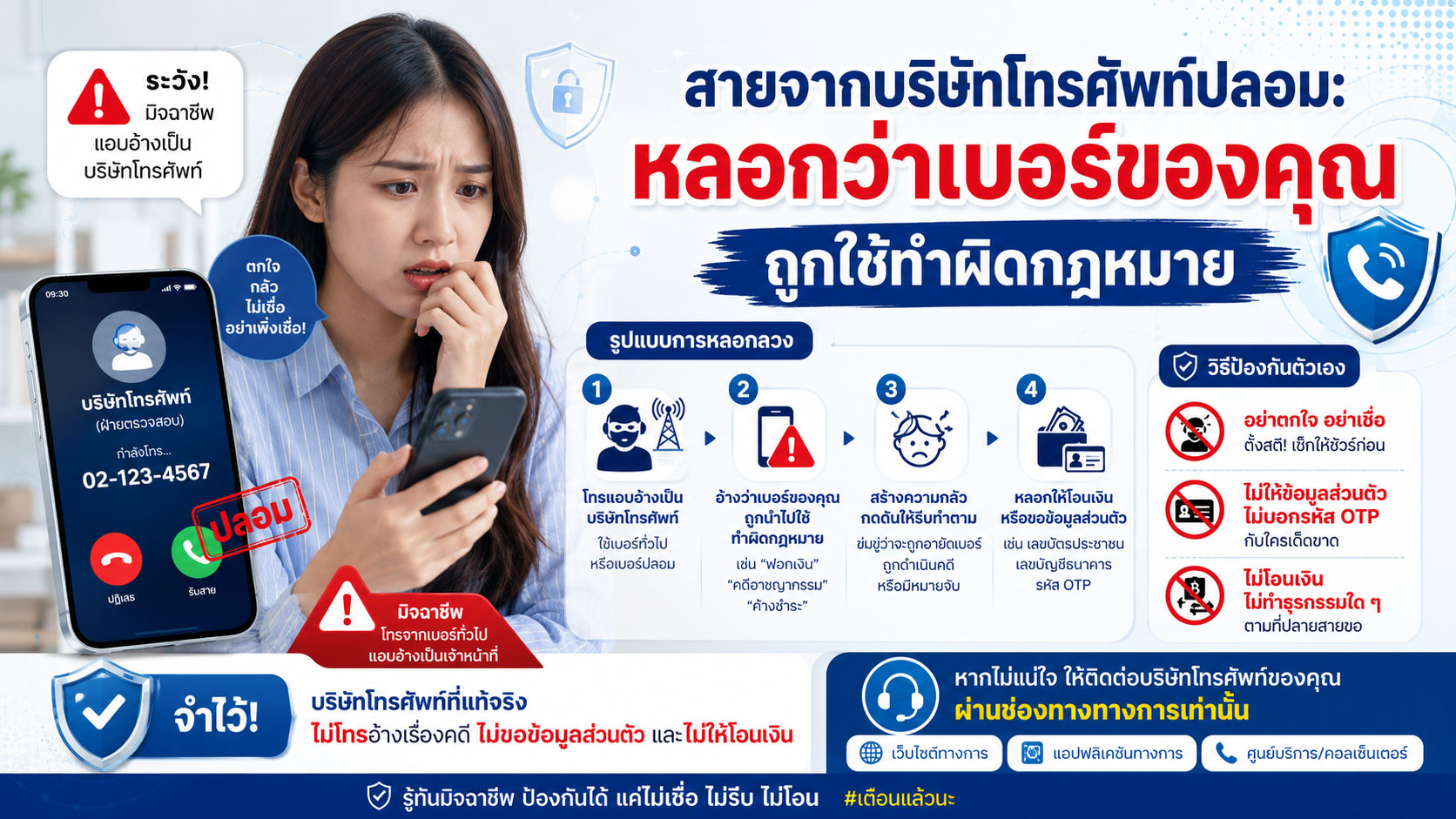
“เบอร์โทรศัพท์ของคุณถูกนำไปใช้ทำผิดกฎหมาย”
“มีการใช้ซิมในชื่อคุณส่ง SMS หลอกลวง”
“เบอร์นี้เกี่ยวข้องกับคดีฉ้อโกงออนไลน์”
“ถ้าไม่รีบยืนยันตัวตน ซิมของคุณจะถูกระงับ”
“เดี๋ยวจะโอนสายให้เจ้าหน้าที่ตำรวจรับเรื่องนะคะ”
ถ้าได้รับสายแบบนี้ หลายคนอาจตกใจทันที
เพราะเบอร์โทรศัพท์ไม่ใช่แค่เบอร์สำหรับโทรเข้าออกอีกต่อไป
เบอร์เดียวกันอาจผูกกับบัญชีธนาคาร
แอป Mobile Banking
บัญชีโซเชียลมีเดีย
อีเมล
แอปซื้อของออนไลน์
บริการส่งของ
บัตรเครดิต
บัญชีภาครัฐ
หรือรหัส OTP หลายอย่างในชีวิตประจำวัน
เมื่อมีคนโทรมาบอกว่า “เบอร์ของคุณถูกใช้ทำผิดกฎหมาย” เราจึงไม่ได้กลัวแค่เรื่องเบอร์ถูกปิด
แต่กลัวว่าเราอาจถูกโยงเข้ากับคดี
กลัวว่าชื่อเราจะถูกนำไปใช้
กลัวว่าแอปต่างๆ จะเข้าไม่ได้
กลัวว่าเงินในบัญชีจะไม่ปลอดภัย
และกลัวว่าถ้าไม่รีบทำตาม อาจเกิดปัญหาใหญ่
นี่คือจุดที่มิจฉาชีพใช้เล่นงาน
เขาเริ่มจากบริษัทโทรศัพท์ปลอม
แล้วค่อยๆ พาเรื่องไปสู่ตำรวจปลอม
จากเรื่องซิม
กลายเป็นเรื่องคดี
จากการยืนยันตัวตน
กลายเป็นการขอข้อมูลส่วนตัว
จากการป้องกันเบอร์ถูกระงับ
กลายเป็นการขอ OTP เปิดแอปธนาคาร แชร์หน้าจอ ติดตั้งแอป หรือโอนเงิน
จำไว้ว่า
เบอร์โทรมีปัญหาจริง ต้องตรวจสอบกับผู้ให้บริการโดยตรง ไม่ใช่ให้คนปลายสายโอนเรื่องไปตำรวจปลอม
ทำไมมิจฉาชีพชอบอ้างว่าเบอร์โทรถูกใช้ทำผิดกฎหมาย
เพราะเบอร์โทรเป็นสิ่งที่ใกล้ตัวมาก
ทุกคนมีเบอร์โทร
หลายคนใช้เบอร์เดิมมาหลายปี
หลายคนผูกเบอร์กับแอปสำคัญ
หลายคนใช้เบอร์รับ OTP
และหลายคนกลัวมากถ้าเบอร์ถูกระงับหรือถูกนำไปใช้ผิดทาง
มิจฉาชีพจึงใช้เบอร์โทรเป็นจุดเริ่มต้นที่ทำให้เรื่องดูน่าเชื่อ
เขาอาจพูดว่า
“มีซิมเปิดในชื่อคุณ”
“เบอร์นี้ถูกใช้ส่งข้อความหลอกลวง”
“มีผู้เสียหายแจ้งว่าได้รับ SMS จากเบอร์ที่เกี่ยวข้องกับคุณ”
“ชื่อของคุณอยู่ในรายการตรวจสอบซิมผิดกฎหมาย”
“ต้องยืนยันตัวตนเพื่อป้องกันการระงับหมายเลข”
ฟังดูเหมือนเป็นงานบริการลูกค้าหรือฝ่ายความปลอดภัยของบริษัทโทรศัพท์
แต่จริงๆ แล้วอาจเป็นแค่บทแรกของคอลเซ็นเตอร์สแกม
บทต่อไปอาจเป็นตำรวจปลอม ธนาคารปลอม หรือเจ้าหน้าที่ปลอมที่ค่อยๆ กดดันให้เราทำตาม
จากบริษัทโทรศัพท์ปลอม สู่ตำรวจปลอม
รูปแบบที่พบบ่อยคือ คนแรกโทรมาอ้างว่าเป็นบริษัทโทรศัพท์
อาจพูดเหมือนเจ้าหน้าที่ Call Center จริง
บอกชื่อค่ายมือถือ
บอกว่าระบบตรวจพบความผิดปกติ
บอกว่าเบอร์ของเรามีปัญหา
หรือบอกว่ามีซิมที่เปิดในชื่อเราไปใช้ทำผิดกฎหมาย
จากนั้นเรื่องจะค่อยๆ ร้ายแรงขึ้น
จาก “ซิมผิดปกติ”
กลายเป็น “SMS หลอกลวง”
จาก “เบอร์ถูกนำไปใช้”
กลายเป็น “มีผู้เสียหายแจ้งความ”
จาก “ต้องยืนยันตัวตน”
กลายเป็น “ต้องคุยกับตำรวจ”
จาก “ตรวจสอบเบอร์”
กลายเป็น “สอบสวนคดี”
แล้วเขาอาจพูดว่า
“เรื่องนี้เกี่ยวข้องกับคดีแล้วค่ะ บริษัทไม่สามารถดำเนินการต่อได้”
“เดี๋ยวจะโอนสายให้เจ้าหน้าที่ตำรวจ”
“ให้เพิ่ม LINE เจ้าหน้าที่เพื่อรับเอกสาร”
“ต้องให้ปากคำเพื่อยืนยันว่าไม่ได้เกี่ยวข้อง”
สิ่งที่ต้องระวังคือ การโอนสายจากคนหนึ่งไปอีกคนหนึ่ง ไม่ได้พิสูจน์ว่าเป็นหน่วยงานจริง
อาจเป็นเพียงคนในกลุ่มเดียวกันที่รับบทต่อกัน
คนแรกเล่นบทบริษัทโทรศัพท์
คนที่สองเล่นบทตำรวจ
คนที่สามเล่นบทฝ่ายสอบสวน
และทุกคนมีเป้าหมายเดียวกัน คือทำให้เรากลัวจนทำตาม
คำว่า “เบอร์คุณเกี่ยวข้องกับคดี” ทำให้คนบริสุทธิ์รีบพิสูจน์ตัวเอง
เมื่อมีคนบอกว่าเบอร์ของเราเกี่ยวข้องกับคดี คนส่วนใหญ่มักรีบปฏิเสธทันที
“ไม่ใช่เบอร์ฉัน”
“ฉันไม่ได้ส่ง SMS แบบนั้น”
“ฉันไม่เคยเปิดซิมเพิ่ม”
“มีคนเอาชื่อฉันไปใช้หรือเปล่า”
“ฉันจะพิสูจน์ยังไงว่าไม่เกี่ยว”
ความรู้สึกอยากพิสูจน์ตัวเองเป็นเรื่องธรรมดา
แต่จุดที่อันตรายคือ มิจฉาชีพจะใช้ความอยากพิสูจน์ตัวเองนี้พาเราไปให้ข้อมูลมากขึ้น
จากแค่ถามชื่อ
อาจกลายเป็นขอเลขบัตรประชาชนเต็ม
ขอวันเดือนปีเกิด
ขอที่อยู่
ขอรูปบัตรประชาชน
ขอรูปหน้าตรง
ขอข้อมูลบัญชีธนาคาร
ขอให้แจ้งยอดเงิน
ขอ OTP
ขอให้เปิดกล้อง
ขอให้เพิ่ม LINE
หรือขอให้ติดตั้งแอปเพื่อ “ตรวจสอบ”
ถ้าเราไม่ได้เกี่ยวข้องจริง เราไม่จำเป็นต้องพิสูจน์ตัวเองผ่านสายโทรศัพท์ที่ตรวจสอบไม่ได้
เราควรวางสาย แล้วตรวจสอบกับผู้ให้บริการโทรศัพท์หรือหน่วยงานจริงด้วยตัวเอง
อย่ากลัวคำว่า “ระงับซิม” จนรีบทำตาม
มิจฉาชีพอาจพูดว่า
“ถ้าไม่ยืนยันตัวตน ซิมจะถูกระงับภายใน 2 ชั่วโมง”
“ถ้าไม่ดำเนินการวันนี้ เบอร์จะถูกปิดถาวร”
“ถ้าเบอร์ถูกระงับ จะกระทบแอปธนาคารและการรับ OTP”
“ถ้าไม่ให้ความร่วมมือ จะถือว่ายอมรับว่าเกี่ยวข้องกับคดี”
คำพูดเหล่านี้ถูกออกแบบมาให้เรากลัวและรีบ
เพราะถ้าเบอร์ถูกปิดจริง ชีวิตประจำวันอาจยุ่งยากมาก
แต่การกลัวซิมถูกระงับ ไม่ควรทำให้เราส่งข้อมูลสำคัญให้คนที่ยังไม่รู้ว่าเป็นใคร
ถ้าซิมมีปัญหาจริง ผู้ให้บริการควรมีช่องทางทางการให้ตรวจสอบได้ เช่น แอปของผู้ให้บริการ เว็บไซต์ Call Center ทางการ หรือศูนย์บริการ
ไม่ควรต้องคุยกับตำรวจผ่าน LINE
ไม่ควรต้องให้ OTP
ไม่ควรต้องแชร์หน้าจอ
ไม่ควรต้องเปิดแอปธนาคาร
และไม่ควรต้องโอนเงินเพื่อกันเบอร์ถูกระงับ
สัญญาณเตือนของสายบริษัทโทรศัพท์ปลอม
ถ้ามีคนโทรมาอ้างว่าเป็นบริษัทโทรศัพท์ ให้ระวังเป็นพิเศษเมื่อมีพฤติกรรมเหล่านี้
อ้างว่าเบอร์ของคุณถูกใช้ทำผิดกฎหมาย
บอกว่ามีซิมเปิดในชื่อคุณโดยที่คุณไม่รู้
บอกว่าเบอร์ของคุณถูกใช้ส่ง SMS หลอกลวง
อ้างว่าเบอร์เกี่ยวข้องกับคดีฉ้อโกงหรือฟอกเงิน
บอกว่าจะระงับซิมทันทีถ้าไม่ยืนยันตัวตน
โอนสายให้ตำรวจหรือหน่วยงานสอบสวน
ให้เพิ่ม LINE เจ้าหน้าที่
ส่งเอกสารคดีผ่านแชท
บอกว่าห้ามวางสาย
บอกว่าห้ามบอกคนในบ้าน
ขอเลขบัตรประชาชนเต็ม
ขอรูปบัตรประชาชนหรือรูปหน้าตรง
ขอ OTP หรือรหัสยืนยัน
ให้กดลิงก์เพื่อยืนยันซิม
ให้ติดตั้งแอปตรวจสอบ
ให้แชร์หน้าจอ
ให้เปิดแอปธนาคาร
ขอให้แจ้งยอดเงินในบัญชี
หรือให้โอนเงินไปบัญชีตรวจสอบหรือบัญชีปลอดภัย
ถ้าเริ่มมีคำว่า OTP แอปธนาคาร แชร์หน้าจอ ติดตั้งแอป หรือโอนเงิน ให้หยุดทันที
เพราะเรื่องเบอร์โทรไม่ควรพาเราไปทำธุรกรรมทางการเงินกับคนปลายสาย
อย่ากดลิงก์ยืนยันซิมจากคนปลายสาย
บางครั้งมิจฉาชีพจะส่ง SMS หรือข้อความแชทตามมา
ข้อความอาจบอกให้กดลิงก์เพื่อ
ยืนยันตัวตน
ป้องกันการระงับซิม
ตรวจสอบซิมที่เปิดในชื่อเรา
ดูรายละเอียดคดี
ยกเลิกซิมผิดกฎหมาย
หรืออัปเดตข้อมูลผู้ใช้บริการ
ลิงก์อาจดูคล้ายเว็บไซต์ของผู้ให้บริการจริง
มีโลโก้
มีสีแบรนด์
มีแบบฟอร์มให้กรอก
มีข้อความเร่งด่วน
หรือมีช่องให้ใส่รหัส OTP
แต่ถ้าเราเข้าไปกรอกข้อมูลในเว็บปลอม ข้อมูลอาจถูกส่งให้มิจฉาชีพทันที
อย่ากดลิงก์จากคนปลายสาย
ถ้าต้องการตรวจสอบซิม ให้เข้าแอปหรือเว็บไซต์ของผู้ให้บริการด้วยตัวเอง
พิมพ์เว็บไซต์เอง
เปิดแอปที่ติดตั้งจาก Store ทางการ
โทร Call Center ทางการ
หรือไปศูนย์บริการจริง
อย่าให้คนที่โทรมาหลอกเป็นคนกำหนดช่องทางตรวจสอบให้เรา
OTP ไม่ใช่รหัสสำหรับยืนยันกับบริษัทโทรศัพท์ปลอม
มิจฉาชีพอาจขอ OTP โดยใช้เหตุผลที่ฟังดูน่าเชื่อ
เช่น
“ขอ OTP เพื่อยืนยันว่าเป็นเจ้าของเบอร์”
“ใช้รหัสนี้เพื่อระงับซิมที่ถูกเปิดผิดกฎหมาย”
“อ่านรหัสให้เจ้าหน้าที่เพื่อป้องกันการปิดเบอร์”
“ระบบต้องยืนยันก่อนโอนเรื่องให้ตำรวจ”
“ถ้าไม่แจ้ง OTP เบอร์จะถูกระงับ”
อย่าให้
OTP คือรหัสสำคัญที่อาจใช้ยืนยันธุรกรรม เข้าบัญชี เปลี่ยนข้อมูล ผูกอุปกรณ์ หรือเปิดทางให้คนอื่นเข้าถึงบริการบางอย่างแทนเรา
ต่อให้อีกฝ่ายพูดว่า “เป็นแค่รหัสยืนยัน” ก็ไม่ควรบอก
OTP คือกุญแจ ไม่ใช่ข้อมูลสำหรับบอกคนปลายสาย
เบอร์โทรผูกกับหลายบัญชี ยิ่งต้องระวังการยืนยันตัวตนปลอม
หลายคนใช้เบอร์โทรเดียวรับ OTP จากหลายบริการ
เช่น ธนาคาร
อีเมล
Facebook
LINE
แพลตฟอร์มซื้อของ
แอปเรียกรถ
บริการส่งอาหาร
กระเป๋าเงินออนไลน์
หรือแอปภาครัฐ
ถ้ามิจฉาชีพหลอกให้เราให้ OTP หรือข้อมูลส่วนตัวได้ เขาอาจไม่ได้ต้องการแค่เบอร์โทร
เขาอาจต้องการเข้าถึงบัญชีอื่นที่ผูกกับเบอร์นั้น
บางครั้งสายที่เริ่มจาก “บริษัทโทรศัพท์” อาจพาไปสู่การยึดบัญชีโซเชียล
ขโมยบัญชีธนาคาร
เปลี่ยนรหัสผ่าน
เข้าถึงอีเมล
หรือใช้ข้อมูลเราไปหลอกคนอื่นต่อ
ดังนั้น อย่าคิดว่าเรื่องเบอร์โทรเป็นเรื่องเล็ก
ถ้ามีใครขอรหัสหรือข้อมูลเพื่อยืนยันเบอร์ ให้ตรวจสอบให้แน่ใจก่อนว่าเป็นช่องทางจริง
ถ้าเขาให้เปิดแอปธนาคาร เรื่องนี้ไม่ใช่แค่ซิมแล้ว
บริษัทโทรศัพท์ไม่ควรต้องให้คุณเปิดแอปธนาคารเพื่อแก้ปัญหาเรื่องเบอร์
ถ้าคนปลายสายเริ่มถามว่า
ใช้ธนาคารอะไร
มียอดเงินเท่าไร
เปิดแอปธนาคารได้ไหม
ขอให้แชร์หน้าจอ
ให้กดเมนูนี้
ให้โอนเงินเพื่อกันความเสียหาย
ให้ย้ายเงินไปบัญชีปลอดภัย
หรือให้ยืนยันรายการบางอย่างในแอปธนาคาร
ให้หยุดทันที
เพราะเรื่องนี้ไม่ใช่การตรวจสอบซิมตามปกติแล้ว
มันกำลังกลายเป็นการหลอกเอาข้อมูลทางการเงินหรือหลอกให้โอนเงิน
ผู้ให้บริการโทรศัพท์จริงไม่ควรขอให้คุณเปิด Mobile Banking เพื่อพิสูจน์ว่าเบอร์ไม่ได้ทำผิด
และตำรวจจริงไม่ควรให้คุณโอนเงินเพื่อยืนยันความบริสุทธิ์
เอกสารที่ส่งมาในแชทอาจเป็นเอกสารปลอม
บางครั้งคนที่อ้างว่าเป็นตำรวจหรือเจ้าหน้าที่จะส่งเอกสารมาให้ดู
เช่น
เอกสารระงับซิม
หนังสือแจ้งความ
หมายเรียก
หมายจับ
เอกสารสอบสวน
เอกสารจากบริษัทโทรศัพท์
เอกสารที่มีตราครุฑ
หรือเอกสารที่มีชื่อและเลขบัตรบางส่วนของเรา
เอกสารเหล่านี้ทำให้คนตกใจได้มาก
แต่เอกสารที่ส่งผ่านแชทไม่ได้แปลว่าเป็นของจริงเสมอไป
โลโก้ปลอมได้
ตราประทับปลอมได้
ลายเซ็นปลอมได้
เลขคดีแต่งขึ้นได้
แบบฟอร์มทำเลียนแบบได้
และข้อมูลบางส่วนของเราอาจถูกนำมาจากแหล่งอื่น
อย่าตรวจสอบเอกสารกับคนที่ส่งมา
ให้เก็บไว้เป็นหลักฐาน แล้วติดต่อบริษัทโทรศัพท์หรือหน่วยงานจริงผ่านช่องทางที่คุณหาเอง
ถ้าได้รับสายแบบนี้ ควรทำอย่างไร
สิ่งแรกคือ ไม่ต้องรีบพิสูจน์ตัวเอง
ไม่ต้องรีบตอบทุกคำถาม
ไม่ต้องรีบแจ้งข้อมูล
ไม่ต้องรีบกดลิงก์
ไม่ต้องอยู่ในสายจนจบ
และไม่ต้องขออนุญาตวางสาย
คุณสามารถพูดสั้นๆ ว่า
“ขอบคุณค่ะ/ครับ เดี๋ยวจะตรวจสอบกับผู้ให้บริการผ่านช่องทางทางการเอง”
แล้ววางสาย
จากนั้นให้ตรวจสอบผ่านช่องทางที่คุณหาเอง เช่น
แอปของผู้ให้บริการโทรศัพท์
เว็บไซต์ทางการ
Call Center ทางการ
ศูนย์บริการ
หรือช่องทางลูกค้าสัมพันธ์ที่ตรวจสอบได้
ถ้าเขาอ้างว่าเกี่ยวข้องกับคดี ให้ติดต่อหน่วยงานจริงด้วยตัวเอง
อย่าใช้เบอร์ ลิงก์ LINE หรือบัญชีที่คนปลายสายส่งมาเป็นช่องทางตรวจสอบ
เพราะนั่นอาจเป็นส่วนหนึ่งของฉากที่เขาเตรียมไว้
ถ้าเผลอให้ข้อมูล กดลิงก์ หรือให้ OTP ไปแล้ว
ถ้าคุณเผลอให้ข้อมูล กดลิงก์ ให้ OTP ส่งเอกสาร ติดตั้งแอป แชร์หน้าจอ หรือโอนเงินไปแล้ว ให้หยุดทันที
อย่าทำขั้นตอนต่อ
อย่าให้รหัสเพิ่ม
อย่าโอนเงินเพิ่ม
อย่าคุยต่อเพราะเขาบอกว่าจะช่วยแก้เรื่องซิมหรือคดี
อย่าลบแชท
อย่าลบ SMS
อย่าลบสลิป
อย่าลบประวัติการโทร
ให้เก็บหลักฐานทั้งหมด เช่น
เบอร์โทร
ชื่อที่อีกฝ่ายใช้
ชื่อบริษัทที่ถูกอ้าง
ข้อความ SMS
ลิงก์
แชท
เอกสารที่ส่งมา
เลขบัญชีปลายทาง
ชื่อบัญชี
สลิปโอนเงิน
เวลาที่เกิดเหตุ
และคำพูดที่ใช้กดดัน
จากนั้นติดต่อผู้ให้บริการโทรศัพท์ผ่านช่องทางทางการ
ถ้าให้ข้อมูลธนาคารหรือ OTP ที่เกี่ยวข้องกับธุรกรรม ให้ติดต่อธนาคารผ่านช่องทางทางการโดยเร็ว
ถ้าติดตั้งแอปน่าสงสัย ให้หยุดใช้มือถือเครื่องนั้นทำธุรกรรมสำคัญก่อน และขอความช่วยเหลือจากคนที่ไว้ใจได้
อย่าอายที่จะขอความช่วยเหลือ
การหยุดเร็วสำคัญกว่าการพยายามแก้ปัญหาคนเดียว
ควรคุยกับคนในบ้านเรื่องซิมและเบอร์โทรไว้ก่อน
กลโกงนี้ควรบอกคนในบ้านไว้ล่วงหน้า
โดยเฉพาะผู้สูงอายุ คนที่ใช้เบอร์เดิมมานาน หรือคนที่ไม่คุ้นกับการตรวจสอบผ่านแอปและช่องทางทางการ
อาจตกลงกันง่ายๆ ว่า
ถ้ามีคนโทรมาบอกว่าเบอร์ถูกใช้ทำผิดกฎหมาย ให้ไม่ต้องตกใจ
ถ้าบอกว่าจะระงับซิม ให้ตรวจสอบกับค่ายมือถือเอง
ถ้าโอนสายให้ตำรวจ ให้ยังไม่เชื่อทันที
ถ้าให้เพิ่ม LINE เจ้าหน้าที่ ให้ไม่เพิ่ม
ถ้าขอ OTP ให้ไม่ให้
ถ้าให้กดลิงก์ ให้ไม่กด
ถ้าให้ติดตั้งแอปหรือแชร์หน้าจอ ให้ไม่ทำตาม
ถ้าให้เปิดแอปธนาคาร ให้หยุดทันที
และถ้าไม่แน่ใจ ให้โทรหาคนในบ้านก่อนเสมอ
ข้อตกลงง่ายๆ เหล่านี้อาจช่วยให้คนที่กำลังตกใจไม่ต้องตัดสินใจคนเดียว
อย่าโทษตัวเองถ้าคุณเคยตกใจ
ถ้าคุณเคยได้รับสายแนวนี้แล้วตกใจ นั่นเป็นเรื่องเข้าใจได้
เพราะเบอร์โทรเป็นเหมือนกุญแจของหลายบัญชีในชีวิต
ไม่มีใครอยากให้เบอร์ถูกปิด
ไม่มีใครอยากให้ซิมถูกใช้ทำผิดกฎหมาย
ไม่มีใครอยากถูกโยงกับคดี
ไม่มีใครอยากเสียสิทธิ์เข้าแอปธนาคาร
และไม่มีใครอยากให้ชื่อของตัวเองไปเกี่ยวกับ SMS หลอกลวง
มิจฉาชีพเลือกใช้เรื่องนี้เพราะรู้ว่ามันทำให้คนกลัวได้จริง
สิ่งสำคัญไม่ใช่การไม่เคยกลัว
แต่คือเมื่อเริ่มรู้สึกว่ามีอะไรไม่ปกติ ให้หยุดก่อน
วางสาย
ไม่กดลิงก์
ไม่บอก OTP
ไม่ให้ข้อมูลสำคัญ
ไม่เปิดแอปธนาคาร
ไม่ติดตั้งแอป
และตรวจสอบกับผู้ให้บริการหรือหน่วยงานจริงด้วยตัวเอง
ประโยคที่ควรจำ: เบอร์โทรมีปัญหาจริง ต้องตรวจสอบกับผู้ให้บริการโดยตรง
ถ้าต้องจำประโยคเดียวจากบทความนี้ ขอให้จำว่า
เบอร์โทรมีปัญหาจริง ต้องตรวจสอบกับผู้ให้บริการโดยตรง ไม่ใช่ให้คนปลายสายโอนเรื่องไปตำรวจปลอม
ถ้ามีซิมในชื่อเราจริง ควรตรวจสอบกับค่ายมือถือได้
ถ้าเบอร์จะถูกระงับจริง ควรมีช่องทางทางการให้ตรวจสอบ
ถ้ามีปัญหาการใช้งานจริง ศูนย์บริการหรือ Call Center ทางการควรช่วยได้
แต่ถ้าคนปลายสายรีบโอนเรื่องไปตำรวจ ให้เพิ่ม LINE ขอ OTP ให้กดลิงก์ หรือให้เปิดแอปธนาคาร นั่นไม่ใช่ขั้นตอนปกติ
นั่นอาจเป็นสัญญาณว่ากำลังถูกพาออกจากเรื่องซิม ไปสู่กลโกงที่ใหญ่กว่า
สรุป: สายเรื่องเบอร์โทรอาจไม่จบแค่เรื่องซิม
กลโกง “เบอร์ของคุณถูกใช้ทำผิดกฎหมาย” อันตรายเพราะมันเริ่มจากเรื่องที่ทุกคนเกี่ยวข้อง
เบอร์โทร
ซิม
SMS
การยืนยันตัวตน
และการระงับบริการ
แต่เมื่อมิจฉาชีพเริ่มใส่คำว่า คดี ตำรวจ หมายจับ ฟอกเงิน หรือบัญชีปลอดภัย เรื่องก็อาจเปลี่ยนจากปัญหาซิมเป็นคอลเซ็นเตอร์สแกมเต็มรูปแบบ
สิ่งที่ควรทำคือหยุดก่อน
อย่าให้ข้อมูลส่วนตัว
อย่าให้ OTP
อย่ากดลิงก์
อย่าเพิ่ม LINE ที่เขาส่งมา
อย่าติดตั้งแอป
อย่าแชร์หน้าจอ
อย่าเปิดแอปธนาคาร
อย่าโอนเงิน
และอย่าอยู่ในสายเพราะเขาบอกว่าห้ามวาง
ให้วางสาย แล้วตรวจสอบกับผู้ให้บริการโทรศัพท์หรือหน่วยงานจริงผ่านช่องทางทางการด้วยตัวเอง
ถ้าเป็นเรื่องจริง ช่องทางจริงยังตรวจสอบได้
แต่ถ้าเป็นมิจฉาชีพ การวางสายอาจช่วยหยุดไม่ให้เรื่อง “เบอร์โทร” กลายเป็นความเสียหายเรื่องเงินและข้อมูลสำคัญ
A Call from a Fake Telecom Company: They Claim Your Phone Number Has Been Used for Illegal Activities
“Your phone number has been used for illegal activities.”
“A SIM card under your name has been used to send scam SMS messages.”
“This number is linked to an online fraud case.”
“If you do not verify your identity immediately, your SIM will be suspended.”
“We will transfer the call to a police officer to handle this matter.”
If you receive a call like this, many people may panic immediately.
A phone number is no longer just a number for making and receiving calls.
The same number may be linked to your bank account.
Mobile banking app.
Social media accounts.
Email.
Online shopping apps.
Delivery services.
Credit cards.
Government accounts.
Or many OTP codes used in everyday life.
So when someone calls and says, “Your number has been used for illegal activities,” we are not only afraid that the number may be suspended.
We may also worry that we are being linked to a criminal case.
That someone has used our identity.
That we may lose access to important apps.
That money in our account may not be safe.
And that if we do not act quickly, a bigger problem may follow.
This is exactly where scammers attack.
They begin as a fake telecom company.
Then they gradually lead the story toward fake police.
A SIM issue becomes a criminal case.
Identity verification becomes a request for personal information.
Preventing SIM suspension becomes a request for OTPs, banking app access, screen sharing, app installation, or money transfers.
Remember this:
If your phone number really has a problem, verify it directly with your service provider — not through a caller who transfers you to fake police.
Why Scammers Claim Your Phone Number Was Used Illegally
Because phone numbers are extremely personal and close to everyday life.
Everyone has a phone number.
Many people have used the same number for years.
Many link their number to important apps.
Many use their number to receive OTPs.
And many people would be very worried if their number were suspended or misused.
Scammers use phone numbers as a believable starting point.
They may say:
“A SIM card was opened under your name.”
“This number was used to send scam messages.”
“A victim reported receiving SMS messages from a number linked to you.”
“Your name appears on a list of illegal SIM users.”
“You must verify your identity to prevent suspension of the number.”
This may sound like customer service or a security department from a telecom company.
But it may only be the first act of a call center scam.
The next act may involve fake police, fake bank officers, or fake investigators who slowly pressure you into following their instructions.
From Fake Telecom Staff to Fake Police
A common pattern begins with someone claiming to be from a telecom company.
They may sound like a real call center officer.
They may mention a mobile network provider.
Say the system found suspicious activity.
Say your number has a problem.
Or claim that a SIM card under your name has been used illegally.
Then the story gradually becomes more serious.
An “unusual SIM issue” becomes “scam SMS.”
A “number being used” becomes “a victim has filed a police report.”
“Identity verification” becomes “you must speak with the police.”
“Checking a phone number” becomes “criminal investigation.”
Then they may say:
“This matter is now related to a criminal case, so the company cannot continue handling it.”
“We will transfer the call to a police officer.”
“Please add the officer’s LINE account to receive documents.”
“You must give a statement to prove you are not involved.”
The important point is this: being transferred from one person to another does not prove that the next person is from a real agency.
It may simply be another person in the same scam group playing the next role.
One person plays the telecom staff.
Another plays the police officer.
Another plays the investigator.
And all of them have the same goal: to make you afraid enough to obey.
“Your Number Is Linked to a Case” Makes Innocent People Rush to Prove Themselves
When someone says your phone number is linked to a criminal case, most people rush to deny it.
“That is not my number.”
“I did not send those SMS messages.”
“I never opened another SIM card.”
“Did someone use my name?”
“How can I prove I am not involved?”
Wanting to prove yourself is a normal reaction.
But the danger is that scammers use this urge to make you reveal more information.
What begins as confirming your name may become a request for:
Your full national ID number
Date of birth
Address
A photo of your ID card
A face photo
Bank account information
Account balance
OTP codes
Camera access
Adding a LINE account
Or installing an app for “verification”
If you are not involved, you do not need to prove yourself through an unverified phone call.
You should hang up and verify directly with your telecom provider or the real agency yourself.
Do Not Let “SIM Suspension” Scare You into Following Instructions
Scammers may say:
“If you do not verify your identity, your SIM will be suspended within two hours.”
“If you do not act today, your number will be permanently closed.”
“If the number is suspended, it may affect your banking app and OTP access.”
“If you do not cooperate, it will be considered an admission that you are involved in the case.”
These statements are designed to create fear and urgency.
If a SIM card is really suspended, daily life can become very inconvenient.
But fear of SIM suspension should not make you send sensitive information to someone whose identity you have not verified.
If your SIM truly has a problem, your service provider should have official channels for checking it, such as the provider’s app, official website, official call center, or service center.
It should not require you to speak with police through LINE.
It should not require you to provide OTPs.
It should not require screen sharing.
It should not require opening your banking app.
And it should not require transferring money to prevent SIM suspension.
Warning Signs of a Fake Telecom Company Call
If someone calls claiming to be from a telecom company, be especially careful if they do any of the following:
They claim your number has been used for illegal activities.
They say a SIM card was opened under your name without your knowledge.
They say your number was used to send scam SMS messages.
They claim your number is linked to a fraud or money laundering case.
They say your SIM will be suspended immediately if you do not verify your identity.
They transfer the call to police or an investigation unit.
They ask you to add a LINE officer.
They send case documents through chat.
They tell you not to hang up.
They tell you not to tell anyone at home.
They ask for your full national ID number.
They ask for a photo of your ID card or face.
They ask for an OTP or verification code.
They ask you to click a link to verify your SIM.
They tell you to install a checking app.
They ask you to share your screen.
They ask you to open your banking app.
They ask you to disclose your account balance.
Or they ask you to transfer money to a verification account or safe account.
If the conversation starts involving OTPs, banking apps, screen sharing, app installation, or money transfers, stop immediately.
A phone number issue should not lead you into financial transactions with someone on the phone.
Do Not Click SIM Verification Links Sent by the Caller
Sometimes scammers send an SMS or chat message after the call.
The message may ask you to click a link to:
Verify your identity
Prevent SIM suspension
Check SIM cards opened under your name
View case details
Cancel an illegal SIM
Or update user information
The link may look similar to a real telecom provider’s website.
It may have a logo.
Brand colors.
A form to fill in.
Urgent wording.
Or a box for entering OTP codes.
But if you enter information into a fake website, that information may go directly to scammers.
Do not click links sent by the caller.
If you want to check your SIM, open the service provider’s official app or website yourself.
Type the website yourself.
Open the app installed from an official app store.
Call the official call center.
Or visit a real service center.
Do not let the caller choose the verification channel for you.
An OTP Is Not a Code to Give to a Fake Telecom Officer
Scammers may ask for an OTP using reasons that sound believable.
For example:
“Please provide the OTP to confirm you own the number.”
“This code will suspend the illegally opened SIM.”
“Read the code to the officer to prevent your number from being closed.”
“The system must verify before transferring the matter to police.”
“If you do not provide the OTP, the number will be suspended.”
Do not give it.
An OTP is a sensitive code that may be used to confirm a transaction, access an account, change information, link a device, or allow someone else to access a service on your behalf.
Even if the caller says, “It is only a verification code,” you should not share it.
An OTP is a key, not information to tell someone on the phone.
Because Phone Numbers Are Linked to Many Accounts, Fake Verification Is Especially Dangerous
Many people use one phone number to receive OTPs from many services.
For example:
Banks
Email
Facebook
LINE
Online shopping platforms
Ride-hailing apps
Food delivery services
Digital wallets
Or government apps
If scammers trick you into giving them an OTP or personal information, they may not only want your phone number.
They may be trying to access other accounts linked to that number.
Sometimes a call that begins as a “telecom company” scam may lead to social media account takeover.
Bank account theft.
Password changes.
Email access.
Or the use of your information to scam other people.
So do not treat phone number issues as minor.
If someone asks for codes or personal information to verify your number, make sure you are using the real channel first.
If They Ask You to Open Your Banking App, This Is No Longer Just a SIM Issue
A telecom company should not need you to open your banking app to fix a phone number issue.
If the caller starts asking:
Which bank do you use?
How much money is in your account?
Can you open your banking app?
Can you share your screen?
Please tap this menu.
Please transfer money to prevent damage.
Please move your money to a safe account.
Or please confirm something in your banking app.
Stop immediately.
This is no longer a normal SIM verification process.
It is becoming an attempt to obtain financial information or trick you into transferring money.
A real telecom provider should not ask you to open mobile banking to prove your number was not used illegally.
And real police should not ask you to transfer money to prove your innocence.
Documents Sent Through Chat May Be Fake
Sometimes the person claiming to be police or an officer may send documents to you.
For example:
SIM suspension documents
Police reports
Summons documents
Arrest warrants
Investigation documents
Telecom company documents
Documents with government emblems
Or documents showing your name and part of your ID number
These documents can be frightening.
But documents sent through chat are not always real.
Logos can be forged.
Stamps can be forged.
Signatures can be forged.
Case numbers can be invented.
Forms can be copied.
And some of your personal information may have come from other sources.
Do not verify the documents with the same person who sent them.
Save them as evidence, then contact the telecom company or real agency through a channel you find yourself.
What Should You Do If You Receive This Kind of Call?
The first thing is: do not rush to prove yourself.
You do not need to answer every question.
You do not need to provide information immediately.
You do not need to click links.
You do not need to stay on the call until the end.
And you do not need to ask permission to hang up.
You can simply say:
“Thank you. I will verify this with the service provider through official channels myself.”
Then hang up.
After that, check through a channel you find yourself, such as:
The telecom provider’s app
Official website
Official call center
Service center
Or a verifiable customer support channel
If they claim the matter is related to a criminal case, contact the real agency yourself.
Do not use the phone number, link, LINE account, or bank account sent by the caller as your verification channel.
Those may be part of the scene they prepared.
If You Already Shared Information, Clicked a Link, or Gave an OTP
If you already shared information, clicked a link, gave an OTP, sent documents, installed an app, shared your screen, or transferred money, stop immediately.
Do not continue the next steps.
Do not provide more codes.
Do not transfer more money.
Do not keep talking because they say they can fix the SIM or the case.
Do not delete chats.
Do not delete SMS messages.
Do not delete transfer slips.
Do not delete call history.
Save all evidence, such as:
Phone number
Name used by the caller
Company name they claimed to represent
SMS messages
Links
Chat messages
Documents sent to you
Destination account number
Account name
Transfer slip
Time of the incident
And the words they used to pressure you
Then contact your telecom provider through official channels.
If you shared banking information or an OTP related to a transaction, contact your bank through official channels as soon as possible.
If you installed a suspicious app, stop using that phone for important transactions and ask someone you trust for help.
Do not be embarrassed to ask for help.
Stopping quickly matters more than trying to solve the problem alone.
Talk with Your Family About SIM and Phone Number Scams Before It Happens
This scam is worth discussing with people at home in advance.
Especially elderly family members, people who have used the same number for many years, or people who are not familiar with checking through official apps and channels.
You can agree on simple rules:
If someone calls saying your number was used illegally, do not panic.
If they say your SIM will be suspended, check with the mobile provider yourself.
If they transfer the call to police, do not believe it immediately.
If they ask you to add a LINE officer, do not add it.
If they ask for an OTP, do not give it.
If they ask you to click a link, do not click it.
If they ask you to install an app or share your screen, do not do it.
If they ask you to open your banking app, stop immediately.
And if you are unsure, call someone in the family first.
Simple agreements like these can help someone who is panicking avoid making decisions alone.
Do Not Blame Yourself If You Felt Afraid
If you have ever received a call like this and felt afraid, that is understandable.
A phone number is like a key to many accounts in life.
No one wants their number to be closed.
No one wants a SIM under their name to be used illegally.
No one wants to be linked to a criminal case.
No one wants to lose access to banking apps.
And no one wants their name connected to scam SMS messages.
Scammers use this topic because they know it can create real fear.
The key is not to never feel afraid.
The key is that when something feels wrong, you stop first.
Hang up.
Do not click links.
Do not share OTPs.
Do not provide sensitive information.
Do not open your banking app.
Do not install apps.
And verify with the real service provider or agency yourself.
A Sentence to Remember: If Your Phone Number Really Has a Problem, Verify Directly with the Provider
If you remember only one sentence from this article, remember this:
If your phone number really has a problem, verify it directly with your service provider — not through a caller who transfers you to fake police.
If there really is a SIM under your name, your mobile provider should be able to check it.
If your number is really going to be suspended, there should be an official channel to verify it.
If there is a real service issue, the official service center or call center should be able to help.
But if the caller rushes to transfer you to police, asks you to add LINE, requests an OTP, sends a link, or tells you to open your banking app, that is not a normal process.
It may be a sign that you are being moved from a SIM issue into a much larger scam.
Conclusion: A Call About Your Phone Number May Not End with the SIM
The “your number has been used illegally” scam is dangerous because it starts with something almost everyone depends on.
A phone number.
A SIM card.
SMS messages.
Identity verification.
And service suspension.
But once scammers add words like case, police, arrest warrant, money laundering, or safe account, the issue may quickly change from a SIM problem into a full call center scam.
The right response is to stop first.
Do not share personal information.
Do not provide OTPs.
Do not click links.
Do not add LINE accounts they send.
Do not install apps.
Do not share your screen.
Do not open your banking app.
Do not transfer money.
And do not stay on the call just because they tell you not to hang up.
Hang up, then verify with your telecom provider or the real agency through official channels yourself.
If the issue is real, real channels can still help you check.
But if it is a scam, hanging up may prevent a “phone number issue” from becoming real damage to your money and personal information.

Leave a Reply
You must be logged in to post a comment.