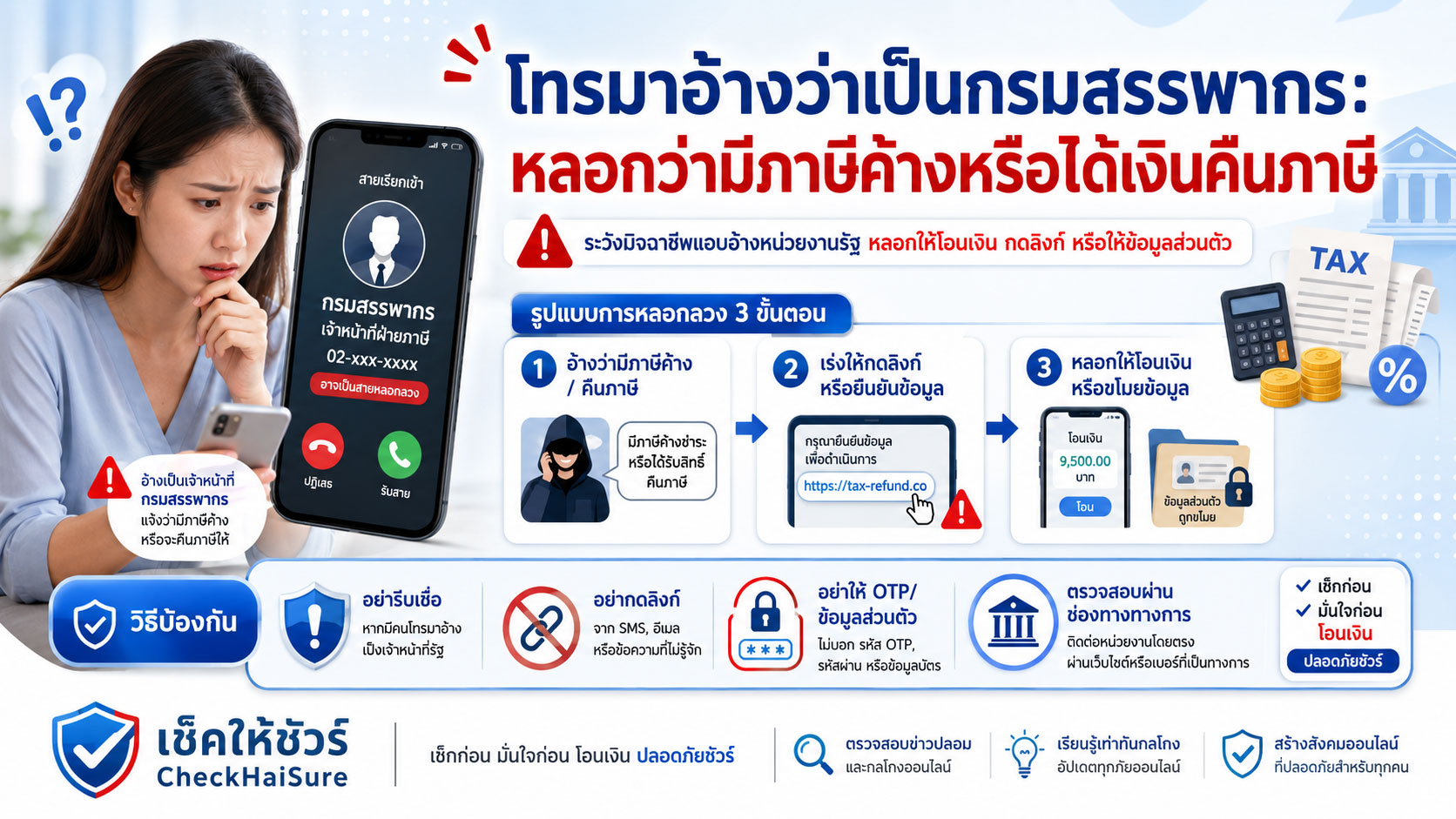
“คุณมีภาษีค้างชำระ ต้องรีบดำเนินการวันนี้”
“ระบบพบว่ามียอดภาษีที่ยังไม่ได้จ่าย”
“ถ้าไม่ชำระภายในเวลาที่กำหนด อาจมีค่าปรับเพิ่ม”
“คุณมีสิทธิ์ได้เงินคืนภาษี กรุณายืนยันบัญชีรับเงิน”
“กดลิงก์นี้เพื่อตรวจสอบยอดภาษีหรือรับเงินคืน”
ถ้าได้รับสายหรือข้อความแบบนี้ หลายคนอาจเริ่มไม่สบายใจทันที
เพราะคำว่า “ภาษี” เป็นเรื่องที่ดูจริงจัง และเกี่ยวข้องกับหน่วยงานรัฐ
บางคนกลัวว่าตัวเองอาจยื่นภาษีผิด
บางคนไม่แน่ใจว่าจ่ายครบหรือยัง
บางคนเคยยื่นภาษีแล้วรอเงินคืน
บางคนมีรายได้หลายทางและกลัวมีรายการตกหล่น
บางคนไม่คุ้นกับขั้นตอนภาษีออนไลน์
บางคนแค่ได้ยินคำว่า “ค่าปรับ” ก็เริ่มกังวลแล้ว
มิจฉาชีพเข้าใจความรู้สึกนี้ดี
เขาจึงอาจโทรมาอ้างว่าเป็นกรมสรรพากร เจ้าหน้าที่ภาษี ฝ่ายตรวจสอบ ฝ่ายคืนภาษี หรือศูนย์บริการผู้เสียภาษี แล้วใช้เรื่อง “ภาษีค้าง” หรือ “เงินคืนภาษี” เป็นเหยื่อล่อ
ถ้าใช้ความกลัว เขาจะบอกว่าเรามียอดค้าง ต้องรีบจ่าย
ถ้าใช้ความหวัง เขาจะบอกว่าเรามีเงินคืน ต้องรีบยืนยันบัญชี
ไม่ว่าจะมาแบบไหน เป้าหมายอาจเหมือนกัน คือหลอกให้เรากดลิงก์ ให้ข้อมูลส่วนตัว ให้ OTP หรือโอนเงินผ่านช่องทางที่ตรวจสอบไม่ได้
จำไว้ว่า
ภาษีจริงต้องตรวจสอบผ่านช่องทางทางการ ไม่ใช่กดลิงก์หรือโอนตามคำสั่งจากคนปลายสาย
ทำไมกลโกงภาษีถึงทำให้คนตกใจง่าย
เพราะภาษีเป็นเรื่องที่หลายคนไม่มั่นใจเต็มร้อย
แม้จะตั้งใจทำถูกต้อง แต่ก็ยังอาจมีคำถามในใจ
ยื่นครบไหม
กรอกถูกไหม
ลืมรายได้บางส่วนหรือเปล่า
มีเอกสารอะไรตกหล่นไหม
ต้องจ่ายเพิ่มไหม
มีค่าปรับไหม
เงินคืนจะเข้าบัญชีไหน
หรือมีใครใช้ข้อมูลเราไปทำอะไรหรือเปล่า
เมื่อมีคนโทรมาพูดด้วยน้ำเสียงจริงจังและอ้างว่าเป็นเจ้าหน้าที่ หลายคนจึงรีบฟัง
ไม่ใช่เพราะเชื่อทุกอย่างทันที
แต่เพราะกลัวว่าถ้าเป็นเรื่องจริงแล้วไม่รีบจัดการ อาจมีปัญหาตามมา
นี่คือช่องว่างที่มิจฉาชีพใช้
เขาไม่จำเป็นต้องรู้เรื่องภาษีของเราจริงทั้งหมด
แค่ทำให้เรากลัวว่า “อาจมีปัญหา” ก็อาจทำให้เรายอมทำตามขั้นตอนที่เขาบอก
กลโกงแบบ “ภาษีค้าง” ใช้ความกลัวเป็นตัวเร่ง
รูปแบบแรกที่พบบ่อยคือการอ้างว่ามีภาษีค้าง
คนปลายสายอาจพูดว่า
“คุณมียอดภาษีค้างชำระ”
“มีรายการยื่นภาษีไม่สมบูรณ์”
“มีค่าปรับที่ต้องดำเนินการ”
“มีเอกสารภาษีผิดพลาด”
“ถ้าไม่จ่ายวันนี้ จะมีการส่งเรื่องต่อ”
คำเหล่านี้ทำให้คนฟังรู้สึกว่าตัวเองกำลังมีปัญหากับหน่วยงานรัฐ
จากนั้นเขาอาจเร่งให้เรา
โอนเงินค่าภาษี
โอนค่าปรับ
จ่ายค่าดำเนินการ
กดลิงก์ตรวจสอบ
กรอกข้อมูลส่วนตัว
เพิ่ม LINE เจ้าหน้าที่
ส่งเอกสาร
หรือให้ OTP เพื่อยืนยันการชำระ
ต้องระวังเป็นพิเศษถ้าเขาให้โอนเงินเข้าบัญชีบุคคลธรรมดา หรือบัญชีที่ไม่สามารถตรวจสอบได้ว่าเป็นของหน่วยงานจริง
เรื่องภาษีจริงควรตรวจสอบได้ผ่านช่องทางทางการ ไม่ใช่ผ่านเลขบัญชีที่คนแปลกหน้าส่งมาในแชท
กลโกงแบบ “ได้เงินคืนภาษี” ใช้ความหวังเป็นตัวล่อ
อีกรูปแบบหนึ่งคือการอ้างว่าเรามีสิทธิ์ได้เงินคืนภาษี
ประโยคที่อาจเจอ เช่น
“คุณได้รับอนุมัติเงินคืนภาษี”
“ระบบมีเงินคืนรอจ่ายให้คุณ”
“ต้องยืนยันบัญชีรับเงินภายในวันนี้”
“หากไม่ยืนยัน เงินคืนจะถูกระงับ”
“กรุณากดลิงก์เพื่อรับเงินคืน”
ฟังแล้วอาจดูน่าดีใจ
โดยเฉพาะคนที่เพิ่งยื่นภาษี หรือเคยรอเงินคืนภาษีมาก่อน
แต่ต้องระวังว่า มิจฉาชีพอาจใช้คำว่า “เงินคืน” เพื่อให้เรายอมกรอกข้อมูลที่สำคัญ
เช่น เลขบัตรประชาชน
เลขบัญชีธนาคาร
ข้อมูลบัตรเครดิต
Username หรือ Password
รหัส OTP
ข้อมูลหลังบัตรประชาชน
หรือข้อมูลเข้าระบบบางอย่าง
บางครั้งอาจทำเว็บปลอมให้ดูเหมือนเป็นหน้าตรวจสอบเงินคืน
แต่เมื่อกรอกข้อมูลไปแล้ว ข้อมูลเหล่านั้นอาจถูกนำไปใช้ทำธุรกรรมหรือแอบอ้างตัวตนต่อ
เงินคืนที่ไม่ตรวจสอบ อาจกลายเป็นเงินที่เราสูญเสียแทน
อย่าให้คำว่า “เจ้าหน้าที่รัฐ” ทำให้เรารีบเชื่อ
มิจฉาชีพมักรู้ว่า คนส่วนใหญ่ให้ความเกรงใจหรือเกรงกลัวกับคำว่าเจ้าหน้าที่รัฐ
เขาอาจพูดด้วยน้ำเสียงจริงจัง
ใช้คำราชการ
พูดเลขอ้างอิง
พูดชื่อหน่วยงาน
พูดเหมือนมีระบบตรวจสอบอยู่ตรงหน้า
หรือบอกว่าเป็นเคสเร่งด่วนที่ต้องดำเนินการทันที
แต่การพูดเหมือนเจ้าหน้าที่ ไม่ได้แปลว่าเป็นเจ้าหน้าที่จริง
ชื่อหน่วยงานพูดได้
โลโก้ปลอมได้
เอกสารปลอมได้
เว็บปลอมได้
หมายเลขอ้างอิงแต่งขึ้นได้
และเบอร์โทรสามารถทำให้ดูน่าเชื่อได้
สิ่งที่ควรดูไม่ใช่แค่ว่าเขาพูดเหมือนจริงหรือไม่
แต่ต้องดูว่าเขาขอให้เราทำอะไร
ถ้าเขาขอข้อมูลลับ ขอ OTP ให้กดลิงก์ ให้โอนเงินเข้าบัญชีแปลกๆ หรือห้ามวางสายไปตรวจสอบ ให้สงสัยไว้ก่อน
ระวังลิงก์ปลอมสำหรับ “ตรวจภาษี” หรือ “รับเงินคืน”
ลิงก์ปลอมเป็นเครื่องมือที่ใช้บ่อยมาก
คนปลายสายหรือข้อความอาจส่งลิงก์มาให้ แล้วบอกว่าเป็นลิงก์สำหรับ
ตรวจสอบยอดภาษีค้าง
ยื่นเอกสารเพิ่มเติม
ชำระค่าภาษี
รับเงินคืนภาษี
ยืนยันบัญชีรับเงิน
แก้ไขข้อมูลผู้เสียภาษี
หรือดาวน์โหลดเอกสารจากระบบ
หน้าเว็บอาจดูเหมือนจริง
มีโลโก้
มีสีที่ดูเป็นทางการ
มีช่องให้กรอกเลขบัตรประชาชน
มีช่องให้ใส่เบอร์โทร
มีหน้าขอข้อมูลบัญชี
มีช่องให้ใส่รหัส OTP
หรือมีปุ่มให้ดาวน์โหลดไฟล์
แต่ถ้าเป็นเว็บปลอม ข้อมูลที่กรอกอาจตกไปอยู่กับมิจฉาชีพทันที
อย่ากดลิงก์จาก SMS หรือจากคนที่โทรมาเอง
ถ้าต้องการตรวจสอบภาษี ให้เข้าเว็บไซต์หรือแอปทางการด้วยตัวเอง หรือใช้ช่องทางที่คุณหาเองจากแหล่งที่เชื่อถือได้
อย่าให้ลิงก์ที่คนปลายสายส่งมาเป็นทางเข้าของข้อมูลส่วนตัวเรา
บัญชีรับเงินปลายทางต้องตรวจสอบให้ดี
ถ้าเขาอ้างว่าคุณต้องชำระภาษีหรือค่าปรับ แล้วให้โอนเงินเข้าบัญชีใดบัญชีหนึ่ง ให้ดูชื่อบัญชีทันที
ถ้าเป็นบัญชีบุคคลธรรมดา ให้หยุดก่อน
ถ้าเป็นชื่อคนทั่วไป
ชื่อบัญชีไม่ใช่หน่วยงาน
ชื่อบัญชีไม่ตรงกับเรื่องที่อ้าง
ชื่อบัญชีเป็นบริษัทแปลกๆ
หรือบอกว่าเป็นบัญชีเจ้าหน้าที่ บัญชีเคสเร่งด่วน บัญชีฝ่ายตรวจสอบ หรือบัญชีพักเงิน
ให้ระวังมาก
มิจฉาชีพอาจพูดว่า
“โอนเข้าบัญชีนี้ก่อน ระบบจะปรับยอดให้”
“บัญชีหลักใช้งานไม่ได้ชั่วคราว”
“บัญชีนี้เป็นช่องทางเร่งด่วน”
“โอนแล้วส่งสลิปมา เดี๋ยวออกเอกสารให้”
“ถ้าชำระตอนนี้จะลดค่าปรับได้”
อย่าเชื่อทันที
หน่วยงานจริงควรมีช่องทางชำระที่ตรวจสอบได้ ไม่ใช่ให้โอนเข้าบัญชีส่วนตัวตามคำสั่งจากสายโทรศัพท์
OTP ไม่เกี่ยวกับการรับเงินคืนภาษีจากคนปลายสาย
จุดที่ต้องระวังที่สุดคือ OTP
มิจฉาชีพอาจอ้างว่า
“OTP นี้ใช้ยืนยันบัญชีรับเงินคืน”
“ขอรหัสเพื่อยืนยันการยกเลิกค่าปรับ”
“ต้องอ่านรหัสเพื่อปิดยอดภาษีค้าง”
“รหัสนี้เป็นแค่การยืนยันตัวตน ไม่เกี่ยวกับเงิน”
“ถ้าไม่ให้ OTP ระบบจะดำเนินการต่อไม่ได้”
อย่าให้
OTP อาจใช้เข้าสู่บัญชี
ผูกอุปกรณ์
ยืนยันธุรกรรม
เปลี่ยนข้อมูล
สมัครบริการ
หรืออนุมัติบางอย่างแทนเรา
ไม่มีเหตุผลที่เราต้องอ่าน OTP ให้คนที่โทรมาเองฟัง เพื่อรับเงินคืนหรือชำระภาษี
OTP คือกุญแจ ไม่ใช่รหัสสำหรับรับเงินคืนภาษีจากคนแปลกหน้า
สัญญาณเตือนของสายสรรพากรปลอม
ถ้ามีคนโทรมาอ้างว่าเป็นกรมสรรพากรหรือเจ้าหน้าที่ภาษี ให้ระวังเป็นพิเศษเมื่อมีพฤติกรรมเหล่านี้
บอกว่ามีภาษีค้าง แต่ไม่ให้ตรวจสอบผ่านช่องทางทางการ
บอกว่าจะมีค่าปรับหรือส่งเรื่องต่อ ถ้าไม่จ่ายวันนี้
อ้างว่าได้เงินคืนภาษี แต่ให้กดลิงก์เพื่อรับเงิน
ขอเลขบัตรประชาชนเต็ม
ขอข้อมูลบัญชีธนาคาร
ขอข้อมูลบัตรเครดิต
ขอ Username หรือ Password
ขอ OTP หรือรหัสยืนยัน
ให้เพิ่ม LINE เจ้าหน้าที่
ส่งเอกสารผ่านแชทแล้วเร่งให้ทำตาม
ให้โอนเงินเข้าบัญชีบุคคล
บอกว่าบัญชีหลักใช้ไม่ได้ชั่วคราว
ขู่ว่าจะถูกตรวจสอบหรือถูกดำเนินการถ้าไม่ทำทันที
บอกว่าห้ามวางสายเพราะระบบกำลังทำรายการ
หรือไม่ยอมให้คุณตรวจสอบกับช่องทางทางการด้วยตัวเอง
ถ้ามีหลายข้อในนี้ ให้หยุดก่อน
อย่าให้ข้อมูล
อย่าให้ OTP
อย่ากดลิงก์
อย่าโอนเงิน
อย่าเพิ่ม LINE
และอย่าตัดสินใจเพราะกลัวคำว่าภาษีหรือค่าปรับ
ถ้าไม่แน่ใจว่ามีภาษีค้างจริงหรือไม่ ควรทำอย่างไร
ถ้าได้รับสายหรือข้อความแล้วไม่แน่ใจ ให้ตั้งหลักก่อน
ไม่ต้องรีบแก้ในสายนั้น
ให้วางสาย แล้วตรวจสอบด้วยตัวเองผ่านช่องทางทางการที่คุณหาเอง
เช่น เว็บไซต์ทางการ
ระบบหรือแอปทางการ
Call Center ทางการ
เอกสารภาษีที่คุณมี
สำนักงานหรือช่องทางบริการที่ตรวจสอบได้
หรือผู้เชี่ยวชาญด้านภาษีที่คุณรู้จักและไว้ใจ
อย่าใช้ลิงก์จาก SMS ที่น่าสงสัย
อย่าโทรกลับเบอร์ที่คนปลายสายให้มา
อย่าเพิ่ม LINE ที่อ้างว่าเป็นเจ้าหน้าที่
อย่าเปิดไฟล์แนบที่ไม่แน่ใจ
และอย่าโอนเงินเพียงเพราะเขาพูดว่าคุณกำลังจะมีปัญหา
ถ้าภาษีค้างจริง ควรตรวจสอบได้ผ่านช่องทางจริง
ถ้าเงินคืนมีจริง ควรตรวจสอบได้ผ่านระบบจริง
ถ้าเคยยื่นภาษีและกำลังรอเงินคืน ยิ่งต้องระวัง
คนที่รอเงินคืนภาษีอาจตกเป็นเป้าหมายได้ง่าย
เพราะเมื่อมีคนโทรมาบอกว่า “เงินคืนอนุมัติแล้ว” เราอาจรู้สึกว่าตรงกับสถานการณ์ของเรา
มิจฉาชีพอาจใช้ช่วงเวลานี้หลอกให้กรอกข้อมูลบัญชีหรือกดลิงก์รับเงินคืน
สิ่งที่ควรจำคือ เงินคืนจริงควรตรวจสอบได้ผ่านช่องทางทางการ ไม่ใช่ลิงก์ที่ส่งมาจากเบอร์แปลก
อย่ารีบกรอกข้อมูลเพียงเพราะคำว่า “เงินจะเข้าเร็วขึ้น”
อย่าให้ OTP เพื่อเร่งรับเงิน
อย่าให้ข้อมูลบัตรเครดิตเพื่อรับเงินคืน
และอย่าเชื่อว่าต้องจ่ายค่าธรรมเนียมก่อนถึงจะได้รับเงินคืน
เงินคืนภาษีไม่ควรเริ่มจากการให้เราจ่ายเงินให้คนแปลกหน้า
ระวังเอกสารภาษีปลอมที่ส่งผ่านแชท
บางครั้งมิจฉาชีพอาจส่งเอกสารมาให้ดู
เช่น
ใบแจ้งภาษีค้าง
หนังสือเตือนชำระ
เอกสารคืนภาษี
เอกสารค่าปรับ
เอกสารตรวจสอบ
หรือไฟล์ที่อ้างว่าเป็นหนังสือจากหน่วยงาน
เอกสารเหล่านี้อาจมีโลโก้ มีชื่อเรา มีเลขอ้างอิง หรือมีข้อความจริงจัง
แต่เอกสารที่ส่งผ่านแชทไม่ได้แปลว่าเป็นของจริงเสมอไป
โลโก้ปลอมได้
ตราประทับปลอมได้
เลขเอกสารแต่งขึ้นได้
ยอดเงินสร้างขึ้นได้
และไฟล์แนบอาจมีความเสี่ยง
อย่าเปิดไฟล์ที่ไม่น่าไว้ใจ
อย่าตรวจสอบเอกสารกับคนที่ส่งเอกสารนั้นมาเอง
ให้เก็บหลักฐานไว้ แล้วตรวจสอบกับช่องทางทางการด้วยตัวเอง
ถ้าได้รับสายแบบนี้ ควรตอบอย่างไร
ในช่วงที่ตกใจ อาจเตรียมประโยคง่ายๆ ไว้ใช้
“ขอบคุณค่ะ/ครับ เดี๋ยวขอตรวจสอบผ่านช่องทางทางการเอง”
“ขอไม่ให้ข้อมูลในสายนี้”
“ขอไม่กดลิงก์จาก SMS หรือแชท”
“ขอไม่โอนเงินจนกว่าจะตรวจสอบกับหน่วยงานจริง”
“ถ้ามีเอกสารจริง กรุณาให้ตรวจสอบผ่านช่องทางทางการได้”
คุณไม่จำเป็นต้องคุยต่อจนเขาพอใจ
ไม่จำเป็นต้องพิสูจน์ว่าเขาเป็นมิจฉาชีพ
ไม่จำเป็นต้องตอบคำถามส่วนตัว
ไม่จำเป็นต้องอยู่ในสายเพราะเขาบอกว่าเป็นเรื่องด่วน
สิ่งที่สำคัญคือออกจากสถานการณ์ที่เขาควบคุม แล้วตรวจสอบด้วยตัวเอง
ถ้าเผลอกดลิงก์ ให้ข้อมูล หรือโอนเงินไปแล้ว
ถ้าเผลอกดลิงก์ กรอกข้อมูล ให้ OTP หรือโอนเงินไปแล้ว ให้หยุดทันที
อย่าทำขั้นตอนต่อ
อย่าให้รหัสเพิ่ม
อย่าโอนเงินเพิ่ม
อย่าคุยต่อเพราะเขาบอกว่าจะช่วยแก้ให้สมบูรณ์
ให้รีบเก็บหลักฐาน เช่น
เบอร์โทร
SMS
ลิงก์
แชท
ชื่อที่อีกฝ่ายใช้
ชื่อหน่วยงานที่ถูกอ้าง
เอกสารที่ส่งมา
เลขบัญชีปลายทาง
ชื่อบัญชี
สลิปโอนเงิน
เวลาที่เกิดเหตุ
จำนวนเงิน
ข้อมูลที่เผลอให้ไป
และคำพูดที่ใช้กดดัน
จากนั้นติดต่อธนาคารผ่านช่องทางทางการหากมีข้อมูลบัญชี บัตร หรือการโอนเงินเกี่ยวข้อง
หากให้ข้อมูลส่วนตัวไปแล้ว ให้เฝ้าระวังการถูกนำข้อมูลไปแอบอ้าง
และแจ้งเหตุผ่านช่องทางที่เกี่ยวข้อง
อย่าลบหลักฐานเพราะอายหรือคิดว่าเป็นเรื่องเล็ก
การหยุดเร็วและเก็บหลักฐานไว้ อาจช่วยลดความเสียหายได้มาก
คุยกับคนในบ้านเรื่องสายภาษีปลอม
เรื่องภาษีอาจทำให้ผู้ใหญ่ในบ้าน เจ้าของกิจการ คนทำงานอิสระ หรือคนที่ไม่คุ้นกับระบบออนไลน์ตกใจได้ง่าย
ควรคุยกันไว้ล่วงหน้าว่า
ถ้ามีคนโทรมาอ้างว่ามีภาษีค้าง ให้ไม่โอนเงินทันที
ถ้าบอกว่าได้เงินคืนภาษี ให้ไม่กดลิงก์จาก SMS
ถ้าขอเลขบัตรประชาชนเต็ม ให้หยุดก่อน
ถ้าขอ OTP ให้ไม่ให้
ถ้าให้เพิ่ม LINE เจ้าหน้าที่ ให้ไม่เพิ่ม
ถ้าให้โอนเข้าบัญชีบุคคล ให้สงสัยทันที
ถ้าไม่แน่ใจ ให้ตรวจสอบผ่านช่องทางทางการเอง
และถ้าฟังแล้วรู้สึกกลัวหรือสับสน ให้ถามคนในบ้านหรือคนที่ไว้ใจก่อน
หลายครั้ง การมีคนช่วยฟังอีกคนอาจช่วยเห็นความผิดปกติที่คนกำลังตกใจมองไม่เห็น
อย่าโทษตัวเองถ้าคุณกลัวเรื่องภาษี
ถ้าคุณได้รับสายแบบนี้แล้วตกใจ นั่นไม่ใช่เรื่องแปลก
ภาษีเป็นเรื่องที่หลายคนรู้สึกว่าไม่อยากผิดพลาด
ไม่มีใครอยากมีภาษีค้าง
ไม่มีใครอยากโดนค่าปรับ
ไม่มีใครอยากถูกตรวจสอบ
ไม่มีใครอยากเสียสิทธิ์เงินคืน
และไม่มีใครอยากมีปัญหากับหน่วยงานรัฐ
มิจฉาชีพเลือกใช้เรื่องภาษี เพราะรู้ว่าคนจำนวนมากจะรู้สึกกังวลทันที
สิ่งสำคัญไม่ใช่การไม่กลัว
แต่คือเมื่อกลัวแล้วให้หยุดก่อน
ไม่กดลิงก์ทันที
ไม่ให้ข้อมูลทันที
ไม่ให้ OTP
ไม่โอนเงิน
ไม่เพิ่ม LINE
และไม่ปล่อยให้คำว่า “ภาษีค้าง” หรือ “เงินคืน” ทำให้เราลืมตรวจสอบช่องทางจริง
ประโยคที่ควรจำ: ภาษีจริงต้องตรวจสอบได้จากช่องทางจริง
ถ้าต้องจำประโยคเดียวจากบทความนี้ ขอให้จำว่า
ภาษีจริงต้องตรวจสอบได้จากช่องทางจริง ไม่ใช่จากลิงก์หรือบัญชีที่คนปลายสายส่งมา
ถ้ามีภาษีค้างจริง ระบบทางการควรตรวจสอบได้
ถ้ามีเงินคืนจริง ช่องทางทางการควรตรวจสอบได้
ถ้าต้องชำระจริง ควรมีช่องทางจ่ายที่เชื่อถือได้
ถ้าให้โอนเข้าบัญชีบุคคล ให้หยุด
ถ้าขอ OTP ให้ไม่ให้
ถ้าส่งลิงก์มาให้รีบทำ ให้ระวัง
ถ้าห้ามวางสายไปตรวจสอบ ให้ยิ่งต้องวางสาย
สรุป: อย่าให้คำว่าภาษี ทำให้เรากดลิงก์หรือโอนเงินโดยไม่ตรวจสอบ
กลโกงสรรพากรปลอมอันตราย เพราะมันใช้ทั้งความกลัวและความหวัง
กลัวภาษีค้าง
กลัวค่าปรับ
กลัวถูกตรวจสอบ
กลัวเอกสารผิดพลาด
หวังได้เงินคืน
หวังให้เรื่องจบเร็ว
หวังให้เงินเข้าบัญชีเร็วขึ้น
แต่ไม่ว่าจะมาแบบกลัวหรือแบบหวัง สิ่งที่ควรทำคือหยุดก่อน
อย่ากดลิงก์จาก SMS หรือแชท
อย่าให้ข้อมูลส่วนตัวกับคนที่โทรมาเอง
อย่าให้ OTP
อย่าให้ข้อมูลบัตร
อย่าเพิ่ม LINE เจ้าหน้าที่
อย่าโอนเข้าบัญชีบุคคล
อย่าอยู่ในสายเพราะเขาบอกว่าระบบกำลังทำรายการ
ให้วางสาย แล้วตรวจสอบผ่านช่องทางทางการที่คุณหาเอง
ถ้าเป็นภาษีจริง ยังตรวจสอบและดำเนินการได้
แต่ถ้าเป็นมิจฉาชีพ การหยุดเช็กก่อน อาจช่วยไม่ให้คำว่าภาษีหรือเงินคืน กลายเป็นเงินที่หายไปจริง
A Call Claims to Be from the Revenue Department: Beware of Fake Tax Debt and Fake Tax Refund Scams
“You have unpaid tax that must be handled today.”
“Our system found an outstanding tax balance.”
“If you do not pay within the required time, additional penalties may apply.”
“You are eligible for a tax refund. Please confirm your receiving account.”
“Click this link to check your tax balance or receive your refund.”
If you receive a call or message like this, many people may feel uneasy right away.
The word “tax” sounds serious, and it is connected to a government agency.
Some people worry they may have filed incorrectly.
Some are not sure whether they paid everything.
Some have already filed and are waiting for a refund.
Some have multiple sources of income and worry that something was missed.
Some are not familiar with online tax systems.
Some simply hear the word “penalty” and start to panic.
Scammers understand this feeling very well.
They may call pretending to be from the Revenue Department, a tax officer, an audit team, a tax refund team, or a taxpayer service center. Then they use either “unpaid tax” or “tax refund” as the bait.
If they use fear, they say you owe tax and must pay quickly.
If they use hope, they say you have a refund waiting and must confirm your account.
Either way, the goal may be the same: to trick you into clicking a link, sharing personal information, providing an OTP, or transferring money through an unverifiable channel.
Remember this:
Real tax matters should be checked through official channels, not handled through links or bank accounts sent by someone on the phone.
Why Tax Scams Make People Panic Easily
Tax is something many people are not fully confident about.
Even if you try to do everything correctly, you may still wonder:
Did I file everything?
Did I fill in the form correctly?
Did I miss any income?
Did I forget any document?
Do I need to pay more?
Will there be a penalty?
Which account will my refund go to?
Has someone used my information for something?
So when someone calls in a serious tone and claims to be an officer, many people listen carefully.
Not because they believe everything immediately.
But because they worry that if it is real and they do not act quickly, the problem may become worse.
That is the gap scammers use.
They do not need to know your real tax situation in detail.
They only need to make you think, “Maybe there is a problem,” and that may be enough to make you follow their instructions.
Fake “Unpaid Tax” Scams Use Fear as Pressure
One common version is claiming that you have unpaid tax.
The caller may say:
“You have outstanding tax.”
“Your tax filing is incomplete.”
“There is a penalty that must be handled.”
“There is an error in your tax documents.”
“If you do not pay today, the matter will be escalated.”
These words can make you feel as if you are already in trouble with a government agency.
Then they may pressure you to:
Transfer tax payment
Transfer a penalty fee
Pay a processing fee
Click a link to check details
Fill in personal information
Add a LINE officer
Send documents
Or provide an OTP to confirm payment
Be especially careful if they ask you to transfer money to a personal bank account or to an account that cannot be verified as belonging to an official agency.
Real tax matters should be verifiable through official channels, not through an account number sent by a stranger in a chat.
Fake “Tax Refund” Scams Use Hope as Bait
Another version claims that you are eligible for a tax refund.
You may hear messages like:
“Your tax refund has been approved.”
“There is a refund waiting for you in the system.”
“You must confirm your receiving account today.”
“If you do not confirm, the refund will be suspended.”
“Please click this link to receive your refund.”
This can sound exciting, especially if you recently filed your tax return or have been waiting for a refund.
But scammers may use the word “refund” to make you share important information, such as:
National ID number
Bank account number
Credit card details
Username or password
OTP
Back-of-ID information
Or login details for a system
Sometimes they may create a fake website that looks like a refund-checking page.
Once you enter your information, it may go directly to scammers.
An unchecked refund link may turn into real financial loss instead.
Do Not Let the Words “Government Officer” Make You Believe Too Quickly
Scammers know that many people feel nervous or respectful when someone claims to be a government officer.
They may speak seriously.
Use formal language.
Mention reference numbers.
Name an official agency.
Sound like they are checking a system.
Or say that your case is urgent and must be handled immediately.
But sounding like an officer does not prove they are one.
An agency name can be spoken by anyone.
A logo can be copied.
A document can be faked.
A website can be imitated.
A reference number can be invented.
And a phone number can be made to look convincing.
The key question is not only whether they sound real.
The key question is: what are they asking you to do?
If they ask for secret information, request an OTP, send a link, ask you to transfer money to a strange account, or refuse to let you hang up and verify, treat it as suspicious.
Beware of Fake Links for “Tax Check” or “Tax Refund”
Fake links are commonly used in this type of scam.
A caller or message may send you a link and claim it is for:
Checking outstanding tax
Submitting additional documents
Paying tax
Receiving a tax refund
Confirming your receiving account
Updating taxpayer information
Or downloading documents from the system
The page may look real.
It may have a logo.
It may use official-looking colors.
It may ask for your national ID number.
It may ask for your phone number.
It may ask for bank account information.
It may ask for an OTP.
Or it may ask you to download a file.
But if the website is fake, the information you enter may go straight to scammers.
Do not click links from suspicious SMS messages or from someone who called you first.
If you need to check your tax status, go to the official website or official app yourself, or use a channel you find from a trusted source.
Do not let a link sent by the caller become the doorway to your personal information.
Check the Receiving Account Carefully
If they claim that you must pay tax or a penalty and ask you to transfer money, check the receiving account immediately.
If it is a personal bank account, stop first.
Be very careful if:
The account name is an individual person.
The account name is not an official agency.
The account name does not match the issue.
The account name belongs to an unfamiliar company.
Or they say it is an officer account, urgent case account, audit account, or holding account.
Scammers may say:
“Transfer to this account first, and the system will update the balance.”
“The main account is temporarily unavailable.”
“This is the urgent payment channel.”
“Transfer and send the slip. We will issue the document later.”
“If you pay now, the penalty can be reduced.”
Do not believe this immediately.
A real government agency should have verifiable payment channels, not ask you to transfer to someone’s personal account based on a phone call.
OTP Has Nothing to Do with Receiving a Tax Refund from a Caller
The most important thing to protect is your OTP.
Scammers may say:
“This OTP confirms your tax refund receiving account.”
“We need the code to cancel the penalty.”
“You must read the code to close the outstanding tax balance.”
“This code is only for identity verification. It is not about money.”
“If you do not provide the OTP, the system cannot continue.”
Do not provide it.
An OTP may be used to access an account, link a device, confirm a transaction, change information, register a service, or approve something on your behalf.
There is no reason to read an OTP to someone who called you first in order to receive a refund or pay tax.
An OTP is a key, not a code for receiving a tax refund from a stranger.
Warning Signs of a Fake Revenue Department Call
If someone calls claiming to be from the Revenue Department or a tax office, be especially careful if they do any of the following:
They say you owe tax but do not allow verification through official channels.
They say there will be penalties or escalation if you do not pay today.
They claim you have a tax refund but ask you to click a link to receive it.
They ask for your full national ID number.
They ask for bank account information.
They ask for credit card information.
They ask for a username or password.
They ask for an OTP or verification code.
They ask you to add a LINE officer.
They send documents through chat and rush you to follow instructions.
They ask you to transfer money to a personal account.
They say the main account is temporarily unavailable.
They threaten that you will be audited or face action if you do not act immediately.
They tell you not to hang up because the system is processing.
Or they refuse to let you verify through official channels yourself.
If several of these signs appear, stop first.
Do not share information.
Do not provide OTPs.
Do not click links.
Do not transfer money.
Do not add LINE.
And do not make decisions out of fear of tax or penalties.
What Should You Do If You Are Not Sure Whether You Really Owe Tax?
If you receive a call or message and are unsure, pause first.
You do not need to solve it during that call.
Hang up and check by yourself through official channels you find independently.
For example:
Official website
Official system or app
Official call center
Your own tax documents
A verified service office or channel
Or a tax professional you know and trust
Do not use suspicious SMS links.
Do not call back the number given by the caller.
Do not add a LINE account claiming to be an officer.
Do not open attachments you do not trust.
And do not transfer money just because someone says you are about to have a problem.
If you truly owe tax, it should be verifiable through real channels.
If you truly have a refund, it should be verifiable through the real system.
If You Filed Taxes and Are Waiting for a Refund, Be Extra Careful
People waiting for a tax refund can be easy targets.
When someone says, “Your refund has been approved,” it may sound like it matches your situation.
Scammers may use this timing to trick you into entering bank details or clicking a refund link.
Remember: a real tax refund should be checkable through official channels, not through a link sent from a strange number.
Do not rush to enter information because someone says “the money will arrive faster.”
Do not provide an OTP to speed up a refund.
Do not provide credit card information to receive a refund.
And do not believe that you must pay a fee before receiving your tax refund.
A tax refund should not begin with you paying money to a stranger.
Beware of Fake Tax Documents Sent Through Chat
Sometimes scammers may send documents to make the story look real.
For example:
Unpaid tax notice
Payment warning
Tax refund document
Penalty document
Audit document
Or a file claiming to be an official letter
These documents may include logos, your name, reference numbers, or serious language.
But documents sent through chat are not always real.
Logos can be copied.
Stamps can be faked.
Document numbers can be invented.
Balances can be created.
And attachments may be risky.
Do not open files you do not trust.
Do not verify the document only with the person who sent it.
Save it as evidence, then check through official channels yourself.
What Should You Say If You Receive This Kind of Call?
When you are surprised, it helps to have simple sentences ready.
You can say:
“Thank you. I will check through the official channel myself.”
“I will not provide information on this call.”
“I will not click links from SMS or chat.”
“I will not transfer money until I verify with the real agency.”
“If there is a real document, it should be verifiable through an official channel.”
You do not need to keep talking until they are satisfied.
You do not need to prove that they are scammers.
You do not need to answer personal questions.
You do not need to stay on the call just because they say it is urgent.
The important thing is to leave the situation they are controlling and verify it yourself.
If You Already Clicked a Link, Shared Information, or Transferred Money
If you already clicked a link, entered information, provided an OTP, or transferred money, stop immediately.
Do not continue the next steps.
Do not provide more codes.
Do not transfer more money.
Do not keep talking because they say they can fix it completely.
Collect all evidence, such as:
Phone number
SMS
Link
Chat messages
Name used by the caller
Agency name they claimed
Documents sent to you
Destination account number
Account name
Transfer slip
Time of incident
Amount transferred
Information you shared
And words they used to pressure you
Then contact your bank through official channels if bank, card, or transfer information was involved.
If you shared personal information, watch for possible identity misuse.
Report the incident through the relevant channels.
Do not delete evidence because you feel embarrassed or think it is a small matter.
Stopping quickly and keeping evidence can reduce further damage.
Talk with Your Family About Fake Tax Calls
Tax-related calls can easily scare older family members, business owners, freelancers, or anyone unfamiliar with online tax systems.
It is worth discussing simple rules at home:
If someone calls claiming there is unpaid tax, do not transfer money immediately.
If they say there is a tax refund, do not click SMS links.
If they ask for a full national ID number, stop first.
If they ask for an OTP, do not provide it.
If they ask you to add a LINE officer, do not add it.
If they ask you to transfer to a personal account, be suspicious immediately.
If you are unsure, check through official channels yourself.
And if the call makes you feel scared or confused, ask someone you trust before doing anything.
Often, having one more person listen can help reveal warning signs that are hard to see when you are panicking.
Do Not Blame Yourself If Tax Issues Make You Anxious
If you receive this kind of call and feel worried, that is understandable.
Tax is something many people do not want to get wrong.
No one wants unpaid tax.
No one wants penalties.
No one wants to be audited.
No one wants to lose a refund.
And no one wants trouble with a government agency.
Scammers use tax stories because they know many people will feel anxious immediately.
The goal is not to never feel afraid.
The goal is to stop when fear begins.
Do not click links immediately.
Do not share information immediately.
Do not provide OTPs.
Do not transfer money.
Do not add LINE.
And do not let the words “unpaid tax” or “refund” make you forget to verify through real channels.
A Sentence to Remember: Real Tax Matters Must Be Verifiable Through Real Channels
If you remember only one sentence from this article, remember this:
Real tax matters must be verifiable through real channels, not through links or accounts sent by someone on the phone.
If there is real unpaid tax, the official system should show it.
If there is a real refund, the official channel should show it.
If payment is truly required, there should be a trusted payment channel.
If they ask you to transfer to a personal account, stop.
If they ask for an OTP, do not provide it.
If they send a link and rush you, be careful.
If they refuse to let you hang up and verify, that is even more reason to hang up.
Conclusion: Do Not Let the Word “Tax” Make You Click Links or Transfer Money Without Checking
Fake Revenue Department scams are dangerous because they use both fear and hope.
Fear of unpaid tax.
Fear of penalties.
Fear of audits.
Fear of incorrect documents.
Hope for a refund.
Hope to solve the issue quickly.
Hope that money will arrive faster.
But whether the story comes through fear or hope, the safest first step is to stop.
Do not click links from SMS or chat.
Do not share personal information with someone who called you first.
Do not provide OTPs.
Do not share card information.
Do not add a LINE officer.
Do not transfer to a personal account.
Do not stay on the call because they say the system is processing.
Hang up and check through official channels you find yourself.
If it is a real tax matter, it can still be verified and handled.
But if it is a scam, stopping to check first may prevent the words “tax” or “refund” from becoming real money lost.

Leave a Reply
You must be logged in to post a comment.