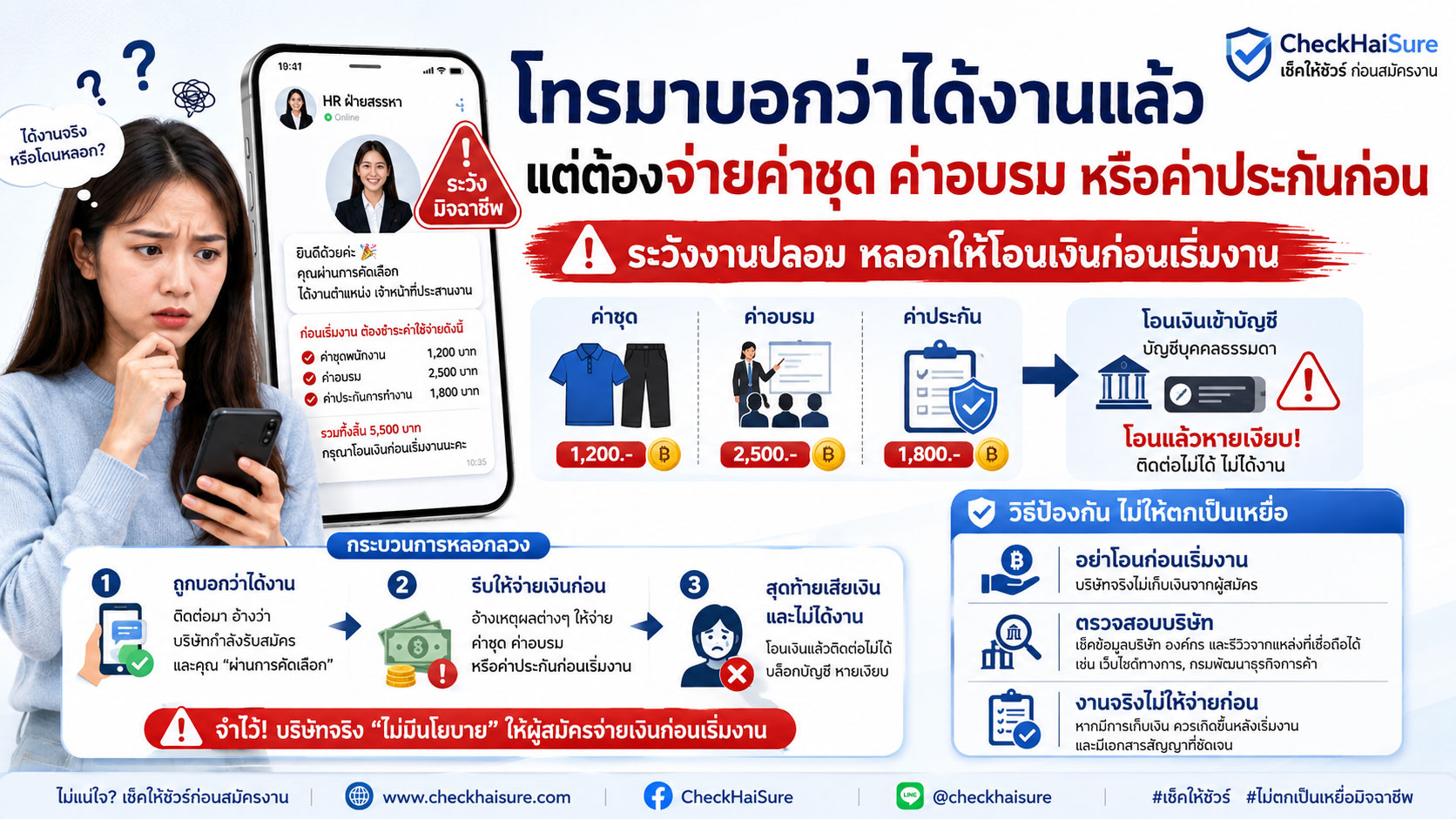
“ยินดีด้วยค่ะ คุณผ่านการคัดเลือกแล้ว”
“เริ่มงานได้ทันที แต่ต้องชำระค่าชุดก่อน”
“ต้องจ่ายค่าอบรมเพื่อเปิดรหัสพนักงาน”
“มีค่าประกันงานเล็กน้อย เดี๋ยวคืนให้หลังเริ่มงาน”
“ถ้าไม่จ่ายวันนี้ ตำแหน่งอาจหลุดให้คนอื่น”
ถ้าใครกำลังหางานอยู่ แล้วได้รับสายแบบนี้ อาจรู้สึกดีใจทันที
เพราะช่วงที่กำลังหางาน หลายคนอยู่ในจังหวะที่เหนื่อย กังวล และอยากได้โอกาสใหม่เร็วๆ
บางคนเพิ่งตกงาน
บางคนอยากมีรายได้เสริม
บางคนอยากเปลี่ยนงาน
บางคนมีภาระค่าใช้จ่ายรออยู่
บางคนสมัครงานไปหลายที่แต่ยังไม่มีใครติดต่อกลับ
บางคนแค่อยากได้งานที่มั่นคงขึ้นเพื่อดูแลครอบครัว
เมื่อมีคนโทรมาบอกว่า “คุณได้งานแล้ว” ความหวังจึงเกิดขึ้นเร็วมาก
แต่บางครั้ง ความหวังนี้อาจถูกมิจฉาชีพใช้เป็นเครื่องมือ
เขาอาจอ้างว่าเป็นฝ่าย HR บริษัทจัดหางาน หัวหน้าทีม แอดมินรับสมัครงาน หรือเจ้าหน้าที่บริษัทใหญ่ แล้วบอกว่าเราได้งานแล้ว แต่ต้องจ่ายเงินบางอย่างก่อนเริ่มงาน
ค่าชุด
ค่าอบรม
ค่าประกันงาน
ค่าทำบัตรพนักงาน
ค่าตรวจประวัติ
ค่ามัดจำอุปกรณ์
ค่าระบบ
ค่าลงทะเบียน
หรือค่าดำเนินการเอกสาร
ฟังดูเหมือนขั้นตอนปกติ
แต่ในหลายกรณี นี่อาจไม่ใช่งานจริง
อาจเป็นเพียงกลโกงที่ใช้คำว่า “ได้งานแล้ว” มาทำให้คนกำลังหางานยอมโอนเงินก่อน
จำไว้ว่า
งานที่ดีไม่ควรเริ่มจากการให้ผู้สมัครโอนเงินให้คนแปลกหน้า
ทำไมคนหางานถึงถูกหลอกได้ง่ายในช่วงนี้
เพราะการหางานเป็นช่วงที่คนมีความหวังและความกังวลอยู่พร้อมกัน
เราอยากได้โอกาส
อยากมีรายได้
อยากเริ่มต้นใหม่
อยากให้ชีวิตดีขึ้น
อยากรีบตอบรับก่อนตำแหน่งหลุด
และบางครั้งก็กลัวว่าถ้าปฏิเสธเงื่อนไขเล็กๆ น้อยๆ ไป งานนี้อาจหายไป
มิจฉาชีพเข้าใจความรู้สึกนี้ดี
เขาจึงมักพูดให้เหมือนว่าโอกาสนี้มีเวลาจำกัด
“ตำแหน่งเหลือไม่กี่ที่”
“ต้องยืนยันสิทธิ์วันนี้”
“ถ้าชำระแล้วจะเริ่มงานได้ทันที”
“ถ้าไม่โอนภายในเวลานี้ ระบบจะตัดสิทธิ์”
“คนสมัครเยอะมาก ต้องรีบจองตำแหน่ง”
คำพูดเหล่านี้ทำให้คนที่กำลังต้องการงานรู้สึกกดดัน
จากเดิมที่ควรถามรายละเอียดก่อน
กลายเป็นกลัวเสียโอกาส
จากเดิมที่ควรเช็กบริษัทก่อน
กลายเป็นรีบโอนเงิน
จากเดิมที่ควรดูสัญญาหรือเอกสาร
กลายเป็นรีบทำตามแอดมินในแชท
นี่คือจุดที่ต้องระวัง
เพราะงานจริงควรทำให้เรามองเห็นเส้นทางการจ้างงานชัดเจน ไม่ใช่รีบให้เราโอนเงินก่อนรู้รายละเอียด
กลโกงมักเริ่มจากคำว่า “ผ่านแล้ว”
คำว่า “ผ่านแล้ว” เป็นคำที่ทำให้คนหางานรู้สึกโล่งใจ
เหมือนเราได้ข้ามขั้นตอนยากๆ ไปแล้ว
ไม่ต้องสัมภาษณ์เพิ่ม
ไม่ต้องรอผลนาน
ไม่ต้องแข่งกับใคร
ไม่ต้องส่งเอกสารซ้ำ
และเหมือนมีคนเลือกเราแล้ว
มิจฉาชีพอาจใช้ประโยคเช่น
“คุณผ่านการคัดเลือกเบื้องต้นแล้ว”
“บริษัทอนุมัติรับคุณเข้าทำงานแล้ว”
“คุณได้เริ่มงานรอบนี้แน่นอน”
“เหลือแค่ชำระค่าชุดและยืนยันตัวตน”
“จ่ายค่าประกันก่อน แล้วเข้ากลุ่มพนักงานได้เลย”
คำพูดเหล่านี้ทำให้การจ่ายเงินดูเหมือนเป็นขั้นตอนสุดท้ายก่อนเริ่มงาน
แต่ถ้ายังไม่มีการสัมภาษณ์ที่ชัดเจน
ไม่มีสัญญาจ้าง
ไม่มีอีเมลบริษัท
ไม่มีรายละเอียดงานจริง
ไม่มีชื่อบริษัทที่ตรวจสอบได้
ไม่มีสถานที่ทำงานชัดเจน
และมีแต่การเร่งให้โอนเงิน
ให้สงสัยไว้ก่อนว่า “ผ่านแล้ว” อาจเป็นเพียงคำหลอกให้เรารีบจ่าย
ค่าชุดทำงานที่ดูเล็กน้อย อาจเป็นเหยื่อล่อ
ค่าชุดเป็นข้ออ้างที่เจอบ่อย
เพราะฟังดูเหมือนเป็นเรื่องที่เข้าใจได้
บางงานอาจต้องมีเครื่องแบบจริง
บางบริษัทอาจมีชุดพนักงานจริง
บางร้านอาจมีเสื้อทีมจริง
บางตำแหน่งอาจต้องมีอุปกรณ์เฉพาะจริง
มิจฉาชีพจึงใช้คำว่า “ค่าชุด” ทำให้การโอนเงินดูไม่แปลก
ยอดอาจไม่สูงมาก เช่น
300 บาท
500 บาท
890 บาท
1,200 บาท
1,500 บาท
หรือ 2,000 บาท
คนสมัครงานอาจคิดว่า “ถ้าได้งานจริง ยอมจ่ายก่อนก็ได้”
แต่หลังจากโอนค่าชุดแล้ว อาจมีค่าอื่นตามมา
ค่าอบรม
ค่าทำบัตร
ค่าประกันงาน
ค่ามัดจำอุปกรณ์
ค่าระบบ
ค่าตรวจเอกสาร
ค่าปลดล็อกบัญชีพนักงาน
หรือค่ารอบเริ่มงาน
จากเงินก้อนเล็กๆ อาจกลายเป็นหลายรอบ
และทุกครั้งมักมีเหตุผลใหม่ให้รีบจ่าย
ถ้าเป็นงานจริง ควรตรวจสอบได้ว่าค่าชุดมีจริงหรือไม่ จ่ายให้ใคร มีใบเสร็จหรือไม่ และเป็นนโยบายของบริษัทจริงหรือไม่
อย่าโอนเพียงเพราะคนในแชทบอกว่า “ทุกคนต้องจ่ายเหมือนกัน”
ค่าอบรมก่อนเริ่มงาน ต้องระวังเป็นพิเศษ
บางสายอาจบอกว่า ผู้สมัครต้องจ่ายค่าอบรมก่อนเริ่มงาน
เช่น
ค่าเปิดคอร์ส
ค่าเอกสารอบรม
ค่าระบบพนักงาน
ค่าครูฝึก
ค่าลงทะเบียนอบรม
หรือค่าประเมินก่อนบรรจุ
ถ้าเป็นการอบรมของบริษัทจริง ควรมีรายละเอียดชัดเจน
อบรมเรื่องอะไร
อบรมที่ไหน
อบรมกับใคร
บริษัทเป็นผู้จัดหรือไม่
มีเอกสารทางการหรือไม่
มีสัญญาจ้างแล้วหรือยัง
และค่าใช้จ่ายนี้อยู่ในเงื่อนไขใด
แต่ถ้าอีกฝ่ายพูดแค่ให้โอนก่อน แล้วค่อยส่งรายละเอียดทีหลัง ให้หยุดก่อน
โดยเฉพาะถ้าไม่มีสัญญาจ้าง ไม่มีอีเมลบริษัท ไม่มีที่อยู่บริษัทที่ตรวจสอบได้ และบัญชีรับเงินเป็นชื่อบุคคลธรรมดา
การอบรมก่อนเริ่มงานไม่ควรกลายเป็นช่องให้มิจฉาชีพเก็บเงินจากคนที่ยังไม่ได้งานจริง
ค่าประกันงานหรือค่ามัดจำ อาจเป็นคำที่ทำให้ดูน่าเชื่อ
อีกข้ออ้างที่พบบ่อยคือ “ค่าประกันงาน”
มิจฉาชีพอาจบอกว่า
“ต้องมีเงินประกันเพื่อป้องกันการทิ้งงาน”
“เป็นค่ามัดจำอุปกรณ์ เดี๋ยวคืนให้หลังทำงานครบกำหนด”
“บริษัทต้องเก็บไว้เพื่อยืนยันความตั้งใจ”
“จ่ายแล้วจะได้สิทธิ์เริ่มงานทันที”
“ถ้าไม่จ่าย จะถือว่าสละสิทธิ์”
คำเหล่านี้ทำให้ผู้สมัครรู้สึกว่าการจ่ายเงินเป็นการรับประกันตำแหน่ง
แต่ในความจริง งานที่น่าเชื่อถือควรมีขั้นตอนชัดเจน ไม่ใช่ให้ผู้สมัครโอนเงินเข้าบัญชีคนแปลกหน้าเพื่อยืนยันว่าจะได้งาน
ถ้าต้องมีเงินประกันจริง ควรมีเอกสาร สัญญา ใบเสร็จ ชื่อนิติบุคคล และช่องทางชำระเงินที่ตรวจสอบได้
ไม่ใช่แค่เลขบัญชีในแชทและคำเร่งว่า “ต้องโอนวันนี้”
บัญชีรับเงินคือจุดที่ต้องดูให้ดี
ถ้ามีการให้โอนเงินก่อนเริ่มงาน สิ่งแรกที่ต้องดูคือบัญชีปลายทาง
ถ้าเป็นบัญชีบุคคลธรรมดา ให้ระวังทันที
เช่น
ชื่อบัญชีเป็นชื่อคนทั่วไป
ชื่อบัญชีไม่ตรงกับบริษัท
ชื่อบัญชีไม่ใช่นิติบุคคล
ชื่อบัญชีเป็นคนละบริษัทกับที่ประกาศงาน
หรือแอดมินบอกว่าเป็นบัญชี HR บัญชีหัวหน้าทีม บัญชีฝ่ายเอกสาร หรือบัญชีรับสมัครงาน
บริษัทจริงควรมีช่องทางชำระเงินที่ตรวจสอบได้
ถ้ามีค่าใช้จ่ายจริง ควรมีเอกสารและใบเสร็จที่ชัดเจน
อย่าเชื่อคำว่า
“โอนเข้าบัญชีเจ้าหน้าที่ก่อน เดี๋ยวออกใบเสร็จให้”
“เป็นบัญชีรับสมัครงานโดยเฉพาะ”
“บัญชีบริษัทใช้ไม่ได้ชั่วคราว”
“จ่ายช่องทางนี้จะได้คิวเริ่มงานเร็วกว่า”
“โอนแล้วแคปสลิปส่งมา ระบบจะออกสัญญาให้”
ช่องทางที่ตรวจสอบไม่ได้ มักเป็นช่องทางที่เสี่ยง
ระวังงานที่ดีเกินจริง
งานหลอกมักมีข้อเสนอที่ดึงดูดมาก
เช่น
ไม่ต้องมีประสบการณ์
รายได้สูงมาก
ทำงานวันละไม่กี่ชั่วโมง
เริ่มงานได้ทันที
ไม่ต้องสัมภาษณ์จริงจัง
ไม่ต้องเข้าบริษัท
ได้เงินทุกวัน
รับทุกเพศทุกวัย
ทำจากมือถือได้
มีรายได้แน่นอน
หรือจ่ายเงินก่อนแล้วได้งานทันที
บางข้ออาจพบได้ในงานจริงบางประเภท
แต่ถ้าทุกอย่างดูง่ายเกินไป ดีเกินไป และรีบให้โอนเงินเกินไป ต้องระวัง
งานจริงควรมีรายละเอียดหน้าที่ ความรับผิดชอบ บริษัท ผู้ติดต่อ เงื่อนไขค่าจ้าง และขั้นตอนการสมัครที่ตรวจสอบได้
ถ้างานมีแต่คำว่า “รายได้ดี” “เริ่มทันที” “โอนก่อน” และ “ตำแหน่งกำลังจะเต็ม” ให้หยุดก่อน
สัญญาณเตือนของงานปลอมที่โทรมาบอกว่าได้งานแล้ว
ถ้ามีคนโทรหรือทักมาบอกว่าได้งานแล้ว ให้ระวังเป็นพิเศษเมื่อมีพฤติกรรมเหล่านี้
บอกว่าได้งานทั้งที่ยังไม่ได้สัมภาษณ์ชัดเจน
ไม่บอกชื่อบริษัทหรือรายละเอียดงานให้ครบ
ใช้บัญชีโซเชียลหรือ LINE ส่วนตัวแทนช่องทางบริษัท
เร่งให้จ่ายเงินเพื่อยืนยันสิทธิ์
ขอค่าชุดก่อนเริ่มงาน
ขอค่าอบรมก่อนเริ่มงาน
ขอค่าประกันงานหรือค่ามัดจำอุปกรณ์
ขอค่าทำบัตรพนักงาน
ขอค่าตรวจประวัติ
บอกว่าจ่ายแล้วจะได้เริ่มงานทันที
บอกว่าถ้าไม่จ่ายวันนี้ตำแหน่งจะหลุด
ให้โอนเงินเข้าบัญชีบุคคลธรรมดา
ไม่มีสัญญาจ้างหรือเอกสารบริษัทที่ตรวจสอบได้
ส่งเอกสารผ่านแชทแบบเร่งด่วน
ขอข้อมูลบัตรประชาชน รูปหน้าตรง หรือข้อมูลบัญชีธนาคารเกินจำเป็น
ขอ OTP หรือรหัสยืนยัน
หรือให้กดลิงก์เพื่อสมัครและชำระเงิน
ถ้ามีหลายข้อในนี้ ให้หยุดก่อน
อย่าโอนเงิน
อย่าให้ข้อมูลสำคัญ
อย่าให้ OTP
อย่ากดลิงก์
และอย่าตัดสินใจเพราะกลัวเสียโอกาส
อย่าให้ข้อมูลส่วนตัวมากเกินไปเพียงเพราะเขาบอกว่าได้งานแล้ว
การสมัครงานจริงอาจต้องใช้ข้อมูลบางอย่าง
แต่ต้องให้ผ่านช่องทางที่เหมาะสม และเมื่อมั่นใจว่าบริษัทมีตัวตนจริง
มิจฉาชีพอาจขอข้อมูล เช่น
เลขบัตรประชาชนเต็ม
รูปบัตรประชาชน
รูปหน้าตรง
ที่อยู่
ข้อมูลบัญชีธนาคาร
ข้อมูลบัตรเครดิต
สำเนาทะเบียนบ้าน
ข้อมูลคนในครอบครัว
หรือ OTP
บางอย่างอาจถูกอ้างว่าใช้ทำสัญญา เปิดบัญชีเงินเดือน ตรวจประวัติ หรือออกบัตรพนักงาน
แต่ถ้าเรายังไม่รู้แน่ชัดว่าบริษัทจริงหรือไม่ ข้อมูลเหล่านี้อาจถูกนำไปใช้แอบอ้างตัวตน สมัครบริการอื่น เปิดบัญชี หรือหลอกคนอื่นต่อ
อย่าให้ข้อมูลสำคัญเพียงเพราะดีใจว่าได้งานแล้ว
ความดีใจไม่ควรทำให้เราลืมตรวจสอบ
OTP ไม่เกี่ยวกับการสมัครงานปกติ
ถ้ามีคนที่อ้างว่าเป็น HR หรือบริษัทจัดหางานขอ OTP ให้หยุดทันที
เขาอาจบอกว่า
“ขอ OTP เพื่อยืนยันการสมัคร”
“ใช้รหัสนี้เพื่อเปิดรหัสพนักงาน”
“อ่านรหัสเพื่อเข้ากลุ่มงาน”
“ระบบส่งรหัสเพื่อยืนยันบัญชีรับเงินเดือน”
“ถ้าไม่ให้ OTP จะเริ่มงานไม่ได้”
อย่าให้
OTP อาจใช้ยืนยันธุรกรรม เข้าบัญชี สมัครบริการ เปลี่ยนข้อมูล หรืออนุมัติบางอย่างแทนเรา
งานจริงไม่ควรต้องให้ผู้สมัครอ่าน OTP ให้คนปลายสายฟัง
OTP คือกุญแจ ไม่ใช่ขั้นตอนรับเข้าทำงาน
ถ้าเป็นบริษัทจริง ควรตรวจสอบได้
ก่อนโอนเงินหรือส่งข้อมูลสำคัญ ให้เช็กก่อนว่า
บริษัทมีเว็บไซต์จริงไหม
ชื่อบริษัทตรงกับประกาศงานไหม
มีที่อยู่หรือสำนักงานจริงไหม
เบอร์ติดต่อเป็นเบอร์บริษัทหรือไม่
อีเมลที่ใช้ติดต่อเป็นอีเมลบริษัทหรือฟรีอีเมลทั่วไป
ตำแหน่งงานมีประกาศในเว็บไซต์บริษัทหรือแพลตฟอร์มหางานที่น่าเชื่อถือไหม
ชื่อผู้ติดต่อค้นหาเจอในบริบทของบริษัทจริงหรือไม่
เลขบัญชีรับเงินตรงกับชื่อบริษัทหรือไม่
มีสัญญาจ้างหรือเอกสารที่เป็นทางการหรือไม่
และเงื่อนไขค่าใช้จ่ายก่อนเริ่มงานสมเหตุสมผลหรือไม่
ถ้าหลายอย่างตอบไม่ได้ ให้ยังไม่โอนเงิน
งานจริงควรตรวจสอบได้
ไม่ใช่มีเพียงแชท LINE และเลขบัญชี
ถ้าอยากเช็กให้ปลอดภัย ควรถามอะไร
ถ้ามีคนบอกว่าได้งานแล้ว แต่ต้องจ่ายเงินก่อน ให้ถามอย่างสุภาพได้ว่า
บริษัทชื่ออะไร
ตำแหน่งงานอะไร
สถานที่ทำงานอยู่ที่ไหน
มีสัญญาจ้างหรือหนังสือรับเข้าทำงานหรือไม่
ค่าใช้จ่ายนี้ระบุในเอกสารบริษัทหรือไม่
บัญชีรับเงินเป็นชื่อบริษัทหรือไม่
มีใบเสร็จหรือไม่
สามารถชำระที่สำนักงานได้ไหม
สามารถตรวจสอบกับฝ่าย HR ผ่านเบอร์บริษัทได้ไหม
มีอีเมลบริษัทสำหรับยืนยันรายละเอียดไหม
ถ้าอีกฝ่ายตอบไม่ชัด โกรธ เร่งให้โอน หรือบอกว่า “ถ้าไม่จ่ายก็หมดสิทธิ์” ให้ระวังมากขึ้น
คนที่รับสมัครงานจริงควรให้ข้อมูลชัดเจน ไม่ใช่ใช้ความกดดันแทนคำตอบ
ถ้าเผลอโอนเงินไปแล้ว
ถ้าเผลอโอนเงินค่าสมัคร ค่าชุด ค่าอบรม หรือค่าประกันไปแล้ว ให้หยุดทันที
อย่าโอนเพิ่ม
มิจฉาชีพอาจบอกว่า
“ยังเหลือค่าทำบัตร”
“ต้องจ่ายค่าระบบเพิ่ม”
“ต้องโอนค่าประกันอีกก้อน”
“ยอดแรกเป็นแค่ค่าจองตำแหน่ง”
“ถ้าไม่โอนต่อ จะไม่ได้เริ่มงานและเงินเดิมจะไม่คืน”
อย่าเชื่อทันที
ให้เก็บหลักฐานทั้งหมด เช่น
ประกาศงาน
เบอร์โทร
บัญชี LINE หรือโซเชียลที่ติดต่อ
ชื่อคนที่อ้างว่าเป็น HR
ชื่อบริษัทที่ถูกอ้าง
แชท
ลิงก์
เลขบัญชีปลายทาง
ชื่อบัญชี
สลิปโอนเงิน
ยอดเงิน
วันและเวลา
และคำพูดที่ใช้เร่งให้โอน
จากนั้นติดต่อธนาคารผ่านช่องทางทางการหากมีการโอนเงิน
ถ้ามีการส่งข้อมูลส่วนตัวหรือเอกสาร เช่น บัตรประชาชน ให้เฝ้าระวังการถูกนำข้อมูลไปแอบอ้าง
และแจ้งเหตุผ่านช่องทางที่เกี่ยวข้อง
อย่าลบหลักฐานเพราะอาย
คนที่กำลังหางานอาจถูกหลอกได้ เพราะเขากำลังต้องการโอกาสจริงๆ
สิ่งสำคัญคือหยุดเร็ว ไม่โอนเพิ่ม และเก็บหลักฐานไว้ให้ครบที่สุด
คุยกับคนในบ้านเรื่องงานที่ต้องจ่ายก่อนเริ่มงาน
กลโกงนี้ควรบอกคนในบ้านไว้ล่วงหน้า
โดยเฉพาะนักเรียน นักศึกษา คนเพิ่งจบใหม่ คนที่กำลังตกงาน คนที่อยากหารายได้เสริม หรือผู้สูงอายุที่อาจสนใจงานง่ายๆ จากโทรศัพท์
อาจตกลงกันง่ายๆ ว่า
ถ้ามีงานบอกว่าได้งานแล้วแต่ให้จ่ายก่อน ให้เช็กก่อนเสมอ
ถ้าให้โอนค่าชุด ค่าอบรม หรือค่าประกันเข้าบัญชีบุคคล ให้หยุด
ถ้างานรายได้ดีมากแต่รายละเอียดน้อย ให้สงสัย
ถ้าไม่เคยสัมภาษณ์แต่บอกว่าผ่านแล้ว ให้ตรวจสอบ
ถ้าขอ OTP ให้ไม่ให้
ถ้าขอเอกสารส่วนตัวเร็วเกินไป ให้หยุดก่อน
ถ้าให้รีบโอนเพราะตำแหน่งจะหลุด ให้ไม่ตัดสินใจทันที
และถ้าไม่แน่ใจ ให้ปรึกษาคนในบ้านก่อนเสมอ
บางครั้งแค่มีคนช่วยดูประกาศงานหรือชื่อบัญชีปลายทาง ก็อาจเห็นความผิดปกติที่คนกำลังดีใจมองข้ามไป
อย่าโทษตัวเองถ้าคุณเคยดีใจจนเกือบเชื่อ
ถ้าคุณเคยได้รับสายหรือข้อความบอกว่าได้งานแล้ว แล้วรู้สึกดีใจ นั่นเป็นเรื่องปกติมาก
เพราะงานไม่ใช่แค่รายได้
งานคือความหวัง
ความมั่นคง
โอกาสเริ่มต้นใหม่
ความรู้สึกว่ามีคนเห็นคุณค่า
และทางออกจากภาระหลายอย่างในชีวิต
มิจฉาชีพเลือกใช้เรื่องงาน เพราะรู้ว่าคนจำนวนมากกำลังต้องการโอกาสจริงๆ
สิ่งสำคัญไม่ใช่การไม่เคยดีใจ
แต่คือเมื่อเขาเริ่มขอเงินก่อนเริ่มงาน ให้หยุดคิดก่อน
งานที่ดีควรทำให้เรามีรายได้ ไม่ใช่ทำให้เราเสียเงินตั้งแต่ยังไม่ได้เริ่ม
ประโยคที่ควรจำ: งานที่ดีไม่ควรเริ่มจากการให้ผู้สมัครโอนเงิน
ถ้าต้องจำประโยคเดียวจากบทความนี้ ขอให้จำว่า
งานที่ดีไม่ควรเริ่มจากการให้ผู้สมัครโอนเงินให้คนแปลกหน้า
ถ้าบอกว่าได้งานแล้ว แต่ให้โอนค่าชุด ให้ตรวจสอบก่อน
ถ้าบอกว่าเริ่มงานได้ แต่ต้องจ่ายค่าอบรม ให้ถามเอกสารก่อน
ถ้าบอกว่าต้องจ่ายค่าประกันเพื่อยืนยันสิทธิ์ ให้ดูชื่อบัญชีและชื่อบริษัทก่อน
ถ้าบอกว่าตำแหน่งจะหลุดถ้าไม่โอนวันนี้ ให้หยุดก่อน
ถ้าขอ OTP ให้ไม่ให้
และถ้าทุกอย่างเกิดขึ้นผ่านแชทกับเลขบัญชีที่ตรวจสอบไม่ได้ ให้สงสัยไว้ก่อนว่าอาจไม่ใช่งานจริง
สรุป: อย่าให้คำว่า “ได้งานแล้ว” ทำให้เราเสียเงินก่อนเริ่มงาน
กลโกงงานปลอมอันตราย เพราะมันไม่ได้หลอกแค่เงิน
แต่มันหลอกความหวังของคนที่กำลังมองหาโอกาส
จากคำว่า “ผ่านแล้ว”
กลายเป็น “จ่ายค่าชุดก่อน”
จาก “ค่าชุด”
กลายเป็น “ค่าอบรม”
จาก “ค่าอบรม”
กลายเป็น “ค่าประกันงาน”
และจากความหวังว่าจะได้งาน
กลายเป็นการเสียเงินให้คนที่ไม่มีงานให้จริง
สิ่งที่ควรทำคือหยุดก่อน
อย่ารีบโอนเงิน
อย่าให้ OTP
อย่ากดลิงก์
อย่าส่งเอกสารส่วนตัวก่อนตรวจสอบ
อย่าโอนเข้าบัญชีบุคคล
อย่าตัดสินใจเพราะกลัวตำแหน่งหลุด
ให้ตรวจสอบบริษัท ตรวจสอบตำแหน่ง ตรวจสอบช่องทางติดต่อ และตรวจสอบบัญชีรับเงินให้ชัดเจน
ถ้าเป็นงานจริง ยังตรวจสอบได้
แต่ถ้าเป็นมิจฉาชีพ การไม่โอนเงินก่อน อาจช่วยให้ความหวังของคุณไม่กลายเป็นความเสียหาย
A Call Says You Got the Job, but You Must Pay for Uniforms, Training, or a Deposit First
“Congratulations, you passed the selection process.”
“You can start immediately, but you need to pay for the uniform first.”
“There is a training fee to activate your employee ID.”
“There is a small work deposit, and it will be returned after you start.”
“If you do not pay today, the position may be given to someone else.”
If you are currently looking for a job and receive a call like this, you may feel excited right away.
Job hunting can be tiring, stressful, and full of uncertainty. Many people just want a new opportunity as soon as possible.
Some people have recently lost their job.
Some need extra income.
Some want to change jobs.
Some have bills waiting.
Some have applied to many places but have not heard back.
Some simply want more stability so they can support their family.
So when someone calls and says, “You got the job,” hope can appear very quickly.
But sometimes, that hope is exactly what scammers try to exploit.
They may pretend to be HR staff, a recruitment agency, a team leader, a hiring admin, or a representative of a well-known company. Then they say you have been accepted, but you must pay something before you can start.
Uniform fee
Training fee
Work deposit
Employee card fee
Background check fee
Equipment deposit
System fee
Registration fee
Document processing fee
It may sound like a normal hiring step.
But in many cases, this may not be a real job.
It may simply be a scam using the words “you got the job” to make job seekers transfer money first.
Remember this:
A good job should not begin with an applicant transferring money to a stranger.
Why Job Seekers Can Be Vulnerable to This Scam
Job hunting is a time when hope and anxiety often exist together.
You want an opportunity.
You want income.
You want a fresh start.
You want life to get better.
You want to accept quickly before the position is gone.
And sometimes, you may worry that if you question a small condition, the job may disappear.
Scammers understand this feeling very well.
They often make the opportunity sound time-sensitive.
“There are only a few positions left.”
“You must confirm your slot today.”
“After payment, you can start immediately.”
“If you do not transfer within this time, the system will cancel your right.”
“Many people are applying, so you need to reserve your position quickly.”
These words pressure people who need work.
Instead of asking for details first, you may fear losing the chance.
Instead of checking the company first, you may rush to pay.
Instead of reviewing a contract or document, you may follow the admin’s instructions in chat.
That is the dangerous point.
A real job should give you a clear hiring process, not rush you into transferring money before you understand the details.
The Scam Often Starts with the Words “You Passed”
The words “you passed” can make a job seeker feel relieved.
It feels like you have already crossed the difficult part.
No more interviews.
No more waiting for results.
No more competition.
No more repeated document submissions.
And it feels like someone has already chosen you.
Scammers may say:
“You passed the initial selection.”
“The company has approved you for employment.”
“You are guaranteed to start in this round.”
“You only need to pay for the uniform and verify your identity.”
“Pay the deposit first, then you can enter the employee group.”
These words make the payment feel like the final step before starting work.
But if there has been no clear interview,
no employment contract,
no company email,
no real job details,
no verifiable company name,
no clear workplace,
and only pressure to transfer money,
be suspicious.
“You passed” may simply be a phrase used to make you pay quickly.
A Small Uniform Fee Can Be the First Bait
Uniform fees are a common excuse.
They can sound believable.
Some jobs really do require uniforms.
Some companies really do provide employee shirts.
Some shops really do have team clothing.
Some positions really do require certain equipment.
That is why scammers use the word “uniform fee” to make the transfer look normal.
The amount may not be very high, such as:
300 baht
500 baht
890 baht
1,200 baht
1,500 baht
or 2,000 baht
A job seeker may think, “If this job is real, paying first is fine.”
But after paying the uniform fee, another fee may appear.
Training fee
Employee card fee
Work deposit
Equipment deposit
System fee
Document check fee
Employee account activation fee
Or start-date confirmation fee
A small first payment can become several rounds of payment.
And each time, there is usually a new reason to pay quickly.
If it is a real job, you should be able to verify whether the uniform fee truly exists, who receives the payment, whether there is a receipt, and whether it is really company policy.
Do not transfer money simply because someone in a chat says, “Everyone has to pay this.”
Be Extra Careful with Training Fees Before Starting Work
Some callers may say applicants must pay for training before starting work.
For example:
Course opening fee
Training document fee
Employee system fee
Trainer fee
Training registration fee
Pre-employment assessment fee
If it is real company training, the details should be clear.
What is the training about?
Where will it be held?
Who conducts the training?
Is it organized by the company?
Is there an official document?
Has an employment contract already been issued?
What are the terms of this fee?
But if the person only says “transfer first, then we will send the details,” stop first.
Be especially careful if there is no employment contract, no company email, no verifiable office address, and the receiving account is a personal bank account.
Training before work should not become a way for scammers to collect money from people who have not actually received a job.
“Work Deposit” or “Equipment Deposit” Can Sound More Trustworthy Than It Is
Another common excuse is a “work deposit.”
Scammers may say:
“There must be a deposit to prevent workers from abandoning the job.”
“It is an equipment deposit and will be returned after you complete the required period.”
“The company keeps it to confirm your commitment.”
“Once you pay, you can start immediately.”
“If you do not pay, it will be treated as giving up the position.”
These words make the payment feel like a way to secure the job.
But a trustworthy job should have a clear hiring process. It should not require an applicant to transfer money to a stranger’s bank account to prove they want the job.
If a deposit truly exists, there should be documents, a contract, a receipt, a company name, and a verifiable payment channel.
Not just an account number in chat and pressure saying, “You must pay today.”
The Receiving Account Is One of the Most Important Warning Signs
If someone asks you to transfer money before starting work, the first thing to check is the receiving account.
If it is a personal bank account, be careful immediately.
For example:
The account name is an individual person.
The account name does not match the company.
The account is not under a registered company.
The account belongs to a different company from the job post.
Or the admin says it is an HR account, team leader account, document department account, or recruitment account.
A real company should have payment channels that can be verified.
If there is a real cost, there should be clear documentation and a proper receipt.
Do not trust statements such as:
“Transfer to the officer’s account first, and we will issue a receipt later.”
“This is the recruitment account.”
“The company account is temporarily unavailable.”
“Pay through this channel to get an earlier start date.”
“Transfer and send the slip; the system will issue your contract.”
A payment channel that cannot be verified is a risky channel.
Beware of Jobs That Sound Too Good to Be True
Fake jobs often use attractive offers.
For example:
No experience required
Very high income
Only a few hours of work per day
Start immediately
No serious interview
No need to go to an office
Daily payment
Open to all ages and backgrounds
Can be done from a phone
Guaranteed income
Pay first and get the job immediately
Some of these conditions may exist in real jobs.
But if everything sounds too easy, too good, and too urgent about payment, be careful.
A real job should have clear details about duties, responsibilities, company, contact person, pay conditions, and an application process that can be verified.
If the job is mostly “high income,” “start now,” “transfer first,” and “positions almost full,” stop first.
Warning Signs of a Fake Job Offer Call
If someone calls or messages saying you got the job, be especially careful if they do any of the following:
They say you got the job even though there was no clear interview.
They do not provide the full company name or job details.
They use a personal social media account or LINE instead of a company channel.
They pressure you to pay to confirm your position.
They ask for a uniform fee before starting work.
They ask for a training fee before starting work.
They ask for a work deposit or equipment deposit.
They ask for an employee card fee.
They ask for a background check fee.
They say paying will let you start immediately.
They say the position will be lost if you do not pay today.
They ask you to transfer money to a personal bank account.
There is no contract or verifiable company document.
They send documents through chat in a rushed way.
They ask for ID card information, a face photo, or bank information too early.
They ask for an OTP or verification code.
Or they send a link for registration and payment.
If several of these signs appear, stop first.
Do not transfer money.
Do not provide sensitive information.
Do not provide OTPs.
Do not click links.
And do not decide out of fear of losing the opportunity.
Do Not Share Too Much Personal Information Just Because They Say You Got the Job
A real job application may require some information.
But it should be provided through the right channel and only when you are confident that the company is real.
Scammers may ask for:
Full national ID number
Photo of your ID card
Face photo
Address
Bank account information
Credit card information
House registration document
Family information
Or OTP
Some of these may be described as necessary for a contract, salary account, background check, or employee card.
But if you are not yet sure the company is real, this information may be used to impersonate you, apply for other services, open accounts, or scam other people.
Do not share sensitive information just because you are happy that you got the job.
Excitement should not replace verification.
OTP Has No Place in a Normal Job Application
If someone claiming to be HR or a recruitment company asks for an OTP, stop immediately.
They may say:
“We need the OTP to confirm your application.”
“This code activates your employee ID.”
“Read the code so we can add you to the work group.”
“The system sent a code to confirm your salary account.”
“If you do not provide the OTP, you cannot start work.”
Do not share it.
An OTP may be used to confirm transactions, access accounts, register services, change information, or approve actions on your behalf.
A real job should not require an applicant to read an OTP to someone on the phone.
An OTP is a key, not a hiring step.
A Real Company Should Be Verifiable
Before transferring money or sending sensitive documents, check whether:
The company has a real website.
The company name matches the job post.
There is a real address or office.
The contact number belongs to the company.
The email address is a company email, not a free email account.
The position appears on the company website or a trusted job platform.
The contact person can be found in a real company context.
The receiving account matches the company name.
There is an official employment contract or document.
The fee before starting work makes sense and is documented.
If many of these cannot be confirmed, do not transfer money yet.
A real job should be checkable.
It should not exist only through a LINE chat and a bank account number.
What Should You Ask Before Paying Anything?
If someone says you got the job but must pay first, you can politely ask:
What is the company name?
What is the job position?
Where is the workplace?
Is there an employment contract or official job offer letter?
Is this fee written in the company’s official document?
Is the receiving account under the company name?
Will there be a receipt?
Can I pay at the office?
Can I verify this with HR through the company’s official phone number?
Is there a company email confirming the details?
If the person answers vaguely, gets angry, pressures you, or says, “If you do not pay, you lose the job,” be more cautious.
A real recruiter should provide clear information, not replace answers with pressure.
If You Already Transferred Money
If you already transferred money for an application fee, uniform fee, training fee, or deposit, stop immediately.
Do not transfer more.
Scammers may say:
“There is still an employee card fee.”
“You need to pay an additional system fee.”
“You must transfer another deposit.”
“The first payment was only a position reservation fee.”
“If you do not continue, you cannot start and the first payment will not be refunded.”
Do not believe this immediately.
Save all evidence, such as:
Job post
Phone number
LINE account or social media account used
Name of the person claiming to be HR
Company name being used
Chat messages
Links
Destination account number
Account name
Transfer slip
Amount
Date and time
And words used to pressure you to transfer
Then contact your bank through official channels if money has been transferred.
If you sent personal information or documents, such as an ID card, watch for possible identity misuse.
Report the incident through the relevant channels.
Do not delete evidence because you feel embarrassed.
People looking for work can be scammed because they truly need opportunities.
The important thing is to stop quickly, avoid transferring more, and keep as much evidence as possible.
Talk with Your Family About Jobs That Ask for Money First
This scam should be discussed at home in advance.
Especially with students, new graduates, people who recently lost their jobs, people seeking extra income, or older family members who may be interested in simple phone-based jobs.
You can agree on simple rules:
If a job says you got accepted but asks you to pay first, always check first.
If they ask you to transfer uniform, training, or deposit fees to a personal account, stop.
If the income is very high but details are unclear, be suspicious.
If there was no interview but they say you passed, verify first.
If they ask for an OTP, do not provide it.
If they ask for personal documents too early, stop first.
If they rush you to transfer because the position may be lost, do not decide immediately.
And if you are unsure, ask someone in the family first.
Sometimes another person can notice something strange in the job post or receiving account that the excited job seeker may miss.
Do Not Blame Yourself If You Felt Happy and Almost Believed It
If you have ever received a call or message saying you got the job and felt happy, that is very normal.
A job is not just income.
It is hope.
Stability.
A fresh start.
A feeling that someone sees your value.
And a possible way out of many burdens in life.
Scammers use job offers because they know many people truly need opportunities.
The key is not to never feel excited.
The key is to stop and think when they start asking for money before work begins.
A good job should help you earn money, not make you lose money before you even start.
A Sentence to Remember: A Good Job Should Not Begin with an Applicant Transferring Money
If you remember only one sentence from this article, remember this:
A good job should not begin with an applicant transferring money to a stranger.
If they say you got the job but ask for a uniform fee, verify first.
If they say you can start but must pay a training fee, ask for documents first.
If they say you must pay a deposit to confirm your slot, check the account name and company name first.
If they say the position will be lost if you do not transfer today, stop first.
If they ask for an OTP, do not provide it.
And if everything happens through chat with an unverifiable account number, treat it as suspicious.
Conclusion: Do Not Let “You Got the Job” Make You Lose Money Before You Start Work
Fake job scams are dangerous because they do not only steal money.
They steal hope from people who are looking for an opportunity.
From “you passed,”
it becomes “pay the uniform fee first.”
From “uniform fee,”
it becomes “training fee.”
From “training fee,”
it becomes “work deposit.”
And from the hope of getting a job,
it becomes losing money to someone who never had a real job to offer.
The safest response is to stop first.
Do not rush to transfer money.
Do not provide OTPs.
Do not click links.
Do not send personal documents before verification.
Do not transfer to a personal bank account.
Do not decide because you are afraid the position will disappear.
Check the company.
Check the position.
Check the contact channel.
Check the receiving account.
If it is a real job, it can still be verified.
But if it is a scam, refusing to pay first may protect your hope from turning into financial loss.


Leave a Reply
You must be logged in to post a comment.