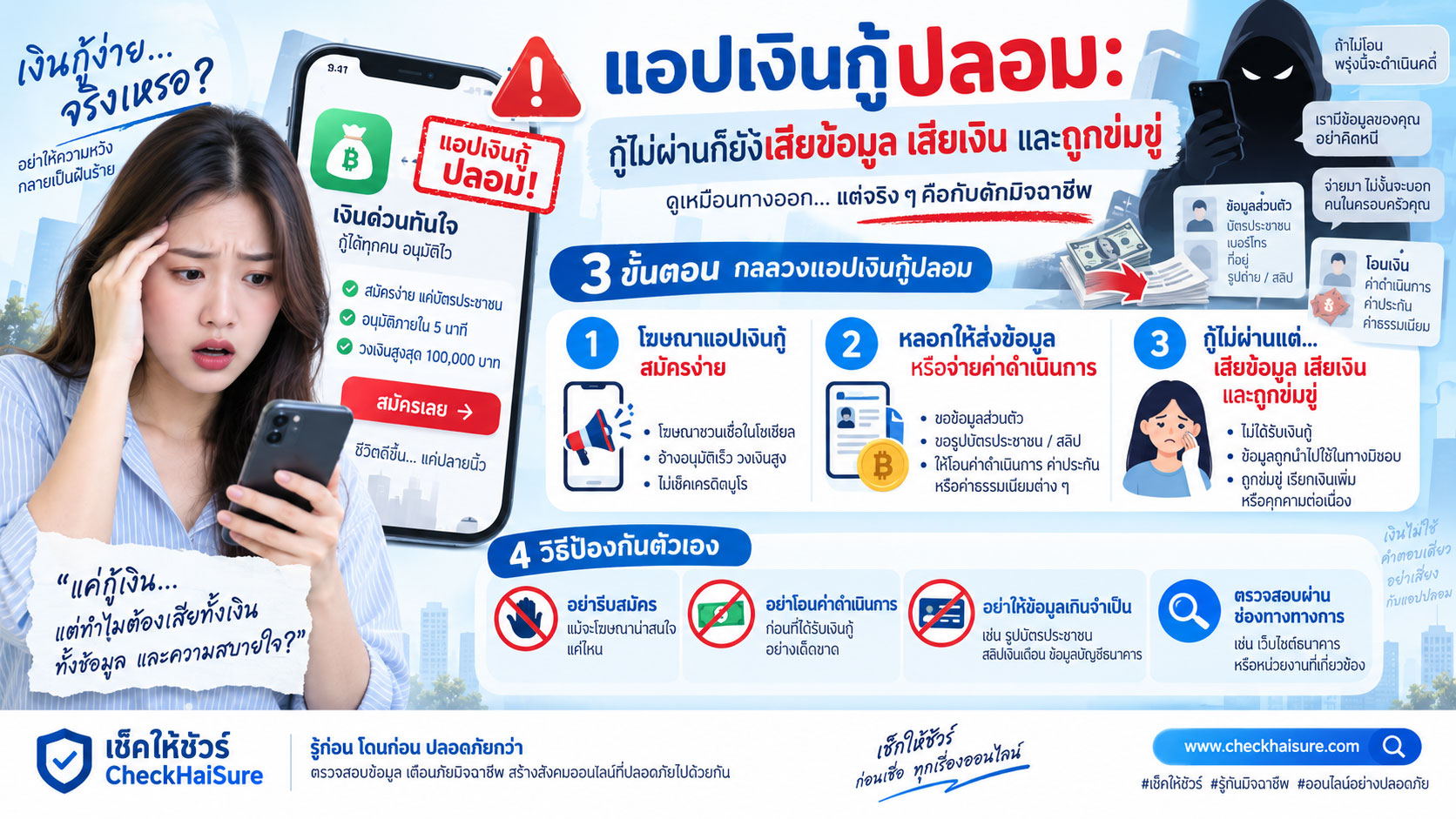
“อนุมัติไว ไม่เช็กเครดิต”
“กู้ 10,000 บาท รับเงินภายใน 10 นาที”
“ไม่ต้องมีสลิปเงินเดือน”
“เครดิตไม่ดีก็กู้ได้”
“สมัครผ่านแอปง่ายๆ ใช้แค่บัตรประชาชน”
ในวันที่เงินไม่พอ ประโยคแบบนี้อาจฟังดูเหมือนทางออก
ค่าเช่ากำลังจะถึงกำหนด
รถต้องซ่อม
ลูกต้องใช้เงิน
ค่ารักษาพยาบาลรอไม่ได้
ร้านต้องหมุนเงิน
หรือมีหนี้อีกก้อนที่ต้องจ่ายวันนี้
เวลาคนกำลังเดือดร้อน สิ่งที่ต้องการที่สุดคือ “เงินเร็ว”
มิจฉาชีพรู้เรื่องนี้ดี
แอปเงินกู้ปลอมจึงมักไม่ได้เริ่มต้นด้วยสิ่งที่ดูน่ากลัว
มันเริ่มจากคำว่า “ง่าย”
“เร็ว”
“ผ่านแน่นอน”
“ไม่เช็กเครดิต”
และ “ได้เงินวันนี้”
แต่สิ่งที่หลายคนเพิ่งรู้เมื่อสายไปแล้ว คือบางแอปไม่ได้ต้องการให้เรากู้เงินสำเร็จตั้งแต่แรก
มันอาจต้องการข้อมูลในมือถือ
รายชื่อคนที่เรารู้จัก
รูปบัตรประชาชน
ข้อมูลบัญชีธนาคาร
ค่าธรรมเนียมล่วงหน้า
หรือข้อมูลส่วนตัวมากพอที่จะใช้กดดันเราในภายหลัง
สุดท้ายอาจเกิดสถานการณ์ที่แปลกมากคือ
เงินก็ไม่ได้ แต่ข้อมูลเสียไปแล้ว เงินค่าธรรมเนียมก็เสีย และยังถูกโทรข่มขู่ตามมาอีก
คนที่ต้องการเงินด่วน ไม่ได้แปลว่าเป็นคนประมาท
เวลาพูดถึงแอปเงินกู้ปลอม บางคนอาจสงสัยว่า
“ทำไมถึงยอมโหลด”
“ทำไมถึงโอนค่าธรรมเนียมก่อน”
“ทำไมถึงให้สิทธิ์เข้าถึงรายชื่อในมือถือ”
แต่ถ้าเราอยู่ในสถานการณ์ที่ต้องหาเงินให้ได้ภายในวันนั้น การตัดสินใจอาจไม่เหมือนตอนที่เรานั่งอ่านคำเตือนอย่างใจเย็น
คนที่กำลังขาดเงินอาจลองหลายทางมาแล้ว
ขอยืมคนรู้จักไม่ได้
ธนาคารไม่อนุมัติ
บัตรเครดิตเต็ม
รายได้ไม่แน่นอน
มีหนี้เดิม
หรือไม่มีเอกสารที่สถาบันการเงินปกติต้องการ
เมื่อเห็นโฆษณาว่า
“ไม่เช็กเครดิต”
“อาชีพอิสระก็กู้ได้”
“ไม่มีคนค้ำก็ผ่าน”
ความหวังก็เกิดขึ้นทันที
ตรงนี้คือสิ่งที่มิจฉาชีพใช้
ไม่ใช่เพราะเหยื่ออยากได้ของฟรี
แต่เพราะเขาต้องการทางออกในเวลาที่ทางเลือกเหลือน้อย
แอปเงินกู้ปลอมอาจไม่ได้ต้องการปล่อยกู้จริง
ชื่อว่าแอปเงินกู้ แต่จุดประสงค์อาจไม่ใช่การให้สินเชื่อเลย
บางแอปอาจออกแบบมาเพื่อเก็บข้อมูล
บางแอปอาจหลอกเก็บค่าธรรมเนียม
บางแอปอาจใช้ข้อมูลในมือถือไปข่มขู่
บางแอปอาจให้กู้จำนวนเล็กน้อย แล้วเรียกเก็บเงินมากผิดปกติ
บางแอปอาจเพียงสร้างหน้าจอให้ดูเหมือนว่า “สินเชื่อได้รับอนุมัติ” จากนั้นก็เริ่มเรียกเงินเพิ่ม
ตัวอย่างเช่น
คุณสมัครกู้ 20,000 บาท
ระบบขึ้นว่า
“อนุมัติแล้ว 20,000 บาท”
แต่ก่อนเงินจะเข้า มีข้อความว่า
“กรุณาชำระค่าดำเนินการ 699 บาท”
พอจ่ายแล้ว อาจมีอีกขั้น
“ต้องชำระค่าประกันสินเชื่อ 1,200 บาท”
จ่ายอีก
แล้วมีอีกข้อความ
“ข้อมูลบัญชีผิด เงินถูกพักไว้ ต้องจ่ายค่าปลดล็อก 2,000 บาท”
สุดท้ายเงินกู้ไม่เคยเข้าบัญชี
แต่เงินของเราออกไปทีละก้อน
“ต้องจ่ายก่อนถึงจะได้เงินกู้” เป็นจุดที่ควรหยุด
ประโยคที่ควรระวังมากคือ
“โอนก่อน แล้วเงินกู้จะเข้า”
อาจเรียกเงินก้อนนั้นหลายชื่อ
ค่าดำเนินการ
ค่าประกัน
ค่าปลดล็อกวงเงิน
ค่าตรวจสอบเครดิต
ค่าธรรมเนียมโอน
ค่าประกันความเสี่ยง
ค่าภาษี
ค่ารับรองบัญชี
หรือเงินยืนยันตัวตน
ชื่อแตกต่างกันได้
แต่รูปแบบเหมือนกันคือ
เราต้องเสียเงินก่อน เพื่อหวังว่าจะได้เงินจำนวนมากกว่ากลับมา
ถ้าคุณกำลังจะกู้เงินเพราะเงินไม่พอ การถูกขอให้โอนเงินเพิ่มก่อนควรเป็นสัญญาณให้หยุดและตรวจสอบทันที
อย่าให้ประโยคว่า “อีกนิดเดียวเงินจะเข้าแล้ว” ทำให้ต้องโอนต่อไปเรื่อยๆ
อนุญาตให้แอปเข้าถึงรายชื่อในมือถือ อาจดูไม่สำคัญในตอนแรก
ตอนติดตั้งแอป เรามักกด “Allow” ผ่านไปเร็วๆ
เข้าถึงรายชื่อ
เข้าถึงโทรศัพท์
เข้าถึงรูปภาพ
เข้าถึงไฟล์
เข้าถึงตำแหน่ง
เข้าถึง SMS
บางคนคิดว่าเป็นเรื่องปกติของแอป
แต่ต้องถามว่า
แอปเงินกู้จำเป็นต้องรู้จักคนทุกคนในโทรศัพท์ของเราจริงหรือ
รายชื่อในมือถือไม่ได้มีแค่เบอร์โทร
มันอาจบอกได้ว่าใครคือ
พ่อ
แม่
สามี
ภรรยา
หัวหน้า
เพื่อนร่วมงาน
ลูกค้า
ญาติ
หรือคนที่เราเกรงใจ
และนี่อาจกลายเป็นเครื่องมือกดดันเราในภายหลัง
จาก “ข้อมูลติดต่อ” กลายเป็นเครื่องมือข่มขู่
บางคนรู้ตัวว่าเจอแอปอันตรายก็ตอนเริ่มมีคนโทรหาคนรอบตัว
เช่น
โทรหาพ่อแม่
โทรหาคู่สมรส
โทรหาหัวหน้า
โทรหาเพื่อนร่วมงาน
หรือส่งข้อความไปหาคนในรายชื่อ
เป้าหมายคือทำให้เจ้าของมือถือรู้สึกอาย กลัว และรีบจ่ายเงิน
บางครั้งอาจใช้ถ้อยคำรุนแรง
บางครั้งอาจกล่าวหาว่าเราโกง
บางครั้งอาจส่งข้อความที่ทำให้คนรู้จักเข้าใจผิด
บางกรณีอาจนำรูปหรือข้อมูลส่วนตัวไปใช้สร้างความกดดัน
จุดนี้ทำให้ปัญหาไม่ได้เป็นแค่เรื่องเงินอีกต่อไป
มันกระทบถึงงาน
ครอบครัว
ความสัมพันธ์
ชื่อเสียง
และความรู้สึกปลอดภัยของเรา
ดังนั้นเวลาติดตั้งแอปทางการเงิน อย่าดูแค่คำว่า “อนุมัติเร็ว”
ให้ดูด้วยว่าแอปกำลังขอเข้าถึงอะไรในมือถือของเรา
ระวังโฆษณาที่ดูง่ายเกินจริง
โฆษณาแอปเงินกู้ปลอมมักไม่ดูเหมือนมิจฉาชีพ
บางอันทำสวยมาก
มีคนรีวิวได้เงิน
มีภาพเงินเข้าบัญชี
มีคะแนนดาว
มีข้อความว่า “ได้รับเงินจริง”
มีจำนวนผู้ใช้จำนวนมาก
หรือมีคนในคลิปพูดเหมือนประสบการณ์จริง
บางโฆษณาอาจบอกว่า
“ใครๆ ก็กู้ผ่าน”
“ไม่ตรวจเครดิต”
“รายได้น้อยก็กู้ได้”
“กู้ได้สูงสุด 100,000 บาท”
“อนุมัติ 100%”
ต้องระวังคำว่า “ทุกคนผ่าน” เป็นพิเศษ
สินเชื่อจริงมีความเสี่ยง
ถ้ามีคนพร้อมให้เงินจำนวนมากกับทุกคนโดยไม่สนใจความสามารถในการชำระเลย เราควรถามก่อนว่าเขาหารายได้จากอะไร และทำไมถึงปล่อยง่ายขนาดนั้น
แอปอยู่ใน Store ไม่ได้แปลว่าปลอดภัย 100%
หลายคนมีหลักคิดว่า
“อยู่ใน Store ก็น่าจะปลอดภัย”
โดยทั่วไป การดาวน์โหลดจากช่องทางทางการย่อมปลอดภัยกว่าการติดตั้งไฟล์จากลิงก์แปลกๆ
แต่การอยู่ใน Store ไม่ได้หมายความว่าเราควรกดติดตั้งโดยไม่ตรวจสอบอะไรเลย
ก่อนติดตั้ง ควรดูเพิ่ม เช่น
ชื่อผู้พัฒนา
ชื่อบริษัท
เว็บไซต์ของผู้พัฒนา
ข้อมูลติดต่อ
รีวิวจากผู้ใช้หลายๆ ราย
วันที่อัปเดต
จำนวนการดาวน์โหลด
รายละเอียดสิทธิ์ที่แอปต้องการ
และลองค้นชื่อแอปหรือชื่อบริษัทจากแหล่งอื่นเพิ่มเติม
ถ้าชื่อผู้พัฒนาไม่สัมพันธ์กับแบรนด์
ไม่มีข้อมูลบริษัท
เว็บไซต์ดูผิดปกติ
รีวิวจำนวนมากเขียนคล้ายกัน
หรือแอปขอสิทธิ์มากเกินหน้าที่ของมัน
ควรหยุดตรวจสอบก่อน
ถ้ามีคนส่งไฟล์ APK มาให้ติดตั้ง ยิ่งต้องระวัง
อีกวิธีที่เสี่ยงมากคือการส่งไฟล์แอปมาโดยตรง
คนปลายสายอาจพูดว่า
“แอปนี้ยังไม่ลง Store”
“เป็นแอปสำหรับลูกค้าพิเศษ”
“ต้องดาวน์โหลดจากลิงก์นี้เท่านั้น”
“เวอร์ชันใน Store ใช้สมัครกู้ไม่ได้”
“โหลดไฟล์นี้แล้วติดตั้ง เดี๋ยวเจ้าหน้าที่ช่วยต่อ”
ถ้าต้องเปิดการตั้งค่าเพื่ออนุญาตการติดตั้งจากแหล่งที่ไม่รู้จัก ควรถือว่าเป็นจุดที่ต้องหยุดและตรวจสอบอย่างจริงจัง
อย่าให้คนที่เสนอเงินกู้เป็นคนเดียวกับคนที่บอกเราว่าต้องลดความปลอดภัยของมือถือก่อน
อย่ารีบส่งบัตรประชาชนเพื่อ “เช็กวงเงิน”
ขั้นตอนสมัครกู้มักเกี่ยวข้องกับข้อมูลส่วนตัวจริง
ตรงนี้จึงทำให้มิจฉาชีพขอข้อมูลได้ง่าย
อาจขอ
รูปบัตรประชาชน
รูปหน้าคู่กับบัตร
เลขหลังบัตร
ที่อยู่
วันเดือนปีเกิด
เบอร์โทร
ข้อมูลการทำงาน
สลิปเงินเดือน
เลขบัญชี
รูปหน้าสมุดบัญชี
หรือข้อมูลคนใกล้ชิด
ถ้าแอปหรือบริษัทนั้นตรวจสอบไม่ได้ ข้อมูลเหล่านี้อาจถูกนำไปใช้ต่อ
ไม่ว่าจะเป็นการแอบอ้าง สมัครบริการ เปิดบัญชีบางประเภท หรือสร้างเรื่องหลอกใหม่ที่รู้ข้อมูลเราแม่นยำขึ้น
อย่าส่งเอกสารเพียงเพราะระบบขึ้นว่า “เหลือขั้นตอนสุดท้าย”
ขั้นตอนสุดท้ายของเขา อาจเป็นขั้นตอนแรกของปัญหาของเรา
ถ้ากู้ไม่ผ่าน แต่ถูกขอเงินเพิ่ม อย่าพยายามเอาเงินเดิมคืนด้วยการโอนอีก
นี่เป็นจุดที่คนเสียเงินเพิ่มได้ง่ายมาก
สมมติเราโอนไปแล้ว 1,000 บาท
อีกฝ่ายบอกว่า
“ระบบติดปัญหา ต้องจ่ายอีก 1,500 บาท แล้วจะคืนทั้งหมดพร้อมเงินกู้”
เราจะเริ่มคิดว่า
ถ้าไม่จ่ายอีก 1,500 บาท เงิน 1,000 บาทแรกก็เสียเปล่า
นี่ทำให้หลายคนยอมโอนเพิ่ม
พอจ่าย 1,500 บาท ก็อาจมีอีก 3,000 บาท
ยิ่งจ่าย ยิ่งรู้สึกว่าต้องจ่ายต่อเพื่อเอาของเดิมคืน
แต่ต้องจำว่า
เงินที่เสียไปแล้ว ไม่ควรกลายเป็นเหตุผลให้เราเสี่ยงเงินก้อนต่อไป
ถ้าเริ่มสงสัย ให้หยุดทันที
สัญญาณเตือนของแอปเงินกู้ที่ควรสงสัย
ถ้าเจอหลายข้อพร้อมกัน ยิ่งควรหยุดก่อน
โฆษณาว่าอนุมัติทุกคน
บอกว่าไม่ตรวจอะไรเลยแต่ให้วงเงินสูง
ให้ดาวน์โหลดแอปจากลิงก์หรือไฟล์ APK
ขอสิทธิ์เข้าถึงรายชื่อทั้งหมดในมือถือ
ขอเข้าถึง SMS โดยไม่มีเหตุผลชัดเจน
ขอรูปบัตรประชาชนก่อนมีข้อมูลบริษัทให้ตรวจสอบ
ให้คุยกับเจ้าหน้าที่ผ่านบัญชีแชทส่วนตัว
ขอให้โอนค่าดำเนินการก่อน
ขอค่าประกันก่อนปล่อยเงิน
บอกว่าบัญชีผิดแล้วต้องจ่ายค่าปลดล็อก
ขอ OTP
ให้โอนไปบัญชีบุคคล
เร่งว่าต้องจ่ายภายในไม่กี่นาที
หรือเริ่มข่มขู่เมื่อเราปฏิเสธจ่าย
ถ้ารู้สึกว่ารูปแบบเริ่มผิดปกติ อย่าคิดว่า “ทำมาเกือบจบแล้ว”
การหยุดกลางทางยังดีกว่าเดินต่อเข้าไปลึกกว่าเดิม
ก่อนติดตั้งแอปเงินกู้ ลองถามตัวเอง 7 ข้อ
ก่อนกดติดตั้ง ลองใช้เวลาไม่กี่นาทีถามตัวเอง
- ใครเป็นผู้ให้บริการสินเชื่อจริงๆ
- บริษัทนี้มีตัวตนและตรวจสอบได้หรือไม่
- แอปมาจากช่องทางทางการหรือจากลิงก์ที่คนส่งมา
- ทำไมแอปต้องเข้าถึงรายชื่อ รูปภาพ SMS หรือข้อมูลอื่นมากขนาดนั้น
- มีการเรียกเงินก่อนที่จะได้รับสินเชื่อหรือไม่
- บัญชีที่ให้โอนเป็นชื่อใคร
- ถ้าปิดแชทตอนนี้ เราสามารถหาเว็บไซต์หรือช่องทางของบริษัทนี้เองได้หรือไม่
ถ้าตอบคำถามเหล่านี้ไม่ได้หลายข้อ อย่าเพิ่งให้ข้อมูลหรือโอนเงิน
ถ้าติดตั้งแอปต้องสงสัยไปแล้ว ควรทำอย่างไร
ถ้าเริ่มสงสัยว่าแอปไม่ปลอดภัย อย่ารอให้เกิดความเสียหายก่อน
ตรวจสอบสิทธิ์ที่แอปได้รับ
ปิดสิทธิ์ที่ไม่จำเป็น
ถอนการติดตั้งแอปถ้าสามารถทำได้อย่างปลอดภัย
เปลี่ยนรหัสผ่านบัญชีสำคัญหากเคยกรอกผ่านแอปหรือลิงก์ที่เกี่ยวข้อง
ตรวจสอบบัญชีธนาคาร
ตรวจสอบ SMS และอีเมลแจ้งเตือน
ระวังการพยายามเข้าสู่ระบบจากอุปกรณ์อื่น
และเก็บหลักฐานที่เกี่ยวข้องไว้
ถ้าแอปมีสิทธิ์ควบคุมอุปกรณ์หรือถอนการติดตั้งไม่ได้ตามปกติ อาจต้องขอความช่วยเหลือจากผู้ที่มีความรู้ด้านโทรศัพท์หรือความปลอดภัยดิจิทัลก่อนดำเนินการต่อ
ถ้าโอนค่าธรรมเนียมไปแล้ว
ถ้าโอนไปแล้ว ให้หยุดการโอนเพิ่มทันที
เก็บหลักฐาน เช่น
ชื่อแอป
หน้าโฆษณาที่เห็น
ลิงก์ดาวน์โหลด
ไฟล์ที่ได้รับ
ชื่อผู้พัฒนา
เบอร์โทร
บัญชี LINE หรือแชท
ข้อความ
เลขบัญชีปลายทาง
ชื่อบัญชี
สลิปโอนเงิน
จำนวนเงิน
วันและเวลา
และคำพูดที่ใช้เรียกเงินเพิ่ม
หากเกี่ยวข้องกับบัญชีธนาคาร ให้ติดต่อธนาคารผ่านช่องทางทางการโดยเร็ว
อย่าติดต่อกลับผ่านเบอร์หรือบัญชีที่มิจฉาชีพเป็นคนให้
ถ้าเริ่มถูกข่มขู่ อย่าจ่ายเพียงเพื่อให้เขาหยุด
นี่เป็นช่วงที่สร้างความเครียดมากที่สุด
บางคนอาจคิดว่า
“จ่ายอีกครั้งให้เขาหยุดโทรดีกว่า”
แต่การจ่ายไม่รับประกันว่าจะหยุด
บางครั้งมันกลับบอกอีกฝ่ายว่า เรากดดันได้ผล
เขาอาจเรียกเพิ่มอีก
ถ้ามีการข่มขู่ ควรเก็บหลักฐานให้มากที่สุด
อย่าตอบโต้ด้วยอารมณ์
อย่าให้ข้อมูลเพิ่ม
แจ้งคนใกล้ตัวว่ากำลังเกิดอะไรขึ้น โดยเฉพาะถ้าอีกฝ่ายมีรายชื่อคนในมือถือ
บอกคนในครอบครัวหรือที่ทำงานไว้ก่อนว่า อาจมีคนโทรไปให้ข้อมูลที่ไม่จริงเกี่ยวกับเรา
การบอกก่อนช่วยลดอำนาจของการข่มขู่ลงมาก
เพราะสิ่งที่มิจฉาชีพพยายามใช้ คือความกลัวว่า “คนอื่นจะรู้”
ถ้ามิจฉาชีพโทรหาคนรอบตัว อย่าเก็บเรื่องไว้คนเดียว
หลายคนยิ่งถูกข่มขู่ ยิ่งไม่กล้าบอกใคร
เพราะรู้สึกอาย
กลัวถูกตำหนิ
กลัวครอบครัวรู้ว่าไปกู้เงิน
หรือกลัวที่ทำงานได้รับผลกระทบ
แต่การเงียบอาจทำให้คนรอบตัวไม่เข้าใจว่าเกิดอะไรขึ้น
ถ้าสถานการณ์เริ่มมีการโทรหรือส่งข้อความหาคนในรายชื่อ ควรบอกคนสำคัญไว้
พูดสั้นๆ ก็ได้ว่า
“ช่วงนี้อาจมีคนแปลกหน้าโทรไปเกี่ยวกับเรา เป็นเรื่องจากแอปต้องสงสัย ถ้ามีคนโทรมา อย่าให้ข้อมูลและไม่ต้องทำตาม”
ไม่จำเป็นต้องเล่าทุกอย่าง
แค่ทำให้คนรอบตัวรู้ว่า สายเหล่านั้นไม่น่าเชื่อถือ
ก็ช่วยลดแรงกดดันได้มากแล้ว
คนในครอบครัวควรช่วยกันโดยไม่เริ่มจากการตำหนิ
ถ้ามีคนในบ้านมาบอกว่าเผลอติดตั้งแอปเงินกู้หรือโอนเงินไปแล้ว สิ่งแรกที่เขาต้องการอาจไม่ใช่คำถามว่า
“ทำไมถึงไปเชื่อ”
แต่คือคนช่วยคิดว่า ตอนนี้ต้องหยุดความเสียหายตรงไหนก่อน
ลองช่วยกันดูว่า
ให้ข้อมูลอะไรไปแล้ว
แอปมีสิทธิ์อะไร
โอนไปเท่าไร
บัญชีไหนเกี่ยวข้อง
มีการข่มขู่หรือไม่
และใครบ้างที่อาจถูกติดต่อ
เมื่อความเสียหายหยุดแล้ว ค่อยกลับมาทบทวนว่าเกิดขึ้นได้อย่างไร
ประโยคที่ควรจำ: กู้เงินเพื่อได้เงิน ไม่ใช่จ่ายเงินไปเรื่อยๆ เพื่อรอว่าจะได้กู้
ถ้าต้องจำประโยคเดียวจากบทความนี้ ขอให้จำว่า
กู้เงินเพื่อได้เงิน ไม่ใช่จ่ายเงินไปเรื่อยๆ เพื่อรอว่าจะได้กู้
ถ้าต้องโอนก่อน ให้ตรวจสอบ
ถ้าต้องส่งข้อมูลมากเกินไป ให้หยุดคิด
ถ้าต้องเปิดรายชื่อทั้งหมดในมือถือ ให้ถามว่าทำไม
ถ้าต้องโหลด APK จากลิงก์แปลกๆ อย่าติดตั้ง
ถ้าขอ OTP อย่าให้
ถ้าจ่ายไปแล้วแต่ยังเรียกเพิ่ม อย่าใช้เงินก้อนเดิมเป็นเหตุผลให้โอนก้อนใหม่
และถ้าเริ่มข่มขู่ ให้เก็บหลักฐานและขอความช่วยเหลือ แทนการจ่ายเพื่อหวังว่าจะจบ
สรุป: แอปเงินกู้ปลอมอาจเอาไปมากกว่าเงิน
เวลาเราต้องการเงินด่วน เรามักคิดถึงความเสี่ยงว่า “จะได้กู้หรือไม่”
แต่กับแอปเงินกู้ปลอม ความเสียหายอาจมากกว่านั้น
อาจเสียค่าธรรมเนียม
อาจเสียข้อมูลบัตรประชาชน
อาจเสียข้อมูลบัญชี
อาจเสียรายชื่อคนรู้จัก
อาจถูกข่มขู่
อาจกระทบครอบครัว
อาจกระทบงาน
และสุดท้ายอาจยังไม่ได้เงินกู้เลยแม้แต่บาทเดียว
ก่อนกดติดตั้ง จึงอย่าดูเพียงว่าแอปให้วงเงินเท่าไร
ให้ดูว่าใครอยู่หลังแอป
แอปต้องการข้อมูลอะไรจากเรา
ต้องจ่ายอะไรก่อนหรือไม่
และเราสามารถตรวจสอบผู้ให้บริการจากช่องทางอื่นได้หรือเปล่า
ในวันที่เราต้องการเงินเร็วที่สุด
อาจเป็นวันที่เราควรช้าลงสักไม่กี่นาทีก่อนให้ข้อมูลหรือโอนเงิน
เพราะเงินที่ยังไม่ได้กู้ อาจยังหาเส้นทางอื่นได้
แต่ข้อมูลส่วนตัวที่ส่งไปแล้ว และเงินที่โอนไปแล้ว อาจเอากลับมายากกว่ามาก
Fake Loan Apps: You May Not Get the Loan, but You Could Lose Money, Personal Data, and Peace of Mind
“Fast approval. No credit check.”
“Borrow 10,000 baht and receive the money within 10 minutes.”
“No salary slip required.”
“Bad credit? You can still apply.”
“Easy application through the app. Just use your ID card.”
When money is tight, messages like these can sound like a solution.
Rent is due.
The car needs repairs.
Your child needs money.
Medical expenses cannot wait.
Your shop needs cash flow.
Or another debt is due today.
When someone is under financial pressure, what they often need most is simple:
Money quickly.
Scammers understand this very well.
That is why fake loan apps rarely begin with something frightening.
They begin with words like:
“Easy.”
“Fast.”
“Guaranteed approval.”
“No credit check.”
“Money today.”
But what many people discover too late is that some of these apps may never have intended to provide a real loan in the first place.
They may be after your phone data.
Your contact list.
Your ID card.
Your bank details.
An upfront fee.
Or enough personal information to pressure and threaten you later.
The result can be strange and painful:
You never receive the loan, but your information is already exposed, your money is gone, and the threatening calls begin anyway.
Needing Money Urgently Does Not Mean Someone Is Careless
When people hear about fake loan apps, it is easy to ask:
“Why did they install it?”
“Why did they pay the fee first?”
“Why did they allow access to their contacts?”
But decisions made during financial stress are very different from decisions made while calmly reading a scam warning.
Someone who urgently needs money may already have tried several options.
They could not borrow from family.
The bank rejected them.
Their credit card is already maxed out.
Their income is irregular.
They have existing debt.
Or they do not have the documents traditional lenders require.
Then they see an advertisement saying:
“No credit check.”
“Freelancers can apply.”
“No guarantor needed.”
Hope appears immediately.
That hope is exactly what scammers exploit.
It is not always about someone wanting “easy money.”
Sometimes it is simply someone looking for one more option when they feel they have very few left.
A Fake Loan App May Not Be Trying to Lend Money at All
It may be called a loan app, but lending may not be its real purpose.
Some apps may be designed to collect personal data.
Some may exist mainly to collect advance fees.
Some may use the information stored on your phone to intimidate you later.
Some may issue a very small amount and demand unreasonable repayment.
Others may simply create a screen showing that your loan has been “approved,” then begin asking you to pay fee after fee.
For example:
You apply for a 20,000-baht loan.
The app says:
“Approved: 20,000 baht.”
But before the money can be released, you see:
“Please pay a 699-baht processing fee.”
You pay it.
Then another message appears:
“Loan insurance fee: 1,200 baht.”
You pay again.
Then:
“Your bank account information is incorrect. The funds are temporarily locked. Please pay a 2,000-baht unlocking fee.”
In the end, the loan never arrives.
But your own money keeps leaving your account one payment at a time.
“Pay First, Then You Will Receive the Loan” Is a Major Warning Sign
One sentence should make you stop:
“Transfer the money first, then your loan will be released.”
The fee may be given many different names:
Processing fee
Insurance fee
Credit verification fee
Loan unlocking fee
Transfer fee
Risk guarantee fee
Tax fee
Account verification fee
Or identity confirmation deposit
The name can change.
The pattern stays the same:
You are asked to pay money now because you are promised a larger amount later.
If you are applying for a loan because you already do not have enough money, being asked to transfer even more before receiving anything should be a reason to stop and verify.
Do not let the words “just one more step” push you into making repeated payments.
Giving an App Access to Your Contacts May Seem Harmless at First
When installing apps, many people tap “Allow” quickly.
Access contacts.
Access phone.
Access photos.
Access files.
Access location.
Access SMS.
It is easy to assume this is normal.
But ask one question:
Does a loan app really need to know every person stored in your phone?
Your contact list is not just a list of numbers.
It may reveal who is your:
Mother
Father
Partner
Boss
Coworker
Customer
Relative
Or someone whose opinion matters to you
That information can later become a tool for intimidation.
Your Contact List Can Become a Weapon
Some people realize they installed a dangerous app only when people around them begin receiving calls.
The app operator may contact:
Parents
Partners
Supervisors
Coworkers
Friends
Or other people stored in the phone
The purpose is often to embarrass, frighten, and pressure the borrower into paying.
Sometimes the language becomes aggressive.
Sometimes they accuse the person of fraud.
Sometimes they send messages designed to damage the person’s reputation.
In some cases, personal photos or information may be used to create even more pressure.
At that point, the damage is no longer only financial.
It can affect:
Your job
Your family
Your relationships
Your reputation
And your sense of safety
So before installing any financial app, do not only ask how much you can borrow.
Ask what the app wants access to on your phone.
Be Careful with Ads That Make Borrowing Look Too Easy
Fake loan app ads do not always look suspicious.
Some look extremely professional.
They may show:
People saying they received money
Screenshots of money arriving
High star ratings
Comments saying “I really got approved”
Large download numbers
Or videos that look like real customer experiences
Some ads may say:
“Everyone gets approved.”
“No credit checks.”
“Low income? No problem.”
“Borrow up to 100,000 baht.”
“100% approval.”
Be especially careful with promises that everyone will qualify.
Real lending involves risk.
If someone is willing to give large amounts of money to anyone without caring about repayment ability, it is worth asking:
How does this business make money?
And why is approval so easy?
Being Listed in an App Store Does Not Automatically Mean an App Is Safe
Many people think:
“If it is in the app store, it must be safe.”
Downloading through an official app marketplace is generally safer than installing files from unknown links.
But being available in a store does not mean you should install the app without checking anything else.
Before downloading, look at:
The developer name
The company name
The developer website
Contact information
Reviews from different users
Recent update history
Number of downloads
Permissions requested
And information about the company outside the app store
Be cautious if:
The developer name does not match the brand.
The company cannot be verified.
The website looks suspicious.
Many reviews use almost identical wording.
Or the app asks for permissions that do not make sense for its purpose.
If Someone Sends You an APK File, Be Even More Careful
A particularly risky pattern is when someone sends the app file directly.
They may say:
“This app is not available in the store yet.”
“This version is only for special customers.”
“You must download it from this link.”
“The store version cannot be used for loan applications.”
“Install this file and our officer will guide you.”
If you are asked to change your phone settings to allow installation from unknown sources, that should be a serious warning sign.
Do not let the same person offering you money also convince you to weaken your phone’s security first.
Do Not Rush to Send Your ID Card Just to “Check Your Loan Limit”
Real loan applications can involve personal information.
That is what makes this scam particularly convincing.
The app may ask for:
Photo of your ID card
Selfie holding your ID
Back-of-ID information
Home address
Date of birth
Phone number
Employment details
Salary slip
Bank account number
Photo of a bank book
Or information about people close to you
If the company or app cannot be verified, this information may be used elsewhere.
It could potentially support impersonation, fraudulent applications, account abuse, or future scams that become more convincing because the scammer now knows more about you.
Do not send important documents simply because the screen says:
“Final step.”
Their final step may become the beginning of your problem.
If the Loan Fails but They Ask for More Money, Do Not Chase the Money You Already Lost
This is one of the easiest ways to lose even more.
Imagine you have already transferred 1,000 baht.
Then they say:
“There is a system problem. Pay another 1,500 baht and we will refund everything together with your loan.”
You may start thinking:
“If I do not pay the extra 1,500, then the first 1,000 is definitely gone.”
That thought can push people to keep paying.
After 1,500 baht, they may ask for 3,000.
Then more.
The more you pay, the stronger the feeling that you must keep going to recover what you already lost.
But remember:
Money already lost should not become a reason to risk more money.
If something starts to feel wrong, stop.
Warning Signs of a Suspicious Loan App
The more of these signs you see together, the more cautious you should be:
Claims that everyone is approved
Promises of a high loan amount with almost no checks
Requires downloading through a link or APK file
Requests full access to your phone contacts
Requests access to SMS without a clear reason
Requests ID documents before you can verify the company
Pushes you to communicate through a personal chat account
Requires a processing fee before releasing funds
Requires loan insurance before payment
Claims your bank account has an error and demands an unlocking fee
Requests an OTP
Asks you to transfer to a personal bank account
Says you must pay within minutes
Or becomes threatening when you refuse to pay
If the process starts feeling wrong, do not tell yourself:
“I have already come this far.”
Stopping halfway is still better than going deeper.
Before Installing a Loan App, Ask Yourself These 7 Questions
Take a few minutes before installing anything.
Ask yourself:
- Who is actually providing the loan?
- Can this company be independently verified?
- Did I find this app through an official source, or did someone send me a link?
- Why does the app need access to my contacts, photos, SMS, or other sensitive information?
- Am I being asked to pay before receiving the loan?
- Whose name is on the account I am being asked to transfer money to?
- If I close this chat right now, can I find the company’s official website and contact information myself?
If you cannot answer several of these questions, do not rush to send information or transfer money.
What Should You Do If You Already Installed a Suspicious Loan App?
If you begin to suspect the app is unsafe, do not wait for damage to happen.
Review the permissions the app has received.
Turn off permissions that are not necessary.
Uninstall the app if it can be removed safely.
Change passwords for important accounts if you entered them through the app or a related link.
Check your bank accounts.
Review SMS and email alerts.
Watch for login attempts from unfamiliar devices.
And save all relevant evidence.
If the app has device-control permissions or cannot be removed normally, you may need help from someone experienced with mobile security before taking further action.
If You Already Paid an Upfront Fee
If you have already transferred money, stop sending more immediately.
Save evidence such as:
App name
The advertisement you saw
Download link
Any file you received
Developer name
Phone number
LINE or chat account
Messages
Destination bank account
Account holder name
Transfer slip
Amount transferred
Date and time
And any messages demanding additional payments
If bank accounts are involved, contact your bank through official channels as soon as possible.
Do not call back using a number provided by the suspected scammer.
If the Threats Begin, Do Not Pay Just to Make Them Stop
This can be one of the most stressful parts of the scam.
Some people may think:
“I will pay one more time so they stop calling.”
But paying does not guarantee the harassment will stop.
Sometimes it tells the scammer that the pressure is working.
That may lead to another demand.
If threats begin:
Save as much evidence as possible.
Do not argue emotionally.
Do not provide additional information.
Tell people close to you what is happening, especially if the app had access to your contacts.
Warn family members or coworkers that they may receive false or threatening calls about you.
Telling people in advance can reduce the scammer’s power.
Much of the pressure comes from one fear:
“What if other people find out?”
Once people around you already know that the messages may be fraudulent, that threat becomes much less effective.
If Scammers Contact People Around You, Do Not Handle It Alone
Some people become quieter as the harassment gets worse.
They may feel ashamed.
They may fear being blamed.
They may not want their family to know they were trying to borrow money.
Or they may worry that their workplace will be affected.
But staying silent can leave the people around you confused when strange calls begin.
If the scammer starts contacting your contacts, tell key people what is happening.
You can keep it simple:
“Someone may contact you about me from a suspicious loan app. If you receive anything, please do not provide information or follow their instructions.”
You do not have to explain every detail.
You only need to help them understand that the caller may not be trustworthy.
That alone can reduce a lot of the pressure.
Families Should Help First, Not Blame First
If someone in your family tells you they installed a suspicious loan app or already sent money, the first thing they may need is not:
“Why did you believe them?”
They may need help figuring out what to stop first.
Try to determine:
What information was shared?
What permissions does the app have?
How much money was transferred?
Which accounts are involved?
Has there been harassment?
Who else may be contacted?
Once the immediate damage is under control, then you can discuss how the situation happened.
A Sentence to Remember: You Borrow Money to Receive Money, Not to Keep Paying for the Chance to Borrow
If you remember only one sentence from this article, remember this:
You borrow money to receive money, not to keep paying money while waiting for the loan to arrive.
If they ask you to transfer money first, verify.
If they ask for too much personal information, stop and think.
If they want full access to your contacts, ask why.
If they send an APK from a strange link, do not install it.
If they ask for an OTP, do not provide it.
If you already paid once and they ask for more, do not let the first loss become the reason for the next one.
And if the threats begin, save evidence and seek help instead of paying in the hope that they will stop.
Conclusion: A Fake Loan App Can Take More Than Money
When someone urgently needs cash, the main question is often:
“Will I get approved?”
But with a fake loan app, the risk may go far beyond approval.
You may lose upfront fees.
You may expose your ID information.
You may expose your bank details.
You may expose your contact list.
You may be harassed.
Your family may be affected.
Your job may be affected.
And after all of that, you may never receive the loan at all.
So before you install a loan app, do not look only at how much it promises to lend.
Look at who is behind the app.
Look at what information it wants from you.
Look at whether it asks for money first.
And ask whether you can verify the lender independently.
On the day you need money the fastest,
that may be the day when taking a few extra minutes to verify matters most.
Because a loan you have not received yet may still have other alternatives.
But personal information already handed over — and money already transferred — can be much harder to get back.
Suggested SEO Title:
Fake Loan Apps: Beware of Losing Money, Personal Data, and Being Harassed Before You Ever Receive a Loan
Suggested Meta Description:
Fake loan apps may promise fast approval but instead collect upfront fees, request excessive phone permissions, steal personal data, access contact lists, or use harassment to pressure users. Learn the warning signs before installing an app or transferring money.
Suggested Slug:fake-loan-app-data-fee-harassment-scam
Suggested Main Category:
Fake / Suspicious App
Secondary Category:
Loan / Credit Scam
Suggested Tags:
Fake Loan App, Loan App Scam, Online Loan Scam, Fake Personal Loan, Upfront Fee Scam, Loan Processing Fee Scam, Loan Unlocking Fee, Fake Loan Insurance Fee, Contact List Access, Personal Data Theft, Loan Harassment, Suspicious APK, App Outside Store, Suspicious App, Identity Theft Risk, Fake Lending App, Loan Scam, Online Fraud Warning, Scam Prevention, CheckHaiSure

Leave a Reply
You must be logged in to post a comment.