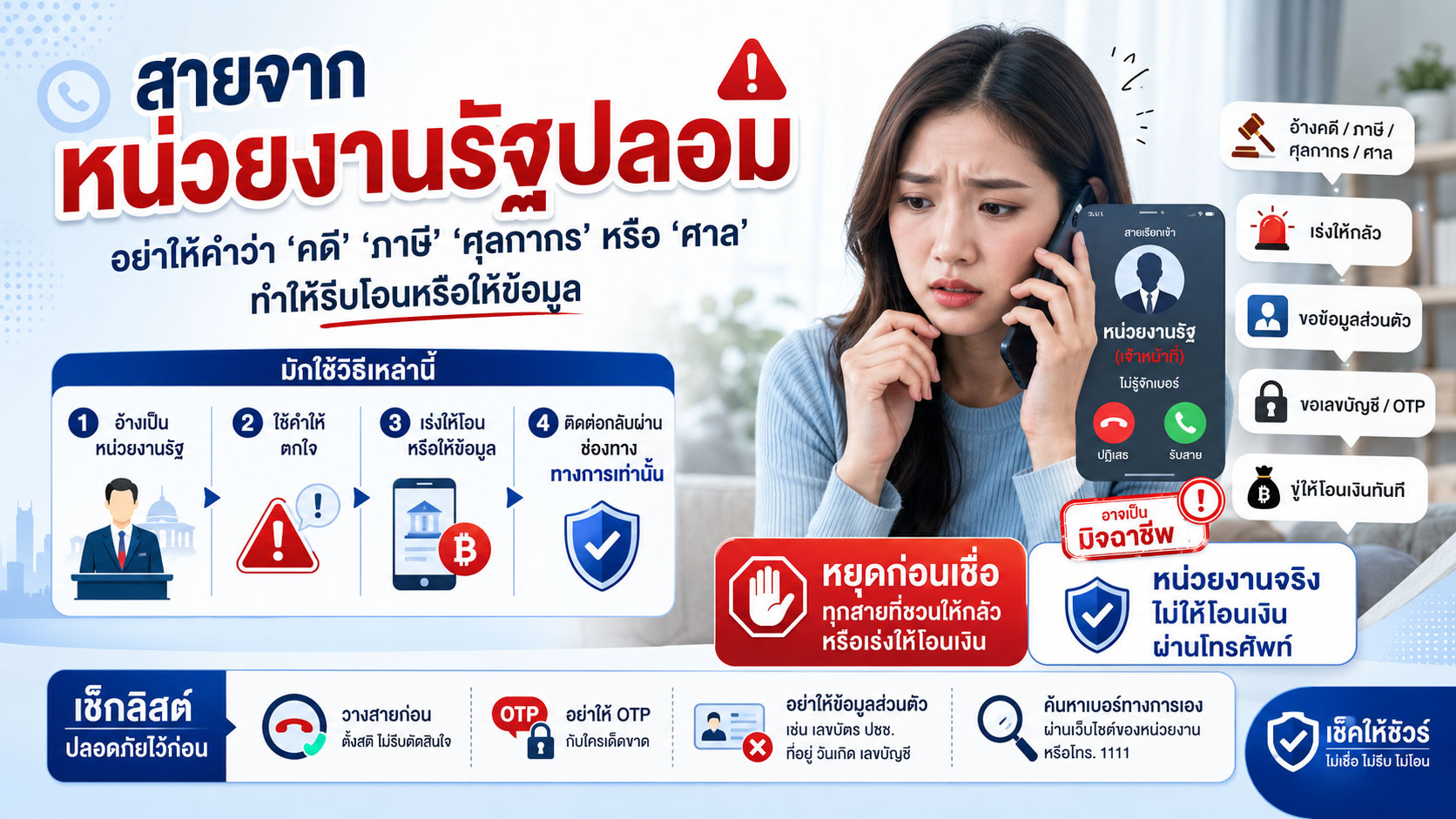
“โทรจากหน่วยงานรัฐนะคะ”
ประโยคนี้เพียงประโยคเดียว อาจทำให้หลายคนตั้งใจฟังมากขึ้นทันที
เพราะเมื่อมีคำว่า “หน่วยงานรัฐ” คนส่วนใหญ่มักรู้สึกว่าเรื่องนี้น่าจะสำคัญ
ถ้าพูดถึงภาษี ก็กลัวว่าตัวเองค้างชำระ
ถ้าพูดถึงศุลกากร ก็กลัวว่ามีพัสดุหรือของผิดกฎหมาย
ถ้าพูดถึงศาล ก็กลัวว่ามีหมายเรียก
ถ้าพูดถึงตำรวจหรือกรมสอบสวน ก็กลัวว่าตัวเองจะเกี่ยวข้องกับคดี
มิจฉาชีพรู้ดีว่า คนธรรมดามักไม่อยากมีปัญหากับหน่วยงานรัฐ
เขาจึงใช้ชื่อหน่วยงานที่ดูน่าเกรงขามมาเป็นเครื่องมือ
บางครั้งอ้างว่าเป็นเจ้าหน้าที่ภาษี
บางครั้งอ้างว่าเป็นศุลกากร
บางครั้งอ้างว่าเป็นศาล
บางครั้งอ้างว่าเป็นตำรวจ
บางครั้งอ้างว่าเป็นหน่วยงานสอบสวน
หรือบางครั้งอ้างว่าเป็นฝ่ายกฎหมายของหน่วยงานใดหน่วยงานหนึ่ง
เป้าหมายไม่ใช่แค่ให้คุณเชื่อว่าเขาเป็นเจ้าหน้าที่จริง
แต่คือทำให้คุณกลัวจนรีบทำตาม
รีบบอกข้อมูล
รีบกดลิงก์
รีบส่งเอกสาร
รีบโอนเงิน
รีบยืนยันตัวตน
หรือรีบทำตามขั้นตอนที่เขาบอก โดยยังไม่ทันตรวจสอบว่าเขาเป็นใครจริงๆ
มิจฉาชีพไม่ได้ใช้แค่ “เรื่องปลอม” แต่ใช้ “ความกลัวของคนจริง”
กลโกงแบบแอบอ้างหน่วยงานรัฐมักได้ผล เพราะมันไม่ได้หลอกด้วยเรื่องที่ดูไกลตัวเสมอไป
แต่หลอกด้วยเรื่องที่คนทั่วไปอาจกังวลอยู่แล้ว
เช่น
กลัวค้างภาษี
กลัวถูกปรับ
กลัวเอกสารราชการผิดพลาด
กลัวมีคนเอาชื่อไปใช้
กลัวพัสดุติดศุลกากร
กลัวมีหมายศาล
กลัวเกี่ยวข้องกับคดี
กลัวถูกเรียกสอบ
กลัวบัญชีถูกตรวจสอบ
หรือกลัวว่าถ้าไม่ทำตามทันที จะกลายเป็นเรื่องใหญ่
บางคนไม่ได้เชื่อเพราะโลภ
แต่เชื่อเพราะไม่อยากเดือดร้อน
นี่คือจุดที่มิจฉาชีพใช้เล่นงาน
เขาไม่จำเป็นต้องอธิบายทุกอย่างให้สมเหตุสมผล
แค่ใช้คำที่ฟังดูเป็นทางการ เร่งให้ทำทันที และทำให้คุณรู้สึกว่าถ้าไม่ให้ความร่วมมือจะมีปัญหา ก็อาจเพียงพอแล้ว
รูปแบบที่มักใช้แอบอ้างหน่วยงานรัฐ
สายหลอกลวงประเภทนี้อาจมาได้หลายแบบ
บางครั้งโทรมาแจ้งว่า คุณมีภาษีค้างชำระ
บางครั้งบอกว่า มีเงินคืนภาษี แต่ต้องยืนยันข้อมูลก่อน
บางครั้งอ้างว่าพัสดุต่างประเทศของคุณติดศุลกากร และพบสิ่งผิดกฎหมาย
บางครั้งบอกว่ามีค่าปรับหรือค่าธรรมเนียมที่ต้องชำระด่วน
บางครั้งอ้างว่ามีหมายศาลหรือหมายเรียกในชื่อคุณ
บางครั้งบอกว่ามีคดีที่โยงกับบัตรประชาชนหรือบัญชีธนาคารของคุณ
บางครั้งอ้างว่าเป็นเจ้าหน้าที่สอบสวน และต้องสอบปากคำผ่านโทรศัพท์หรือวิดีโอคอล
บางครั้งส่งเอกสารปลอมที่มีตราหน่วยงาน โลโก้ราชการ หรือภาษาที่ดูเป็นทางการ
บางครั้งให้เพิ่ม LINE เพื่อคุยกับ “เจ้าหน้าที่”
และบางครั้งอ้างว่าจะโอนสายให้หน่วยงานอื่น เช่น ตำรวจ ศาล หรือฝ่ายตรวจสอบคดี
แม้รูปแบบจะต่างกัน แต่จุดร่วมมักเหมือนกันคือ
ทำให้คุณกลัว
ทำให้คุณรีบ
ทำให้คุณรู้สึกว่าอยู่คนเดียว
และทำให้คุณทำตามช่องทางที่เขาจัดไว้ให้
คำว่า “เจ้าหน้าที่รัฐ” ไม่ควรทำให้เราหยุดตรวจสอบ
การเคารพเจ้าหน้าที่เป็นเรื่องปกติ
แต่การเคารพไม่ได้แปลว่าต้องทำตามทุกอย่างทันที
ถ้ามีคนโทรมาอ้างว่าเป็นเจ้าหน้าที่รัฐ คุณยังมีสิทธิ์ตรวจสอบ
มีสิทธิ์ถามชื่อหน่วยงาน
มีสิทธิ์วางสาย
มีสิทธิ์ติดต่อกลับผ่านช่องทางทางการ
มีสิทธิ์ปรึกษาคนในครอบครัว
มีสิทธิ์ไปที่สำนักงานหรือสถานีตำรวจด้วยตัวเอง
และมีสิทธิ์ไม่ให้ข้อมูลสำคัญทางโทรศัพท์
เจ้าหน้าที่จริงควรเข้าใจว่าประชาชนต้องการตรวจสอบ
แต่ถ้าอีกฝ่ายไม่ยอมให้คุณวางสาย ไม่ยอมให้คุณโทรกลับช่องทางทางการ หรือกดดันให้ทำรายการทันที นั่นเป็นสัญญาณที่ควรระวัง
เพราะหน่วยงานจริงไม่ควรกลัวการตรวจสอบจากประชาชน
คนที่กลัวการตรวจสอบ มักไม่อยากให้คุณเจอความจริง
อย่าโอนเงินเพราะคำว่า “ค่าปรับ” “ค่าธรรมเนียม” หรือ “เงินประกันคดี”
มิจฉาชีพอาจไม่พูดว่า “โอนเงินมาให้เรา”
แต่จะใช้คำที่ฟังดูเป็นทางการกว่า เช่น
ค่าปรับ
ค่าธรรมเนียม
ค่าดำเนินการ
เงินประกันคดี
เงินตรวจสอบ
เงินยืนยันตัวตน
เงินปลดล็อกเอกสาร
เงินระงับหมาย
เงินวางประกัน
หรือเงินโอนเข้าบัญชีกลาง
คำเหล่านี้ทำให้คนฟังรู้สึกว่าเป็นขั้นตอนราชการ
แต่ถ้ามีคนโทรมาแล้วบอกให้โอนเงินเข้าบัญชีที่เขาให้มา โดยเฉพาะบัญชีบุคคลหรือบัญชีที่คุณตรวจสอบเองไม่ได้ ให้หยุดทันที
เรื่องราชการจริงควรมีช่องทางชำระเงินหรือดำเนินการที่ตรวจสอบได้
ไม่ควรให้ประชาชนรีบโอนเงินตามคำสั่งของคนปลายสาย
และไม่ควรบังคับให้ทำธุรกรรมภายในไม่กี่นาทีโดยห้ามวางสาย
ถ้ากังวลว่ามีค่าปรับหรือภาษีจริง ให้ติดต่อหน่วยงานนั้นผ่านเว็บไซต์ทางการ เบอร์ทางการ หรือไปที่สำนักงานด้วยตัวเอง
อย่าใช้เลขบัญชีหรือลิงก์ที่คนปลายสายส่งมา
สัญญาณเตือนของสายจากหน่วยงานรัฐปลอม
ถ้ามีคนโทรมาอ้างว่าเป็นหน่วยงานรัฐ ให้ระวังเป็นพิเศษเมื่อเจอพฤติกรรมเหล่านี้
บอกว่าคุณเกี่ยวข้องกับคดีโดยไม่ให้รายละเอียดที่ตรวจสอบได้
อ้างว่ามีหมายศาล หมายเรียก หรือหมายจับ แต่ส่งเอกสารผ่านแชท
บอกว่าคุณค้างภาษี ค่าปรับ หรือค่าธรรมเนียม และต้องชำระทันที
ให้โอนเงินไปบัญชีที่อ้างว่าเป็นบัญชีกลางหรือบัญชีหน่วยงาน
ให้เพิ่ม LINE เพื่อคุยกับเจ้าหน้าที่
ให้วิดีโอคอลเพื่อสอบสวน
ขอเลขบัตรประชาชนเต็ม
ขอรูปบัตรประชาชนหรือรูปหน้าตรง
ขอข้อมูลบัญชีธนาคาร ยอดเงิน หรือรายการเดินบัญชี
ขอ OTP หรือรหัสยืนยัน
ให้ติดตั้งแอปเพื่อตรวจสอบข้อมูล
ให้แชร์หน้าจอ
ห้ามวางสาย
ห้ามบอกครอบครัว
ห้ามติดต่อหน่วยงานเอง
หรือขู่ว่าถ้าไม่ทำตามตอนนี้ จะถูกดำเนินคดีทันที
หากเจอพฤติกรรมเหล่านี้ อย่าเพิ่งทำตาม
ให้หยุด วางสาย และตรวจสอบผ่านช่องทางทางการด้วยตัวเอง
เอกสารราชการที่ส่งมาในแชท ไม่ใช่หลักฐานว่าจริงเสมอไป
มิจฉาชีพอาจส่งเอกสารที่ดูน่าเชื่อถือมาก
มีตราครุฑ
มีชื่อหน่วยงาน
มีหมายเลขเอกสาร
มีลายเซ็น
มีตราประทับ
มีชื่อคุณ
มีเลขบัตรบางส่วน
หรือมีข้อความที่ดูเหมือนภาษาราชการ
เอกสารแบบนี้ทำให้หลายคนตกใจ เพราะดูเหมือนเป็นเรื่องจริง
แต่เอกสารที่ส่งมาในแชทหรือโชว์ผ่านวิดีโอคอล ยังไม่ใช่หลักฐานที่ตรวจสอบแล้ว
โลโก้สามารถคัดลอกได้
ตราประทับสามารถทำปลอมได้
แบบฟอร์มสามารถจัดหน้าให้ดูเป็นทางการได้
ลายเซ็นสามารถใส่เป็นรูปได้
และข้อมูลบางส่วนของคุณอาจถูกนำมาจากแหล่งอื่น
อย่าตรวจสอบเอกสารกับคนที่ส่งเอกสารนั้นมาเอง
ให้เก็บไว้เป็นหลักฐาน แล้วติดต่อหน่วยงานจริงผ่านช่องทางที่คุณหาเอง
ถ้าเอกสารจริง หน่วยงานจริงควรตรวจสอบให้คุณได้
ถ้าเอกสารปลอม การหยุดก่อนอาจช่วยให้คุณไม่ตกเป็นเหยื่อ
อย่าให้เขาเป็นคน “โอนสาย” ไปหาหน่วยงานอื่นแทนคุณ
อีกกลวิธีหนึ่งที่เจอบ่อยคือการโอนสาย
เริ่มจากหน่วยงานหนึ่ง แล้วโอนไปอีกหน่วยงานหนึ่ง
เช่น
จากศุลกากรไปตำรวจ
จากขนส่งไปตำรวจ
จากธนาคารไปฝ่ายสอบสวน
จากภาษีไปฝ่ายกฎหมาย
จากศาลไปเจ้าหน้าที่คดี
หรือจากเจ้าหน้าที่คนแรกไปเจ้าหน้าที่ระดับสูงกว่า
การโอนสายแบบนี้ทำให้เรื่องดูสมจริงขึ้น
เหมือนมีหลายหน่วยงานเกี่ยวข้อง
แต่ในความจริง อาจเป็นคนกลุ่มเดียวกันที่จัดบทไว้แล้ว
ถ้ามีคนบอกว่าจะโอนสายให้ตำรวจหรือหน่วยงานอื่น ให้ระวัง
คุณไม่จำเป็นต้องรับการโอนสายจากคนที่คุณยังไม่ได้ตรวจสอบ
ให้วางสาย แล้วติดต่อหน่วยงานที่เกี่ยวข้องด้วยตัวเองจากช่องทางทางการ
อย่าให้คนที่คุณสงสัยเป็นคนพาคุณไปหา “เจ้าหน้าที่” อีกคนหนึ่ง
ถ้าเกี่ยวกับภาษี ควรตรวจสอบอย่างไร
ถ้ามีคนโทรมาอ้างว่าคุณค้างภาษี หรือได้รับเงินคืนภาษี ให้ระวังการขอข้อมูลส่วนตัวและลิงก์ปลอม
อย่ากดลิงก์ที่ส่งมาทาง SMS หรือแชท
อย่าแจ้งรหัสผ่าน
อย่าให้ OTP
อย่าโอนค่าดำเนินการเพื่อรับเงินคืน
อย่าส่งรูปบัตรประชาชนให้คนในแชท
หากต้องการตรวจสอบ ให้เข้าเว็บไซต์หรือแอปทางการของหน่วยงานภาษีด้วยตัวเอง หรือใช้ช่องทางติดต่อที่ตรวจสอบได้จากแหล่งทางการ
ถ้าเป็นเรื่องจริง คุณควรตรวจสอบได้ผ่านระบบหรือช่องทางของหน่วยงานจริง
ไม่ใช่ผ่านลิงก์ที่คนปลายสายส่งมาให้ในขณะที่กำลังกดดันคุณ
ถ้าเกี่ยวกับศุลกากรหรือพัสดุ ควรตรวจสอบอย่างไร
ถ้ามีคนบอกว่าพัสดุของคุณติดศุลกากร มีค่าปรับ หรือมีของผิดกฎหมาย อย่าเพิ่งตกใจ
ให้ถามตัวเองก่อนว่า
เราได้สั่งของจากต่างประเทศจริงหรือไม่
มีเลขพัสดุที่ตรวจสอบได้หรือไม่
บริษัทขนส่งคือบริษัทใด
ข้อมูลที่เขาพูดมาจากแหล่งไหน
และทำไมต้องรีบคุยกับตำรวจหรือโอนเงินทันที
อย่าชำระเงินผ่านบัญชีที่คนปลายสายให้มา
อย่าโอนค่าปรับหรือค่าธรรมเนียมแบบเร่งด่วน
อย่าส่งเอกสารส่วนตัวผ่านแชท
หากกังวลจริง ให้ตรวจสอบเลขพัสดุผ่านเว็บไซต์หรือแอปของบริษัทขนส่ง และติดต่อหน่วยงานที่เกี่ยวข้องผ่านช่องทางทางการด้วยตัวเอง
พัสดุที่มีปัญหาไม่ควรพาคุณไปสู่การโอนเงินให้คนแปลกหน้าทางโทรศัพท์
ถ้าเกี่ยวกับศาลหรือหมายเรียก ควรทำอย่างไร
คำว่า “ศาล” หรือ “หมายเรียก” ทำให้หลายคนกลัวมาก
แต่ถ้ามีคนโทรมาแล้วขู่เรื่องหมายศาล พร้อมบอกให้คุณโอนเงิน ส่งเอกสาร หรือห้ามวางสาย ให้ระวังอย่างยิ่ง
อย่าพยายามพิสูจน์ตัวเองผ่านโทรศัพท์
อย่าส่งบัตรประชาชน
อย่าให้ข้อมูลบัญชี
อย่าโอนเงินเพื่อระงับหมาย
อย่ากดลิงก์เพื่อดูเอกสารคดี
อย่าเชื่อเอกสารที่ส่งมาในแชททันที
หากกังวลจริง ให้ติดต่อศาลหรือหน่วยงานที่เกี่ยวข้องผ่านช่องทางทางการ หรือไปสอบถามด้วยตัวเอง
เรื่องสำคัญทางกฎหมายไม่ควรถูกจัดการแบบเร่งรีบผ่านแชทหรือสายโทรศัพท์จากคนที่คุณไม่รู้จัก
ถ้าเขาอ้างว่าเป็นหน่วยงานสอบสวน ควรระวังอะไร
ถ้ามีคนอ้างว่าเป็นเจ้าหน้าที่สอบสวนและต้องสอบปากคำคุณทางโทรศัพท์หรือวิดีโอคอล ให้ตั้งสติก่อน
โดยเฉพาะถ้าเขาเริ่มถามข้อมูลลึกๆ เช่น
ยอดเงินในบัญชี
ธนาคารที่ใช้
รายได้
ข้อมูลครอบครัว
ที่อยู่
เลขบัตรประชาชนเต็ม
รูปบัตรประชาชน
รูปหน้าตรง
รายการโอนเงินย้อนหลัง
หรือรหัสที่ได้รับทาง SMS
การสอบถามแบบนี้อาจไม่ใช่การช่วยเหลือ
แต่อาจเป็นการเก็บข้อมูลไปใช้ต่อ
ถ้ามีเรื่องจริง คุณควรมีสิทธิ์ไปพบเจ้าหน้าที่จริง ตรวจสอบหน่วยงาน และดำเนินการผ่านช่องทางที่เป็นทางการ
ไม่ควรถูกเร่งให้เปิดเผยข้อมูลสำคัญผ่านสายที่คุณยังยืนยันตัวตนอีกฝ่ายไม่ได้
ถ้าได้รับสายแบบนี้ ควรตอบอย่างไร
ไม่จำเป็นต้องเถียง
ไม่จำเป็นต้องพิสูจน์ว่าเขาเป็นมิจฉาชีพ
ไม่จำเป็นต้องฟังจนจบ
และไม่จำเป็นต้องทำตามเพราะกลัวเสียมารยาท
คุณสามารถตอบสั้นๆ ว่า
“ขอบคุณค่ะ/ครับ เดี๋ยวจะติดต่อหน่วยงานทางการด้วยตัวเอง”
แล้ววางสาย
หลังจากนั้น ให้ตรวจสอบผ่านช่องทางที่คุณหาเอง
ไม่ใช่เบอร์ที่เขาให้
ไม่ใช่ลิงก์ที่เขาส่ง
ไม่ใช่ LINE ที่เขาแนะนำ
ไม่ใช่บัญชีธนาคารที่เขาบอก
และไม่ใช่เอกสารที่เขาส่งมาเป็นตัวตัดสินทันที
การวางสายไม่ใช่การไม่ให้ความร่วมมือ
แต่เป็นการเลือกตรวจสอบอย่างปลอดภัย
ถ้าเผลอให้ข้อมูลหรือโอนเงินไปแล้ว
ถ้าคุณเผลอให้ข้อมูลส่วนตัว ส่งเอกสาร กดลิงก์ ติดตั้งแอป หรือโอนเงินไปแล้ว ให้หยุดทันที
อย่าโอนเพิ่ม
อย่าคุยต่อเพราะเขาบอกว่าจะช่วยแก้ปัญหา
อย่าลบหลักฐาน
และอย่าปิดบังเพราะอาย
ให้เก็บหลักฐาน เช่น เบอร์โทร แชท ลิงก์ เอกสารที่ส่งมา เลขบัญชีปลายทาง สลิปโอนเงิน ชื่อที่อีกฝ่ายใช้ และช่วงเวลาที่เกิดเหตุ
ถ้ามีเงินเกี่ยวข้อง ให้ติดต่อธนาคารผ่านช่องทางทางการโดยเร็ว
หากมีการเปิดเผยข้อมูลสำคัญ ให้เปลี่ยนรหัสผ่านที่เกี่ยวข้อง และตรวจสอบบัญชีที่อาจได้รับผลกระทบ
จากนั้นแจ้งเหตุผ่านหน่วยงานที่เกี่ยวข้อง และขอคำแนะนำจากคนที่ไว้ใจได้
อย่ากลับไปคุยกับคนที่หลอกคุณ เพราะเขาอาจหลอกซ้ำด้วยคำว่า “ช่วยปิดคดี” หรือ “ช่วยคืนเงิน”
อย่าให้ความกลัวราชการทำให้เราตัดสินใจคนเดียว
หลายคนโตมากับความรู้สึกว่า ถ้าเป็นเรื่องราชการ ต้องรีบทำให้ถูก
ความคิดนี้ไม่ได้ผิด
แต่ความถูกต้องไม่ควรเกิดจากการทำตามคนแปลกหน้าทางโทรศัพท์โดยไม่ตรวจสอบ
ถ้าเป็นเรื่องราชการจริง ช่องทางจริงยังอยู่
ถ้าเป็นเรื่องคดีจริง หน่วยงานจริงยังตรวจสอบได้
ถ้าเป็นเรื่องภาษีจริง ระบบจริงยังตรวจสอบได้
ถ้าเป็นเรื่องศุลกากรจริง บริษัทขนส่งหรือหน่วยงานจริงยังให้ข้อมูลได้
และถ้าเป็นเรื่องศาลจริง คุณควรมีช่องทางทางการในการสอบถาม
อย่าปล่อยให้คำว่า “ราชการ” ทำให้คุณเชื่อทุกอย่างโดยไม่มีสิทธิ์ถาม
ประชาชนมีสิทธิ์ตรวจสอบ
และการตรวจสอบไม่ได้แปลว่าไม่ให้ความร่วมมือ
คุยกับคนในบ้านไว้ก่อนว่า “หน่วยงานรัฐจริงต้องตรวจสอบได้”
ครอบครัวควรคุยเรื่องนี้ไว้ล่วงหน้า โดยเฉพาะกับผู้สูงอายุ คนที่อยู่คนเดียว หรือคนที่ไม่คุ้นกับกลโกงออนไลน์
อาจตกลงกันง่ายๆ ว่า
ถ้ามีคนโทรมาอ้างว่าเป็นหน่วยงานรัฐ ให้ไม่ให้ข้อมูลสำคัญทันที
ถ้ามีคนพูดเรื่องคดี ภาษี ศุลกากร หรือศาล ให้โทรหาคนในบ้านก่อน
ถ้ามีคนให้โอนเงินไปบัญชีกลาง ให้หยุด
ถ้ามีคนขอ OTP ให้ปฏิเสธ
ถ้ามีคนให้เพิ่ม LINE เจ้าหน้าที่ ให้ไม่ทำตาม
ถ้ามีคนห้ามวางสายหรือห้ามบอกใคร ให้ยิ่งต้องบอกคนในบ้าน
และถ้าไม่แน่ใจ ให้ติดต่อหน่วยงานจริงด้วยตัวเอง
ข้อตกลงง่ายๆ แบบนี้อาจช่วยให้คนที่กำลังตกใจไม่ต้องตัดสินใจคนเดียว
ประโยคที่ควรจำ: หน่วยงานรัฐจริงต้องตรวจสอบได้ ไม่ใช่เร่งให้โอนเงิน
ถ้าต้องจำประโยคเดียวจากบทความนี้ ขอให้จำว่า
หน่วยงานรัฐจริงต้องตรวจสอบได้ ไม่ใช่เร่งให้โอนเงิน
ถ้ามีคนใช้คำว่าคดีเพื่อให้คุณกลัว ให้หยุดก่อน
ถ้ามีคนใช้คำว่าภาษีเพื่อให้คุณกดลิงก์ ให้ตรวจสอบก่อน
ถ้ามีคนใช้คำว่าศุลกากรเพื่อให้คุณโอนเงิน ให้ระวัง
ถ้ามีคนใช้คำว่าศาลเพื่อให้คุณส่งเอกสาร ให้ตรวจสอบกับช่องทางจริง
ถ้ามีคนอ้างว่าเป็นเจ้าหน้าที่ แต่ไม่ยอมให้คุณวางสายไปตรวจสอบ นั่นไม่ใช่ความน่าเชื่อถือ
แต่มันคือสัญญาณอันตราย
สรุป: อย่าให้ชื่อหน่วยงานทำให้ลืมหลักความปลอดภัย
สายจากหน่วยงานรัฐปลอมอันตราย เพราะมันใช้ชื่อที่คนทั่วไปเกรงใจและกลัว
ภาษี
ศุลกากร
ศาล
ตำรวจ
หน่วยงานสอบสวน
ฝ่ายกฎหมาย
หรือหน่วยงานราชการต่างๆ
ชื่อเหล่านี้อาจทำให้เรารู้สึกว่าต้องรีบทำตาม
แต่สิ่งที่ควรทำจริงคือหยุดและตรวจสอบ
อย่าให้ข้อมูลส่วนตัว
อย่าให้เลขบัตรประชาชนเต็ม
อย่าให้ OTP
อย่าส่งรูปบัตรประชาชน
อย่ากดลิงก์
อย่าเพิ่ม LINE เจ้าหน้าที่
อย่าติดตั้งแอป
อย่าแชร์หน้าจอ
อย่าโอนเงินไปบัญชีกลาง
และอย่าอยู่ในสายเพราะเขาบอกว่าห้ามวาง
ให้วางสาย แล้วติดต่อหน่วยงานจริงผ่านช่องทางทางการด้วยตัวเอง
ถ้ามีเงินเกี่ยวข้อง ให้ติดต่อธนาคารทันที
ถ้าเผลอให้ข้อมูลหรือโอนเงินไปแล้ว ให้เก็บหลักฐานและแจ้งเหตุผ่านหน่วยงานที่เกี่ยวข้องโดยเร็ว
อย่าให้คำว่า “ราชการ” ทำให้คุณรีบเชื่อ
เพราะหน่วยงานจริงควรตรวจสอบได้
แต่มิจฉาชีพมักไม่อยากให้คุณตรวจสอบเลย
Calls from Fake Government Agencies: Do Not Let the Words “Case,” “Tax,” “Customs,” or “Court” Rush You into Transferring Money or Sharing Information
“We are calling from a government agency.”
Just one sentence like this can make many people listen more carefully.
When people hear “government agency,” they often feel that the matter must be important.
If the caller mentions tax, they may worry that they owe money.
If the caller mentions customs, they may worry that a parcel or illegal item is involved.
If the caller mentions court, they may worry that there is a summons.
If the caller mentions police or an investigation agency, they may worry that they are linked to a criminal case.
Scammers know that ordinary people generally do not want trouble with government agencies.
So they use official-sounding names as tools.
Sometimes they claim to be tax officers.
Sometimes they claim to be customs officers.
Sometimes they claim to be from the court.
Sometimes they claim to be police.
Sometimes they claim to be investigators.
And sometimes they claim to be from the legal department of an organization.
Their goal is not only to make you believe they are real officers.
Their goal is to make you afraid enough to obey.
To share information quickly.
Click a link quickly.
Send documents quickly.
Transfer money quickly.
Verify your identity quickly.
Or follow the steps they provide before you have time to check who they really are.
Scammers Do Not Only Use “Fake Stories.” They Use Real Human Fear.
Scams that impersonate government agencies often work because they do not always begin with something that feels impossible.
They use concerns that ordinary people may already have.
For example:
Fear of unpaid taxes
Fear of fines
Fear of errors in official documents
Fear that someone used your name
Fear of a parcel stuck at customs
Fear of a court summons
Fear of being linked to a criminal case
Fear of being called for questioning
Fear of having a bank account investigated
Or fear that if you do not act immediately, the problem will become much bigger
Some people do not believe because they are greedy.
They believe because they do not want trouble.
That is exactly where scammers attack.
They do not need every detail to make perfect sense.
Sometimes, using official-sounding words, rushing you to act, and making you feel that failure to cooperate will create serious consequences is enough.
Common Ways Scammers Impersonate Government Agencies
This type of scam call can appear in many forms.
Sometimes they call to say you owe taxes.
Sometimes they say you are eligible for a tax refund, but you must verify your information first.
Sometimes they claim an international parcel under your name is stuck at customs and contains illegal items.
Sometimes they say there is an urgent fine or fee that must be paid.
Sometimes they claim there is a court summons or legal notice under your name.
Sometimes they say your ID card or bank account is linked to a case.
Sometimes they claim to be investigators and want to question you by phone or video call.
Sometimes they send fake documents with government seals, official logos, or formal language.
Sometimes they ask you to add LINE to speak with an “officer.”
And sometimes they claim they will transfer the call to another agency, such as the police, court, or investigation department.
The details may differ, but the pattern is often the same:
They make you afraid.
They make you hurry.
They make you feel alone.
And they make you follow the channel they prepared for you.
The Words “Government Officer” Should Not Stop You from Checking
Respecting officers is normal.
But respect does not mean you must obey everything immediately.
If someone calls claiming to be a government officer, you still have the right to verify.
You have the right to ask which agency they are from.
You have the right to hang up.
You have the right to contact the agency again through official channels.
You have the right to speak with your family.
You have the right to visit an office or police station yourself.
And you have the right not to provide sensitive information by phone.
A real officer should understand that citizens need to verify.
But if the caller refuses to let you hang up, refuses to let you call back through an official channel, or pressures you to act immediately, that is a warning sign.
Real agencies should not be afraid of being checked by citizens.
People who fear verification often do not want you to find the truth.
Do Not Transfer Money Because of Words Like “Fine,” “Fee,” or “Case Deposit”
Scammers may not say directly, “Transfer money to us.”
Instead, they use official-sounding words such as:
Fine
Fee
Processing fee
Case deposit
Verification payment
Identity confirmation fee
Document unlock fee
Warrant suspension fee
Bail payment
Central account transfer
These words can make the payment sound like an official process.
But if someone calls and tells you to transfer money to an account they provide, especially a personal account or an account you cannot verify yourself, stop immediately.
Real government matters should have payment or processing channels that can be verified.
They should not require citizens to rush into transferring money based on instructions from someone on the phone.
And they should not pressure you to complete a transaction within minutes while telling you not to hang up.
If you are worried that a fine, tax issue, or official fee may be real, contact the agency through its official website, official phone number, or office directly.
Do not use the bank account number or link sent by the caller.
Warning Signs of Calls from Fake Government Agencies
If someone calls claiming to be from a government agency, be especially careful if you notice these behaviors:
They say you are linked to a case but do not provide details you can independently verify.
They claim there is a court summons, legal notice, or arrest warrant, but send documents through chat.
They say you owe tax, a fine, or a fee and must pay immediately.
They tell you to transfer money to a “central account” or “agency account.”
They ask you to add LINE to speak with an officer.
They ask for a video call for questioning.
They ask for your full national ID number.
They ask for a photo of your ID card or your face.
They ask for your bank account information, balance, or transaction history.
They ask for an OTP or verification code.
They tell you to install an app to check information.
They ask you to share your screen.
They tell you not to hang up.
They tell you not to tell your family.
They tell you not to contact the agency yourself.
Or they threaten immediate legal action if you do not follow their instructions.
If you notice any of these signs, do not follow their instructions immediately.
Stop, hang up, and verify through official channels yourself.
Official-Looking Documents Sent Through Chat Are Not Always Real
Scammers may send documents that look highly convincing.
They may include:
A government emblem
An agency name
A document number
A signature
A stamp
Your name
Part of your ID number
Or wording that sounds formal and official
Documents like these can make people panic because they look real.
But a document sent through chat or shown through a video call is not automatically verified.
Logos can be copied.
Stamps can be forged.
Forms can be designed to look official.
Signatures can be inserted as images.
And some of your personal details may have come from other sources.
Do not verify the document with the same person who sent it.
Save it as evidence, then contact the real agency through a channel you find yourself.
If the document is real, the real agency should be able to help you verify it.
If it is fake, stopping first may protect you from becoming a victim.
Do Not Let Them “Transfer the Call” to Another Agency for You
Another common tactic is call transfer.
The conversation begins with one agency, then moves to another.
For example:
From customs to police
From a delivery company to police
From a bank to an investigation department
From a tax office to a legal department
From a court to a case officer
Or from a first officer to a more senior officer
This kind of call transfer makes the story seem more realistic.
It feels like several agencies are involved.
But in reality, it may be the same scam group playing different roles.
If someone says they will transfer you to the police or another agency, be careful.
You do not need to accept a transfer from someone you have not verified.
Hang up and contact the relevant agency yourself through official channels.
Do not let a person you already suspect lead you to another “officer.”
If It Involves Tax, How Should You Check?
If someone calls and claims you owe tax or are eligible for a tax refund, be careful with requests for personal information and fake links.
Do not click links sent by SMS or chat.
Do not share passwords.
Do not provide OTPs.
Do not pay a processing fee to receive a refund.
Do not send a photo of your ID card to someone in chat.
To verify, enter the official website or app of the tax authority yourself, or use contact channels listed by the official agency.
If the matter is real, you should be able to check it through the real agency’s system or official channels.
Not through a link sent by someone pressuring you on the phone.
If It Involves Customs or a Parcel, How Should You Check?
If someone says your parcel is stuck at customs, has a fine, or contains illegal items, do not panic.
Ask yourself:
Did I actually order something from overseas?
Is there a tracking number I can check?
Which delivery company is involved?
Where did the caller’s information come from?
And why do I need to talk to the police or transfer money immediately?
Do not pay money into an account given by the caller.
Do not transfer urgent fines or fees.
Do not send personal documents through chat.
If you are genuinely worried, check the tracking number through the delivery company’s official website or app, and contact the relevant agency through official channels yourself.
A parcel problem should not lead you into transferring money to a stranger over the phone.
If It Involves a Court or Summons, What Should You Do?
The words “court” or “summons” can make many people afraid.
But if someone calls and threatens you with a court notice while telling you to transfer money, send documents, or stay on the line, be extremely careful.
Do not try to prove yourself over the phone.
Do not send your ID card.
Do not provide bank account information.
Do not transfer money to suspend a summons or warrant.
Do not click links to view case documents.
Do not immediately believe documents sent through chat.
If you are genuinely concerned, contact the court or relevant agency through official channels, or visit the agency yourself.
Serious legal matters should not be handled in a rushed chat or phone call from someone you do not know.
If They Claim to Be Investigators, What Should You Watch Out For?
If someone claims to be an investigator and wants to question you by phone or video call, pause first.
Be especially careful if they ask for deep personal details such as:
Account balance
Banks you use
Income
Family information
Address
Full national ID number
Photo of your ID card
Face photo
Past transfer history
Or codes received by SMS
These questions may not be for helping you.
They may be collecting information to misuse later.
If the issue is real, you should have the right to meet real officers, verify the agency, and proceed through official channels.
You should not be rushed into revealing sensitive information through a call where you cannot verify the caller’s identity.
What Should You Say If You Receive This Kind of Call?
You do not need to argue.
You do not need to prove they are scammers.
You do not need to listen until the end.
And you do not need to follow their instructions just because you are afraid of being rude.
You can simply say:
“Thank you. I will contact the official agency myself.”
Then hang up.
After that, verify through a channel you find yourself.
Not the phone number they give you.
Not the link they send.
Not the LINE account they recommend.
Not the bank account they provide.
And not the document they send as the final proof.
Hanging up is not refusing to cooperate.
It is choosing to verify safely.
If You Already Shared Information or Transferred Money
If you already shared personal information, sent documents, clicked a link, installed an app, or transferred money, stop immediately.
Do not transfer more.
Do not keep talking because they say they will help fix the problem.
Do not delete evidence.
And do not hide what happened because you feel embarrassed.
Save evidence such as the phone number, chat messages, links, documents sent to you, destination bank account, transfer slip, the name used by the caller, and the time of the incident.
If money is involved, contact your bank through official channels as soon as possible.
If sensitive information was exposed, change related passwords and check accounts that may be affected.
Then report the incident through the relevant authorities and ask someone you trust for help.
Do not go back to the person who scammed you. They may try to scam you again with claims such as “we can close the case” or “we can recover your money.”
Do Not Let Fear of Government Matters Make You Decide Alone
Many people grow up feeling that if something involves the government, they must quickly do it correctly.
That mindset is understandable.
But “doing it correctly” should not mean following a stranger’s instructions over the phone without verification.
If it is a real government matter, real channels still exist.
If it is a real case, real agencies can still help you check.
If it is a real tax issue, real systems can still be checked.
If it is a real customs matter, the delivery company or relevant agency can still provide information.
And if it is a real court issue, there should be official channels to ask.
Do not let the word “government” make you believe everything without the right to question.
Citizens have the right to verify.
Verification is not the same as refusing to cooperate.
Talk with Your Family: “Real Government Agencies Can Be Verified”
Families should discuss this in advance, especially with elderly family members, people living alone, or anyone unfamiliar with online scams.
You can agree on simple rules:
If someone calls claiming to be from a government agency, do not share sensitive information immediately.
If someone mentions a case, tax, customs, or court, call a family member first.
If someone asks you to transfer money to a central account, stop.
If someone asks for an OTP, refuse.
If someone asks you to add an officer on LINE, do not do it.
If someone says not to hang up or not to tell anyone, tell someone in the family immediately.
And if you are unsure, contact the real agency yourself.
Simple agreements like these can help someone who is panicking avoid making decisions alone.
A Sentence to Remember: Real Government Agencies Can Be Verified. They Do Not Rush You to Transfer Money.
If you remember only one sentence from this article, remember this:
Real government agencies can be verified. They do not rush you to transfer money.
If someone uses the word “case” to make you afraid, stop first.
If someone uses the word “tax” to make you click a link, verify first.
If someone uses the word “customs” to make you transfer money, be careful.
If someone uses the word “court” to make you send documents, check through official channels.
If someone claims to be an officer but refuses to let you hang up and verify, that is not credibility.
It is a warning sign.
Conclusion: Do Not Let Agency Names Make You Forget Basic Safety
Calls from fake government agencies are dangerous because they use names that people naturally respect or fear.
Tax office
Customs
Court
Police
Investigation agencies
Legal departments
Or other government offices
These names may make us feel we must act immediately.
But the right response is to stop and verify.
Do not share personal information.
Do not provide your full national ID number.
Do not give an OTP.
Do not send photos of your ID card.
Do not click links.
Do not add an officer on LINE.
Do not install apps.
Do not share your screen.
Do not transfer money to a “central account.”
And do not stay on the call just because they tell you not to hang up.
Hang up, then contact the real agency through official channels yourself.
If money is involved, contact your bank immediately.
If you already shared information or transferred money, save evidence and report the incident to the relevant authorities as soon as possible.
Do not let the word “government” make you believe too quickly.
Real agencies should be verifiable.
Scammers usually do not want you to verify at all.

Leave a Reply
You must be logged in to post a comment.