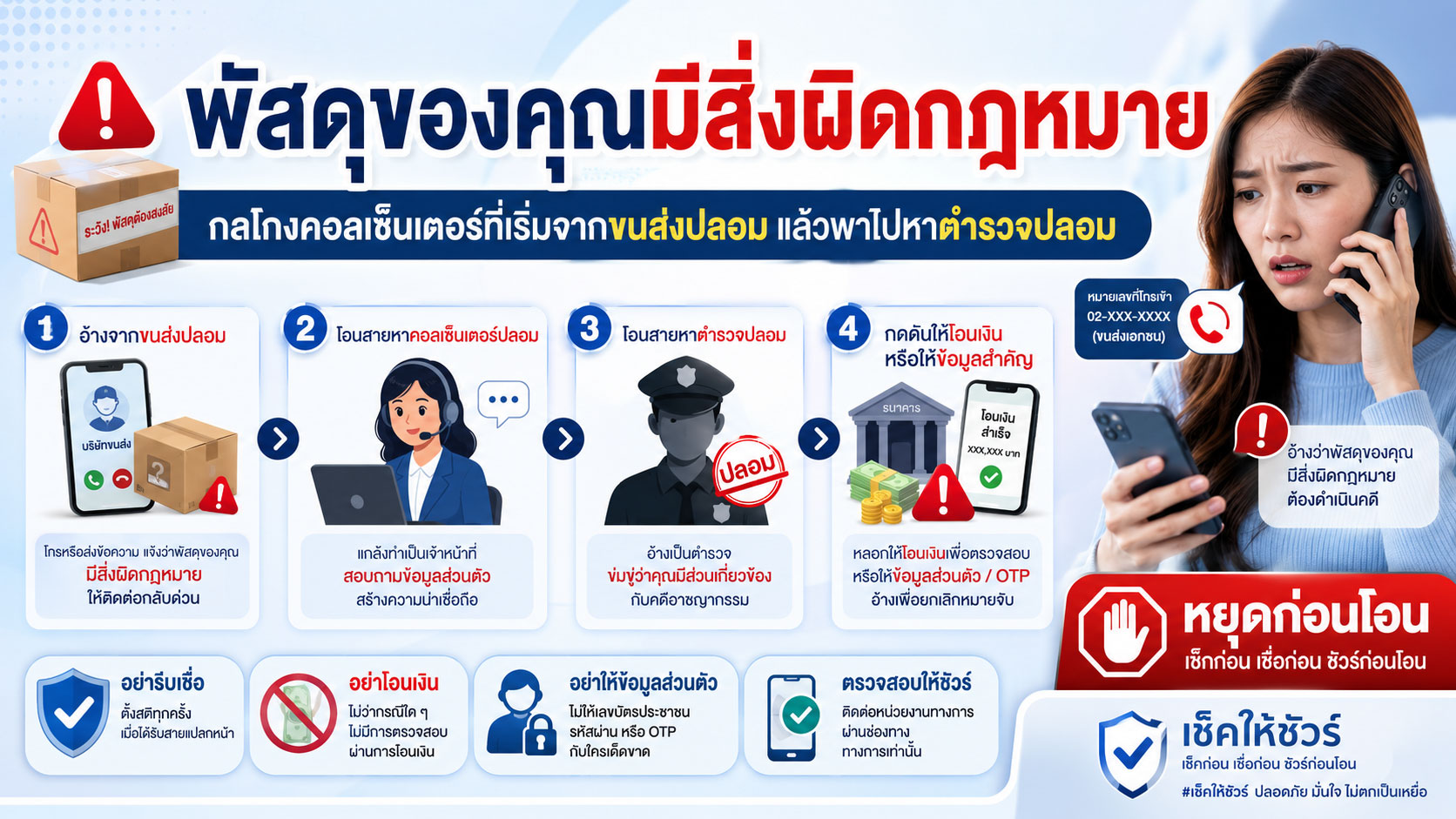
“มีพัสดุของคุณตกค้างอยู่ค่ะ”
“ตรวจพบว่าพัสดุมีสิ่งผิดกฎหมาย”
“ชื่อและบัตรประชาชนของคุณถูกใช้ส่งของต้องห้าม”
“เดี๋ยวจะโอนสายให้เจ้าหน้าที่ตำรวจรับเรื่องนะคะ”
ถ้าได้รับสายแบบนี้ หลายคนอาจตกใจทันที
เพราะเรื่องพัสดุเป็นเรื่องใกล้ตัวมาก เราอาจเคยสั่งของออนไลน์จริง เคยรอของจริง หรืออาจเคยให้เบอร์โทรไว้กับร้านค้าและบริษัทขนส่งหลายครั้ง
มิจฉาชีพจึงใช้คำว่า “พัสดุ” เป็นจุดเริ่มต้นที่ทำให้เรื่องดูเป็นไปได้
ตอนแรกอาจฟังเหมือนปัญหาทั่วไปของบริษัทขนส่ง
แต่ไม่นาน เรื่องอาจถูกยกระดับให้กลายเป็นเรื่องใหญ่
จากพัสดุตกค้าง
กลายเป็นพัสดุมีสิ่งผิดกฎหมาย
จากเจ้าหน้าที่ขนส่ง
กลายเป็นตำรวจ
จากการตรวจสอบเลขพัสดุ
กลายเป็นการสอบสวนคดี
จากการยืนยันตัวตน
กลายเป็นการขอข้อมูลส่วนตัว โอนเงิน หรือให้ติดตั้งแอป
นี่คือกลโกงที่อันตราย เพราะมันไม่ได้เริ่มจากการขอเงินทันที
แต่มันเริ่มจากความตกใจเล็กๆ แล้วค่อยๆ พาเราเข้าไปอยู่ในสถานการณ์ที่มิจฉาชีพควบคุม
จำไว้ว่า
พัสดุที่เราไม่รู้จัก ไม่ควรพาเราไปโอนเงินให้คนที่เราไม่รู้จัก
ทำไมมิจฉาชีพชอบเริ่มจากเรื่องพัสดุ
เพราะทุกวันนี้แทบทุกคนเกี่ยวข้องกับพัสดุ
บางคนสั่งของออนไลน์ทุกสัปดาห์
บางคนมีของจากต่างประเทศ
บางคนมีคนในบ้านสั่งของโดยใช้เบอร์เดียวกัน
บางคนเคยได้รับพัสดุ COD
บางคนเคยเจอพัสดุผิดที่
บางคนเคยได้รับ SMS แจ้งสถานะจากขนส่งจริง
เมื่อมีคนโทรมาบอกว่า “พัสดุของคุณมีปัญหา” เราจึงไม่ปฏิเสธทันทีว่าเป็นไปไม่ได้
เรามักเริ่มจากความสงสัยว่า
“สั่งอะไรไว้หรือเปล่า”
“มีใครใช้ชื่อเราไหม”
“หรือมีพัสดุจากต่างประเทศจริงๆ”
“ถ้ามีของผิดกฎหมายในชื่อเรา จะเดือดร้อนไหม”
มิจฉาชีพใช้ช่องว่างตรงนี้ทำให้เราเริ่มฟังต่อ
เมื่อเราฟังต่อ เขาก็มีเวลาค่อยๆ เพิ่มความกลัว
จากขนส่งปลอมสู่ตำรวจปลอม
รูปแบบที่เจอบ่อยคือ คนแรกอ้างว่าเป็นบริษัทขนส่ง
พูดด้วยน้ำเสียงเหมือนพนักงานบริการลูกค้า
แจ้งว่ามีพัสดุตกค้าง พัสดุตีกลับ หรือพัสดุถูกตรวจพบปัญหา
จากนั้นจะค่อยๆ ใส่คำที่ทำให้เรื่องดูร้ายแรงขึ้น เช่น
“มีเอกสารผิดกฎหมาย”
“มีบัตรประชาชนหลายใบ”
“มีบัญชีธนาคารต้องสงสัย”
“มีสิ่งของต้องห้าม”
“เกี่ยวข้องกับการฟอกเงิน”
“ชื่อคุณอาจถูกใช้ในคดี”
เมื่อเหยื่อเริ่มตกใจ อีกฝ่ายจะบอกว่าเรื่องนี้เกินอำนาจของบริษัทขนส่ง และต้องส่งต่อให้เจ้าหน้าที่ตำรวจหรือหน่วยงานสอบสวน
จากนั้นอาจมีการโอนสาย หรือให้เพิ่ม LINE เพื่อคุยกับ “ตำรวจ”
บางครั้งอาจพาไปวิดีโอคอล
บางครั้งอาจส่งเอกสารปลอม
บางครั้งอาจมีคนแต่งเครื่องแบบหรือใช้ภาพโปรไฟล์เหมือนเจ้าหน้าที่
แต่การที่เขาโอนสายให้ ไม่ได้แปลว่าเป็นเจ้าหน้าที่จริง
อาจเป็นเพียงคนอีกคนในกลุ่มเดียวกันที่รับบทต่อจากขนส่งปลอม
คำว่า “สิ่งผิดกฎหมาย” ทำให้คนกลัวจนรีบอธิบายตัวเอง
เมื่อมีคนพูดว่า “พัสดุของคุณมีสิ่งผิดกฎหมาย” คนส่วนใหญ่มักรีบปฏิเสธ
“ไม่ใช่ของฉัน”
“ฉันไม่ได้ส่ง”
“ฉันไม่ได้สั่ง”
“มีคนเอาชื่อฉันไปใช้หรือเปล่า”
ความรู้สึกอยากพิสูจน์ตัวเองเป็นเรื่องธรรมดา
แต่จุดที่ต้องระวังคือ มิจฉาชีพจะใช้ความอยากพิสูจน์ตัวเองนี้พาเราไปให้ข้อมูลมากขึ้น
จากแค่ถามว่าใช่ชื่อเราไหม
อาจกลายเป็นขอเลขบัตรประชาชน
ขอวันเดือนปีเกิด
ขอที่อยู่
ขอข้อมูลบัญชีธนาคาร
ขอรูปบัตรประชาชน
ขอรูปหน้าตรง
ขอให้เปิดกล้อง
ขอให้เปิดแอปธนาคาร
หรือขอให้ทำตามขั้นตอนเพื่อล้างข้อสงสัย
การพยายามอธิบายตัวเองกับคนที่ยังไม่รู้ว่าเป็นใคร อาจทำให้เราเปิดข้อมูลสำคัญโดยไม่รู้ตัว
ถ้าเราไม่ได้เกี่ยวข้องจริง เราไม่จำเป็นต้องพิสูจน์ตัวเองผ่านสายโทรศัพท์ที่ตรวจสอบไม่ได้
สัญญาณเตือนว่านี่อาจเป็นคอลเซ็นเตอร์สแกม
ถ้ามีคนโทรมาเรื่องพัสดุ แล้วมีพฤติกรรมเหล่านี้ ให้ระวังเป็นพิเศษ
อ้างว่าพัสดุของคุณมีสิ่งผิดกฎหมาย
บอกว่าชื่อหรือบัตรประชาชนของคุณเกี่ยวข้องกับคดี
โอนสายให้ตำรวจหรือหน่วยงานสอบสวนทันที
ให้เพิ่ม LINE เพื่อคุยกับเจ้าหน้าที่
ส่งเอกสารคดี หมายจับ หรือบันทึกประจำวันผ่านแชท
บอกว่าห้ามวางสาย
บอกว่าห้ามบอกคนในบ้าน
บอกว่าต้องให้ปากคำทันที
ขอเลขบัตรประชาชนเต็ม
ขอรูปบัตรประชาชนหรือรูปหน้าตรง
ขอข้อมูลบัญชีธนาคาร
ขอให้แจ้งยอดเงินในบัญชี
ขอ OTP หรือรหัสยืนยัน
ให้ติดตั้งแอปเพื่อตรวจสอบ
ให้แชร์หน้าจอ
ให้โอนเงินไปตรวจสอบ
หรือให้ย้ายเงินไป “บัญชีปลอดภัย”
ถ้ามีมากกว่าหนึ่งข้อในนี้ ให้หยุดทันที
เพราะบริษัทขนส่งจริงไม่ควรพาคุณไปโอนเงิน ตรวจสอบบัญชี หรือพิสูจน์คดีผ่านสายที่เขาควบคุมอยู่
พัสดุจริงควรตรวจสอบได้จากช่องทางขนส่งจริง
ถ้าพัสดุมีปัญหาจริง สิ่งที่ควรทำคือกลับไปตรวจสอบกับบริษัทขนส่งผ่านช่องทางทางการ
ไม่ใช่ทำตามคนที่โทรมาในสายนั้นทันที
ให้ถามตัวเองก่อนว่า
เราได้สั่งของไว้จริงหรือไม่
มีเลขพัสดุที่ตรวจสอบได้หรือไม่
ชื่อบริษัทขนส่งคืออะไร
เลขพัสดุตรวจในแอปหรือเว็บไซต์ทางการได้หรือไม่
คนที่โทรมาจากเบอร์ทางการหรือไม่
เขาให้เราทำอะไรที่เกี่ยวกับเงินหรือข้อมูลส่วนตัวหรือไม่
ถ้าไม่แน่ใจ ให้วางสาย แล้วเข้าเว็บไซต์หรือแอปของบริษัทขนส่งด้วยตัวเอง
อย่ากดลิงก์ที่เขาส่งมา
อย่าโทรกลับเบอร์ที่เขาให้
อย่าเพิ่ม LINE ที่เขาแนะนำ
และอย่าให้คนที่คุณสงสัยเป็นคนกำหนดช่องทางตรวจสอบให้คุณ
อย่ากลัวจนอยู่ในสายต่อเพราะเขาบอกว่าเป็นคดี
มิจฉาชีพมักใช้คำว่า “คดี” เพื่อทำให้เรารู้สึกว่าออกจากสายไม่ได้
เขาอาจบอกว่า
“ถ้าวางสายจะถือว่าไม่ให้ความร่วมมือ”
“ถ้าไม่ทำตอนนี้จะมีหมายจับ”
“ถ้าบอกคนอื่นจะกระทบต่อรูปคดี”
“ต้องสอบสวนแบบลับ”
“ต้องทำตามขั้นตอนเจ้าหน้าที่ทันที”
คำพูดเหล่านี้ไม่ได้แปลว่าเขาเป็นเจ้าหน้าที่จริง
แต่เป็นวิธีควบคุมไม่ให้เรามีเวลาตรวจสอบ
ถ้าเป็นเรื่องจริง คุณควรมีสิทธิ์วางสาย และติดต่อสถานีตำรวจหรือหน่วยงานที่เกี่ยวข้องด้วยตัวเอง
เรื่องจริงไม่ควรกลัวการตรวจสอบ
แต่เรื่องหลอกมักกลัวมาก เพราะทันทีที่คุณวางสาย เขาจะเสียการควบคุม
อย่าโอนเงินเพื่อพิสูจน์ว่าไม่ได้เกี่ยวข้อง
หนึ่งในจุดอันตรายที่สุดคือ เมื่ออีกฝ่ายบอกให้โอนเงิน
อาจใช้คำว่า
บัญชีตรวจสอบ
บัญชีกลาง
บัญชีปลอดภัย
เงินประกันคดี
เงินยืนยันความบริสุทธิ์
เงินตรวจสอบเส้นทางการเงิน
หรือเงินที่ต้องย้ายออกเพื่อป้องกันการอายัด
ไม่ว่าจะใช้คำไหน หลักสำคัญคือ
ไม่ควรมีใครโทรมาแล้วสั่งให้คุณโอนเงินเพื่อพิสูจน์ว่าไม่ได้ทำผิด
ถ้าคุณไม่ได้เกี่ยวข้องกับพัสดุนั้น การโอนเงินไม่ได้ทำให้คุณบริสุทธิ์ขึ้น
แต่ทำให้เงินออกจากบัญชีคุณจริง
เจ้าหน้าที่จริงไม่ควรให้ประชาชนโอนเงินไปบัญชีที่คนปลายสายระบุ
และไม่ควรให้ทำธุรกรรมทางการเงินระหว่างที่ถูกกดดันให้คุยต่อ
อย่าให้ OTP หรือเปิดแอปธนาคารระหว่างคุย
บางครั้งมิจฉาชีพอาจไม่ขอให้โอนเงินทันที
แต่อาจพยายามพาคุณไปเปิดแอปธนาคาร หรือให้รหัสบางอย่าง
เช่น
“ขอ OTP เพื่อยืนยันตัวตน”
“เปิดแอปธนาคารเพื่อตรวจสอบยอดเงิน”
“แชร์หน้าจอให้เจ้าหน้าที่ดู”
“กดตามขั้นตอนเพื่อยืนยันว่าเงินไม่เกี่ยวกับคดี”
“ติดตั้งแอปนี้เพื่อให้เจ้าหน้าที่ช่วยตรวจสอบ”
สิ่งเหล่านี้อันตรายมาก
OTP ไม่ใช่รหัสสำหรับบอกเจ้าหน้าที่
แอปธนาคารไม่ควรเปิดให้คนแปลกหน้าดู
การแชร์หน้าจออาจทำให้อีกฝ่ายเห็นข้อมูลสำคัญ
และแอปที่ให้ติดตั้งอาจเปิดทางให้มิจฉาชีพเข้าถึงมือถือหรือควบคุมการทำรายการได้
ถ้าเริ่มมีคำว่า OTP แอปธนาคาร แชร์หน้าจอ หรือติดตั้งแอป ให้ถือว่าเป็นสัญญาณอันตรายทันที
เอกสารที่ส่งมาในแชทอาจเป็นเอกสารปลอม
บางครั้งมิจฉาชีพจะส่งเอกสารให้ดู
เช่น
หมายจับ
หมายเรียก
บันทึกคดี
เอกสารตรวจพัสดุ
เอกสารจากบริษัทขนส่ง
เอกสารจากตำรวจ
เอกสารที่มีตราครุฑ
หรือเอกสารที่มีชื่อและเลขบัตรบางส่วนของเรา
เอกสารเหล่านี้อาจทำให้คนตกใจมาก เพราะดูเหมือนจริง
แต่เอกสารที่ส่งมาในแชท ไม่ใช่หลักฐานว่าจริงเสมอไป
โลโก้ปลอมได้
ตราประทับปลอมได้
ลายเซ็นปลอมได้
แบบฟอร์มปลอมได้
และข้อมูลบางส่วนของเราอาจถูกนำมาจากแหล่งอื่น
อย่าตรวจสอบเอกสารกับคนที่ส่งเอกสารนั้นมาเอง
ให้เก็บไว้เป็นหลักฐาน แล้วติดต่อหน่วยงานจริงผ่านช่องทางที่คุณหาเอง
ถ้าได้รับสายแบบนี้ ควรทำอย่างไร
สิ่งแรกคือหยุดก่อน
ไม่ต้องเถียง
ไม่ต้องพิสูจน์ให้เขาเชื่อ
ไม่ต้องอยู่ฟังจนจบ
และไม่ต้องขออนุญาตวางสาย
คุณสามารถพูดสั้นๆ ว่า
“ขอบคุณค่ะ/ครับ เดี๋ยวจะตรวจสอบกับบริษัทขนส่งหรือหน่วยงานทางการด้วยตัวเอง”
แล้ววางสาย
จากนั้นให้ตรวจสอบผ่านช่องทางที่คุณหาเอง
ถ้าอ้างว่าเป็นบริษัทขนส่ง ให้เข้าแอปหรือเว็บไซต์ทางการของบริษัทขนส่ง
ถ้าอ้างว่าเป็นตำรวจ ให้ติดต่อสถานีตำรวจหรือหน่วยงานที่ตรวจสอบได้
ถ้าอ้างว่าเกี่ยวกับธนาคาร ให้ติดต่อธนาคารผ่านแอป เว็บไซต์ เบอร์หลังบัตร หรือสาขา
อย่าใช้เบอร์ ลิงก์ LINE หรือบัญชีที่คนปลายสายส่งมาเป็นช่องทางตรวจสอบ
เพราะนั่นอาจเป็นส่วนหนึ่งของฉากที่เขาจัดไว้
ถ้าเผลอให้ข้อมูลหรือโอนเงินไปแล้ว
ถ้าคุณเผลอให้ข้อมูล กดลิงก์ ติดตั้งแอป ให้ OTP แชร์หน้าจอ หรือโอนเงินไปแล้ว ให้หยุดทันที
อย่าโอนเพิ่ม
อย่าคุยต่อเพราะเขาบอกว่าจะช่วยล้างคดี
อย่าลบแชท
อย่าลบสลิป
อย่าลบประวัติการโทร
ให้เก็บหลักฐานทั้งหมด เช่น
เบอร์โทร
ชื่อที่อีกฝ่ายใช้
แชท
ลิงก์
เอกสารที่ส่งมา
เลขบัญชีปลายทาง
ชื่อบัญชี
สลิปโอนเงิน
วันเวลาเกิดเหตุ
และรายละเอียดคำพูดที่ใช้ขู่หรือหลอก
ถ้ามีเรื่องเงินเกี่ยวข้อง ให้ติดต่อธนาคารผ่านช่องทางทางการโดยเร็ว
ถ้าเคยติดตั้งแอปที่น่าสงสัย ให้หยุดทำธุรกรรมสำคัญบนเครื่องนั้นก่อน ตรวจสอบแอปและสิทธิ์ที่อนุญาต และขอความช่วยเหลือจากคนที่ไว้ใจได้
จากนั้นแจ้งเหตุผ่านหน่วยงานหรือแพลตฟอร์มที่เกี่ยวข้อง
สิ่งสำคัญคืออย่าปิดบังเพราะอาย
การหยุดเร็วและเก็บหลักฐานไว้ อาจช่วยลดความเสียหายได้มากกว่าการพยายามคุยกับคนเดิมต่อ
บอกคนในบ้านไว้ก่อน โดยเฉพาะผู้สูงอายุ
กลโกงพัสดุมีสิ่งผิดกฎหมายอาจกระทบคนในบ้านได้ทุกวัย
โดยเฉพาะคนที่ไม่คุ้นกับการสั่งของออนไลน์ หรือไม่คุ้นกับกลวิธีของคอลเซ็นเตอร์
ควรคุยกันไว้ล่วงหน้าว่า
ถ้ามีคนโทรมาบอกว่าพัสดุมีสิ่งผิดกฎหมาย ให้ไม่ต้องตกใจ
ถ้าเขาโอนสายให้ตำรวจ ให้ยังไม่เชื่อทันที
ถ้าเขาห้ามวางสาย ให้ถือว่าน่าสงสัย
ถ้าเขาห้ามบอกคนในบ้าน ให้ยิ่งต้องบอก
ถ้าเขาขอ OTP ให้ไม่ให้
ถ้าเขาให้โอนเงิน ให้หยุด
ถ้าเขาให้ติดตั้งแอป ให้ไม่ทำตาม
และถ้าไม่แน่ใจ ให้โทรหาคนในบ้านก่อนเสมอ
ข้อตกลงเล็กๆ แบบนี้อาจช่วยให้คนที่กำลังตกใจไม่ต้องตัดสินใจคนเดียว
ประโยคที่ควรจำ: พัสดุที่เราไม่รู้จัก ไม่ควรพาเราไปโอนเงิน
ถ้าต้องจำประโยคเดียวจากบทความนี้ ขอให้จำว่า
พัสดุที่เราไม่รู้จัก ไม่ควรพาเราไปโอนเงิน
ถ้าพัสดุมีปัญหาจริง ควรตรวจสอบได้กับบริษัทขนส่งหรือหน่วยงานจริง
ไม่ควรต้องเพิ่ม LINE เจ้าหน้าที่ปลอม
ไม่ควรต้องวิดีโอคอลกับตำรวจปลอม
ไม่ควรต้องให้ OTP
ไม่ควรต้องติดตั้งแอป
ไม่ควรต้องเปิดแอปธนาคาร
และไม่ควรต้องโอนเงินเพื่อพิสูจน์ความบริสุทธิ์
ถ้าเรื่องเริ่มจากพัสดุ แต่จบที่การขอเงินหรือข้อมูลสำคัญ ให้หยุดทันที
สรุป: สายเรื่องพัสดุอาจไม่ใช่เรื่องพัสดุ แต่เป็นทางเข้าของคอลเซ็นเตอร์สแกม
กลโกง “พัสดุของคุณมีสิ่งผิดกฎหมาย” อันตรายเพราะมันเริ่มจากเรื่องธรรมดา
เรื่องพัสดุ
เรื่องขนส่ง
เรื่องเลขพัสดุ
เรื่องของตกค้าง
เรื่องเอกสาร
หรือเรื่องของที่เราอาจไม่รู้จัก
แต่เมื่อมิจฉาชีพเริ่มใส่คำว่า คดี ตำรวจ หมายจับ ฟอกเงิน หรือบัญชีตรวจสอบ เรื่องก็อาจเปลี่ยนจากความสงสัยเล็กๆ เป็นความกลัวทันที
สิ่งที่ควรทำคือหยุดก่อน
อย่าให้ข้อมูลส่วนตัว
อย่าให้ OTP
อย่ากดลิงก์
อย่าเพิ่ม LINE ที่เขาส่งมา
อย่าติดตั้งแอป
อย่าแชร์หน้าจอ
อย่าเปิดแอปธนาคาร
อย่าโอนเงิน
และอย่าอยู่ในสายเพราะเขาบอกว่าห้ามวาง
ให้วางสาย แล้วตรวจสอบผ่านบริษัทขนส่ง ธนาคาร หรือหน่วยงานจริงด้วยตัวเอง
ถ้าเป็นเรื่องจริง ช่องทางจริงยังตรวจสอบได้
แต่ถ้าเป็นมิจฉาชีพ การวางสายอาจช่วยหยุดความเสียหายได้ทันเวลา
“Your Parcel Contains Illegal Items”: A Call Center Scam That Starts with a Fake Delivery Company and Leads to Fake Police
“There is a parcel under your name that has been left pending.”
“We found illegal items inside your parcel.”
“Your name and ID card have been used to send prohibited goods.”
“We will transfer the call to a police officer to handle this matter.”
If you receive a call like this, many people may panic immediately.
Because parcels are part of everyday life. You may have ordered something online, waited for a delivery, or shared your phone number with online stores and delivery companies many times before.
Scammers use the word “parcel” as a starting point because it sounds believable.
At first, it may sound like a normal delivery issue.
But soon, the situation may be made to feel much more serious.
A pending parcel becomes a parcel containing illegal items.
A delivery staff member becomes a police officer.
Checking a tracking number becomes a criminal investigation.
Identity verification becomes a request for personal information, money transfers, or app installation.
This scam is dangerous because it does not always begin by asking for money.
It begins with a small moment of panic, then gradually pulls you into a situation controlled by scammers.
Remember this:
A parcel you do not recognize should not lead you to transfer money to someone you do not know.
Why Scammers Like to Start with Parcels
Because almost everyone deals with parcels today.
Some people shop online every week.
Some receive items from overseas.
Some have family members who order using the same phone number.
Some have received Cash on Delivery parcels.
Some have received parcels sent to the wrong address.
Some have received real delivery status SMS messages before.
So when someone calls and says, “There is a problem with your parcel,” many people do not immediately reject it as impossible.
They may start wondering:
“Did I order something?”
“Did someone use my name?”
“Could there really be an overseas parcel?”
“If illegal goods are linked to my name, will I be in trouble?”
Scammers use this uncertainty to keep you listening.
And once you keep listening, they have time to increase your fear.
From Fake Delivery Staff to Fake Police
A common pattern starts with someone claiming to be from a delivery company.
They may speak like a customer service representative.
They say there is a pending parcel, a returned parcel, or a parcel that has a problem.
Then they gradually introduce words that make the issue sound more serious, such as:
“Illegal documents”
“Multiple ID cards”
“Suspicious bank accounts”
“Prohibited items”
“Money laundering”
“Your name may be linked to a case”
Once the victim becomes frightened, the caller says that the issue is beyond the delivery company’s authority and must be transferred to the police or an investigation unit.
Then they may transfer the call or ask you to add LINE to speak with a “police officer.”
Sometimes they may move you to a video call.
Sometimes they may send fake documents.
Sometimes they may use uniforms or profile pictures that look like real officers.
But the fact that they transfer the call does not mean the next person is a real officer.
It may simply be another person in the same scam group playing the next role after the fake delivery staff.
The Words “Illegal Items” Make People Panic and Try to Explain Themselves
When someone says, “Your parcel contains illegal items,” most people rush to deny it.
“That is not mine.”
“I did not send it.”
“I did not order it.”
“Did someone use my name?”
Wanting to prove your innocence is a normal reaction.
But the danger is that scammers use this need to explain yourself to make you reveal more information.
What begins as confirming whether the name is yours may become a request for:
Your national ID number
Date of birth
Address
Bank account information
A photo of your ID card
A face photo
Camera access
Access to your banking app
Or steps to “clear your name”
Trying to explain yourself to someone whose identity you have not verified may cause you to reveal sensitive information without realizing it.
If you are not involved, you do not need to prove yourself through an unverified phone call.
Warning Signs That This May Be a Call Center Scam
If someone calls about a parcel and does any of the following, be especially careful:
They claim your parcel contains illegal items.
They say your name or ID card is linked to a criminal case.
They transfer the call to police or an investigation unit immediately.
They ask you to add LINE to speak with an officer.
They send case documents, arrest warrants, or police reports through chat.
They tell you not to hang up.
They tell you not to tell your family.
They say you must give a statement immediately.
They ask for your full national ID number.
They ask for a photo of your ID card or face.
They ask for bank account information.
They ask you to disclose your account balance.
They ask for an OTP or verification code.
They tell you to install an app for checking.
They ask you to share your screen.
They ask you to transfer money for verification.
Or they tell you to move money to a “safe account.”
If more than one of these signs appears, stop immediately.
A real delivery company should not lead you into money transfers, account checks, or criminal verification through a call controlled by the caller.
A Real Parcel Should Be Verifiable Through the Real Delivery Company
If a parcel truly has a problem, you should verify it through the delivery company’s official channels.
Do not immediately follow instructions from the person on the call.
Ask yourself first:
Did I actually order something?
Is there a tracking number I can check?
Which delivery company is involved?
Can the tracking number be checked through the official app or website?
Is the caller using an official contact channel?
Are they asking me to do anything involving money or sensitive personal information?
If you are unsure, hang up and open the delivery company’s official website or app yourself.
Do not click links they send.
Do not call back numbers they provide.
Do not add LINE accounts they recommend.
And do not let the person you suspect choose the verification channel for you.
Do Not Stay on the Call Just Because They Say It Is a Criminal Case
Scammers often use the word “case” to make you feel that you cannot leave the call.
They may say:
“If you hang up, it will be recorded as non-cooperation.”
“If you do not act now, an arrest warrant may be issued.”
“If you tell anyone else, it may affect the case.”
“This must be handled confidentially.”
“You must follow the officer’s steps immediately.”
These words do not prove that they are real officers.
They are a way to control you and prevent you from checking.
If the matter is real, you should have the right to hang up and contact a police station or relevant agency yourself.
Real matters should not be afraid of verification.
Fake matters often are, because the moment you hang up, the scammer loses control.
Do Not Transfer Money to Prove You Are Not Involved
One of the most dangerous points is when the caller asks you to transfer money.
They may use words such as:
Verification account
Central account
Safe account
Case deposit
Innocence verification payment
Financial investigation fund
Or money that must be moved to prevent account freezing
Whatever wording they use, the key rule is this:
No one should call and tell you to transfer money to prove you are innocent.
If you are not involved with that parcel, transferring money does not make you more innocent.
It only makes money leave your account.
Real officers should not ask citizens to transfer money into an account provided by someone on the phone.
And they should not ask you to perform financial transactions while pressuring you to stay on the call.
Do Not Share OTPs or Open Your Banking App During the Call
Sometimes scammers may not ask you to transfer money immediately.
Instead, they may try to get you to open your banking app or provide certain codes.
For example:
“Please provide the OTP to verify your identity.”
“Open your banking app so we can check your balance.”
“Share your screen so the officer can see.”
“Follow these steps to confirm that your money is not linked to the case.”
“Install this app so the officer can help check.”
These requests are extremely dangerous.
An OTP is not a code to tell an officer.
Your banking app should not be shown to strangers.
Screen sharing may expose sensitive information.
And an app they ask you to install may give scammers access to your phone or help them control transactions.
If the conversation starts involving OTPs, banking apps, screen sharing, or app installation, treat it as a serious warning sign immediately.
Documents Sent Through Chat May Be Fake
Sometimes scammers send documents to make the situation look real.
These may include:
Arrest warrants
Summons documents
Case records
Parcel inspection documents
Delivery company documents
Police documents
Documents with government emblems
Or documents showing your name and part of your ID number
These documents can frighten people because they look official.
But a document sent through chat is not proof that it is real.
Logos can be forged.
Stamps can be forged.
Signatures can be forged.
Forms can be faked.
And some of your personal information may have come from other sources.
Do not verify the document with the same person who sent it.
Save it as evidence, then contact the real agency through a channel you find yourself.
What Should You Do If You Receive This Kind of Call?
The first step is to stop.
You do not need to argue.
You do not need to prove anything to them.
You do not need to listen until the end.
And you do not need to ask permission to hang up.
You can simply say:
“Thank you. I will check with the delivery company or official agency myself.”
Then hang up.
After that, verify through channels you find yourself.
If they claim to be from a delivery company, open the company’s official app or website.
If they claim to be police, contact a police station or verified official channel.
If they claim the matter involves your bank, contact your bank through the official app, official website, number on the back of your card, or a branch.
Do not use the phone number, link, LINE account, or bank account sent by the caller as your verification channel.
Those may be part of the scene they prepared.
If You Already Shared Information or Transferred Money
If you already shared information, clicked a link, installed an app, provided an OTP, shared your screen, or transferred money, stop immediately.
Do not transfer more.
Do not continue talking because they say they can clear your case.
Do not delete chats.
Do not delete transfer slips.
Do not delete call history.
Save all evidence, such as:
Phone number
Name used by the caller
Chat messages
Links
Documents they sent
Destination account number
Account name
Transfer slip
Date and time of the incident
And details of the words they used to threaten or deceive you
If money is involved, contact your bank through official channels as soon as possible.
If you installed a suspicious app, stop using that device for important transactions, check the apps and permissions, and ask someone you trust for help.
Then report the incident through the relevant authority or platform.
Most importantly, do not hide what happened because you feel embarrassed.
Stopping early and keeping evidence may reduce the damage more than continuing to talk to the same person.
Warn People at Home, Especially Elderly Family Members
The “illegal parcel” scam can affect people of any age.
It is especially important to warn people who may not be familiar with online shopping or call center scam tactics.
Families can agree in advance:
If someone calls saying a parcel contains illegal items, do not panic.
If they transfer you to the police, do not believe it immediately.
If they tell you not to hang up, treat it as suspicious.
If they tell you not to tell anyone at home, tell someone at home immediately.
If they ask for an OTP, do not give it.
If they ask you to transfer money, stop.
If they tell you to install an app, do not follow the instruction.
And if you are unsure, call someone in the family first.
Small agreements like these may help someone who is panicking avoid making decisions alone.
A Sentence to Remember: A Parcel You Do Not Recognize Should Not Lead You to Transfer Money
If you remember only one sentence from this article, remember this:
A parcel you do not recognize should not lead you to transfer money.
If a parcel truly has a problem, it should be verifiable through the real delivery company or official agency.
It should not require you to add a fake officer on LINE.
It should not require a video call with fake police.
It should not require an OTP.
It should not require installing an app.
It should not require opening your banking app.
And it should not require transferring money to prove your innocence.
If the issue starts with a parcel but ends with a request for money or sensitive information, stop immediately.
Conclusion: A Call About a Parcel May Not Really Be About a Parcel
The “your parcel contains illegal items” scam is dangerous because it begins with something ordinary.
A parcel.
A delivery company.
A tracking number.
A pending item.
A document.
Or an item you may not recognize.
But once scammers add words like case, police, arrest warrant, money laundering, or verification account, a small uncertainty can quickly become fear.
The right response is to stop first.
Do not share personal information.
Do not provide an OTP.
Do not click links.
Do not add LINE accounts they send.
Do not install apps.
Do not share your screen.
Do not open your banking app.
Do not transfer money.
And do not stay on the call just because they tell you not to hang up.
Hang up, then verify with the delivery company, bank, or official agency yourself.
If the matter is real, real channels can still help you check.
But if it is a scam, hanging up may stop the damage in time.

Leave a Reply
You must be logged in to post a comment.