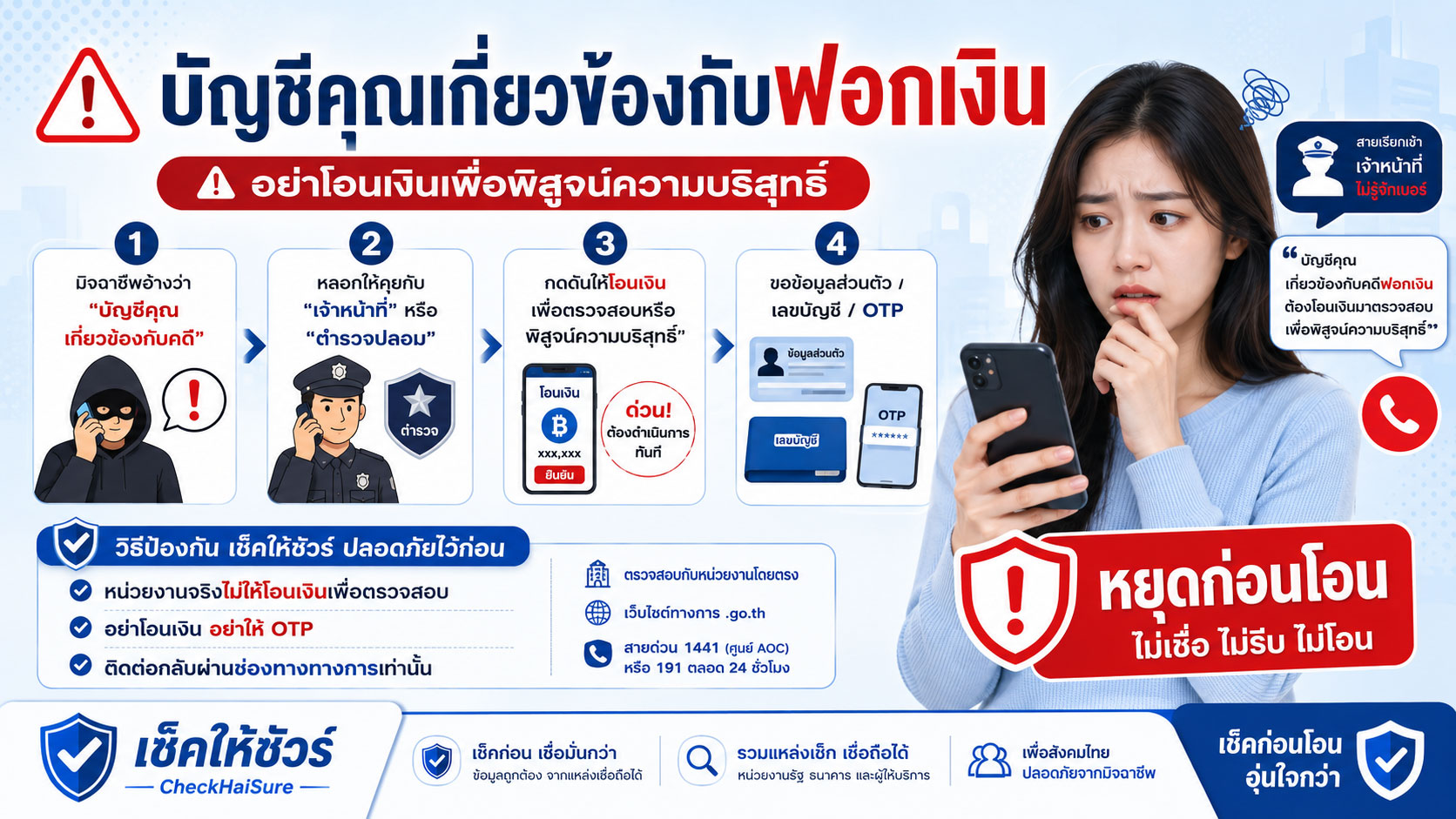
“บัญชีของคุณเกี่ยวข้องกับคดีฟอกเงิน”
“มีเงินผิดกฎหมายผ่านบัญชีของคุณ”
“ชื่อของคุณอยู่ในเครือข่ายบัญชีม้า”
“ถ้าไม่ให้ความร่วมมือ อาจถูกออกหมายจับ”
“ต้องโอนเงินไปตรวจสอบก่อน เพื่อพิสูจน์ว่าคุณบริสุทธิ์”
ถ้าได้รับสายแบบนี้ หลายคนอาจตกใจจนตัวชา
เพราะคำว่า “ฟอกเงิน” ไม่ใช่คำธรรมดา
มันฟังดูใหญ่
ฟังดูเป็นคดีร้ายแรง
ฟังดูเกี่ยวข้องกับตำรวจ
ฟังดูเหมือนชีวิตกำลังจะมีปัญหา
และทำให้คนธรรมดาที่ไม่เคยยุ่งกับเรื่องผิดกฎหมายรู้สึกกลัวมาก
มิจฉาชีพรู้ดีว่า คนบริสุทธิ์มักกลัวการถูกกล่าวหา
เมื่อมีคนบอกว่าเราเกี่ยวข้องกับคดี ทั้งที่เราไม่ได้ทำอะไร เรามักอยากรีบอธิบาย รีบพิสูจน์ และรีบทำให้เรื่องจบ
จุดนี้เองที่มิจฉาชีพใช้เล่นงาน
เขาไม่ได้ต้องการให้คุณเข้าใจกฎหมายจริงๆ
เขาต้องการให้คุณกลัวจนทำตาม
ให้ข้อมูล
ส่งเอกสาร
เปิดแอปธนาคาร
อ่าน OTP
ติดตั้งแอป
แชร์หน้าจอ
หรือโอนเงินไปยังบัญชีที่เขาเรียกว่า “บัญชีตรวจสอบ” หรือ “บัญชีปลอดภัย”
จำไว้ว่า
คนบริสุทธิ์ไม่ต้องโอนเงินเพื่อพิสูจน์ว่าไม่ได้ทำผิด
ทำไมคำว่า “ฟอกเงิน” ถึงทำให้คนกลัวมาก
เพราะเป็นคำที่คนทั่วไปไม่ได้เจอในชีวิตประจำวัน
หลายคนไม่รู้ว่ากระบวนการจริงเป็นอย่างไร
ไม่รู้ว่าหน่วยงานไหนเกี่ยวข้อง
ไม่รู้ว่าถ้ามีชื่อเราอยู่ในคดีต้องทำอะไร
ไม่รู้ว่าการถูกกล่าวหาจะส่งผลแค่ไหน
และไม่รู้ว่าควรตรวจสอบจากที่ไหน
เมื่อไม่รู้ ความกลัวจึงเข้ามาแทนที่
มิจฉาชีพจึงใช้คำที่ฟังดูเป็นทางการและหนักมาก เช่น
ฟอกเงิน
บัญชีม้า
เครือข่ายอาชญากรรม
หมายจับ
อายัดบัญชี
ตรวจสอบเส้นทางการเงิน
สอบสวนลับ
บัญชีกลาง
หรือบัญชีปลอดภัย
คำเหล่านี้ทำให้คนรู้สึกว่าถ้าไม่ทำตามทันที อาจเกิดเรื่องใหญ่
ทั้งที่จริงแล้ว สายโทรศัพท์ที่เราไม่รู้ที่มา ไม่ควรมีอำนาจทำให้เราต้องเปิดเผยข้อมูลสำคัญหรือโอนเงินออกจากบัญชี
กลโกงมักเริ่มจากการทำให้เราสงสัยตัวเอง
มิจฉาชีพไม่ได้เริ่มจากคำว่า “โอนเงินมาให้เรา” ทันที
เขามักเริ่มจากการทำให้เราสงสัยว่า มีอะไรผิดปกติเกิดขึ้นกับชื่อหรือบัญชีของเราหรือเปล่า
เช่น
มีคนใช้บัตรประชาชนของคุณเปิดบัญชี
มีเงินผิดกฎหมายโอนผ่านบัญชีของคุณ
บัญชีของคุณเกี่ยวข้องกับแก๊งฟอกเงิน
ชื่อคุณอยู่ในเอกสารคดี
มีหมายเรียกหรือหมายจับในชื่อคุณ
มีผู้เสียหายโอนเงินเข้าบัญชีที่เกี่ยวข้องกับคุณ
หรือคุณต้องให้ข้อมูลเพื่อแยกตัวเองออกจากคดี
เมื่อฟังแบบนี้ คนที่ไม่เคยทำผิดมักรีบปฏิเสธ
“ไม่ใช่บัญชีฉัน”
“ฉันไม่เกี่ยว”
“ฉันไม่รู้เรื่อง”
“มีคนเอาชื่อฉันไปใช้หรือเปล่า”
ความรู้สึกอยากพิสูจน์ตัวเองนี้เป็นเรื่องธรรมชาติ
แต่ถ้าเราพิสูจน์ตัวเองกับคนผิด เราอาจกลายเป็นฝ่ายส่งข้อมูลและเงินให้มิจฉาชีพเอง
จากการกล่าวหา สู่การควบคุม
หลังจากทำให้เรากลัวแล้ว มิจฉาชีพจะเริ่มควบคุมสถานการณ์
อาจพูดว่า
“ห้ามวางสาย”
“ห้ามบอกใคร เพราะเป็นคดีลับ”
“ห้ามติดต่อธนาคารเอง”
“ถ้าไม่ทำตาม จะถือว่าไม่ให้ความร่วมมือ”
“เจ้าหน้าที่กำลังทำเรื่องให้คุณอยู่”
“ต้องทำตามขั้นตอนตอนนี้เท่านั้น”
“ถ้าช้า บัญชีจะถูกอายัดทั้งหมด”
“ถ้าให้ความร่วมมือ จะช่วยกันชื่อคุณออกจากคดีได้”
คำพูดเหล่านี้ไม่ได้ทำให้เขาดูน่าเชื่อถือ
แต่เป็นสัญญาณว่าเขากำลังพยายามตัดคุณออกจากความช่วยเหลือภายนอก
เพราะถ้าคุณวางสาย คุณจะมีเวลาคิด
ถ้าคุณบอกคนในบ้าน คุณอาจได้รับคำเตือน
ถ้าคุณโทรหาธนาคารเอง คุณอาจรู้ว่าไม่มีเรื่องแบบนั้น
ถ้าคุณไปสถานีตำรวจจริง คุณอาจรู้ว่าสายนี้คือมิจฉาชีพ
เรื่องจริงไม่ควรกลัวการตรวจสอบ
แต่เรื่องหลอกมักกลัวมาก
“บัญชีปลอดภัย” อาจเป็นบัญชีของมิจฉาชีพ
หนึ่งในคำที่อันตรายมากคือ “บัญชีปลอดภัย”
มิจฉาชีพอาจบอกว่า
“ให้ย้ายเงินออกจากบัญชีคุณก่อน เพื่อป้องกันการอายัด”
“โอนไปบัญชีกลางชั่วคราว เดี๋ยวตรวจสอบเสร็จจะคืนให้”
“เงินต้องถูกตรวจสอบว่าไม่เกี่ยวกับคดี”
“ต้องโอนทั้งหมด เพื่อให้เจ้าหน้าที่กันเงินไว้ให้”
“บัญชีนี้เป็นบัญชีของหน่วยงาน ใช้รับเงินตรวจสอบเท่านั้น”
คำพูดเหล่านี้ทำให้เหยื่อรู้สึกว่าไม่ได้เสียเงิน แต่แค่ย้ายเงินไปไว้ที่ปลอดภัย
แต่ความจริงอาจตรงกันข้าม
เงินที่ออกจากบัญชีคุณแล้ว อาจไปอยู่ในบัญชีที่มิจฉาชีพควบคุม
และเมื่อโอนไปแล้ว อาจถูกโอนต่อ ถอนออก หรือกระจายไปหลายบัญชีอย่างรวดเร็ว
คำว่า “บัญชีปลอดภัย” จึงอาจไม่ใช่ที่ปลอดภัยสำหรับคุณ
แต่อาจเป็นปลายทางของเงินที่มิจฉาชีพเตรียมไว้
ไม่มีเจ้าหน้าที่จริงคนไหนควรให้คุณโอนเงินเพื่อพิสูจน์ความบริสุทธิ์
นี่คือจุดที่ต้องจำให้ชัด
ถ้ามีคนอ้างว่าเป็นตำรวจ เจ้าหน้าที่รัฐ ฝ่ายสอบสวน ธนาคาร หรือหน่วยงานใดก็ตาม แล้วบอกให้คุณโอนเงินเพื่อพิสูจน์ว่าไม่เกี่ยวข้องกับคดี ให้หยุดทันที
เพราะการโอนเงินไม่ได้พิสูจน์ความบริสุทธิ์
การโอนเงินไม่ได้ทำให้คดีหายไป
การโอนเงินไม่ได้ล้างชื่อคุณ
การโอนเงินไม่ได้ยืนยันว่าเงินของคุณสะอาด
และการโอนเงินตามคำสั่งของคนปลายสาย อาจทำให้คุณเสียเงินจริง
ถ้ามีข้อกล่าวหาจริง ควรมีกระบวนการตรวจสอบผ่านหน่วยงานจริง เอกสารจริง และช่องทางที่ตรวจสอบได้
ไม่ใช่การคุยในสายที่ห้ามวาง ห้ามบอกใคร และให้โอนเงินทันที
สัญญาณเตือนของกลโกง “บัญชีเกี่ยวข้องกับฟอกเงิน”
หากมีคนโทรมาพูดเรื่องฟอกเงินหรือบัญชีเกี่ยวข้องกับคดี ให้ระวังเป็นพิเศษเมื่อมีพฤติกรรมเหล่านี้
อ้างว่าบัญชีคุณเกี่ยวข้องกับคดีฟอกเงิน
บอกว่าชื่อคุณอยู่ในเครือข่ายบัญชีม้า
อ้างว่ามีหมายจับหรือหมายเรียก
ส่งเอกสารคดีผ่านแชท
ให้คุยกับตำรวจหรือเจ้าหน้าที่ผ่าน LINE
ขอให้วิดีโอคอลเพื่อสอบสวน
ห้ามวางสาย
ห้ามบอกคนในบ้าน
ห้ามติดต่อธนาคารเอง
ขอเลขบัตรประชาชนเต็ม
ขอรูปบัตรประชาชนหรือรูปหน้าตรง
ขอข้อมูลบัญชีธนาคาร
ขอให้แจ้งยอดเงินในบัญชี
ขอ OTP หรือรหัสยืนยัน
ให้ติดตั้งแอปเพื่อตรวจสอบ
ให้แชร์หน้าจอ
ให้เปิดแอปธนาคารระหว่างอยู่ในสาย
ให้โอนเงินไปบัญชีกลาง บัญชีตรวจสอบ หรือบัญชีปลอดภัย
หรือบอกว่าถ้าไม่ทำทันที จะถูกดำเนินคดี
ถ้ามีคำขอเกี่ยวกับเงิน รหัส หรือแอปธนาคารเข้ามาในบทสนทนา ให้ถือว่านี่ไม่ใช่การตรวจสอบปกติ
แต่เป็นสัญญาณอันตราย
เอกสารคดีที่ส่งมาในแชท ไม่ได้แปลว่าเป็นของจริง
มิจฉาชีพอาจส่งเอกสารที่ดูน่ากลัว
เช่น
หมายจับ
หมายเรียก
หนังสืออายัดบัญชี
บันทึกคดี
เอกสารสอบสวน
เอกสารตรวจเส้นทางการเงิน
เอกสารที่มีตราครุฑ
เอกสารที่มีโลโก้ตำรวจหรือหน่วยงานรัฐ
หรือเอกสารที่มีชื่อและเลขบัตรบางส่วนของคุณ
เมื่อเห็นเอกสารเหล่านี้ หลายคนอาจยิ่งกลัว
แต่เอกสารที่ส่งมาในแชทหรือโชว์ผ่านวิดีโอคอล ไม่ใช่หลักฐานว่าจริงเสมอไป
โลโก้ปลอมได้
ตราประทับปลอมได้
ลายเซ็นปลอมได้
แบบฟอร์มปลอมได้
เลขคดีแต่งขึ้นได้
และข้อมูลบางส่วนของคุณอาจถูกนำมาจากแหล่งอื่น
อย่าตรวจสอบเอกสารกับคนที่ส่งเอกสารนั้นมาเอง
ให้เก็บไว้เป็นหลักฐาน แล้วตรวจสอบผ่านหน่วยงานจริงที่คุณติดต่อเอง
ระวังการให้ข้อมูลเพื่อ “กันชื่อออกจากคดี”
บางคนอาจไม่ถูกหลอกให้โอนเงินทันที แต่ถูกหลอกให้ให้ข้อมูลก่อน
มิจฉาชีพอาจบอกว่า
“ขอข้อมูลเพื่อยืนยันว่าไม่ใช่คุณ”
“ขอข้อมูลเพื่อแยกบัญชีของคุณออกจากคดี”
“ขอรูปบัตรประชาชนเพื่อทำบันทึก”
“ขอข้อมูลธนาคารเพื่อดูว่าเงินในบัญชีเกี่ยวข้องไหม”
“ขอ OTP เพื่อยืนยันตัวตนในระบบ”
ฟังดูเหมือนเป็นขั้นตอนช่วยเหลือ
แต่ข้อมูลเหล่านี้อาจถูกนำไปใช้ต่อได้
เลขบัตรประชาชนอาจถูกใช้แอบอ้างตัวตน
รูปบัตรประชาชนอาจถูกใช้สมัครบริการอื่น
ข้อมูลบัญชีธนาคารอาจใช้หลอกต่อ
OTP อาจใช้ยืนยันธุรกรรมหรือเข้าถึงบัญชี
และข้อมูลที่คุณให้ อาจทำให้ scam รอบต่อไปดูน่าเชื่อถือขึ้น
ดังนั้น อย่าให้ข้อมูลสำคัญเพียงเพราะอีกฝ่ายบอกว่าจะช่วยกันชื่อคุณออกจากคดี
ถ้าเขาให้ติดตั้งแอปหรือแชร์หน้าจอ ให้หยุดทันที
บางกรณีมิจฉาชีพอาจบอกให้ติดตั้งแอปเพื่อตรวจสอบบัญชี
หรือให้แชร์หน้าจอขณะเปิดแอปธนาคาร
หรือให้ทำตามขั้นตอนในมือถือโดยมีเจ้าหน้าที่คอยบอก
สิ่งนี้อันตรายมาก
เพราะการแชร์หน้าจออาจทำให้อีกฝ่ายเห็นข้อมูลสำคัญ
แอปบางตัวอาจเปิดทางให้คนอื่นควบคุมมือถือ
การเปิดแอปธนาคารระหว่างอยู่ในสายอาจทำให้คุณถูกชี้นำให้กดทำรายการ
และการอ่าน OTP หรือกดอนุมัติโดยไม่เข้าใจ อาจทำให้เงินออกจากบัญชี
ถ้ามีคำว่า “ติดตั้งแอป” “แชร์หน้าจอ” “เปิดแอปธนาคาร” หรือ “กดตามที่เจ้าหน้าที่บอก” ให้หยุดทันที
อย่าทำธุรกรรมทางการเงินภายใต้การควบคุมของคนที่คุณยังตรวจสอบไม่ได้
ถ้าได้รับสายแบบนี้ ควรตอบอย่างไร
คุณไม่จำเป็นต้องเถียง
ไม่จำเป็นต้องพิสูจน์ว่าเขาเป็นมิจฉาชีพ
ไม่จำเป็นต้องอยู่ฟังจนจบ
และไม่จำเป็นต้องขออนุญาตวางสาย
คุณสามารถพูดสั้นๆ ว่า
“ขอบคุณค่ะ/ครับ เดี๋ยวจะติดต่อหน่วยงานทางการด้วยตัวเอง”
แล้ววางสาย
จากนั้นให้ตรวจสอบผ่านช่องทางที่คุณหาเอง
ถ้าอ้างว่าเป็นตำรวจ ให้ติดต่อสถานีตำรวจหรือหน่วยงานที่ตรวจสอบได้ด้วยตัวเอง
ถ้าเกี่ยวข้องกับบัญชีธนาคาร ให้ติดต่อธนาคารผ่านแอป เว็บไซต์ทางการ เบอร์หลังบัตร หรือสาขา
ถ้ามีเอกสารส่งมา ให้เก็บไว้เป็นหลักฐาน แต่ไม่ต้องทำตามคำสั่งในเอกสารนั้นทันที
อย่าโทรกลับเบอร์ที่เขาให้
อย่ากดลิงก์ที่เขาส่ง
อย่าเพิ่ม LINE เจ้าหน้าที่ที่เขาแนะนำ
และอย่าใช้ช่องทางที่คนปลายสายเตรียมไว้ให้ตรวจสอบตัวคนปลายสายเอง
ถ้าเผลอให้ข้อมูลหรือโอนเงินไปแล้ว
ถ้าคุณเผลอให้ข้อมูล ส่งเอกสาร ให้ OTP ติดตั้งแอป แชร์หน้าจอ หรือโอนเงินไปแล้ว ให้หยุดทันที
อย่าโอนเพิ่ม
อย่าคุยต่อเพราะเขาบอกว่าจะช่วยเคลียร์คดี
อย่าลบแชท
อย่าลบเอกสาร
อย่าลบสลิป
อย่าลบประวัติการโทร
ให้เก็บหลักฐานทุกอย่าง เช่น
เบอร์โทร
ชื่อที่อีกฝ่ายใช้
แชท
ลิงก์
เอกสารที่ส่งมา
เลขบัญชีปลายทาง
ชื่อบัญชี
สลิปโอนเงิน
เวลาที่เกิดเหตุ
คำพูดที่ใช้ขู่
และขั้นตอนที่เขาให้ทำ
หากมีการโอนเงิน ให้ติดต่อธนาคารผ่านช่องทางทางการโดยเร็ว
หากติดตั้งแอปที่น่าสงสัย ให้หยุดใช้มือถือเครื่องนั้นทำธุรกรรมสำคัญก่อน ตรวจสอบแอปและสิทธิ์ที่อนุญาต และขอความช่วยเหลือจากคนที่ไว้ใจได้
แจ้งเหตุผ่านหน่วยงานที่เกี่ยวข้อง
และบอกคนใกล้ตัวให้ช่วยตั้งหลัก
อย่าปิดบังเพราะอาย
คนที่ถูกขู่ด้วยคำว่าคดี ฟอกเงิน หรือหมายจับ อาจตกใจได้ทุกคน
สิ่งสำคัญคือหยุดให้เร็ว และไม่ให้เงินหรือข้อมูลออกไปมากกว่าเดิม
ควรคุยเรื่องนี้กับคนในบ้านก่อนเกิดเหตุ
กลโกงแบบนี้น่ากลัวตรงที่มันใช้คำใหญ่และเร่งให้ตัดสินใจทันที
โดยเฉพาะผู้สูงอายุ คนที่อยู่คนเดียว หรือคนที่ไม่คุ้นกับกระบวนการทางกฎหมาย อาจตกใจได้ง่าย
ควรคุยกันไว้ล่วงหน้าว่า
ถ้ามีคนโทรมาบอกว่าบัญชีเกี่ยวข้องกับฟอกเงิน ให้ไม่ต้องตกใจ
ถ้าเขาบอกว่ามีคดี ให้ขอวางสายก่อน
ถ้าเขาห้ามวางสาย ให้ถือว่าน่าสงสัย
ถ้าเขาห้ามบอกคนในบ้าน ให้ยิ่งต้องบอก
ถ้าเขาขอ OTP ให้ไม่ให้
ถ้าเขาให้โอนเงินไปตรวจสอบ ให้หยุด
ถ้าเขาให้ติดตั้งแอปหรือแชร์หน้าจอ ให้ไม่ทำตาม
และถ้าไม่แน่ใจ ให้โทรหาคนในบ้านหรือธนาคารผ่านช่องทางทางการก่อนเสมอ
ประโยคง่ายๆ เหล่านี้อาจช่วยให้คนที่กำลังตกใจไม่ต้องตัดสินใจคนเดียว
อย่าโทษตัวเองถ้าคุณเคยตกใจ
ถ้าคุณเคยได้รับสายลักษณะนี้แล้วตกใจ นั่นไม่ได้แปลว่าคุณอ่อนแอ
คนธรรมดาส่วนใหญ่ไม่อยากมีชื่ออยู่ในคดี
ไม่อยากเกี่ยวข้องกับฟอกเงิน
ไม่อยากถูกอายัดบัญชี
ไม่อยากให้ครอบครัวเดือดร้อน
และไม่อยากถูกออกหมายจับ
มิจฉาชีพจึงเลือกใช้คำเหล่านี้ เพราะรู้ว่ามันทำให้คนกลัวได้จริง
สิ่งสำคัญไม่ใช่การไม่เคยตกใจ
แต่คือเมื่อเริ่มรู้สึกว่ามีอะไรไม่ปกติ ให้หยุด วางสาย และตรวจสอบจากช่องทางที่เชื่อถือได้
ความกลัวเกิดขึ้นได้
แต่เราไม่จำเป็นต้องตัดสินใจเรื่องเงินและข้อมูลสำคัญในขณะที่กำลังกลัว
ประโยคที่ควรจำ: คนบริสุทธิ์ไม่ต้องโอนเงินเพื่อพิสูจน์ว่าไม่ได้ทำผิด
ถ้าต้องจำประโยคเดียวจากบทความนี้ ขอให้จำว่า
คนบริสุทธิ์ไม่ต้องโอนเงินเพื่อพิสูจน์ว่าไม่ได้ทำผิด
ถ้ามีคนใช้คำว่าฟอกเงินเพื่อให้คุณกลัว ให้หยุดก่อน
ถ้ามีคนใช้คำว่าบัญชีม้าเพื่อให้คุณให้ข้อมูล ให้ตรวจสอบก่อน
ถ้ามีคนใช้คำว่าหมายจับเพื่อให้คุณอยู่ในสาย ให้ถอยออกมาก่อน
ถ้ามีคนใช้คำว่าบัญชีปลอดภัยเพื่อให้คุณโอนเงิน ให้สงสัยทันที
และถ้ามีคนบอกว่าเขาช่วยคุณได้ แต่ต้องทำตอนนี้เท่านั้น ให้จำไว้ว่าเรื่องจริงควรตรวจสอบได้
ไม่ใช่บังคับให้คุณทำตามด้วยความกลัว
สรุป: ฟังดูเป็นคดีใหญ่ แต่เริ่มป้องกันได้ด้วยการวางสาย
กลโกง “บัญชีคุณเกี่ยวข้องกับฟอกเงิน” อันตรายเพราะมันทำให้คนธรรมดารู้สึกเหมือนกำลังถูกกล่าวหาในเรื่องใหญ่
จากความตกใจ กลายเป็นความกลัว
จากความกลัว กลายเป็นการอยากพิสูจน์ตัวเอง
จากการพิสูจน์ตัวเอง กลายเป็นการให้ข้อมูล
และจากการทำตาม กลายเป็นการโอนเงินให้มิจฉาชีพ
สิ่งที่ควรทำคือหยุดก่อน
อย่าให้ข้อมูลส่วนตัว
อย่าให้ OTP
อย่าส่งรูปบัตรประชาชน
อย่ากดลิงก์
อย่าเพิ่ม LINE เจ้าหน้าที่
อย่าติดตั้งแอป
อย่าแชร์หน้าจอ
อย่าเปิดแอปธนาคารตามคำสั่งคนปลายสาย
อย่าโอนเงินไปบัญชีกลาง บัญชีตรวจสอบ หรือบัญชีปลอดภัย
และอย่าอยู่ในสายเพราะเขาบอกว่าห้ามวาง
ให้วางสาย แล้วตรวจสอบกับหน่วยงานจริงหรือธนาคารผ่านช่องทางทางการด้วยตัวเอง
ถ้าเป็นเรื่องจริง ยังมีช่องทางจริงให้ตรวจสอบ
แต่ถ้าเป็นมิจฉาชีพ การวางสายอาจช่วยหยุดความเสียหายได้ทันเวลา
“Your Account Is Linked to Money Laundering”: Do Not Transfer Money to Prove Your Innocence
“Your account is linked to a money laundering case.”
“Illegal money has passed through your account.”
“Your name is connected to a mule account network.”
“If you do not cooperate, an arrest warrant may be issued.”
“You must transfer money for verification first to prove your innocence.”
If you receive a call like this, many people may freeze in fear.
Because “money laundering” is not an ordinary phrase.
It sounds serious.
It sounds like a major criminal case.
It sounds connected to the police.
It sounds like your life may suddenly be in trouble.
And it can make an ordinary person who has never been involved in anything illegal feel extremely afraid.
Scammers know very well that innocent people are often afraid of being accused.
When someone says we are connected to a case, even though we did nothing wrong, we may rush to explain, prove ourselves, and make the problem disappear as quickly as possible.
That is exactly where scammers attack.
They do not want you to understand the real legal process.
They want you to become afraid enough to follow their instructions.
To share information.
Send documents.
Open your banking app.
Read out an OTP.
Install an app.
Share your screen.
Or transfer money into an account they call a “verification account” or “safe account.”
Remember this:
An innocent person does not need to transfer money to prove they did nothing wrong.
Why the Words “Money Laundering” Create So Much Fear
Because this is not a phrase most people deal with in everyday life.
Many people do not know what the real process looks like.
They do not know which agencies are involved.
They do not know what to do if their name is mentioned in a case.
They do not know how serious the consequences may be.
And they do not know where to verify the situation safely.
When knowledge is missing, fear often takes over.
Scammers use heavy and official-sounding words such as:
Money laundering
Mule account
Criminal network
Arrest warrant
Account freezing
Financial trail investigation
Confidential investigation
Central account
Safe account
These words make people feel that if they do not act immediately, something terrible may happen.
But an unknown phone call should not have the power to make you reveal sensitive information or transfer money out of your account.
The Scam Often Begins by Making You Doubt Yourself
Scammers usually do not begin by saying, “Transfer money to us.”
They often begin by making you wonder whether something unusual may have happened to your name or bank account.
For example:
Someone used your ID card to open an account.
Illegal money passed through your account.
Your account is linked to a money laundering group.
Your name appears in case documents.
There is a summons or arrest warrant under your name.
A victim transferred money into an account connected to you.
Or you must provide information to separate yourself from the case.
When people hear this, innocent people often rush to deny it.
“That is not my account.”
“I am not involved.”
“I do not know anything about this.”
“Did someone use my name?”
Wanting to prove yourself is natural.
But if you try to prove yourself to the wrong person, you may end up giving your information and money directly to scammers.
From Accusation to Control
After making you afraid, scammers begin to control the situation.
They may say:
“Do not hang up.”
“Do not tell anyone, because this is a confidential case.”
“Do not contact your bank yourself.”
“If you do not follow the instructions, it will be considered non-cooperation.”
“The officer is helping you with the case.”
“You must follow the steps now.”
“If you are too slow, all your accounts will be frozen.”
“If you cooperate, we can help remove your name from the case.”
These words do not make them more credible.
They are warning signs that someone is trying to cut you off from outside help.
Because if you hang up, you will have time to think.
If you tell someone at home, they may warn you.
If you call your bank yourself, you may learn that there is no such issue.
If you contact a real police station, you may learn that the call was a scam.
Real matters should not be afraid of verification.
Fake matters usually are.
A “Safe Account” May Be the Scammer’s Account
One of the most dangerous phrases is “safe account.”
Scammers may say:
“Move your money out first to prevent it from being frozen.”
“Transfer it temporarily to a central account. It will be returned after verification.”
“The money must be checked to confirm it is not linked to the case.”
“You must transfer all funds so the officer can protect them.”
“This account belongs to the agency and is used only for verification.”
These words make victims feel that they are not losing money, only moving it to a safer place.
But the truth may be the opposite.
Once the money leaves your account, it may go into an account controlled by scammers.
After that, it may be transferred onward, withdrawn, or split across many accounts very quickly.
So the phrase “safe account” may not mean safe for you.
It may be the destination prepared by scammers.
No Real Officer Should Ask You to Transfer Money to Prove Your Innocence
This is the point to remember clearly.
If someone claims to be police, a government officer, an investigator, a bank officer, or any official authority, and tells you to transfer money to prove that you are not involved in a case, stop immediately.
Transferring money does not prove innocence.
Transferring money does not make a case disappear.
Transferring money does not clear your name.
Transferring money does not prove that your money is clean.
And transferring money under pressure from someone on the phone can cause real financial loss.
If there is a real accusation, there should be a proper process through real agencies, real documents, and verifiable channels.
Not a phone call where you are told not to hang up, not to tell anyone, and to transfer money immediately.
Warning Signs of the “Your Account Is Linked to Money Laundering” Scam
If someone calls about money laundering or says your account is linked to a criminal case, be especially careful if they do any of the following:
They claim your account is linked to money laundering.
They say your name is part of a mule account network.
They claim there is an arrest warrant or summons.
They send case documents through chat.
They ask you to speak with police or officers through LINE.
They request a video call for questioning.
They tell you not to hang up.
They tell you not to tell anyone at home.
They tell you not to contact your bank yourself.
They ask for your full national ID number.
They ask for a photo of your ID card or your face.
They ask for bank account information.
They ask you to disclose your account balance.
They ask for an OTP or verification code.
They tell you to install an app for checking.
They ask you to share your screen.
They tell you to open your banking app during the call.
They ask you to transfer money to a central account, verification account, or safe account.
Or they say that if you do not act immediately, legal action will be taken.
If the conversation begins to involve money, codes, or banking apps, treat it as a serious warning sign.
This is not normal verification.
It is danger.
Case Documents Sent Through Chat Do Not Prove They Are Real
Scammers may send frightening-looking documents.
For example:
Arrest warrants
Summons documents
Account freeze notices
Case records
Investigation documents
Financial trail investigation papers
Documents with government emblems
Documents with police or government agency logos
Or documents showing your name and part of your ID number
When people see these documents, they may become even more afraid.
But documents sent through chat or shown through video call are not always real.
Logos can be copied.
Stamps can be forged.
Signatures can be faked.
Forms can be created.
Case numbers can be invented.
And some of your personal information may have come from other sources.
Do not verify the document with the same person who sent it.
Save it as evidence, then verify through a real agency using a channel you find yourself.
Be Careful When They Ask for Information to “Remove Your Name from the Case”
Some people are not tricked into transferring money immediately.
They are tricked into giving information first.
Scammers may say:
“We need your information to confirm it is not you.”
“We need the information to separate your account from the case.”
“Please send a photo of your ID card for the record.”
“We need your bank information to see whether the money is connected to the case.”
“Please provide the OTP to verify your identity in the system.”
These requests may sound like they are helping you.
But the information may be misused later.
Your ID number may be used for identity impersonation.
Your ID card photo may be used to register for other services.
Your bank information may be used in future scams.
An OTP may be used to confirm a transaction or access an account.
And the information you provide may make the next scam more convincing.
Do not share sensitive information just because someone says they can help remove your name from a case.
If They Ask You to Install an App or Share Your Screen, Stop Immediately
In some cases, scammers may tell you to install an app to check your account.
Or ask you to share your screen while opening your banking app.
Or tell you to follow steps on your phone while an “officer” guides you.
This is extremely dangerous.
Screen sharing may expose sensitive information.
Some apps may allow others to control your phone.
Opening your banking app during the call may let them guide you into making transactions.
And reading out an OTP or approving something without understanding it may cause money to leave your account.
If the conversation includes phrases like “install this app,” “share your screen,” “open your banking app,” or “follow the officer’s instructions,” stop immediately.
Do not perform financial actions under the control of someone you have not verified.
What Should You Say If You Receive This Kind of Call?
You do not need to argue.
You do not need to prove that they are scammers.
You do not need to listen until the end.
And you do not need to ask permission to hang up.
You can simply say:
“Thank you. I will contact the official agency myself.”
Then hang up.
After that, verify through channels you find yourself.
If they claim to be police, contact a real police station or verified official channel yourself.
If the matter involves your bank account, contact your bank through the official app, official website, number on the back of your card, or a branch.
If they sent documents, save them as evidence, but do not follow the instructions in those documents immediately.
Do not call back the number they provide.
Do not click the link they send.
Do not add the LINE officer they recommend.
And do not use a channel prepared by the caller to verify the caller.
If You Already Shared Information or Transferred Money
If you already shared information, sent documents, provided an OTP, installed an app, shared your screen, or transferred money, stop immediately.
Do not transfer more.
Do not keep talking because they say they can clear your case.
Do not delete chats.
Do not delete documents.
Do not delete transfer slips.
Do not delete call history.
Save everything, including:
Phone number
Name used by the caller
Chat messages
Links
Documents they sent
Destination account number
Account name
Transfer slip
Time of the incident
Threatening words they used
And the steps they told you to follow
If money was transferred, contact your bank through official channels as soon as possible.
If you installed a suspicious app, stop using that phone for important transactions, check the apps and permissions, and ask someone you trust for help.
Report the incident through the relevant authorities.
And tell someone close to you so they can help you regain control.
Do not hide what happened because you feel embarrassed.
Anyone can panic when threatened with words like case, money laundering, or arrest warrant.
The important thing is to stop quickly and prevent more money or information from leaving your control.
Talk About This with Your Family Before It Happens
This scam is frightening because it uses heavy words and pressures people to decide immediately.
Elderly family members, people living alone, or anyone unfamiliar with legal processes may be especially vulnerable.
Families should discuss simple rules in advance:
If someone calls and says your account is linked to money laundering, do not panic.
If they say there is a criminal case, ask to hang up first.
If they tell you not to hang up, treat it as suspicious.
If they tell you not to tell anyone at home, tell someone at home immediately.
If they ask for an OTP, do not give it.
If they ask you to transfer money for verification, stop.
If they ask you to install an app or share your screen, do not follow the instruction.
And if you are unsure, call someone in the family or contact your bank through official channels first.
Simple rules like these may help someone who is panicking avoid making decisions alone.
Do Not Blame Yourself If You Felt Afraid
If you have ever received a call like this and felt afraid, that does not mean you are weak.
Most ordinary people do not want their name connected to a criminal case.
They do not want to be linked to money laundering.
They do not want their bank account frozen.
They do not want their family to be affected.
And they do not want an arrest warrant under their name.
Scammers use these words because they know they can genuinely create fear.
The key is not to never feel afraid.
The key is to stop, hang up, and verify through trusted channels once something feels wrong.
Fear can happen.
But you do not need to make decisions about money and sensitive information while you are afraid.
A Sentence to Remember: An Innocent Person Does Not Need to Transfer Money to Prove They Did Nothing Wrong
If you remember only one sentence from this article, remember this:
An innocent person does not need to transfer money to prove they did nothing wrong.
If someone uses “money laundering” to make you afraid, pause first.
If someone uses “mule account” to make you share information, verify first.
If someone uses “arrest warrant” to keep you on the line, step back.
If someone uses “safe account” to make you transfer money, be suspicious immediately.
And if someone says they can help you but you must act right now, remember that real matters should be verifiable.
They should not force you to act out of fear.
Conclusion: It May Sound Like a Serious Case, but Protection Can Start by Hanging Up
The “your account is linked to money laundering” scam is dangerous because it makes ordinary people feel as if they are being accused of something serious.
Shock becomes fear.
Fear becomes the urge to prove yourself.
The urge to prove yourself becomes information sharing.
And following instructions may lead to transferring money to scammers.
The right response is to stop first.
Do not share personal information.
Do not provide an OTP.
Do not send photos of your ID card.
Do not click links.
Do not add a LINE officer.
Do not install apps.
Do not share your screen.
Do not open your banking app under the caller’s instructions.
Do not transfer money to a central account, verification account, or safe account.
And do not stay on the call because they tell you not to hang up.
Hang up, then verify with a real agency or your bank through official channels yourself.
If the matter is real, real channels still exist.
But if it is a scam, hanging up may stop the damage in time.

Leave a Reply
You must be logged in to post a comment.