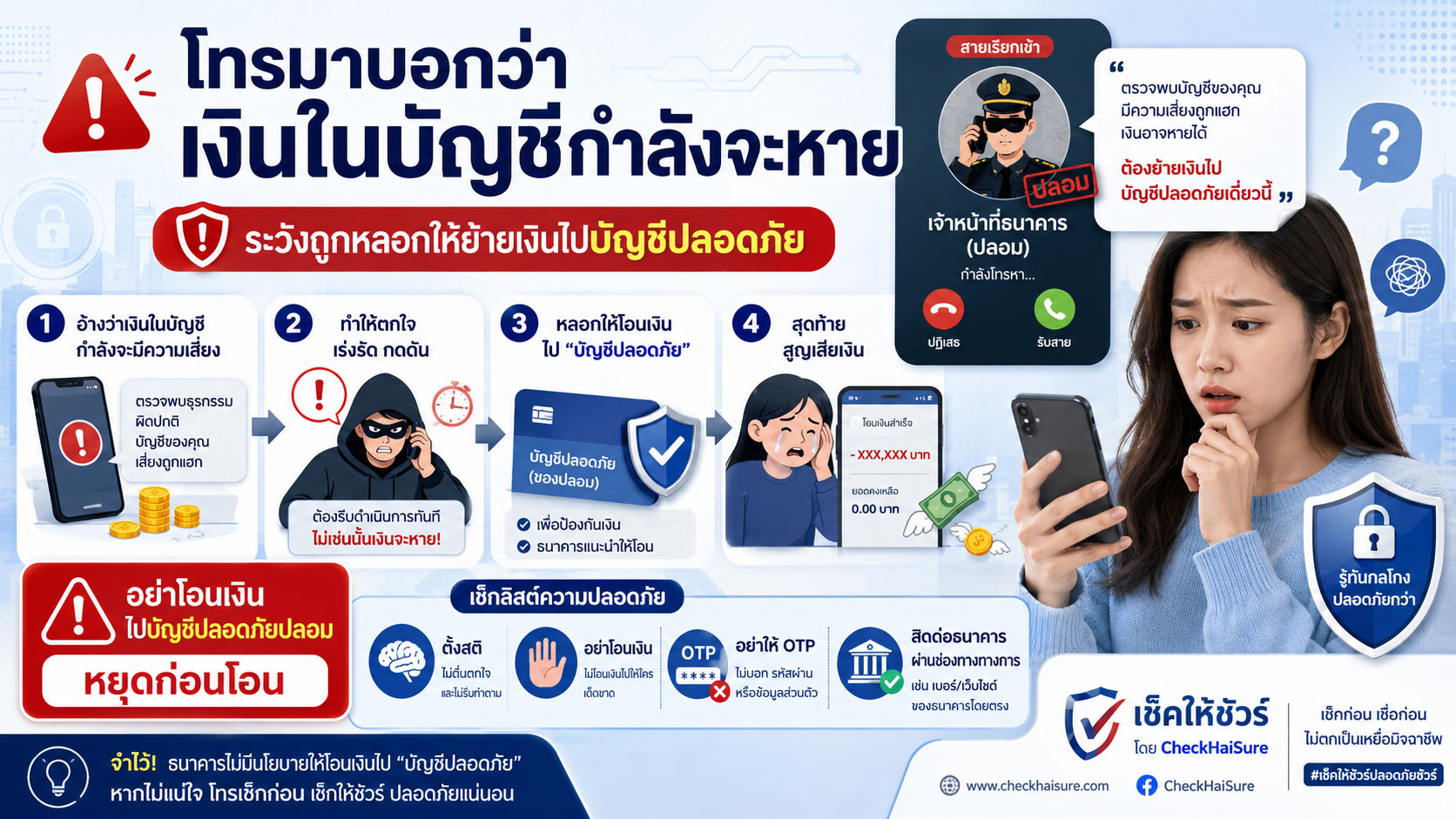
“มีคนกำลังพยายามถอนเงินจากบัญชีของคุณ”
“บัญชีคุณไม่ปลอดภัยแล้ว”
“พบธุรกรรมผิดปกติ ต้องรีบย้ายเงินออกก่อน”
“ถ้าช้ากว่านี้ เงินอาจหายทั้งหมด”
“ให้โอนเงินไปบัญชีปลอดภัยก่อน เดี๋ยวตรวจสอบเสร็จจะโอนคืน”
ถ้าได้รับสายแบบนี้ หลายคนอาจตกใจทันที
เพราะเรื่องเงินในบัญชีเป็นเรื่องที่ทำให้คนกลัวได้เร็วมาก
เงินนั้นอาจเป็นเงินเดือน
เงินเก็บทั้งชีวิต
เงินที่เตรียมจ่ายหนี้
เงินที่เก็บไว้ให้ลูก
เงินค่ารักษาพยาบาล
หรือเงินหมุนเวียนของครอบครัว
แค่มีคนบอกว่า “เงินกำลังจะหาย” สมองเราอาจเริ่มคิดหาทางป้องกันทันที
และมิจฉาชีพก็รู้ดีว่า ถ้าทำให้เรากลัวเรื่องเงินได้เร็วพอ เราอาจรีบทำตามก่อนจะทันตรวจสอบ
เขาจึงไม่ได้ขอเงินตรงๆ เสมอไป
แต่จะพูดเหมือนกำลังช่วยเรา “ปกป้องเงิน”
ให้รีบย้ายเงิน
ให้โอนไปบัญชีกลาง
ให้โอนไปบัญชีปลอดภัย
ให้ทำรายการเพื่อหยุดความเสียหาย
หรือให้กดตามขั้นตอนเพื่อรักษาเงินในบัญชี
ฟังดูเหมือนเป็นการช่วยเหลือ
แต่ความจริง เงินที่โอนออกจากบัญชีเราไปแล้ว อาจไม่ได้ปลอดภัยขึ้น
มันอาจหายไปจริงๆ จากคำสั่งของคนที่บอกว่าจะช่วยเรา
จำไว้ว่า
เงินที่ปลอดภัยที่สุด คือเงินที่ยังอยู่ในบัญชีเรา จนกว่าเราจะตรวจสอบกับธนาคารเอง
ทำไมคำว่า “เงินในบัญชีกำลังจะหาย” ถึงทำให้คนรีบ
เพราะไม่มีใครอยากเสียเงินที่ตัวเองเก็บมา
เมื่อมีคนโทรมาบอกว่าเงินในบัญชีกำลังเสี่ยง สมองเรามักเข้าสู่โหมดฉุกเฉินทันที
เราอาจไม่ได้คิดว่า “คนนี้เป็นใคร”
แต่อาจคิดก่อนว่า
“ต้องทำยังไงให้เงินไม่หาย”
“ถ้าช้าไปจะทำอย่างไร”
“ถ้าเงินถูกถอนออกไปหมดจะตามคืนได้ไหม”
“ถ้าไม่ทำตามตอนนี้จะเสียโอกาสป้องกันไหม”
มิจฉาชีพใช้ความกลัวตรงนี้สร้างแรงกดดัน
เขาอาจพูดเร็วขึ้น
ทำเสียงจริงจัง
บอกว่าระบบกำลังแจ้งเตือน
บอกว่าเวลามีจำกัด
บอกว่าต้องทำเดี๋ยวนี้
หรือบอกว่าถ้าวางสายจะช่วยไม่ทัน
ทั้งหมดนี้มีเป้าหมายเดียว คือทำให้เราไม่มีเวลาตรวจสอบ
เพราะถ้าเราได้หยุดคิดสักนาที เราอาจเริ่มสงสัยว่า
ทำไมธนาคารต้องให้เราโอนเงินออกเอง
ทำไมต้องโอนไปบัญชีที่ไม่ใช่ชื่อเรา
ทำไมต้องทำผ่านสายโทรศัพท์
ทำไมถึงห้ามวางสาย
ทำไมถึงไม่ให้เราโทรกลับธนาคารเอง
คำถามเหล่านี้คือสิ่งที่มิจฉาชีพไม่อยากให้เราได้คิด
“บัญชีปลอดภัย” อาจไม่ปลอดภัยสำหรับเรา
คำว่า “บัญชีปลอดภัย” ฟังดูดีมาก
มันทำให้เรารู้สึกว่าเงินจะถูกย้ายไปไว้ในที่ที่ปลอดภัยกว่า
แต่ในกลโกงคอลเซ็นเตอร์ คำนี้มักเป็นเพียงชื่อที่มิจฉาชีพตั้งขึ้น เพื่อทำให้การโอนเงินดูสมเหตุสมผล
เขาอาจเรียกบัญชีนั้นว่า
บัญชีปลอดภัย
บัญชีกลาง
บัญชีพักเงิน
บัญชีตรวจสอบ
บัญชีสำรอง
บัญชีอายัดชั่วคราว
หรือบัญชีของเจ้าหน้าที่
แต่ไม่ว่าจะเรียกชื่ออย่างไร ถ้าบัญชีนั้นถูกบอกมาจากคนปลายสาย และให้เรารีบโอนเงินเข้าไป ให้สงสัยไว้ก่อนว่าอาจเป็นบัญชีม้าหรือบัญชีที่มิจฉาชีพควบคุมอยู่
เงินที่โอนออกไปแล้ว อาจถูกโอนต่อภายในเวลาไม่นาน
อาจถูกถอนออก
อาจถูกกระจายไปหลายบัญชี
อาจถูกแปลงเป็นทรัพย์สินอื่น
หรืออาจตามกลับมายากมาก
ดังนั้น อย่าให้คำว่า “ปลอดภัย” ทำให้ลืมตรวจสอบว่าเงินกำลังไปอยู่ที่ไหน
ธนาคารจริงไม่ควรให้คุณโอนเงินไปบัญชีแปลกๆ เพื่อป้องกันเงินหาย
ถ้าบัญชีธนาคารมีความเสี่ยงจริง ธนาคารควรมีวิธีตรวจสอบผ่านช่องทางทางการ
เช่น แอปธนาคาร
Call Center ทางการ
สาขาธนาคาร
การระงับบัญชี
การตรวจสอบธุรกรรม
หรือขั้นตอนความปลอดภัยของธนาคารเอง
แต่สิ่งที่ไม่ควรเกิดขึ้นคือ มีคนโทรมาแล้วสั่งให้คุณโอนเงินไปบัญชีอื่น โดยบอกว่าจะช่วยรักษาเงินให้
เพราะถ้าเงินยังอยู่ในบัญชีของคุณ ธนาคารยังสามารถตรวจสอบบัญชีของคุณได้
แต่ถ้าคุณโอนเงินออกไปเองตามคำสั่งของคนปลายสาย เงินนั้นอาจไม่อยู่ในพื้นที่ปลอดภัยอีกต่อไป
อย่าลืมว่า มิจฉาชีพไม่ได้ต้องขโมยเงินจากบัญชีด้วยเทคนิคซับซ้อนเสมอไป
บางครั้งเขาใช้วิธีง่ายที่สุด คือทำให้คุณกลัว แล้วให้คุณเป็นคนกดโอนด้วยตัวเอง
สัญญาณเตือนของสาย “เงินกำลังจะหาย”
ถ้ามีคนโทรมาอ้างว่าเงินในบัญชีกำลังจะหาย ให้ระวังมากเป็นพิเศษเมื่อมีพฤติกรรมเหล่านี้
บอกว่ามีคนกำลังถอนเงินจากบัญชีของคุณ
บอกว่าบัญชีถูกแฮ็ก
บอกว่าพบธุรกรรมผิดปกติ แต่ไม่ให้คุณตรวจสอบเอง
บอกว่าต้องรีบย้ายเงินออก
ให้โอนเงินไปบัญชีปลอดภัย
ให้โอนเงินไปบัญชีกลางหรือบัญชีตรวจสอบ
ให้ทำรายการในขณะที่ยังอยู่ในสาย
บอกว่าห้ามวางสาย
บอกว่าห้ามโทรหาธนาคารเอง
บอกว่าห้ามบอกคนในบ้าน
ขอให้เปิดแอปธนาคาร
ให้กดตามขั้นตอนที่เจ้าหน้าที่บอก
ขอ OTP หรือรหัสยืนยัน
ให้แชร์หน้าจอ
ให้ติดตั้งแอปเพื่อให้เจ้าหน้าที่ช่วยตรวจสอบ
หรือบอกว่าถ้าไม่ทำตอนนี้ เงินจะหายทั้งหมด
ถ้ามีหนึ่งหรือหลายข้อในนี้ ให้หยุดทันที
อย่าทำรายการต่อ
อย่าโอนเงิน
อย่าให้รหัส
อย่าเปิดแอปธนาคารให้เขาชี้นำ
และอย่าเชื่อว่าการรีบทำตามคือทางเดียวที่จะรักษาเงินไว้
อย่าเปิดแอปธนาคารแล้วทำรายการในขณะที่ยังอยู่ในสาย
มิจฉาชีพบางคนจะไม่ขอให้คุณโอนเงินตรงๆ ตั้งแต่แรก
แต่จะพาคุณไปเปิดแอปธนาคาร แล้วค่อยบอกให้กดทีละขั้นตอน
เขาอาจใช้คำพูดเช่น
“กดเพื่อยืนยันว่าไม่ใช่ธุรกรรมของคุณ”
“กดเพื่อยกเลิกรายการที่กำลังเกิดขึ้น”
“กดเพื่อระงับการโอน”
“กดเพื่อย้ายเงินไปพักชั่วคราว”
“ระบบจะไม่ตัดเงินจริง เป็นเพียงการตรวจสอบ”
ปัญหาคือ คนที่กำลังกลัวอาจไม่ได้อ่านทุกข้อความบนหน้าจออย่างละเอียด
เขาอาจคิดว่ากำลังกดยกเลิก ทั้งที่จริงกำลังกดยืนยัน
เขาอาจคิดว่ากำลังป้องกันเงินหาย ทั้งที่จริงกำลังโอนเงินออก
เขาอาจคิดว่าทำตามเจ้าหน้าที่ แต่จริงๆ กำลังทำตามมิจฉาชีพ
ดังนั้น ถ้าคนปลายสายให้เปิดแอปธนาคารและทำรายการ ให้หยุดทันที
การทำธุรกรรมทางการเงินควรเกิดขึ้นเมื่อเรามีสติ อ่านเอง เข้าใจเอง และตรวจสอบช่องทางเอง
ไม่ใช่ทำภายใต้แรงกดดันจากคนในสาย
อย่าให้ OTP แม้อีกฝ่ายบอกว่าใช้เพื่อหยุดการโอน
มิจฉาชีพอาจบอกว่า OTP จำเป็นสำหรับการหยุดรายการที่ผิดปกติ
เช่น
“ระบบส่ง OTP เพื่อยืนยันการระงับบัญชี”
“อ่านรหัสเพื่อยกเลิกธุรกรรม”
“ขอรหัสเพื่อหยุดคนร้ายไม่ให้ถอนเงิน”
“ต้องใช้ OTP เพื่อยืนยันว่าเจ้าของบัญชีตัวจริงต้องการป้องกันบัญชี”
คำพูดเหล่านี้ฟังดูเหมือนเป็นขั้นตอนความปลอดภัย
แต่ OTP คือรหัสที่ไม่ควรบอกใคร
รหัสนี้อาจถูกใช้ยืนยันธุรกรรม
เข้าสู่ระบบ
เปลี่ยนข้อมูล
ผูกอุปกรณ์
หรืออนุมัติบางอย่างแทนเรา
ถ้ามีคนขอ OTP จากคุณ ไม่ว่าจะอ้างเหตุผลว่าอะไร ให้ถือว่าอันตรายทันที
OTP คือกุญแจ ไม่ใช่เครื่องมือให้คนปลายสายช่วยรักษาเงิน
ระวังการแชร์หน้าจอและแอปควบคุมมือถือ
บางสายอาจพัฒนาไปไกลกว่าการบอกให้โอนเงิน
เขาอาจให้ติดตั้งแอป
ให้แชร์หน้าจอ
ให้เปิดสิทธิ์การเข้าถึง
ให้ยืนยันตัวตนผ่านกล้อง
หรือให้เจ้าหน้าที่ “ช่วยดูหน้าจอ” เพื่อแก้ปัญหา
ถ้าคุณแชร์หน้าจอขณะเปิดแอปธนาคาร อีกฝ่ายอาจเห็นข้อมูลสำคัญ
ถ้าคุณติดตั้งแอปควบคุมมือถือ อีกฝ่ายอาจช่วยกดหรือควบคุมบางอย่างได้
ถ้าคุณเปิดสิทธิ์มากเกินไป มือถือของคุณอาจไม่ใช่พื้นที่ส่วนตัวเหมือนเดิม
และถ้าคุณทำสิ่งเหล่านี้ในขณะที่กำลังกลัว โอกาสพลาดจะสูงขึ้นมาก
ธนาคารจริงไม่ควรต้องควบคุมมือถือของคุณเพื่อรักษาเงินในบัญชี
ถ้ามีคำว่า “แชร์หน้าจอ” “ติดตั้งแอป” หรือ “ให้เจ้าหน้าที่ช่วยดูมือถือ” ให้หยุดทันที
ถ้าเงินกำลังเสี่ยงจริง ควรทำอย่างไร
ถ้าคุณได้รับสายแบบนี้และกังวลว่าอาจมีความเสี่ยงจริง ให้ใช้วิธีที่ปลอดภัยกว่า
วางสายก่อน
อย่าโอนเงินตามคำสั่งคนปลายสาย
อย่ากดลิงก์
อย่าให้ OTP
อย่าเปิดแอปธนาคารขณะคุยกับเขา
จากนั้นติดต่อธนาคารผ่านช่องทางทางการด้วยตัวเอง
เช่น
แอปธนาคารที่ติดตั้งจาก Store ทางการ
เว็บไซต์ธนาคารที่คุณพิมพ์เอง
เบอร์ Call Center หลังบัตร
เบอร์จากเว็บไซต์ทางการของธนาคาร
หรือสาขาธนาคาร
เมื่อคุยกับธนาคาร ให้เล่าให้ชัดว่า มีคนโทรมาอ้างว่าเงินในบัญชีกำลังจะหาย และให้ย้ายเงินไปบัญชีปลอดภัย
ถ้ามีธุรกรรมผิดปกติจริง ธนาคารจะตรวจสอบผ่านระบบของธนาคาร
แต่ถ้าไม่มี ธนาคารก็จะช่วยยืนยันได้ว่าสายที่โทรมานั้นน่าสงสัย
สิ่งสำคัญคือ ให้เราเป็นคนเริ่มช่องทางตรวจสอบเอง ไม่ใช่ใช้ช่องทางที่มิจฉาชีพส่งมา
อย่าใช้เบอร์ ลิงก์ หรือ LINE ที่คนปลายสายให้มา
มิจฉาชีพมักเตรียมฉากไว้ต่อเนื่อง
ถ้าเราบอกว่าจะตรวจสอบ เขาอาจให้เบอร์ Call Center ปลอม
ส่งลิงก์เว็บไซต์ปลอม
ให้เพิ่ม LINE เจ้าหน้าที่ปลอม
หรือโอนสายไปอีกคนที่รับบทเป็นฝ่ายความปลอดภัย
ทุกอย่างอาจดูเหมือนเป็นระบบ
แต่ถ้าแหล่งที่มาของช่องทางเหล่านั้นมาจากคนปลายสายคนเดิม ก็ยังไม่น่าเชื่อถือ
การตรวจสอบที่ปลอดภัยคือการใช้ช่องทางที่คุณหาเองจากแหล่งที่เชื่อถือได้
ไม่ใช่ช่องทางที่คนที่คุณกำลังสงสัยเตรียมไว้ให้
จำไว้ว่า
อย่าใช้เส้นทางของมิจฉาชีพเพื่อตรวจสอบมิจฉาชีพ
ถ้าเผลอโอนเงินไปบัญชีปลอดภัยแล้ว
ถ้าคุณเผลอโอนเงินไปแล้ว ให้หยุดทันที
อย่าโอนเพิ่ม
มิจฉาชีพอาจบอกว่า
“ต้องโอนส่วนที่เหลือเพื่อให้ระบบตรวจสอบครบ”
“โอนผิดขั้นตอน ต้องทำใหม่”
“ต้องจ่ายค่าปลดล็อก”
“ต้องโอนเพิ่มเพื่อคืนเงินทั้งหมด”
“ถ้าไม่ทำต่อ เงินก้อนแรกจะหาย”
อย่าเชื่อ
การโอนเพิ่มมักทำให้ความเสียหายมากขึ้น
ให้เก็บหลักฐานทั้งหมด เช่น
เบอร์โทร
แชท
ลิงก์
เลขบัญชีปลายทาง
ชื่อบัญชี
สลิปโอนเงิน
วันและเวลา
คำพูดที่เขาใช้กดดัน
และขั้นตอนที่เขาให้ทำ
จากนั้นรีบติดต่อธนาคารผ่านช่องทางทางการ
แจ้งว่าคุณสงสัยว่าถูกหลอกให้โอนเงินไปบัญชีที่อ้างว่าเป็นบัญชีปลอดภัย
หากมีการติดตั้งแอปหรือแชร์หน้าจอ ให้หยุดใช้มือถือเครื่องนั้นทำธุรกรรมสำคัญก่อน และขอความช่วยเหลือจากคนที่ไว้ใจได้
อย่าลบหลักฐานเพราะอาย
ยิ่งหยุดเร็ว ยิ่งมีโอกาสจำกัดความเสียหายได้มากขึ้น
ควรคุยกับคนในบ้านเรื่อง “บัญชีปลอดภัย” ไว้ก่อน
หลายคนอาจไม่เคยได้ยินคำว่า “บัญชีปลอดภัย” ในรูปแบบของมิจฉาชีพ
จึงควรคุยกันในครอบครัวไว้ล่วงหน้า
โดยเฉพาะกับผู้สูงอายุ คนที่อยู่คนเดียว หรือคนที่ใช้ Mobile Banking แต่ไม่ค่อยรู้กลโกงใหม่ๆ
อาจตกลงกันง่ายๆ ว่า
ถ้ามีคนโทรมาบอกว่าเงินกำลังจะหาย ให้ไม่ต้องรีบทำตาม
ถ้าเขาให้โอนเงินไปบัญชีปลอดภัย ให้ไม่โอน
ถ้าเขาบอกว่าห้ามวางสาย ให้ยิ่งต้องวาง
ถ้าเขาห้ามบอกคนในบ้าน ให้ยิ่งต้องบอก
ถ้าเขาขอ OTP ให้ไม่ให้
ถ้าเขาให้เปิดแอปธนาคาร ให้หยุด
ถ้าเขาให้ติดตั้งแอปหรือแชร์หน้าจอ ให้ไม่ทำตาม
และถ้าไม่แน่ใจ ให้โทรหาคนในบ้านหรือธนาคารผ่านช่องทางทางการก่อนเสมอ
ข้อตกลงง่ายๆ แบบนี้อาจช่วยให้คนที่กำลังตกใจมีทางออกก่อนตัดสินใจโอนเงิน
อย่าโทษตัวเองถ้าคุณเคยกลัวคำว่าเงินกำลังจะหาย
ถ้าคุณเคยได้รับสายลักษณะนี้แล้วตกใจ นั่นเป็นเรื่องเข้าใจได้
คนส่วนใหญ่จะกลัวเมื่อได้ยินว่าเงินในบัญชีไม่ปลอดภัย
เพราะเงินไม่ใช่แค่ตัวเลข
มันคือเวลา
แรงงาน
ความเหนื่อย
ความหวัง
ความรับผิดชอบ
และความมั่นคงของครอบครัว
มิจฉาชีพเลือกใช้คำนี้เพราะรู้ว่ามันกระทบใจคนจริงๆ
สิ่งสำคัญไม่ใช่การไม่เคยกลัว
แต่คือเมื่อเริ่มกลัว ให้หยุดก่อน
อย่าตัดสินใจเรื่องเงินในนาทีที่ถูกเร่ง
อย่าโอนเงินเพราะเสียงปลายสายบอกว่าต้องทำตอนนี้
และอย่าลืมว่า ถ้าเงินอยู่ในบัญชีเรา เรายังมีเวลาตรวจสอบกับธนาคารได้
ประโยคที่ควรจำ: เงินที่ปลอดภัยที่สุด คือเงินที่ยังอยู่ในบัญชีเรา
ถ้าต้องจำประโยคเดียวจากบทความนี้ ขอให้จำว่า
เงินที่ปลอดภัยที่สุด คือเงินที่ยังอยู่ในบัญชีเรา จนกว่าเราจะตรวจสอบกับธนาคารเอง
ถ้ามีคนบอกว่าเงินกำลังจะหาย ให้หยุดก่อน
ถ้ามีคนให้ย้ายเงินไปบัญชีปลอดภัย ให้สงสัยทันที
ถ้ามีคนบอกว่าต้องทำตอนนี้เท่านั้น ให้ถอยออกมา
ถ้ามีคนขอ OTP ให้ไม่ให้
ถ้ามีคนให้เปิดแอปธนาคารแล้วกดตาม ให้หยุด
และถ้ามีคนห้ามวางสาย ให้จำไว้ว่า เขาอาจกลัวคุณโทรหาธนาคารจริง
สรุป: อย่าให้ความกลัวเรื่องเงิน ทำให้เราเป็นคนโอนเงินออกไปเอง
กลโกง “เงินในบัญชีกำลังจะหาย” อันตรายเพราะมันทำให้เหยื่อรู้สึกว่ากำลังป้องกันตัวเอง
แต่จริงๆ แล้วอาจกำลังทำตามแผนของมิจฉาชีพ
จากความกลัวว่าเงินจะหาย
กลายเป็นการเปิดแอปธนาคาร
จากการเปิดแอป
กลายเป็นการกดตามคำสั่ง
จากการกดตาม
กลายเป็นการโอนเงินไปบัญชีปลอดภัย
และจากบัญชีปลอดภัย
เงินอาจหายไปจริงๆ
สิ่งที่ควรทำคือหยุดก่อน
อย่าโอนเงินตามคำสั่งคนปลายสาย
อย่าให้ OTP
อย่ากดลิงก์
อย่าเปิดแอปธนาคารแล้วกดตาม
อย่าแชร์หน้าจอ
อย่าติดตั้งแอป
อย่าใช้เบอร์หรือ LINE ที่เขาส่งมา
และอย่าอยู่ในสายเพราะเขาบอกว่าห้ามวาง
ให้วางสาย แล้วติดต่อธนาคารผ่านช่องทางทางการด้วยตัวเอง
ถ้าเงินมีปัญหาจริง ธนาคารจริงยังตรวจสอบได้
แต่ถ้าเป็นมิจฉาชีพ การไม่โอนเงินออกไป อาจเป็นสิ่งที่ช่วยรักษาเงินของคุณไว้ได้มากที่สุด
A Call Says Your Money Is About to Disappear: Beware of Being Tricked into Moving It to a “Safe Account”
“Someone is trying to withdraw money from your account.”
“Your account is no longer safe.”
“We found suspicious activity. You must move your money out immediately.”
“If you wait too long, all your money may disappear.”
“Transfer the money to a safe account first. Once verification is complete, it will be returned.”
If you receive a call like this, many people may panic immediately.
Money in a bank account is not just money.
It may be your salary.
Your life savings.
Money prepared for debt payments.
Money saved for your child.
Money for medical expenses.
Or the cash flow your family depends on.
Just hearing that “your money is about to disappear” can make your mind search for a way to protect it immediately.
Scammers know this very well.
If they can make you afraid about your money quickly enough, you may follow their instructions before you have time to check.
They may not directly say, “Send us your money.”
Instead, they may make it sound like they are helping you “protect your money.”
Move the money quickly.
Transfer it to a central account.
Send it to a safe account.
Complete a transaction to stop the damage.
Follow these steps to protect the money in your account.
It may sound like help.
But in reality, once the money leaves your account, it may not become safer.
It may disappear because of the very person who claimed to be helping you.
Remember this:
The safest money is the money that stays in your own account until you verify the situation with your bank yourself.
Why the Words “Your Money Is About to Disappear” Make People Act Quickly
No one wants to lose the money they worked hard to save.
When someone calls and says your account is at risk, your mind may immediately enter emergency mode.
You may not first think, “Who is this person?”
Instead, you may think:
“How do I stop the money from disappearing?”
“What if I am too late?”
“If the money is withdrawn, can I get it back?”
“If I do not act now, will I lose the chance to protect it?”
Scammers use this fear to create pressure.
They may speak faster.
Use a serious tone.
Say the system is showing an alert.
Say time is limited.
Say it must be done now.
Or say that if you hang up, they will not be able to help in time.
All of this has one goal: to stop you from verifying.
Because if you pause for even one minute, you may start asking:
Why would the bank need me to transfer money out by myself?
Why must I transfer to an account that is not mine?
Why must this be done by phone?
Why am I not allowed to hang up?
Why am I not allowed to call the bank myself?
These are the questions scammers do not want you to ask.
A “Safe Account” May Not Be Safe for You
The phrase “safe account” sounds reassuring.
It makes people feel that money is being moved somewhere safer.
But in call center scams, this phrase is often just a name scammers use to make the transfer sound reasonable.
They may call it:
A safe account
A central account
A holding account
A verification account
A backup account
A temporary frozen account
Or an officer’s account
No matter what name they use, if the account number comes from the person on the phone and they pressure you to transfer money into it, assume it may be a mule account or an account controlled by scammers.
Once the money is transferred, it may be moved again very quickly.
It may be withdrawn.
It may be split across several accounts.
It may be converted into other assets.
Or it may become very difficult to trace back.
Do not let the word “safe” make you forget to check where your money is actually going.
A Real Bank Should Not Ask You to Transfer Money to a Strange Account to Protect It
If your bank account is truly at risk, the bank should have official ways to verify and respond.
For example:
The official banking app
The official call center
A bank branch
Account suspension procedures
Transaction investigation
Or the bank’s own security process
What should not happen is someone calling you and telling you to transfer money to another account because they will “protect it” for you.
If your money remains in your own account, your bank can still check your account.
But if you transfer money out under the caller’s instructions, that money may no longer be in a safe place.
Scammers do not always need advanced techniques to steal from your account.
Sometimes they use the simplest method:
They make you afraid, then make you press the transfer button yourself.
Warning Signs of the “Your Money Is About to Disappear” Call
If someone calls and claims that money in your account is about to disappear, be especially careful if they do any of the following:
They say someone is trying to withdraw money from your account.
They say your account has been hacked.
They claim suspicious transactions were found but do not let you verify by yourself.
They say you must move your money out immediately.
They tell you to transfer money to a safe account.
They tell you to transfer money to a central account or verification account.
They ask you to complete transactions while still on the call.
They tell you not to hang up.
They tell you not to call the bank yourself.
They tell you not to tell anyone at home.
They ask you to open your banking app.
They tell you to follow the officer’s steps.
They ask for an OTP or verification code.
They ask you to share your screen.
They tell you to install an app so the officer can help check.
Or they say that if you do not act now, all your money will disappear.
If one or more of these signs appear, stop immediately.
Do not continue the transaction.
Do not transfer money.
Do not share codes.
Do not open your banking app while being guided by the caller.
And do not believe that rushing to follow their instructions is the only way to protect your money.
Do Not Open Your Banking App and Make Transactions While Still on the Call
Some scammers do not ask you to transfer money directly at first.
They may guide you to open your banking app, then tell you to tap step by step.
They may say:
“Tap here to confirm that this transaction is not yours.”
“Tap here to cancel the transaction.”
“Tap here to block the transfer.”
“Tap here to move the money temporarily.”
“The system will not deduct real money. It is only checking.”
The problem is that when people are afraid, they may not carefully read every message on the screen.
You may think you are canceling something when you are actually confirming it.
You may think you are protecting your money when you are actually transferring it out.
You may think you are following an officer when you are actually following a scammer.
So if the caller asks you to open your banking app and make any transaction, stop immediately.
Financial transactions should happen when you are calm, can read everything yourself, understand what is happening, and verify the channel yourself.
Not under pressure from someone on the phone.
Do Not Share an OTP, Even If They Say It Is Needed to Stop a Transfer
Scammers may say that an OTP is needed to stop a suspicious transaction.
For example:
“The system sent an OTP to confirm account suspension.”
“Read the code to cancel the transaction.”
“We need the code to stop the criminal from withdrawing money.”
“The OTP confirms that the real account owner wants to protect the account.”
These words may sound like a security process.
But an OTP is a code you should not tell anyone.
It may be used to confirm a transaction.
Log in to an account.
Change information.
Link a device.
Or approve something on your behalf.
If anyone asks for your OTP, no matter what reason they give, treat it as a danger sign immediately.
An OTP is a key, not a tool for a caller to protect your money.
Be Careful with Screen Sharing and Remote Control Apps
Some calls may go further than asking you to transfer money.
They may ask you to install an app.
Share your screen.
Allow accessibility permissions.
Verify yourself through camera.
Or let an “officer” help look at your phone screen.
If you share your screen while opening your banking app, the caller may see sensitive information.
If you install a remote control app, the other person may be able to help tap or control some actions.
If you allow too many permissions, your phone may no longer be fully private.
And if you do these things while afraid, the chance of making a mistake becomes much higher.
A real bank should not need to control your phone to protect the money in your account.
If you hear “share your screen,” “install this app,” or “let the officer look at your phone,” stop immediately.
If Your Money Is Truly at Risk, What Should You Do?
If you receive this kind of call and worry that the risk may be real, choose the safer path.
Hang up first.
Do not transfer money based on the caller’s instructions.
Do not click links.
Do not share OTPs.
Do not open your banking app while talking to them.
Then contact your bank through official channels yourself.
Use channels such as:
The banking app installed from an official app store
The bank website you type yourself
The call center number on the back of your card
The number from the bank’s official website
Or a bank branch
When speaking with the bank, explain clearly that someone called claiming money in your account was about to disappear and asked you to move it to a safe account.
If there really is suspicious activity, the bank can check through its own system.
If there is no issue, the bank can help confirm that the call was suspicious.
The important point is that you should be the one who starts the verification through a trusted channel.
Do not use a channel the scammer sends to you.
Do Not Use the Phone Number, Link, or LINE Account Given by the Caller
Scammers often prepare a full setup.
If you say you want to check, they may provide a fake call center number.
Send a fake website link.
Ask you to add a fake LINE officer.
Or transfer the call to another person pretending to be a security department.
Everything may look organized.
But if the source of those channels is the same caller, they are still not trustworthy.
Safe verification means using a channel you find yourself from a reliable source.
Not a channel prepared by the person you are trying to verify.
Remember this:
Do not use the scammer’s route to verify the scammer.
If You Already Transferred Money to a “Safe Account”
If you already transferred money, stop immediately.
Do not transfer more.
Scammers may say:
“You must transfer the rest so the system can complete the verification.”
“You did it in the wrong step. You need to do it again.”
“You must pay an unlocking fee.”
“You must transfer more to return the full amount.”
“If you do not continue, the first amount will disappear.”
Do not believe this.
Transferring more usually increases the damage.
Save all evidence, such as:
Phone number
Chat messages
Links
Destination account number
Account name
Transfer slip
Date and time
Words they used to pressure you
And the steps they told you to follow
Then contact your bank through official channels immediately.
Tell them you suspect you were tricked into transferring money to an account that was claimed to be a “safe account.”
If you installed an app or shared your screen, stop using that phone for important transactions and ask someone you trust for help.
Do not delete evidence because you feel embarrassed.
The faster you stop, the better chance you have of limiting the damage.
Talk with Your Family About “Safe Account” Scams Before It Happens
Many people may not know that scammers use the phrase “safe account.”
It is worth discussing this with family members in advance.
Especially elderly people, people who live alone, or people who use mobile banking but may not know newer scam tactics.
You can agree on simple rules:
If someone calls and says money is about to disappear, do not rush to follow them.
If they ask you to transfer money to a safe account, do not transfer.
If they tell you not to hang up, that is even more reason to hang up.
If they tell you not to tell anyone at home, tell someone at home immediately.
If they ask for an OTP, do not provide it.
If they ask you to open your banking app, stop.
If they ask you to install an app or share your screen, do not do it.
And if you are unsure, call someone in the family or contact the bank through official channels first.
Simple agreements like these can give someone who is panicking a way out before making a transfer.
Do Not Blame Yourself If the Words “Your Money Is About to Disappear” Scared You
If you have ever received this kind of call and felt afraid, that is understandable.
Most people would be afraid if they heard that the money in their account was not safe.
Money is not just a number.
It represents time.
Work.
Tiredness.
Hope.
Responsibility.
And family stability.
Scammers use this fear because they know it touches people deeply.
The key is not to never feel afraid.
The key is to stop when fear begins.
Do not make financial decisions in the minute you are being rushed.
Do not transfer money because a voice on the phone says it must be done now.
And remember: if your money is still in your account, you still have time to check with your bank.
A Sentence to Remember: The Safest Money Is the Money Still in Your Own Account
If you remember only one sentence from this article, remember this:
The safest money is the money that stays in your own account until you verify the situation with your bank yourself.
If someone says your money is about to disappear, pause first.
If someone asks you to move money to a safe account, be suspicious immediately.
If someone says it must be done right now, step back.
If someone asks for an OTP, do not give it.
If someone tells you to open your banking app and follow instructions, stop.
And if someone tells you not to hang up, remember that they may be afraid you will call the real bank.
Conclusion: Do Not Let Fear About Money Make You Transfer It Out Yourself
The “your money is about to disappear” scam is dangerous because it makes victims feel that they are protecting themselves.
But in reality, they may be following the scammer’s plan.
Fear that the money will disappear becomes opening the banking app.
Opening the app becomes following instructions.
Following instructions becomes transferring money to a “safe account.”
And from that “safe account,” the money may truly disappear.
The right response is to stop first.
Do not transfer money based on the caller’s instructions.
Do not share OTPs.
Do not click links.
Do not open your banking app and follow instructions.
Do not share your screen.
Do not install apps.
Do not use the phone number or LINE account they send.
And do not stay on the call because they tell you not to hang up.
Hang up, then contact your bank through official channels yourself.
If there is a real problem, the real bank can still verify it.
But if it is a scam, refusing to transfer the money out may be the most important thing that protects it.

Leave a Reply
You must be logged in to post a comment.