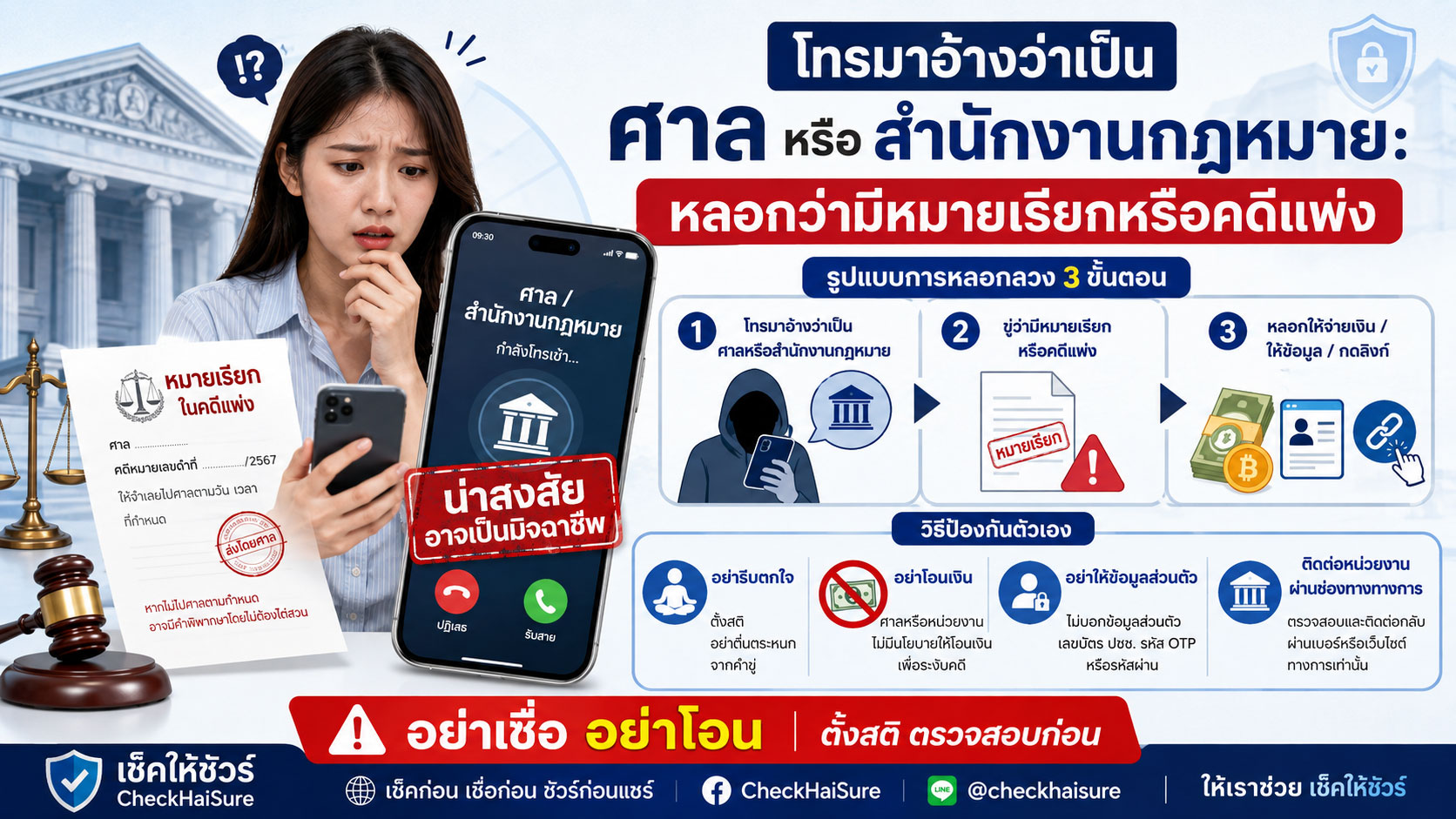
“คุณมีหมายเรียกจากศาล”
“มีคดีแพ่งอยู่ในชื่อคุณ ต้องรีบติดต่อกลับ”
“ถ้าไม่ดำเนินการวันนี้ อาจมีการออกหมายบังคับคดี”
“สามารถไกล่เกลี่ยได้ แต่ต้องชำระค่าดำเนินการก่อน”
“ถ้าอยากปิดเรื่องเงียบๆ ให้โอนเงินเข้าบัญชีนี้”
ถ้าได้รับสายแบบนี้ หลายคนอาจใจหายทันที
เพราะคำว่า “ศาล” “หมายเรียก” “คดีแพ่ง” หรือ “สำนักงานกฎหมาย” เป็นคำที่ฟังดูจริงจังและน่ากลัว
บางคนไม่เคยมีเรื่องคดีมาก่อน
บางคนกลัวว่าจะถูกฟ้องโดยไม่รู้ตัว
บางคนกลัวว่าชื่อจะเสีย
บางคนกลัวว่าจะมีเอกสารส่งถึงบ้านหรือที่ทำงาน
บางคนกลัวว่าทรัพย์สินหรือบัญชีจะถูกอายัด
บางคนกลัวว่าถ้าปล่อยไว้ เรื่องจะใหญ่ขึ้น
มิจฉาชีพเข้าใจความกลัวนี้ดี
เขาจึงอาจโทรมาอ้างว่าเป็นเจ้าหน้าที่ศาล สำนักงานกฎหมาย ฝ่ายกฎหมายของบริษัท เจ้าหน้าที่ไกล่เกลี่ย เจ้าหน้าที่บังคับคดี หรือทนายความ แล้วบอกว่าเรามีหมายเรียก มีคดีแพ่ง มียอดหนี้ หรือมีเรื่องที่ต้องรีบจัดการ
จากนั้นจะค่อยๆ พาเราไปสู่การโอนเงิน กดลิงก์ ส่งเอกสาร ให้ข้อมูลส่วนตัว หรือเพิ่ม LINE เพื่อคุยกับ “เจ้าหน้าที่” ที่ตรวจสอบไม่ได้
จำไว้ว่า
คดีจริงต้องตรวจสอบผ่านช่องทางจริง ไม่ใช่โอนเงินเพื่อปิดเรื่องจากสายโทรศัพท์
ทำไมคำว่า “หมายศาล” ถึงทำให้คนกลัว
เพราะคนส่วนใหญ่ไม่อยากมีปัญหาทางกฎหมาย
ต่อให้ยังไม่รู้ว่าเรื่องจริงหรือไม่ แค่ได้ยินคำว่า “คดี” ก็ทำให้กังวลแล้ว
เราอาจเริ่มคิดว่า
ไปค้างจ่ายอะไรไว้หรือเปล่า
เคยเซ็นเอกสารอะไรโดยไม่รู้ตัวไหม
มีใครเอาชื่อเราไปใช้หรือไม่
เคยมีหนี้ที่ลืมไปแล้วไหม
มีสัญญาอะไรที่ยังไม่จบหรือเปล่า
ถ้าถูกฟ้องจริงต้องทำอย่างไร
จะมีตำรวจหรือเจ้าหน้าที่มาหาที่บ้านไหม
จะถูกอายัดบัญชีหรือทรัพย์สินหรือไม่
มิจฉาชีพไม่จำเป็นต้องมีข้อมูลจริงครบทั้งหมด
แค่ทำให้เราคิดว่า “หรือจะมีเรื่องจริง” ก็พอที่จะทำให้เราตกใจและยอมฟังต่อ
และเมื่อเรากลัว เขาจะเริ่มเร่งให้ทำตามขั้นตอนของเขา
รูปแบบที่มักใช้ในการหลอกเรื่องคดีแพ่ง
สายลักษณะนี้อาจมาได้หลายบทบาท
บางครั้งอ้างว่าเป็นเจ้าหน้าที่ศาล
บางครั้งอ้างว่าเป็นสำนักงานกฎหมาย
ฝ่ายกฎหมายของบริษัทใหญ่
บริษัทติดตามหนี้
ทนายความ
เจ้าหน้าที่ไกล่เกลี่ย
เจ้าหน้าที่บังคับคดี
หรือคนกลางที่ช่วยปิดคดี
เรื่องที่ใช้หลอกอาจมีหลายแบบ เช่น
มีหมายเรียกจากศาล
มีคดีแพ่งจากหนี้ที่ไม่รู้จัก
มีสัญญาค้างชำระ
มีค่าปรับจากบริการที่เราไม่ได้สมัคร
มีเอกสารทวงถามทางกฎหมาย
มีบริษัทฟ้องร้องเรา
มีคำสั่งบังคับคดี
หรือมีเอกสารจะส่งไปที่บ้านหรือที่ทำงาน
จากนั้นจะมีข้อเสนอเหมือนช่วยเรา
“สามารถปิดเรื่องได้”
“ยังไกล่เกลี่ยทัน”
“ถ้าชำระวันนี้จะไม่ส่งเรื่องต่อ”
“จ่ายค่าดำเนินการก่อนแล้วจะถอนเรื่อง”
“โอนเงินก้อนนี้แล้วคดีจะจบ”
ฟังดูเหมือนเป็นทางออก
แต่ถ้าเป็นทางออกที่เริ่มจากการโอนเงินเข้าบัญชีที่ตรวจสอบไม่ได้ ให้หยุดก่อนเสมอ
คำว่า “ไกล่เกลี่ย” อาจถูกใช้ให้ดูน่าเชื่อ
มิจฉาชีพมักใช้คำที่ฟังเหมือนภาษากฎหมาย
เช่น
ไกล่เกลี่ย
ประนีประนอม
บังคับคดี
หมายเรียก
หมายศาล
หนังสือทวงถาม
ค่าดำเนินการ
ค่าธรรมเนียมศาล
ค่าปิดคดี
หรือค่าถอนฟ้อง
คำเหล่านี้ทำให้คนฟังรู้สึกว่าอีกฝ่ายมีความรู้และน่าจะเป็นเจ้าหน้าที่จริง
แต่การใช้คำกฎหมายได้ ไม่ได้แปลว่าเป็นคนจากศาลหรือสำนักงานกฎหมายจริง
คำเหล่านี้หาอ่านได้
เอกสารปลอมทำได้
โลโก้ปลอมทำได้
ตราประทับปลอมทำได้
และน้ำเสียงจริงจังไม่ได้พิสูจน์ตัวตนของใคร
สิ่งที่ต้องดูคือเขาขอให้เราทำอะไร
ถ้าเขารีบให้โอนเงิน ขอข้อมูลส่วนตัว ขอ OTP ให้เพิ่ม LINE หรือห้ามวางสายไปตรวจสอบ ให้สงสัยไว้ก่อน
ระวัง “ค่าปิดเรื่อง” หรือ “ค่าถอนคดี” ที่จ่ายเข้าบัญชีบุคคล
จุดที่ต้องระวังมากคือบัญชีรับเงิน
ถ้าคนปลายสายอ้างว่าต้องจ่ายค่าปิดคดี ค่าทนาย ค่าศาล ค่าดำเนินการ หรือค่าถอนเรื่อง แต่ให้โอนเข้าบัญชีบุคคลธรรมดา ให้หยุดทันที
เช่น
ชื่อบัญชีเป็นชื่อคนทั่วไป
ชื่อบัญชีไม่ใช่สำนักงานกฎหมายที่ตรวจสอบได้
ชื่อบัญชีไม่ใช่หน่วยงานที่เกี่ยวข้อง
ชื่อบัญชีไม่ตรงกับบริษัทที่อ้าง
บอกว่าเป็นบัญชีของทนาย
บอกว่าเป็นบัญชีของเจ้าหน้าที่ศาล
บอกว่าเป็นบัญชีเคสเร่งด่วน
บอกว่าเป็นบัญชีกลาง
หรือบอกว่าโอนก่อนแล้วจะออกเอกสารให้ภายหลัง
มิจฉาชีพอาจพูดให้ดูเร่งด่วนว่า
“ต้องชำระก่อนระบบปิด”
“โอนวันนี้จะลดค่าปรับได้”
“ถ้าไม่โอนจะส่งเรื่องต่อศาล”
“บัญชีนี้เป็นช่องทางสำหรับเคสไกล่เกลี่ย”
“โอนแล้วจะออกหนังสือปิดคดีให้”
อย่าเชื่อทันที
คดีจริงหรือหนี้จริงควรมีเอกสารและช่องทางตรวจสอบที่ชัดเจน ไม่ใช่ให้โอนเงินตามคำสั่งจากคนที่โทรมาเอง
เอกสารที่ส่งผ่านแชทอาจเป็นเอกสารปลอม
เพื่อเพิ่มความน่าเชื่อถือ มิจฉาชีพอาจส่งเอกสารมาให้ดู
เช่น
หมายเรียกปลอม
หนังสือทวงถามปลอม
หนังสือจากสำนักงานกฎหมายปลอม
เอกสารค่าปรับปลอม
ใบแจ้งยอดหนี้ปลอม
เอกสารไกล่เกลี่ยปลอม
หนังสือบังคับคดีปลอม
หรือเอกสารที่มีโลโก้หน่วยงานและชื่อของเรา
เอกสารเหล่านี้อาจทำให้เราตกใจมาก
เพราะดูเหมือนเป็นเรื่องจริง มีชื่อ มีเลขอ้างอิง มีลายเซ็น หรือมีตราประทับ
แต่ต้องจำไว้ว่า เอกสารที่ส่งผ่านแชทไม่ได้แปลว่าเป็นของจริงเสมอไป
โลโก้ปลอมได้
ตราประทับปลอมได้
เลขเอกสารแต่งขึ้นได้
ลายเซ็นปลอมได้
ยอดเงินสร้างขึ้นได้
และคำกฎหมายใส่ให้ดูน่ากลัวได้
อย่าตรวจสอบเอกสารกับคนที่ส่งเอกสารนั้นมาเอง
ให้เก็บไว้เป็นหลักฐาน แล้วตรวจสอบกับหน่วยงานหรือบริษัทที่ถูกอ้างผ่านช่องทางทางการที่คุณหาเอง
อย่าให้ข้อมูลส่วนตัวเพื่อ “ตรวจสอบหมายเรียก”
บางครั้งคนปลายสายอาจไม่ได้เริ่มจากขอเงินทันที
แต่ขอข้อมูลก่อน
อาจบอกว่า
“ขอเลขบัตรประชาชนเพื่อตรวจสอบคดี”
“ขอวันเดือนปีเกิดเพื่อยืนยันตัวตน”
“ขอที่อยู่เพื่อเช็กเอกสาร”
“ขอรูปบัตรประชาชนเพื่อยืนยันว่าไม่ใช่บุคคลอื่น”
“ขอข้อมูลบัญชีเพื่อระงับการอายัด”
ข้อมูลเหล่านี้อาจถูกนำไปใช้ต่อได้
เช่น แอบอ้างตัวตน สมัครบริการ เปิดบัญชี หลอกคนอื่น หรือใช้ประกอบการหลอกลวงรอบต่อไป
ถ้าคนที่โทรมาไม่สามารถพิสูจน์ตัวตนผ่านช่องทางทางการได้ อย่าให้ข้อมูลสำคัญ
คนที่ควรพิสูจน์ตัวตนก่อนคือคนที่โทรมา ไม่ใช่เรา
OTP ไม่เกี่ยวกับการปิดคดีทางโทรศัพท์
ถ้าคนปลายสายขอ OTP ให้หยุดทันที
เขาอาจอ้างว่า
“OTP นี้ใช้ยืนยันการไกล่เกลี่ย”
“ต้องอ่านรหัสเพื่อปิดเรื่อง”
“ขอรหัสเพื่อถอนชื่อคุณออกจากคดี”
“รหัสนี้ใช้ยืนยันว่าไม่ได้เกี่ยวข้อง”
“ถ้าไม่ให้ OTP ระบบจะออกหมายต่อ”
อย่าให้
OTP อาจถูกใช้เพื่อเข้าสู่บัญชี ยืนยันธุรกรรม ผูกอุปกรณ์ เปลี่ยนข้อมูล หรืออนุมัติบางอย่างแทนเรา
ไม่มีเหตุผลที่เจ้าหน้าที่ศาลหรือสำนักงานกฎหมายที่โทรมาเองควรขอ OTP จากเราเพื่อปิดคดี
OTP คือกุญแจ ไม่ใช่รหัสสำหรับถอนชื่อออกจากหมายศาล
สัญญาณเตือนของสายศาลหรือสำนักงานกฎหมายปลอม
ถ้ามีคนโทรมาอ้างว่าเป็นศาลหรือสำนักงานกฎหมาย ให้ระวังเป็นพิเศษเมื่อมีพฤติกรรมเหล่านี้
บอกว่ามีหมายเรียกหรือคดี แต่ให้ข้อมูลไม่ชัดเจน
ขู่เรื่องฟ้องร้อง บังคับคดี หรืออายัดบัญชี
เร่งให้โอนเงินภายในวันนี้
บอกว่ายังไกล่เกลี่ยได้ถ้าจ่ายก่อน
ให้โอนเงินเข้าบัญชีบุคคล
ส่งเอกสารผ่านแชทแล้วเร่งให้ทำตาม
ให้เพิ่ม LINE เจ้าหน้าที่หรือทนาย
ขอเลขบัตรประชาชนเต็ม
ขอรูปบัตรประชาชน
ขอข้อมูลบัญชีธนาคาร
ขอ OTP หรือรหัสยืนยัน
บอกว่าห้ามวางสาย
บอกว่าห้ามบอกคนอื่นเพราะจะกระทบคดี
ไม่ให้คุณตรวจสอบกับศาลหรือหน่วยงานจริง
บอกว่าถ้าไม่จ่ายตอนนี้จะส่งเรื่องต่อทันที
หรือใช้คำกฎหมายกดดันให้คุณกลัวจนตัดสินใจเร็ว
ถ้ามีหลายข้อในนี้ ให้หยุดก่อน
อย่าโอนเงิน
อย่าให้ข้อมูล
อย่าให้ OTP
อย่าเพิ่ม LINE
อย่ากดลิงก์
และอย่าตัดสินใจเพราะกลัวคำว่าศาลหรือคดี
ถ้าไม่แน่ใจว่ามีคดีจริงหรือไม่ ควรทำอย่างไร
ถ้าได้รับสายแบบนี้ สิ่งแรกคือไม่ต้องรีบแก้ในสาย
ให้ถามข้อมูลพื้นฐานเท่าที่จำเป็น เช่น
หน่วยงานหรือสำนักงานชื่ออะไร
คดีเกี่ยวกับเรื่องอะไร
เลขคดีหรือเลขเอกสารคืออะไร
ศาลหรือหน่วยงานใดเกี่ยวข้อง
บริษัทหรือคู่กรณีคือใคร
ติดต่อกลับผ่านช่องทางทางการได้หรือไม่
มีเอกสารทางการที่ตรวจสอบได้หรือไม่
จากนั้นวางสาย
อย่าใช้เบอร์ที่เขาให้มาเป็นช่องทางหลัก
ให้ค้นหาช่องทางติดต่อของหน่วยงานหรือบริษัทที่ถูกอ้างด้วยตัวเอง
ถ้าอ้างว่าเป็นศาล ให้ตรวจสอบผ่านช่องทางทางการของศาลหรือหน่วยงานที่เกี่ยวข้อง
ถ้าอ้างว่าเป็นสำนักงานกฎหมาย ให้ตรวจสอบชื่อสำนักงาน ที่อยู่ เบอร์โทร เว็บไซต์ และความเกี่ยวข้องกับเรื่องที่กล่าวอ้าง
ถ้าอ้างว่าเป็นฝ่ายกฎหมายของบริษัท ให้ติดต่อบริษัทนั้นผ่านช่องทางทางการที่คุณหาเอง
เรื่องจริงควรตรวจสอบได้โดยไม่ต้องอยู่ในสายเดียวกับคนที่โทรมาข่มขู่
อย่าให้ความอายทำให้จ่ายเพื่อปิดเรื่อง
มิจฉาชีพอาจใช้ความอายมาบีบให้เราจ่าย
เช่น
“ถ้าเรื่องถึงบ้านจะเสียชื่อ”
“ถ้าส่งเอกสารไปที่ทำงานจะลำบาก”
“ถ้าคนในครอบครัวรู้จะยุ่ง”
“ถ้าจ่ายตอนนี้ เรื่องจะจบเงียบๆ”
“ถ้าไม่จ่าย จะมีประวัติ”
คำพูดเหล่านี้ทำให้คนฟังอยากจ่ายเพื่อให้จบ
แต่เรื่องที่ควรจบจริง ต้องตรวจสอบได้จริง
การโอนเงินเพราะกลัวเสียชื่อ อาจกลายเป็นการเสียเงินให้คนที่ไม่มีอำนาจเกี่ยวข้องกับคดีเลย
ถ้าเป็นคดีจริง การตรวจสอบผ่านช่องทางทางการคือทางที่ปลอดภัยกว่า
ถ้าเป็นคดีปลอม การวางสายคือสิ่งที่ช่วยป้องกันความเสียหาย
อย่าเชื่อคำว่า “จ่ายก่อน เดี๋ยวถอนเรื่องให้”
หนึ่งในประโยคที่ต้องระวังคือการให้จ่ายก่อน
“จ่ายก่อนแล้วจะถอนฟ้อง”
“โอนก่อนแล้วจะลบชื่อออกจากคดี”
“ชำระก่อนแล้วจะออกเอกสารปิดเรื่อง”
“จ่ายก่อนแล้วจะไม่ส่งหมายไปที่บ้าน”
“โอนก่อนแล้วจะหยุดขั้นตอนบังคับคดี”
ถ้าฟังดูเหมือนต้องจ่ายเงินเพื่อแลกกับการไม่ให้เรื่องเกิดขึ้น ให้หยุดก่อน
การแก้ปัญหาทางกฎหมายไม่ควรเริ่มจากการโอนเงินเข้าบัญชีที่ตรวจสอบไม่ได้
ถ้าเรื่องจริง ควรมีขั้นตอน เอกสาร คู่กรณี และช่องทางทางการที่ชัดเจน
ไม่ใช่มีเพียงเสียงในสาย แชท LINE และเลขบัญชี
ถ้าเผลอโอนเงินหรือให้ข้อมูลไปแล้ว
ถ้าเผลอโอนเงิน ให้ข้อมูล กดลิงก์ ส่งเอกสาร หรือให้ OTP ไปแล้ว ให้หยุดทันที
อย่าโอนเพิ่ม
มิจฉาชีพอาจบอกว่า
“ยังเหลือค่าศาล”
“ต้องจ่ายค่าถอนฟ้องเพิ่ม”
“ต้องชำระค่าปิดคดีอีกก้อน”
“ยอดแรกเป็นแค่ค่าดำเนินการ”
“ถ้าไม่จ่ายต่อ เรื่องจะไม่จบ”
อย่าเชื่อทันที
ให้วางสาย แล้วเก็บหลักฐานทั้งหมด เช่น
เบอร์โทร
ชื่อที่อีกฝ่ายใช้
ชื่อศาลหรือสำนักงานที่ถูกอ้าง
แชท
ข้อความ
เอกสารที่ส่งมา
ลิงก์
เลขบัญชีปลายทาง
ชื่อบัญชี
สลิปโอนเงิน
จำนวนเงิน
วันและเวลา
ข้อมูลที่เผลอให้ไป
และคำพูดที่ใช้ขู่หรือเร่ง
จากนั้นติดต่อธนาคารผ่านช่องทางทางการหากมีการโอนเงินหรือข้อมูลบัญชีเกี่ยวข้อง
หากส่งเอกสารส่วนตัวไปแล้ว ให้เฝ้าระวังการถูกนำข้อมูลไปแอบอ้าง
และแจ้งเหตุผ่านช่องทางที่เกี่ยวข้อง
อย่าลบหลักฐานเพราะอาย
การถูกหลอกด้วยคำว่าคดีหรือหมายศาลเกิดขึ้นได้กับคนจำนวนมาก เพราะเป็นเรื่องที่ใครก็ไม่อยากมีปัญหา
คุยกับคนในบ้านเรื่องหมายศาลปลอม
หัวข้อนี้ควรคุยกับคนในบ้านไว้ล่วงหน้า
โดยเฉพาะผู้สูงอายุ เจ้าของกิจการ คนมีหนี้สิน คนค้ำประกัน หรือคนที่กลัวเรื่องกฎหมาย
อาจตกลงกันง่ายๆ ว่า
ถ้ามีคนโทรมาบอกว่ามีหมายศาล ให้ไม่โอนเงินทันที
ถ้าอ้างว่ามีคดี ให้ขอข้อมูลแล้ววางสายไปตรวจสอบเอง
ถ้าให้เพิ่ม LINE เจ้าหน้าที่ ให้ไม่เพิ่มทันที
ถ้าขอ OTP ให้ไม่ให้
ถ้าให้โอนเข้าบัญชีบุคคล ให้หยุด
ถ้าบอกว่าห้ามบอกใคร ให้ยิ่งต้องบอกคนที่ไว้ใจ
ถ้าส่งเอกสารผ่านแชท ให้เก็บไว้ก่อน แต่อย่าเชื่อทันที
และถ้าไม่แน่ใจ ให้ปรึกษาคนในบ้านหรือผู้รู้ก่อนเสมอ
หลายครั้ง แค่มีคนช่วยฟังอีกคน ก็อาจช่วยให้เห็นความผิดปกติที่คนกำลังตกใจมองไม่ทัน
อย่าโทษตัวเองถ้าคุณกลัวคำว่าศาลหรือคดี
ถ้าคุณได้รับสายแบบนี้แล้วตกใจ นั่นเป็นเรื่องเข้าใจได้
ไม่มีใครอยากมีหมายศาล
ไม่มีใครอยากถูกฟ้อง
ไม่มีใครอยากมีคดี
ไม่มีใครอยากถูกอายัดบัญชี
ไม่มีใครอยากเสียชื่อ
และไม่มีใครอยากให้เรื่องกฎหมายมาถึงบ้านหรือที่ทำงาน
มิจฉาชีพเลือกใช้คำเหล่านี้เพราะรู้ว่าคนส่วนใหญ่จะกลัว
สิ่งสำคัญไม่ใช่การไม่กลัว
แต่คือเมื่อกลัวแล้ว ให้หยุดก่อน
ไม่โอนเงินทันที
ไม่ให้ข้อมูลทันที
ไม่ให้ OTP
ไม่เพิ่ม LINE
ไม่เชื่อเอกสารในแชททันที
และไม่ปล่อยให้คำว่า “ศาล” ทำให้เราลืมตรวจสอบช่องทางจริง
ประโยคที่ควรจำ: คดีจริงต้องตรวจสอบผ่านช่องทางจริง
ถ้าต้องจำประโยคเดียวจากบทความนี้ ขอให้จำว่า
คดีจริงต้องตรวจสอบผ่านช่องทางจริง ไม่ใช่โอนเงินเพื่อปิดเรื่องจากสายโทรศัพท์
ถ้ามีหมายจริง ควรตรวจสอบได้
ถ้ามีคดีจริง ควรมีข้อมูลและช่องทางทางการ
ถ้ามีคู่กรณีจริง ควรติดต่อกลับผ่านบริษัทหรือหน่วยงานที่ตรวจสอบได้
ถ้าต้องชำระเงินจริง ควรมีเอกสารและช่องทางที่เชื่อถือได้
ถ้าให้โอนเข้าบัญชีบุคคล ให้หยุด
ถ้าขอ OTP ให้ไม่ให้
ถ้าห้ามวางสายไปตรวจสอบ ให้ยิ่งต้องวางสาย
สรุป: อย่าให้คำว่า “หมายศาล” ทำให้เราโอนเงินก่อนรู้ความจริง
กลโกงศาลหรือสำนักงานกฎหมายปลอมอันตราย เพราะมันใช้ความกลัวเรื่องกฎหมายมาควบคุมเรา
กลัวถูกฟ้อง
กลัวมีหมายเรียก
กลัวบังคับคดี
กลัวอายัดบัญชี
กลัวเสียชื่อ
กลัวคนในบ้านรู้
กลัวเอกสารส่งถึงที่ทำงาน
และกลัวว่าถ้าไม่รีบจ่าย เรื่องจะใหญ่ขึ้น
แต่สิ่งที่ควรทำคือหยุดก่อน
อย่าโอนเงินทันที
อย่าให้ OTP
อย่าให้ข้อมูลส่วนตัว
อย่ากดลิงก์
อย่าเพิ่ม LINE เจ้าหน้าที่
อย่าโอนเข้าบัญชีบุคคล
อย่าเชื่อเอกสารที่ส่งผ่านแชททันที
อย่าอยู่ในสายเพราะเขาบอกว่าห้ามวาง
ให้วางสาย แล้วตรวจสอบกับศาล หน่วยงาน บริษัท หรือสำนักงานที่ถูกอ้างผ่านช่องทางทางการที่คุณหาเอง
ถ้าเป็นเรื่องจริง ยังตรวจสอบและดำเนินการได้
แต่ถ้าเป็นมิจฉาชีพ การหยุดเช็กก่อน อาจช่วยไม่ให้คำว่าคดีหรือหมายศาลกลายเป็นเงินที่หายไปจริง
A Call Claims to Be from a Court or Law Office: Beware of Fake Summons and Fake Civil Case Scams
“You have a court summons.”
“There is a civil case under your name. You must contact us urgently.”
“If you do not take action today, enforcement proceedings may begin.”
“This can still be settled, but you need to pay the processing fee first.”
“If you want to close the matter quietly, transfer the money to this account.”
If you receive a call like this, many people may panic immediately.
Words like “court,” “summons,” “civil case,” or “law office” sound serious and frightening.
Some people have never been involved in any legal matter before.
Some worry they may be sued without knowing it.
Some fear reputational damage.
Some worry that documents may be sent to their home or workplace.
Some fear that their bank account or assets may be frozen.
Some worry that if they ignore it, the matter will become worse.
Scammers understand this fear very well.
They may call pretending to be court staff, a law office, a company’s legal department, a mediation officer, an enforcement officer, or a lawyer. They may claim that you have a summons, a civil case, an unpaid balance, or a legal issue that must be handled urgently.
Then they gradually lead you toward transferring money, clicking a link, sending documents, sharing personal information, or adding a LINE account to speak with an “officer” who cannot be verified.
Remember this:
A real legal case must be checked through real official channels, not settled by transferring money because of a phone call.
Why the Words “Court Summons” Can Be So Scary
Most people do not want legal trouble.
Even before knowing whether the story is true, hearing the word “case” can already cause anxiety.
You may start wondering:
Did I forget to pay something?
Did I sign something without realizing it?
Did someone use my name?
Is there an old debt I forgot about?
Is there an unfinished contract?
What should I do if I am really being sued?
Will someone come to my home?
Can my bank account or assets be frozen?
Scammers do not need to know your full real situation.
They only need to make you think, “What if this is real?” That may be enough to make you panic and continue listening.
Once fear starts, they begin pushing you to follow their instructions.
Common Forms of Fake Civil Case Calls
This type of call can come in many roles.
Sometimes the caller claims to be from a court.
Sometimes they claim to be from a law office.
A legal department of a large company.
A debt collection company.
A lawyer.
A mediation team.
An enforcement department.
Or a middleman who can help close the case.
The story may include claims such as:
There is a court summons under your name.
There is a civil case from a debt you do not recognize.
There is an unpaid contract.
There is a penalty from a service you never signed up for.
There is a legal demand letter.
A company is suing you.
There is an enforcement order.
Or legal documents will be sent to your home or workplace.
Then they offer what sounds like help.
“This can still be closed.”
“There is still time to mediate.”
“If you pay today, the case will not be escalated.”
“Pay the processing fee first, and the matter will be withdrawn.”
“Transfer this amount and the case will end.”
It may sound like a way out.
But if the solution begins with transferring money to an account you cannot verify, stop first.
Legal-Sounding Words Can Be Used to Make the Scam Feel Real
Scammers often use words that sound legal and official.
For example:
Mediation
Settlement
Enforcement
Summons
Court order
Demand letter
Processing fee
Court fee
Case closing fee
Withdrawal fee
These words can make the caller sound knowledgeable and believable.
But using legal terms does not prove they are from a court or a real law office.
These words can be found online.
Fake documents can be created.
Logos can be copied.
Stamps can be faked.
A serious tone does not prove anyone’s identity.
The important question is not whether they sound legal.
The important question is: what are they asking you to do?
If they rush you to transfer money, ask for personal information, request an OTP, ask you to add LINE, or refuse to let you hang up and verify, treat it as suspicious.
Beware of “Case Closing Fees” or “Withdrawal Fees” Paid to Personal Accounts
The receiving account is one of the biggest warning signs.
If the caller says you must pay a case closing fee, lawyer fee, court fee, processing fee, or withdrawal fee, but asks you to transfer money to a personal bank account, stop immediately.
For example:
The account name is an individual person.
The account name is not a verifiable law office.
The account name is not a relevant official agency.
The account name does not match the company they mentioned.
They say it is a lawyer’s account.
They say it is a court officer’s account.
They say it is an urgent case account.
They say it is a central account.
Or they say you should transfer first and documents will be issued later.
Scammers may pressure you with phrases like:
“You must pay before the system closes.”
“If you transfer today, the penalty can be reduced.”
“If you do not pay, the matter will be sent to court.”
“This account is for mediation cases.”
“After payment, we will issue the case closing letter.”
Do not believe this immediately.
A real case or real debt should have clear documents and verifiable channels, not just instructions from someone who called you first.
Documents Sent Through Chat May Be Fake
To make the story look real, scammers may send documents.
For example:
Fake summons
Fake demand letters
Fake law office letters
Fake penalty notices
Fake debt statements
Fake mediation documents
Fake enforcement letters
Or documents with an official-looking logo and your name
These documents can be very frightening.
They may include your name, reference numbers, signatures, stamps, or serious legal language.
But documents sent through chat are not automatically real.
Logos can be copied.
Stamps can be faked.
Document numbers can be invented.
Signatures can be forged.
Debt amounts can be created.
Legal wording can be added to scare you.
Do not verify the document only with the person who sent it.
Save it as evidence, then verify with the real agency, company, or law office through an official channel you find yourself.
Do Not Share Personal Information to “Check the Summons”
Sometimes the caller does not ask for money immediately.
They ask for information first.
They may say:
“Please provide your national ID number so we can check the case.”
“Please confirm your date of birth.”
“Please provide your address so we can check the documents.”
“Please send a photo of your ID card to confirm you are the correct person.”
“Please provide your bank information to prevent account freezing.”
This information can be misused.
It may be used to impersonate you, apply for services, open accounts, scam other people, or support another fraud attempt later.
If the caller cannot prove who they are through official channels, do not share sensitive information.
The person who should prove their identity first is the caller, not you.
OTP Has Nothing to Do with Closing a Legal Case by Phone
If the caller asks for an OTP, stop immediately.
They may claim:
“This OTP confirms mediation.”
“You need to read the code to close the matter.”
“We need the code to remove your name from the case.”
“This code confirms you are not involved.”
“If you do not provide the OTP, the system will issue the summons.”
Do not provide it.
An OTP may be used to access an account, confirm a transaction, link a device, change information, or approve something on your behalf.
There is no valid reason for someone who called you claiming to be from a court or law office to ask for your OTP to close a case.
An OTP is a key, not a code to remove your name from a court summons.
Warning Signs of Fake Court or Law Office Calls
If someone calls claiming to be from a court or law office, be especially careful if they do any of the following:
They say you have a summons or case but provide unclear details.
They threaten lawsuits, enforcement, or account freezing.
They pressure you to transfer money today.
They say mediation is still possible if you pay first.
They ask you to transfer money to a personal account.
They send documents through chat and rush you to follow instructions.
They ask you to add a LINE officer or lawyer.
They ask for your full national ID number.
They ask for a photo of your ID card.
They ask for bank account information.
They ask for an OTP or verification code.
They tell you not to hang up.
They tell you not to tell anyone because it may affect the case.
They refuse to let you verify with the real court or agency.
They say that if you do not pay now, the matter will be escalated immediately.
Or they use legal terms to scare you into deciding quickly.
If several of these signs appear, stop first.
Do not transfer money.
Do not share information.
Do not provide OTPs.
Do not add LINE.
Do not click links.
And do not make decisions because you are afraid of the words “court” or “case.”
What Should You Do If You Are Not Sure Whether There Is a Real Case?
If you receive this kind of call, you do not need to solve it during that call.
Ask only basic information, such as:
What is the agency or office name?
What is the case about?
What is the case number or document number?
Which court or agency is involved?
Who is the company or opposing party?
Can this be verified through an official contact channel?
Is there an official document that can be verified?
Then hang up.
Do not use the number they give you as your main verification channel.
Find the official contact information of the agency or company yourself.
If they claim to be from a court, verify through official court or agency channels.
If they claim to be from a law office, check the office name, address, phone number, website, and whether it is actually connected to the matter.
If they claim to be a company’s legal department, contact that company through official channels you find yourself.
A real matter should be verifiable without staying on a threatening phone call.
Do Not Let Shame Push You into Paying to “Close the Matter”
Scammers may use shame to pressure you.
For example:
“If this reaches your home, you will lose face.”
“If documents are sent to your workplace, it will be difficult.”
“If your family finds out, it will become complicated.”
“If you pay now, the matter will end quietly.”
“If you do not pay, there will be a record.”
These words make people want to pay just to make the problem go away.
But a matter that truly needs to be resolved should also be truly verifiable.
Paying out of fear of embarrassment may mean losing money to someone who has no authority over any case at all.
If the case is real, checking through official channels is safer.
If the case is fake, hanging up protects you from harm.
Do Not Believe “Pay First, Then We Will Withdraw the Case”
One dangerous phrase is “pay first.”
“Pay first, and we will withdraw the lawsuit.”
“Transfer first, and we will remove your name from the case.”
“Pay first, and we will issue the closing document.”
“Transfer first, and we will not send documents to your home.”
“Pay first, and we will stop the enforcement process.”
If it sounds like you must pay money to prevent something from happening, stop first.
Solving a legal matter should not begin with transferring money to an unverifiable account.
If the matter is real, there should be a clear process, documents, parties involved, and official channels.
Not just a voice on the phone, a LINE chat, and a bank account number.
If You Already Transferred Money or Shared Information
If you already transferred money, shared information, clicked a link, sent documents, or provided an OTP, stop immediately.
Do not transfer more.
Scammers may say:
“There is still a court fee.”
“You need to pay an additional withdrawal fee.”
“You must pay another case closing amount.”
“The first amount was only the processing fee.”
“If you do not continue, the case will not end.”
Do not believe this immediately.
Hang up and save all evidence, such as:
Phone number
Name used by the caller
Court or office name they claimed
Chat messages
Text messages
Documents sent to you
Links
Destination account number
Account name
Transfer slip
Amount
Date and time
Information you shared
And words used to threaten or pressure you
Then contact your bank through official channels if money or account information was involved.
If you sent personal documents, watch for possible identity misuse.
Report the incident through relevant channels.
Do not delete evidence because you feel embarrassed.
People can be tricked by words like “case” or “court summons” because legal trouble is something no one wants.
Talk with Your Family About Fake Court Summons
This is a topic worth discussing at home.
Especially with elderly family members, business owners, people with debt, guarantors, or anyone who is afraid of legal matters.
You can agree on simple rules:
If someone calls saying there is a court summons, do not transfer money immediately.
If they claim there is a case, ask for details and hang up to verify yourself.
If they ask you to add a LINE officer, do not add immediately.
If they ask for an OTP, do not provide it.
If they ask you to transfer to a personal account, stop.
If they say not to tell anyone, tell someone you trust.
If they send documents through chat, save them but do not believe them immediately.
And if you are unsure, ask a family member or someone knowledgeable before doing anything.
Often, one more person listening can help spot warning signs that are hard to see while you are panicking.
Do Not Blame Yourself If the Words “Court” or “Case” Scared You
If you receive this kind of call and panic, that is understandable.
No one wants a court summons.
No one wants to be sued.
No one wants a legal case.
No one wants their bank account frozen.
No one wants reputation damage.
And no one wants legal trouble arriving at home or work.
Scammers use these words because they know most people will be afraid.
The goal is not to never feel afraid.
The goal is to stop when fear begins.
Do not transfer money immediately.
Do not share information immediately.
Do not provide OTPs.
Do not add LINE.
Do not immediately believe documents sent through chat.
And do not let the word “court” make you forget to verify through real channels.
A Sentence to Remember: A Real Legal Case Must Be Checked Through Real Channels
If you remember only one sentence from this article, remember this:
A real legal case must be checked through real official channels, not settled by transferring money because of a phone call.
If there is a real summons, it should be verifiable.
If there is a real case, there should be official information and channels.
If there is a real opposing party, you should be able to contact them through verifiable channels.
If payment is truly required, there should be reliable documents and payment methods.
If they ask you to transfer to a personal account, stop.
If they ask for an OTP, do not provide it.
If they refuse to let you hang up and verify, that is even more reason to hang up.
Conclusion: Do Not Let the Words “Court Summons” Make You Transfer Money Before Knowing the Truth
Fake court and fake law office scams are dangerous because they use fear of legal trouble to control you.
Fear of being sued.
Fear of a summons.
Fear of enforcement.
Fear of account freezing.
Fear of losing face.
Fear of family finding out.
Fear of documents being sent to work.
And fear that if you do not pay quickly, the matter will become worse.
But the safest first step is to stop.
Do not transfer money immediately.
Do not provide OTPs.
Do not share personal information.
Do not click links.
Do not add a LINE officer.
Do not transfer to a personal account.
Do not immediately believe documents sent through chat.
Do not stay on the call because they tell you not to hang up.
Hang up and verify with the court, agency, company, or law office being mentioned through official channels you find yourself.
If the matter is real, it can still be checked and handled.
But if it is a scam, stopping to verify first may prevent the words “case” or “court summons” from becoming real money lost.


Leave a Reply
You must be logged in to post a comment.