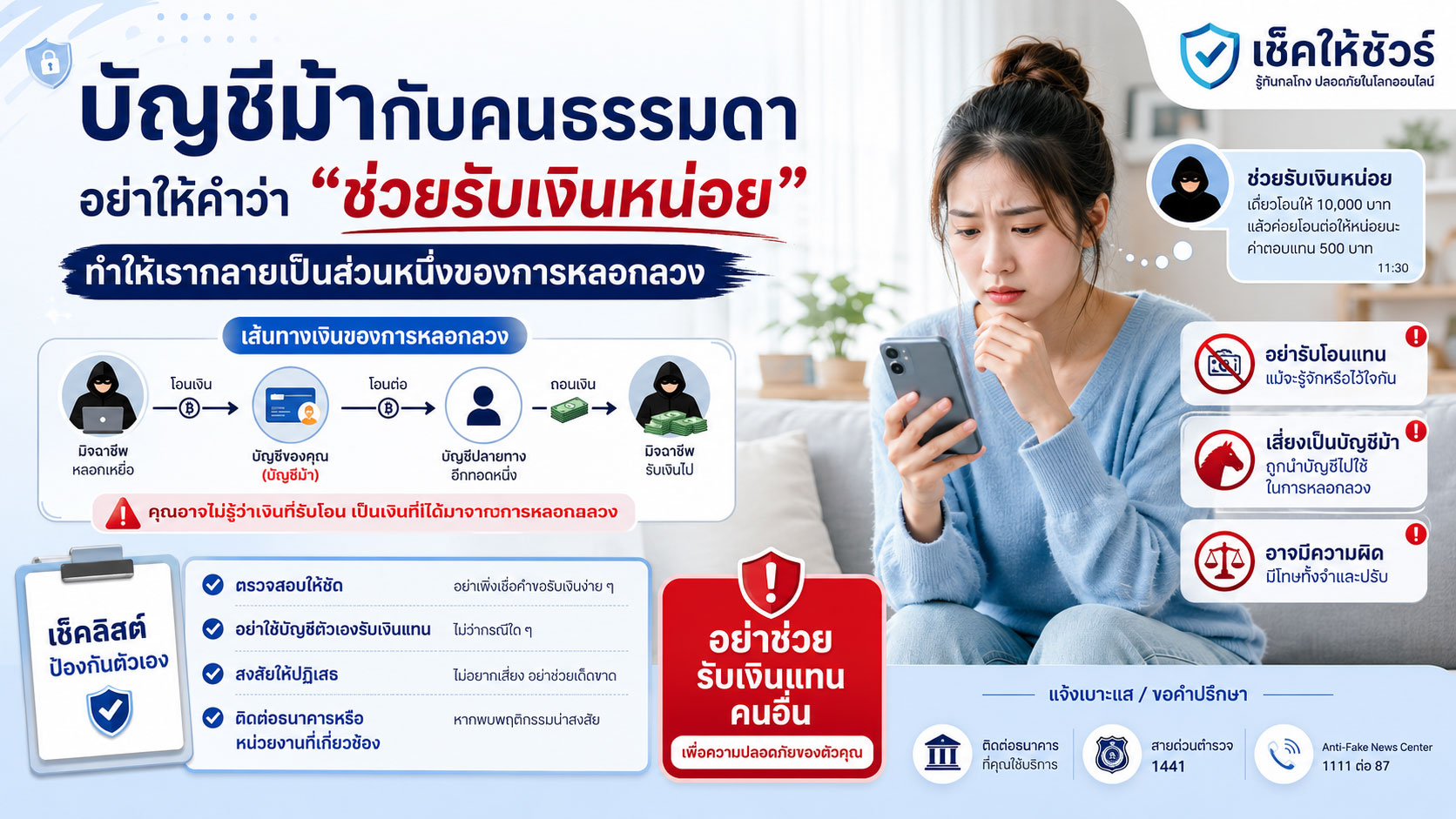
“ขอยืมบัญชีรับเงินหน่อย”
“ช่วยรับเงินแทนให้หน่อย เดี๋ยวให้ค่าตอบแทน”
“เปิดบัญชีไว้รับงานออนไลน์ รายได้ดี ไม่ต้องทำอะไรมาก”
“มีเงินเข้าแล้วโอนต่อให้พี่ เดี๋ยวแบ่งให้”
“ใช้บัญชีแค่แป๊บเดียว ไม่มีอะไรหรอก”
ประโยคเหล่านี้อาจฟังดูไม่รุนแรงในตอนแรก
บางคนอาจคิดว่าเป็นแค่การช่วยเพื่อน
บางคนอาจคิดว่าเป็นงานพิเศษง่ายๆ
บางคนอาจคิดว่าแค่รับเงินแล้วโอนต่อ ไม่ได้ไปหลอกใครเอง
บางคนอาจคิดว่าได้เงินค่าจ้างเล็กน้อยก็ดีกว่าไม่ได้อะไร
และบางคนอาจคิดว่า ถ้าไม่ได้เป็นคนโกงเอง ก็คงไม่เป็นไร
แต่ในความจริง บัญชีที่ใช้รับเงินและส่งต่อเงินอาจเป็นส่วนสำคัญของการหลอกลวง
เพราะเงินที่ถูกโอนเข้ามา อาจเป็นเงินของผู้เสียหาย
คนที่โอนมาอาจเป็นคนที่ถูกหลอกซื้อของ
ถูกหลอกลงทุน
ถูกหลอกให้รัก
ถูกหลอกโดยคอลเซ็นเตอร์
ถูกหลอกให้กู้เงิน
หรือถูกหลอกด้วยกลโกงออนไลน์รูปแบบอื่น
เมื่อบัญชีของเราเข้าไปอยู่ในเส้นทางเงินนั้น ต่อให้เราไม่ได้เป็นคนพูดหลอกเหยื่อเอง เรื่องก็อาจไม่จบง่ายอย่างที่คิด
จำไว้ว่า
บัญชีธนาคารของเรา ไม่ควรเป็นทางผ่านของเงินที่เราอธิบายที่มาไม่ได้
บัญชีม้าคืออะไรในภาษาที่คนทั่วไปเข้าใจ
พูดง่ายๆ บัญชีม้าคือบัญชีธนาคารหรือบัญชีรับเงินที่ถูกใช้แทนตัวมิจฉาชีพ
แทนที่มิจฉาชีพจะใช้บัญชีชื่อตัวเองรับเงิน เขาจะใช้บัญชีของคนอื่น
อาจเป็นบัญชีที่ซื้อมา
บัญชีที่เช่ามา
บัญชีที่หลอกให้เปิด
บัญชีที่ขอยืมใช้
หรือบัญชีที่เจ้าของบัญชีถูกหลอกให้รับเงินและโอนต่อ
เหตุผลที่มิจฉาชีพต้องใช้บัญชีคนอื่น เพราะเขาต้องการซ่อนตัว
เมื่อเหยื่อโอนเงินมา ชื่อที่ปรากฏอาจไม่ใช่ชื่อคนหลอกจริง
เมื่อมีการตรวจสอบ เส้นทางแรกมักไปถึงเจ้าของบัญชีที่รับเงิน
และเมื่อเงินถูกโอนต่อหลายทอด การตามเงินกลับยิ่งยากขึ้น
บัญชีม้าจึงไม่ใช่เรื่องไกลตัว
มันอาจเริ่มจากคนธรรมดาที่ถูกชวนว่า “ช่วยรับเงินหน่อย” หรือ “เปิดบัญชีไว้รับงาน”
แต่สุดท้ายบัญชีนั้นอาจกลายเป็นเครื่องมือของมิจฉาชีพ
ทำไมคนธรรมดาถึงเข้าไปเกี่ยวข้องได้
หลายคนไม่ได้ตื่นเช้ามาแล้วอยากเป็นบัญชีม้า
แต่เข้าไปเกี่ยวข้องเพราะถูกชวน ถูกหลอก ถูกกดดัน หรือกำลังต้องการเงิน
บางคนเจองานออนไลน์ที่บอกว่ารายได้ดี
บางคนถูกชวนให้เปิดบัญชีเพื่อรับค่าคอมมิชชัน
บางคนถูกขอให้รับเงินแทนเพื่อนหรือคนรู้จัก
บางคนถูกบอกว่าเป็นงานรับโอนเงินให้บริษัท
บางคนถูกหลอกให้ส่งบัตรประชาชน หน้าสมุดบัญชี หรือข้อมูล mobile banking
บางคนถูกชวนให้ขายบัญชีเก่าที่ไม่ได้ใช้
บางคนคิดว่าใช้บัญชีที่ไม่มีเงินอยู่แล้วคงไม่เป็นไร
บางคนถูกคนรักออนไลน์หรือคนรู้จักในอินเทอร์เน็ตขอให้ช่วยรับเงิน
และบางคนถูกหลอกว่าเป็นแค่การทดสอบระบบ รับเงินแล้วโอนกลับ
จุดเริ่มต้นอาจดูเล็กมาก
แต่เมื่อบัญชีถูกใช้รับเงินจากเหยื่อแล้ว เรื่องเล็กอาจกลายเป็นปัญหาใหญ่
“แค่รับเงินแล้วโอนต่อ” ไม่ได้ปลอดภัยอย่างที่คิด
มิจฉาชีพมักทำให้เรื่องดูง่าย
เขาอาจบอกว่า
“ไม่ต้องทำอะไร แค่รอเงินเข้า”
“เงินเข้าแล้วโอนต่อให้บัญชีนี้”
“ได้ค่าจ้างต่อรายการ”
“ไม่มีความเสี่ยง เพราะไม่ได้ใช้เงินตัวเอง”
“บัญชีนี้ใช้รับเงินลูกค้าเฉยๆ”
“บริษัทต้องการบัญชีหลายบัญชีเพื่อหมุนระบบ”
คำพูดเหล่านี้อาจทำให้หลายคนรู้สึกว่าเป็นงานธรรมดา
แต่ลองถามตัวเองว่า
ทำไมเขาไม่ใช้บัญชีบริษัทของเขาเอง
ทำไมเงินต้องผ่านบัญชีของเรา
ทำไมต้องรีบโอนต่อ
ทำไมต้องแบ่งค่าตอบแทนให้เรา ทั้งที่เราแทบไม่ได้ทำอะไร
ทำไมต้องใช้บัญชีส่วนตัวหลายคน
และทำไมงานที่ดูง่ายมากถึงให้ค่าตอบแทนดีเกินเหตุ
ถ้าหน้าที่ของเราคือรับเงินที่ไม่รู้ที่มาแล้วรีบส่งต่อ นั่นไม่ใช่งานที่ควรมองว่าไม่มีอะไร
เพราะบัญชีของเรากำลังช่วยให้เงินจากเหยื่อเคลื่อนไปถึงมิจฉาชีพ
สัญญาณเตือนว่านี่อาจเป็นการชวนใช้บัญชีม้า
ถ้ามีใครชวนเกี่ยวกับบัญชีธนาคาร ให้ระวังเป็นพิเศษเมื่อเจอพฤติกรรมเหล่านี้
ขอซื้อบัญชีธนาคารของคุณ
ขอเช่าบัญชีเป็นรายวันหรือรายเดือน
ให้เปิดบัญชีใหม่แล้วส่งสมุดบัญชี บัตร ATM หรือซิมมือถือให้
ขอรหัสเข้า mobile banking
ขอให้รับเงินแล้วโอนต่อ
ให้ใช้บัญชีรับเงินจากลูกค้าที่คุณไม่รู้จัก
บอกว่าไม่ต้องรู้รายละเอียดงาน แค่ทำตามขั้นตอน
ให้ค่าตอบแทนต่อรายการโอน
บอกว่าบัญชีของคุณ “ขาวสะอาด” ใช้รับเงินได้
บอกว่าถ้าเงินเข้าแล้วต้องรีบโอนออกทันที
ให้หลีกเลี่ยงการตอบคำถามธนาคาร
บอกว่าอย่าให้คนในบ้านรู้
หรือบอกว่าใช้บัญชีไม่นาน เดี๋ยวก็จบ
ถ้าได้ยินคำพูดเหล่านี้ ให้หยุดทันที
เพราะบัญชีธนาคารไม่ใช่ของที่ควรให้คนอื่นยืม ใช้ เช่า หรือควบคุม
งานออนไลน์ที่ให้ใช้บัญชีรับเงินแทน ต้องระวังมาก
บางกลโกงไม่ได้ชวนตรงๆ ว่า “มาเป็นบัญชีม้า”
แต่มาในรูปแบบงานออนไลน์
เช่น
แอดมินรับออเดอร์
งานโอนเงิน
งานตรวจสอบยอด
งานรับชำระเงินลูกค้า
งานบัญชีออนไลน์
งานช่วยร้านค้า
งานตัวแทนรับเงิน
งานกดรับยอดแล้วโอนต่อ
หรือ งานพาร์ตไทม์ที่บอกว่าไม่ต้องมีประสบการณ์ รายได้ดี ทำจากบ้านได้
บางงานอาจมีหน้าตาดูเป็นระบบ
มีแอดมินรับสมัคร
มีแบบฟอร์ม
มีไลน์กลุ่ม
มีคนสอนงาน
มีสลิปปลอม
มีรีวิวคนได้เงิน
หรือมีการโอนค่าจ้างเล็กน้อยให้ก่อน เพื่อสร้างความเชื่อใจ
แต่ถ้างานนั้นต้องใช้บัญชีส่วนตัวของคุณรับเงินจากคนแปลกหน้า แล้วโอนต่อไปอีกบัญชี ให้ระวังอย่างมาก
งานจริงควรมีรายละเอียดบริษัทชัดเจน
ควรมีสัญญาและขอบเขตงานที่ตรวจสอบได้
และไม่ควรให้พนักงานใช้บัญชีส่วนตัวเป็นทางผ่านของเงินที่ไม่รู้ที่มา
ถ้ารายได้มาจากการที่เงินคนอื่นไหลผ่านบัญชีเรา อาจไม่ใช่งานที่ปลอดภัย
คนรู้จักก็อาจเป็นจุดเริ่มต้นได้
บางครั้งการชวนใช้บัญชีไม่ได้มาจากคนแปลกหน้า
แต่อาจมาจากคนรู้จัก
เช่น เพื่อน
แฟน
ญาติ
รุ่นพี่
คนในกลุ่มงาน
คนที่รู้จักจากออนไลน์
หรือคนที่เคยช่วยเหลือกันมาก่อน
เขาอาจพูดว่า
“ขอยืมบัญชีหน่อย บัญชีพี่มีปัญหา”
“ช่วยรับเงินให้เพื่อนพี่หน่อย”
“ขอใช้แป๊บเดียว”
“ไว้ใจได้ ไม่มีอะไร”
“ถ้ามีปัญหา เดี๋ยวรับผิดชอบเอง”
แต่เมื่อเกิดปัญหาจริง คนที่ชื่ออยู่บนบัญชีคือเรา
คนที่เงินเข้าและเงินออกคือเรา
หลักฐานแรกที่เห็นคือบัญชีของเรา
และคำว่า “เขาบอกว่าไม่มีอะไร” อาจไม่ช่วยให้เรื่องหายไป
ความไว้ใจในความสัมพันธ์ไม่ควรถูกใช้แทนการตรวจสอบเรื่องเงิน
ถ้าเป็นเรื่องบัญชีธนาคาร ให้ระวังเสมอ แม้คนขอจะเป็นคนรู้จัก
อย่าให้คนอื่นถือซิม บัตร ATM หรือรหัสเข้าแอปธนาคาร
บางคนคิดว่าแค่ให้คนอื่นใช้บัญชี แต่ยังไม่ให้เงินตัวเองเสียหาย คงไม่เป็นไร
แต่ข้อมูลและอุปกรณ์ที่เกี่ยวกับบัญชีธนาคารสำคัญมาก
ไม่ควรให้ใครถือหรือรู้ เช่น
บัตร ATM
สมุดบัญชี
ซิมมือถือที่ผูกกับบัญชี
รหัสเข้า mobile banking
รหัส OTP
รหัส PIN
รูปบัตรประชาชน
รูปหน้าตรง
รหัสผ่านอีเมลที่ผูกกับบัญชี
หรือโทรศัพท์ที่ล็อกอินแอปธนาคารไว้
เพราะเมื่อคนอื่นควบคุมสิ่งเหล่านี้ได้ เขาอาจใช้บัญชีเราโดยที่เราไม่รู้ทันที
และเมื่อเกิดรายการผิดปกติ การอธิบายว่า “ไม่ได้เป็นคนกดเอง” อาจไม่ง่าย
บัญชีธนาคารควรอยู่ในการควบคุมของเจ้าของบัญชีเท่านั้น
ขายบัญชีเก่าที่ไม่ใช้แล้วก็เสี่ยง
บางคนคิดว่า บัญชีเก่าที่ไม่มีเงิน ไม่มีความสำคัญแล้ว
ถ้ามีคนขอซื้อในราคาหลักร้อยหรือหลักพัน ก็น่าจะขายได้
แต่บัญชีว่างก็ยังเป็นบัญชีที่มีชื่อเรา
ถ้าถูกนำไปใช้รับเงินจากเหยื่อ ชื่อของเรายังเกี่ยวข้องกับเส้นทางเงิน
ถ้าถูกใช้เปิดรับโอนจากหลายคน เรื่องอาจย้อนกลับมาที่เจ้าของบัญชี
และถ้าบัญชีนั้นผูกกับเบอร์ อีเมล หรือข้อมูลส่วนตัวอื่นๆ ความเสี่ยงอาจมากกว่าที่คิด
อย่าขายบัญชีเพียงเพราะคิดว่าไม่ได้ใช้แล้ว
ถ้าไม่ต้องการใช้บัญชี ควรปิดบัญชีผ่านธนาคารให้ถูกต้อง
ไม่ใช่ส่งต่อให้คนอื่นใช้
บัญชีของนักเรียน นักศึกษา และคนหางานก็ถูกเล็งได้
กลุ่มที่ควรระวังมากคือคนที่กำลังหางานเสริม
นักเรียน นักศึกษา คนเริ่มทำงาน คนตกงาน หรือคนที่ต้องการรายได้เร็ว
มิจฉาชีพมักใช้ข้อความที่ดูน่าสนใจ เช่น
งานง่าย รายได้ดี
ไม่ต้องมีประสบการณ์
ทำจากบ้านได้
แค่เปิดบัญชีรับเงิน
รับเงินแล้วโอนต่อ ได้ค่าจ้างทันที
ใช้บัญชีว่างก็ได้
ไม่มีความเสี่ยง
ยิ่งคนต้องการเงินเร็ว ยิ่งอาจตัดสินใจเร็ว
แต่เงินค่าจ้างเล็กน้อยอาจไม่คุ้มกับปัญหาที่ตามมา
ถ้างานไหนเริ่มจากการขอบัญชี ขอรหัส ขอซิม หรือให้รับเงินแทนคนอื่น ให้ถอยออกมาก่อน
งานที่ดีไม่ควรเริ่มด้วยการให้เราเสียการควบคุมบัญชีธนาคารของตัวเอง
ถ้าเงินแปลกๆ เข้าบัญชี อย่ารีบโอนต่อ
บางกรณีอาจมีเงินโอนเข้าบัญชีเราโดยที่เราไม่รู้ที่มา
จากนั้นมีคนโทรหรือทักมาบอกว่าโอนผิด
ให้โอนคืนไปอีกบัญชีหนึ่ง
หรือบอกว่าเป็นเงินของเขา ให้รีบส่งต่อ
ถ้าเกิดแบบนี้ อย่ารีบโอนตามคำสั่งของคนที่ติดต่อมา
เพราะเงินนั้นอาจเกี่ยวข้องกับการหลอกลวง หรืออาจเป็นส่วนหนึ่งของกลอุบายให้บัญชีเราเข้าไปอยู่ในเส้นทางเงิน
สิ่งที่ควรทำคือ ตรวจสอบกับธนาคารผ่านช่องทางทางการ
อย่าคืนเงินเข้าบัญชีที่คนแปลกหน้าบอก
อย่าโอนต่อไปบัญชีใหม่
อย่าคิดว่าโอนออกเร็วแล้วจะจบ
ให้เก็บหลักฐานข้อความหรือสายที่ติดต่อมา และให้ธนาคารช่วยแนะนำขั้นตอนที่เหมาะสม
เงินที่เราอธิบายที่มาไม่ได้ ไม่ควรถูกส่งต่อแบบเร่งรีบ
ถ้าถูกหลอกให้เปิดบัญชีหรือรับเงินไปแล้ว ควรทำอย่างไร
ถ้าคุณเริ่มรู้ตัวว่าอาจถูกหลอกให้ใช้บัญชีในทางที่ผิด ให้หยุดทันที
อย่ารับเงินเพิ่ม
อย่าโอนต่อ
อย่าส่งรหัสเพิ่มเติม
อย่าให้คนอื่นใช้บัญชีต่อ
อย่าลบแชทหรือหลักฐาน
รวบรวมข้อมูลทั้งหมด เช่น
คนที่ชวน
ข้อความที่คุยกัน
ลิงก์สมัครงาน
บัญชี LINE หรือ Facebook ที่เกี่ยวข้อง
เลขบัญชีที่ให้โอนต่อ
สลิปการโอน
ยอดเงินเข้าออก
วันเวลาเกิดรายการ
เบอร์โทรที่ติดต่อมา
และรายละเอียดงานที่ถูกอ้าง
จากนั้นติดต่อธนาคารผ่านช่องทางทางการเพื่อแจ้งความผิดปกติและขอคำแนะนำ
ถ้ามีการใช้บัญชีรับเงินที่สงสัยว่าเกี่ยวข้องกับการหลอกลวง ควรปรึกษาหน่วยงานที่เกี่ยวข้องและอธิบายข้อเท็จจริงอย่างตรงไปตรงมา
อย่าปล่อยให้บัญชีถูกใช้ต่อเพราะกลัวหรืออาย
การหยุดเร็วและเก็บหลักฐานไว้ อาจช่วยให้สถานการณ์ไม่แย่ลง
ถ้ามีคนในบ้านถูกชวนให้เปิดบัญชีรับเงิน ควรคุยอย่างไร
ถ้ารู้ว่าคนในบ้านถูกชวนให้เปิดบัญชี รับเงิน หรือโอนต่อ อย่าเพิ่งดุอย่างเดียว
เพราะเขาอาจกำลังถูกหลอกด้วยความหวังเรื่องรายได้
ให้ถามว่า
ใครเป็นคนชวน
รู้จักกันจริงหรือไม่
งานคืออะไร
เงินมาจากไหน
ทำไมต้องใช้บัญชีส่วนตัว
ต้องส่งอะไรให้เขาบ้าง
ต้องให้บัตร ATM หรือซิมหรือไม่
ต้องโอนเงินต่อไปที่ไหน
ได้ค่าจ้างอย่างไร
และมีเอกสารหรือบริษัทที่ตรวจสอบได้หรือไม่
คำถามเหล่านี้ช่วยให้เห็นภาพว่าเรื่องนี้น่าเชื่อถือแค่ไหน
และช่วยให้คนในบ้านรู้สึกว่าเรากำลังช่วย ไม่ใช่ซ้ำเติม
เพราะในหลายกรณี คนที่เกือบเข้าไปเกี่ยวข้องไม่ได้ตั้งใจทำผิด เขาแค่อยากมีรายได้หรืออยากช่วยคนอื่น
ครอบครัวควรมีข้อตกลงเรื่องบัญชีธนาคาร
เรื่องนี้ควรคุยกันในบ้านให้ชัด
โดยเฉพาะกับวัยรุ่น นักศึกษา ผู้สูงอายุ หรือคนที่กำลังหางานออนไลน์
ข้อตกลงง่ายๆ อาจเป็นแบบนี้
ไม่ขายบัญชีธนาคารให้ใคร
ไม่ให้ใครเช่าบัญชี
ไม่เปิดบัญชีให้คนอื่นใช้
ไม่ส่งบัตร ATM ให้คนอื่น
ไม่ส่งซิมที่ผูกกับบัญชีให้ใคร
ไม่บอกรหัส mobile banking
ไม่รับเงินแทนคนที่ไม่รู้ที่มา
ไม่โอนต่อเงินที่อธิบายไม่ได้
ถ้ามีงานที่ต้องใช้บัญชีรับเงินแทน ต้องปรึกษาคนในบ้านก่อน
และถ้ามีเงินแปลกๆ เข้าบัญชี ต้องตรวจสอบกับธนาคารก่อนโอนคืนหรือโอนต่อ
ข้อตกลงแบบนี้ไม่ได้ทำให้ครอบครัวไม่ไว้ใจกัน
แต่ช่วยป้องกันไม่ให้ใครถูกใช้เป็นทางผ่านของเงินผิดปกติ
คนที่กำลังเดือดร้อนเรื่องเงินควรระวังเป็นพิเศษ
เวลาคนกำลังขัดสน เงินค่าจ้างง่ายๆ อาจดูน่าสนใจมาก
“แค่เปิดบัญชี ได้เงินทันที”
“แค่รับเงินแล้วโอนต่อ ได้ค่ารอบละหลายร้อย”
“ไม่ต้องลงทุน”
“ไม่ต้องขายของ”
“ไม่ต้องมีประสบการณ์”
แต่ถ้างานนั้นง่ายเกินไป รายได้ดีเกินไป และเกี่ยวข้องกับบัญชีธนาคารของเราโดยไม่ชัดเจน ให้หยุดคิดก่อน
มิจฉาชีพมักเล็งคนที่ต้องการเงินเร็ว เพราะรู้ว่าความจำเป็นอาจทำให้คนมองข้ามความเสี่ยง
ถ้ากำลังเดือดร้อน อย่าให้ความกดดันทำให้ยอมเสี่ยงกับบัญชีของตัวเอง
เงินที่ได้เร็ว อาจพาปัญหาที่อยู่นานกว่ามาก
ประโยคที่ควรจำ: บัญชีเรา ชื่อเรา ความรับผิดชอบย้อนมาหาเราได้
ถ้าต้องจำประโยคเดียวจากบทความนี้ ขอให้จำว่า
บัญชีเรา ชื่อเรา ความรับผิดชอบย้อนมาหาเราได้
อย่าให้ใครยืมบัญชี
อย่าขายบัญชีเก่า
อย่ารับเงินแทนคนที่ไม่รู้ที่มา
อย่าโอนต่อเงินที่อธิบายไม่ได้
อย่าให้ซิม บัตร ATM หรือรหัสกับคนอื่น
และอย่ามองว่างานรับเงินโอนต่อเป็นเรื่องเล็ก
เพราะสำหรับมิจฉาชีพ บัญชีของคุณอาจเป็นเครื่องมือ
แต่สำหรับผู้เสียหาย ชื่อบัญชีของคุณอาจเป็นชื่อแรกที่เขาเห็นหลังเสียเงิน
สรุป: อย่าให้บัญชีธนาคารของเราเป็นทางผ่านของเงินที่เราไม่รู้จัก
บัญชีม้าไม่ใช่เรื่องของคนไกลตัวเสมอไป
มันอาจเริ่มจากคำชวนธรรมดา
งานออนไลน์ง่ายๆ
รายได้เสริม
เพื่อนขอให้ช่วยรับเงิน
คนรักออนไลน์ขอให้โอนต่อ
บัญชีเก่าที่ไม่ได้ใช้
หรือเงินแปลกๆ ที่เข้ามาแล้วมีคนขอให้โอนออก
แต่ถ้าเงินนั้นไม่รู้ที่มา และเรากลายเป็นคนรับหรือส่งต่อ ความเสี่ยงอาจกลับมาที่เรา
อย่าคิดว่า “ไม่ได้หลอกเอง” แล้วจะไม่มีปัญหา
อย่าคิดว่า “ใช้แค่ครั้งเดียว” แล้วจะไม่เป็นไร
อย่าคิดว่า “เงินไม่ใช่ของเรา” แล้วบัญชีเราไม่เกี่ยว
บัญชีธนาคารควรใช้สำหรับเงินที่เรารู้ที่มาและอธิบายได้
ถ้ามีใครชวนให้ใช้บัญชีรับเงิน โอนต่อ ขายบัญชี หรือให้ข้อมูลเข้าแอปธนาคาร ให้หยุดก่อน
ตรวจสอบ
ปรึกษาคนที่ไว้ใจ
ติดต่อธนาคารหากมีรายการผิดปกติ
และอย่าให้ใครใช้ชื่อบัญชีของเราเป็นทางผ่านของการหลอกลวง
เพราะการป้องกันที่ดีที่สุด คือไม่เปิดประตูให้บัญชีของเราเข้าไปอยู่ในเส้นทางเงินของมิจฉาชีพตั้งแต่แรก
Mule Accounts and Ordinary People: Do Not Let “Please Help Receive Money” Turn You into Part of a Scam
“Can I borrow your bank account to receive money?”
“Please help receive money for me. I’ll give you a commission.”
“Open an account for online work. Good income, almost nothing to do.”
“When the money comes in, transfer it to me. I’ll share some with you.”
“We’ll use your account only briefly. Nothing serious.”
At first, these sentences may not sound dangerous.
Some people may think they are just helping a friend.
Some may think it is an easy side job.
Some may think that receiving money and transferring it onward is harmless.
Some may think a small commission is better than earning nothing.
And some may believe that if they are not the person scamming anyone, then it should be fine.
But in reality, an account used to receive and move money can become an important part of a scam.
The money that enters the account may belong to victims.
It may come from someone who was tricked into buying something.
Someone who was lured into a fake investment.
Someone deceived by a romance scam.
Someone manipulated by a call center scam.
Someone tricked by a fake loan.
Or someone harmed by another type of online fraud.
Once your bank account becomes part of that money trail, even if you were not the person speaking to the victim, the situation may not end as easily as you think.
Remember this:
Your bank account should never be a pass-through for money you cannot explain.
What Is a Mule Account in Simple Terms?
In simple words, a mule account is a bank account or payment account used on behalf of scammers.
Instead of receiving money in their own name, scammers use someone else’s account.
It may be an account they bought.
An account they rented.
An account they tricked someone into opening.
An account they borrowed.
Or an account whose owner was manipulated into receiving money and transferring it onward.
Scammers use other people’s accounts because they want to hide themselves.
When a victim transfers money, the name that appears may not be the real scammer’s name.
When the case is investigated, the first trail often leads to the owner of the receiving account.
And once the money is moved through several accounts, recovering it becomes much harder.
A mule account is not a distant issue.
It can begin with an ordinary person being asked to “help receive money” or “open an account for work.”
But in the end, that account may become a tool for scammers.
How Ordinary People Can Get Involved
Many people do not wake up one day wanting to become a mule account holder.
They may become involved because they are persuaded, deceived, pressured, or urgently need money.
Some see online jobs that promise good income.
Some are asked to open an account to receive commission.
Some are asked to receive money for a friend or acquaintance.
Some are told it is a job receiving transfers for a company.
Some are tricked into sending their ID card, bankbook photo, or mobile banking details.
Some are asked to sell an old bank account they no longer use.
Some think that using an empty account is harmless.
Some are asked by an online partner or internet acquaintance to help receive money.
And some are told it is only a system test: receive money and send it back.
The starting point may seem very small.
But once the account is used to receive money from victims, that small action can become a serious problem.
“Just Receive and Transfer” Is Not as Safe as It Sounds
Scammers often make the task sound simple.
They may say:
“You don’t need to do anything. Just wait for the money to arrive.”
“When the money comes in, transfer it to this account.”
“You get paid per transaction.”
“There is no risk because it is not your own money.”
“This account is only for receiving customer payments.”
“The company needs several accounts to process payments.”
These words can make the task feel like normal work.
But ask yourself:
Why do they not use their own company account?
Why must the money pass through your personal account?
Why must you transfer it out quickly?
Why are they paying you when you are doing almost nothing?
Why do they need many personal accounts?
And why does such an easy task pay so well?
If your role is to receive money from an unknown source and quickly move it onward, it is not something you should treat as harmless.
Your account may be helping money from victims reach scammers.
Warning Signs That Someone May Be Trying to Use You as a Mule Account
If someone asks you about your bank account, be especially careful when you notice these behaviors:
They want to buy your bank account.
They want to rent your account daily or monthly.
They ask you to open a new account and hand over the bankbook, ATM card, or SIM card.
They ask for your mobile banking password.
They ask you to receive money and transfer it onward.
They ask you to use your account to receive money from customers you do not know.
They tell you that you do not need to know the details, just follow instructions.
They pay you for each transfer.
They say your account is “clean” and suitable for receiving money.
They say that when money enters, you must transfer it out immediately.
They tell you how to avoid answering questions from the bank.
They tell you not to tell your family.
Or they say the account will only be used briefly.
If you hear words like these, stop immediately.
A bank account is not something you should lend, rent, sell, or allow others to control.
Online Jobs That Require Your Account to Receive Money Are Very Risky
Some scams do not directly say, “Become a mule account.”
They appear as online jobs.
For example:
Order admin
Money transfer work
Balance checking work
Customer payment receiving work
Online accounting work
Store support work
Payment representative work
Tasks where you accept incoming funds and transfer them onward
Or part-time jobs that say no experience is needed, income is good, and you can work from home
Some jobs may look organized.
There may be a recruiting admin.
A form.
A LINE group.
Someone teaching you what to do.
Fake payment slips.
Reviews from people claiming they got paid.
Or a small first payment to build trust.
But if the job requires you to use your personal bank account to receive money from strangers and transfer it to another account, be very careful.
Real work should have clear company details.
There should be verifiable agreements and a clear job scope.
And employees should not be asked to use personal accounts as pass-through channels for money of unclear origin.
If your income comes from money flowing through your personal account, the job may not be safe.
People You Know Can Also Be the Starting Point
Sometimes the request does not come from a stranger.
It may come from someone you know.
A friend.
A partner.
A relative.
A senior.
Someone from a work group.
Someone you met online.
Or someone who once helped you before.
They may say:
“Can I borrow your account? Mine has a problem.”
“Please help receive money for my friend.”
“I’ll use it only briefly.”
“You can trust me. Nothing will happen.”
“If there is any problem, I’ll take responsibility.”
But when a problem happens, the name on the account is yours.
The money came in and went out through your account.
The first evidence points to your account.
And the sentence “they told me it was nothing” may not make the problem disappear.
Trust in a relationship should not replace caution with financial matters.
When it involves a bank account, always be careful, even if the person asking is someone you know.
Do Not Let Anyone Hold Your SIM Card, ATM Card, or Banking App Password
Some people think that letting someone use an account is harmless as long as their own money is not affected.
But information and devices connected to a bank account are very important.
You should not let anyone hold or know your:
ATM card
Bankbook
SIM card linked to your bank account
Mobile banking password
OTP
PIN
Photo of your ID card
Face photo
Email password connected to the account
Or phone that is logged in to your banking app
Once someone controls these things, they may use your account without you noticing immediately.
And if suspicious transactions occur, explaining that “I was not the one who did it” may not be easy.
A bank account should remain under the control of its rightful owner only.
Selling an Old Bank Account Is Also Risky
Some people think that an old account with no money is no longer important.
If someone offers a few hundred or a few thousand baht for it, selling it may seem harmless.
But an empty account is still an account in your name.
If it is used to receive money from victims, your name is still connected to the money trail.
If it is used to receive transfers from many people, the issue may come back to the account holder.
And if that account is linked to a phone number, email, or other personal information, the risk may be greater than expected.
Do not sell an account simply because you no longer use it.
If you no longer need an account, close it properly through the bank.
Do not pass it to someone else to use.
Students, Job Seekers, and People Looking for Side Income May Be Targeted
Groups that should be especially careful include people looking for extra income.
Students, new workers, unemployed people, or anyone who needs money quickly.
Scammers often use tempting messages such as:
Easy job, good income
No experience needed
Work from home
Just open an account to receive money
Receive money and transfer it onward, get paid immediately
Empty accounts can be used
No risk
The more urgently someone needs money, the more quickly they may decide.
But a small payment may not be worth the trouble that follows.
If a job starts by asking for your account, password, SIM card, or asks you to receive money for someone else, step back first.
A good job should not begin by making you lose control over your own bank account.
If Strange Money Enters Your Account, Do Not Rush to Transfer It Out
In some cases, money may enter your account without you knowing where it came from.
Then someone calls or messages you saying it was transferred by mistake.
They may ask you to send it back to another account.
Or say it belongs to them and ask you to move it quickly.
If this happens, do not transfer it based on instructions from the person contacting you.
The money may be connected to a scam, or it may be part of a trick to make your account part of a suspicious money trail.
The safer step is to contact your bank through official channels.
Do not return the money to an account provided by a stranger.
Do not transfer it to a new account.
Do not assume that moving it out quickly will make the problem disappear.
Save evidence of the messages or calls, and ask the bank to advise you on the proper process.
Money you cannot explain should not be moved onward in a hurry.
What to Do If You Were Tricked into Opening an Account or Receiving Money
If you begin to realize that you may have been tricked into using your account in the wrong way, stop immediately.
Do not receive more money.
Do not transfer more money onward.
Do not send more passwords or codes.
Do not allow anyone else to continue using your account.
Do not delete chats or evidence.
Collect all information, such as:
The person who invited you
Chat messages
Job application links
Related LINE or Facebook accounts
Accounts you were told to transfer money to
Transfer slips
Money in and out of your account
Dates and times of transactions
Phone numbers used to contact you
And the job description they claimed
Then contact your bank through official channels to report the suspicious activity and ask for guidance.
If your account was used to receive money that may be connected to scams, consider consulting the relevant authorities and explain the facts honestly.
Do not let the account continue to be used because of fear or embarrassment.
Stopping quickly and keeping evidence may prevent the situation from getting worse.
How to Talk to Someone at Home Who Was Asked to Open an Account for Money
If you learn that someone in your family was asked to open an account, receive money, or transfer money onward, do not only scold them.
They may have been misled by the hope of earning income.
Ask questions such as:
Who invited you?
Do you really know them?
What is the job?
Where does the money come from?
Why must they use your personal account?
What information do they want from you?
Do they want your ATM card or SIM card?
Where do they want you to transfer the money?
How will you be paid?
Is there a company or document that can be verified?
These questions help reveal whether the situation is credible.
They also help the person feel that you are helping, not blaming.
In many cases, people who nearly become involved did not intend to do anything wrong. They simply wanted income or wanted to help someone else.
Families Should Set Clear Rules About Bank Accounts
This is something families should talk about clearly.
Especially with teenagers, students, elderly relatives, or people looking for online work.
Simple rules can help:
Do not sell your bank account to anyone.
Do not rent your account.
Do not open an account for someone else to use.
Do not give your ATM card to anyone.
Do not give a SIM card linked to your bank account to anyone.
Do not reveal your mobile banking password.
Do not receive money for someone when you do not know the source.
Do not transfer onward money you cannot explain.
If a job requires using your account to receive money for others, ask someone in the family first.
And if strange money enters your account, check with the bank before returning or transferring it.
These rules are not about distrust within the family.
They are about preventing anyone from being used as a channel for suspicious money.
People Facing Financial Difficulty Should Be Extra Careful
When someone is short on money, easy income can look very attractive.
“Just open an account and get paid immediately.”
“Just receive money and transfer it onward. You get paid per transaction.”
“No investment needed.”
“No selling required.”
“No experience needed.”
But if the job is too easy, pays too well, and involves your bank account in an unclear way, stop and think first.
Scammers often target people who need money quickly because they know financial pressure can make people overlook risk.
If you are struggling financially, do not let pressure push you into risking your own bank account.
Fast money may bring problems that last much longer.
A Sentence to Remember: Your Account, Your Name, Your Responsibility May Come Back to You
If you remember only one sentence from this article, remember this:
Your account, your name, your responsibility may come back to you.
Do not lend your account to anyone.
Do not sell an old account.
Do not receive money for someone when you cannot explain where it came from.
Do not transfer onward money you cannot explain.
Do not give your SIM card, ATM card, or passwords to others.
And do not treat “receiving and transferring money” as a small matter.
For scammers, your account may be a tool.
But for victims, your account name may be the first name they see after losing money.
Conclusion: Do Not Let Your Bank Account Become a Pass-Through for Money You Do Not Know
Mule accounts are not always a distant issue.
They can begin with ordinary requests:
Easy online work
Side income
A friend asking for help receiving money
An online partner asking you to transfer money onward
An old account you no longer use
Or strange money entering your account followed by someone asking you to send it out
But if the money has an unclear source and you become the receiver or the person moving it onward, the risk may come back to you.
Do not think, “I was not the one who scammed anyone,” so there will be no problem.
Do not think, “It was only one time,” so it should be fine.
Do not think, “It was not my money,” so your account is not involved.
A bank account should be used only for money you understand and can explain.
If someone asks to use your account to receive money, transfer money onward, buy your account, or access your banking app, stop first.
Verify.
Speak with someone you trust.
Contact your bank if there are suspicious transactions.
And do not let anyone use your account name as a channel for scams.
The best protection is not opening the door for your account to enter a scammer’s money trail in the first place.

Leave a Reply
You must be logged in to post a comment.