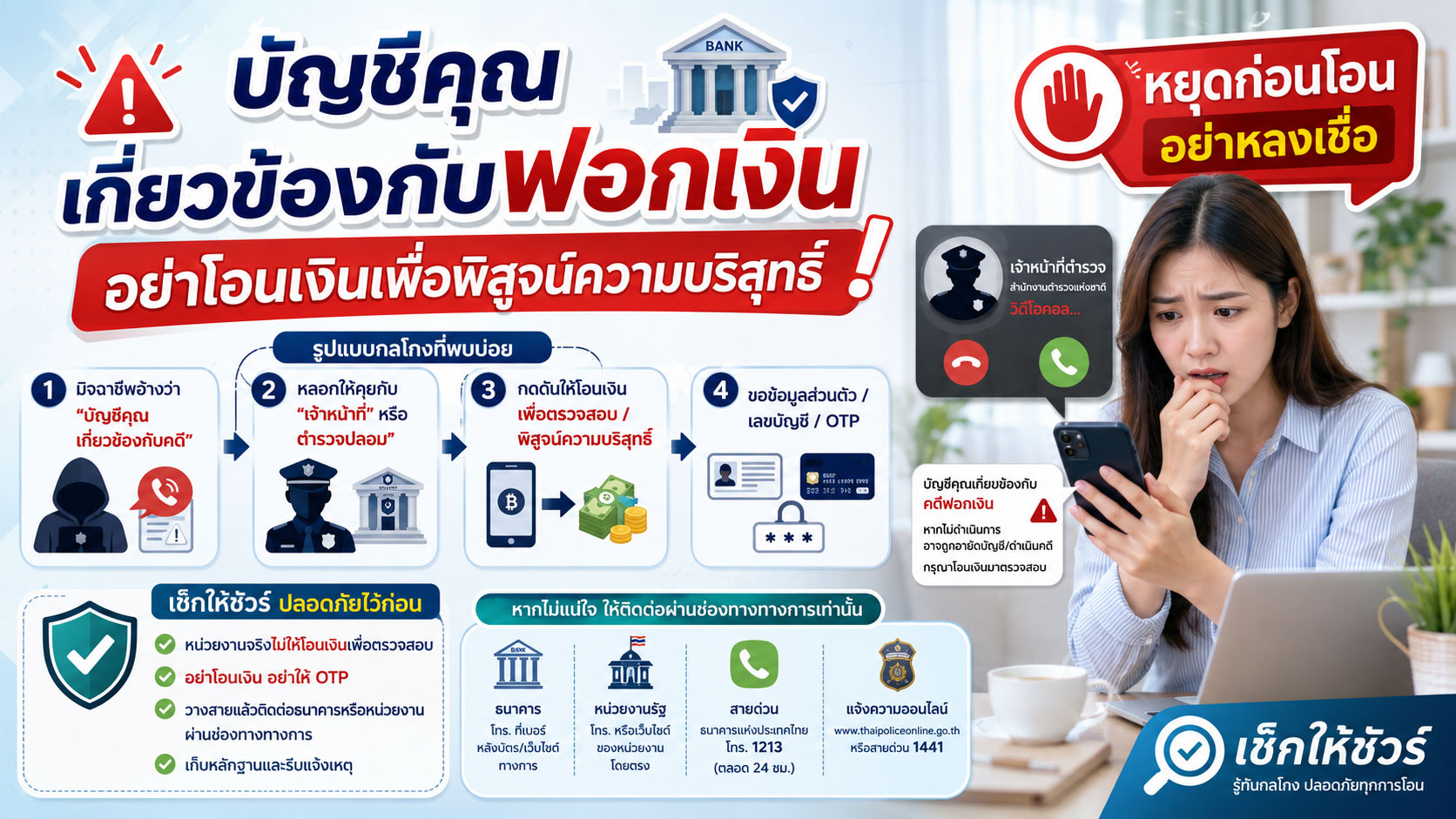
“บัญชีของคุณเกี่ยวข้องกับคดีฟอกเงิน”
ถ้าได้ยินประโยคนี้จากคนปลายสาย หลายคนคงตกใจทันที
แม้ไม่เคยทำอะไรผิด
แม้ไม่รู้จักคนที่ถูกพูดถึง
แม้ไม่เคยเกี่ยวข้องกับคดี
แม้เงินในบัญชีจะเป็นเงินทำงาน เงินเก็บ หรือเงินใช้จ่ายในครอบครัวตามปกติ
แต่คำว่า “ฟอกเงิน” เป็นคำที่หนักมากพอจะทำให้คนธรรมดารู้สึกกลัว
กลัวมีคดี
กลัวบัญชีถูกอายัด
กลัวตำรวจมาหา
กลัวที่ทำงานรู้
กลัวครอบครัวเดือดร้อน
และกลัวว่าถ้าไม่รีบอธิบายตอนนี้ อาจถูกมองว่าเป็นคนผิด
นี่คือจุดที่มิจฉาชีพใช้โจมตี
เขาไม่ได้ต้องการให้คุณเข้าใจข้อกฎหมายจริงๆ
เขาต้องการให้คุณกลัวจนยอมทำตามคำสั่ง
และหนึ่งในคำสั่งที่อันตรายที่สุดคือ
“ให้โอนเงินไปตรวจสอบ เพื่อพิสูจน์ความบริสุทธิ์”
กลโกงนี้ไม่ได้เริ่มจากการขอเงิน แต่เริ่มจากการขู่ให้กลัว
คอลเซ็นเตอร์สแกมประเภทนี้มักเริ่มจากคนที่อ้างว่าเป็นเจ้าหน้าที่
อาจอ้างว่าเป็นตำรวจ
เจ้าหน้าที่ธนาคาร
หน่วยงานรัฐ
ศาล
ปปง.
ฝ่ายตรวจสอบบัญชี
หรือหน่วยงานที่เกี่ยวข้องกับอาชญากรรมทางการเงิน
เขาอาจบอกว่า
บัญชีของคุณรับเงินผิดกฎหมาย
ชื่อของคุณไปเกี่ยวข้องกับบัญชีม้า
มีคนใช้บัตรประชาชนของคุณเปิดบัญชี
บัญชีของคุณถูกใช้รับเงินจากเว็บพนัน
คุณเกี่ยวข้องกับคดีฟอกเงิน
หรือมีหมายเรียก หมายจับ หรือเอกสารคดีที่เกี่ยวข้องกับคุณ
ช่วงแรกมักยังไม่ขอเงินทันที
แต่จะสร้างเรื่องให้ดูจริงจังขึ้นเรื่อยๆ
ให้เลขคดี
พูดชื่อหน่วยงาน
ส่งเอกสารปลอม
โอนสายให้ “เจ้าหน้าที่อีกคน”
พาไปคุยใน LINE
หรือให้วิดีโอคอลกับคนที่แต่งตัวเหมือนเจ้าหน้าที่
ทุกอย่างถูกจัดฉากเพื่อให้คุณรู้สึกว่า “เรื่องนี้ใหญ่กว่าที่คิด”
และเมื่อคุณเริ่มกลัว เขาจะค่อยๆ นำคุณไปสู่ขั้นตอนที่เขาต้องการ
คำว่า “พิสูจน์ความบริสุทธิ์” ถูกใช้เป็นกับดัก
คนบริสุทธิ์มักอยากพิสูจน์ตัวเอง
นี่เป็นเรื่องธรรมดามาก
เมื่อมีคนบอกว่าเราเกี่ยวข้องกับคดี ทั้งที่เราไม่ได้ทำ เรามักอยากรีบอธิบาย อยากรีบให้ข้อมูล และอยากรีบทำให้เรื่องจบ
มิจฉาชีพจึงใช้คำว่า “พิสูจน์ความบริสุทธิ์” เป็นกับดัก
เขาอาจบอกว่า
“ถ้าคุณบริสุทธิ์ ต้องให้ความร่วมมือ”
“ต้องตรวจสอบเส้นทางการเงินของคุณ”
“ต้องโอนเงินไปบัญชีกลางเพื่อตรวจสอบ”
“เงินจะถูกคืนหลังตรวจสอบเสร็จ”
“ถ้าไม่โอน แปลว่าไม่ให้ความร่วมมือ”
“ถ้าวางสาย อาจถูกดำเนินคดี”
“ขั้นตอนนี้เป็นความลับ ห้ามบอกใคร”
ฟังดูเหมือนเป็นขั้นตอนราชการหรือกระบวนการสอบสวน
แต่ในความจริง การพิสูจน์ความบริสุทธิ์ไม่ควรเริ่มจากการโอนเงินให้คนแปลกหน้า
หากคุณไม่ได้ทำผิด คุณไม่จำเป็นต้องย้ายเงินของตัวเองไปยังบัญชีที่คนปลายสายบอก
และไม่มีเหตุผลที่เจ้าหน้าที่จริงจะให้ประชาชนโอนเงินเข้าบัญชีที่อ้างว่าเป็น “บัญชีกลาง” ผ่านคำสั่งทางโทรศัพท์
บัญชีตรวจสอบ บัญชีปลอดภัย หรือบัญชีกลาง อาจเป็นชื่อที่ตั้งมาเพื่อหลอก
มิจฉาชีพมักไม่พูดตรงๆ ว่า “โอนเงินมาให้เรา”
เพราะถ้าพูดแบบนั้น หลายคนอาจรู้ทัน
เขาจึงใช้ชื่อที่ฟังดูปลอดภัยกว่า เช่น
บัญชีกลาง
บัญชีตรวจสอบ
บัญชีพักเงิน
บัญชีปลอดภัย
บัญชีหน่วยงาน
บัญชีสำนักงาน
บัญชีอายัดชั่วคราว
บัญชีสำหรับตรวจเส้นทางการเงิน
ชื่อเหล่านี้ทำให้คนฟังรู้สึกว่าเงินยังอยู่ในระบบราชการหรือระบบตรวจสอบ
แต่ความจริงอาจเป็นบัญชีของมิจฉาชีพ บัญชีม้า หรือบัญชีที่ใช้รับเงินจากเหยื่อหลายราย
จำไว้ว่า
ชื่อที่ฟังดูเป็นทางการ ไม่ได้ทำให้บัญชีนั้นปลอดภัย
ถ้าคนปลายสายเป็นผู้บอกให้คุณโอนเงินไปบัญชีนั้น และคุณไม่สามารถตรวจสอบผ่านช่องทางทางการได้เอง ให้ถือว่าอันตรายมาก
เจ้าหน้าที่จริงจะตรวจสอบบัญชีโดยให้คุณโอนเงินหรือไม่
คำตอบที่ควรจำให้ชัดคือ
ไม่ควรมีเจ้าหน้าที่จริงคนใดให้คุณโอนเงินเพื่อพิสูจน์ความบริสุทธิ์
การตรวจสอบเส้นทางการเงินจริงควรดำเนินการผ่านกระบวนการของหน่วยงานและธนาคารที่เกี่ยวข้อง
ไม่ใช่ให้ประชาชนโอนเงินทั้งหมดออกจากบัญชีตัวเอง
ไม่ใช่ให้โอนไปบัญชีที่ส่งมาในแชท
ไม่ใช่ให้สแกน QR เพื่อย้ายเงิน
ไม่ใช่ให้ทำรายการใน Mobile Banking ระหว่างอยู่ในสาย
และไม่ใช่ให้ส่ง OTP หรือรหัสยืนยันให้คนที่อ้างว่าเป็นเจ้าหน้าที่
หากมีการสอบถามจริง คุณควรมีสิทธิ์ตรวจสอบหน่วยงาน ติดต่อช่องทางทางการ ขอหมายเลขอ้างอิง และไปพบเจ้าหน้าที่ด้วยตัวเองได้
คนที่เป็นเจ้าหน้าที่จริงไม่ควรกลัวว่าคุณจะตรวจสอบ
แต่คนที่เป็นมิจฉาชีพมักไม่อยากให้คุณมีเวลาตรวจสอบ
ทำไมมิจฉาชีพถึงห้ามวางสายและห้ามบอกใคร
เพราะเมื่อคุณวางสาย คุณจะได้กลับมาเป็นเจ้าของจังหวะของตัวเอง
คุณอาจโทรหาครอบครัว
คุณอาจถามเพื่อน
คุณอาจค้นหาข่าวเตือนภัย
คุณอาจโทรหาธนาคารเอง
คุณอาจไปสถานีตำรวจจริง
หรือคุณอาจเริ่มเห็นว่ามีหลายอย่างไม่สมเหตุสมผล
มิจฉาชีพจึงพยายามไม่ให้คุณออกจากบทสนทนา
เขาอาจพูดว่า
“ห้ามวางสาย”
“ห้ามคุยกับใคร เพราะเป็นคดีลับ”
“ถ้าบอกคนอื่นจะถือว่าเปิดเผยข้อมูลคดี”
“ถ้าออกจากสาย ระบบจะถือว่าไม่ให้ความร่วมมือ”
“ต้องทำรายการตอนนี้เท่านั้น”
“เจ้าหน้าที่ระดับสูงรออยู่”
“ถ้าช้า อาจถูกออกหมายจับ”
คำเหล่านี้ไม่ได้เป็นหลักฐานว่าเรื่องจริง
แต่เป็นสัญญาณว่าเขากำลังควบคุมคุณ
ถ้าใครสั่งให้คุณห้ามวางสาย ห้ามปรึกษาคนอื่น และให้โอนเงินในเวลาเดียวกัน ให้หยุดทันที
สัญญาณเตือนของกลโกง “บัญชีเกี่ยวข้องกับฟอกเงิน”
หากได้รับสายหรือข้อความที่อ้างว่าบัญชีคุณเกี่ยวข้องกับฟอกเงิน ให้ระวังเป็นพิเศษเมื่อเจอพฤติกรรมเหล่านี้
อีกฝ่ายอ้างว่าเป็นตำรวจ เจ้าหน้าที่รัฐ ธนาคาร หรือฝ่ายตรวจสอบคดี
บอกว่าบัญชีของคุณเกี่ยวข้องกับเงินผิดกฎหมาย
พูดถึงบัญชีม้า เว็บพนัน ยาเสพติด ฟอกเงิน หรือคดีข้ามจังหวัด
ส่งเอกสาร หมายเรียก หมายจับ หรือบัตรเจ้าหน้าที่ผ่านแชท
ให้เพิ่ม LINE เพื่อคุยกับเจ้าหน้าที่
ขอวิดีโอคอลเพื่อสอบสวน
ห้ามวางสาย
ห้ามบอกครอบครัว
ขอเลขบัตรประชาชนเต็ม
ขอให้ถ่ายรูปบัตรประชาชนหรือใบหน้า
ให้แจ้งยอดเงินในบัญชีทั้งหมด
ให้โอนเงินไปบัญชีกลาง บัญชีตรวจสอบ หรือบัญชีปลอดภัย
ให้สแกน QR เพื่อย้ายเงิน
ขอ OTP หรือรหัสยืนยัน
ให้ติดตั้งแอปสำหรับตรวจสอบมือถือ
หรือขู่ว่าถ้าไม่ทำตามจะถูกดำเนินคดีทันที
ถ้าเจอพฤติกรรมเหล่านี้ ไม่ต้องพยายามเถียง ไม่ต้องพิสูจน์ตัวเองกับคนปลายสาย และไม่ต้องทำตามเพื่อให้เรื่องจบ
ให้วางสาย แล้วตรวจสอบผ่านช่องทางทางการด้วยตัวเอง
ถ้ามีเงินโอนเข้าบัญชีแปลกๆ แล้วมีคนให้โอนต่อ ต้องระวังมาก
อีกสถานการณ์ที่อันตรายคือ มีเงินแปลกๆ โอนเข้าบัญชีของคุณ แล้วมีคนโทรมาบอกให้โอนต่อ
เขาอาจอ้างว่า
เป็นเงินที่ใช้ทดสอบระบบ
เป็นเงินที่ต้องตรวจสอบเส้นทาง
เป็นเงินของเจ้าหน้าที่ที่ส่งเข้ามาตรวจบัญชี
เป็นเงินที่โอนผิด
หรือเป็นขั้นตอนเพื่อพิสูจน์ว่าคุณไม่ได้เกี่ยวข้องกับคดี
ถ้ามีเงินที่คุณไม่รู้ที่มาโอนเข้ามา อย่ารีบถอน อย่ารีบโอนต่อ และอย่าทำตามคำสั่งของคนที่โทรมา
เพราะเงินนั้นอาจเป็นเงินจากเหยื่อรายอื่นที่ถูกหลอกให้โอนเข้าบัญชีคุณ
หากคุณโอนต่อ คุณอาจถูกใช้เป็นทางผ่านของเงินโดยไม่รู้ตัว และเรื่องอาจซับซ้อนขึ้นมาก
สิ่งที่ควรทำคือ ติดต่อธนาคารผ่านช่องทางทางการ แจ้งว่ามีเงินโอนเข้ามาโดยไม่ทราบที่มา และขอคำแนะนำตามขั้นตอน
หากกังวลว่ามีความเกี่ยวข้องกับคดี ให้ไปแจ้งความหรือปรึกษาหน่วยงานที่เกี่ยวข้องด้วยตัวเอง
อย่าให้ใครทางโทรศัพท์สั่งให้คุณจัดการเงินที่คุณไม่รู้ที่มา
ถ้าเขาบอกให้ย้ายเงินไป “บัญชีปลอดภัย” ควรทำอย่างไร
คำว่า “บัญชีปลอดภัย” ฟังเหมือนเป็นทางออก
แต่ถ้าคำนี้มาจากคนปลายสายที่คุณไม่ได้ตรวจสอบเอง ให้ถือว่าอันตราย
เงินจริงในบัญชีของคุณ อาจปลอดภัยกว่ามากเมื่อยังอยู่กับธนาคารของคุณและคุณติดต่อธนาคารผ่านช่องทางทางการ
แต่เมื่อคุณโอนเงินออกไปตามคำสั่งของมิจฉาชีพ เงินอาจหายไปภายในไม่กี่นาที
หากกังวลว่าบัญชีของคุณเสี่ยง ให้โทรหาธนาคารเองจากเบอร์หลังบัตร เว็บไซต์ทางการ หรือแอปธนาคาร
บอกธนาคารว่าได้รับสายต้องสงสัย และขอให้ช่วยตรวจสอบหรือแนะนำวิธีป้องกัน
อย่าให้คนปลายสายเป็นคนกำหนดบัญชีปลายทาง
และอย่าเชื่อว่าการย้ายเงินไปบัญชีที่เขาบอกคือการป้องกันตัว
ถ้าถูกขู่เรื่องคดี ควรตอบอย่างไร
คุณไม่จำเป็นต้องโต้เถียงยาว
ยิ่งคุยนาน ยิ่งเปิดโอกาสให้อีกฝ่ายกดดันหรือหาข้อมูลเพิ่ม
ประโยคที่ใช้ได้คือ
“ขอบคุณค่ะ/ครับ เดี๋ยวจะติดต่อหน่วยงานทางการด้วยตัวเอง”
หรือ
“ถ้าเป็นเรื่องคดีจริง ขอไปตรวจสอบที่สถานีตำรวจเอง”
จากนั้นวางสาย
ไม่ต้องตอบว่าในบัญชีมีเงินเท่าไร
ไม่ต้องบอกธนาคารที่ใช้อยู่
ไม่ต้องยืนยันข้อมูลส่วนตัว
ไม่ต้องส่งเอกสาร
ไม่ต้องอ่านรหัส
ไม่ต้องเพิ่ม LINE
และไม่ต้องติดตั้งแอป
หลังวางสาย ให้ติดต่อช่องทางทางการที่เกี่ยวข้อง เช่น ธนาคาร สถานีตำรวจ หรือสายด่วนรับแจ้งภัยออนไลน์ที่ตรวจสอบได้
การวางสายไม่ใช่การหนีคดี
ถ้าเป็นเรื่องจริง คุณยังสามารถตรวจสอบผ่านหน่วยงานจริงได้
แต่ถ้าเป็นเรื่องหลอก การวางสายอาจช่วยหยุดความเสียหายได้ทัน
ถ้าเผลอโอนเงินไปแล้ว ควรทำอะไรต่อ
ถ้าคุณโอนเงินไปแล้ว ให้หยุดทันที อย่าโอนเพิ่ม
มิจฉาชีพอาจบอกว่า
ต้องโอนอีกรอบเพื่อปลดล็อก
ต้องโอนค่าธรรมเนียม
ต้องโอนเพื่อยืนยันบัญชี
ต้องโอนยอดสุดท้าย
หรือถ้าไม่โอนเพิ่ม เงินเดิมจะคืนไม่ได้
อย่าเชื่อ
ให้รีบติดต่อธนาคารผ่านช่องทางทางการ แจ้งว่าอาจถูกหลอกให้โอนเงิน และเตรียมข้อมูลให้ครบที่สุด
เช่น วันเวลาโอน จำนวนเงิน บัญชีปลายทาง ชื่อบัญชี สลิปโอนเงิน เบอร์โทร แชท ลิงก์ และเอกสารที่อีกฝ่ายส่งมา
จากนั้นแจ้งเหตุผ่านช่องทางที่เกี่ยวข้อง เช่น สายด่วนหรือระบบรับแจ้งอาชญากรรมออนไลน์ และดำเนินการตามคำแนะนำของเจ้าหน้าที่จริง
อย่าติดต่อเพจหรือคนที่อ้างว่าช่วยตามเงินคืนโดยเรียกเก็บค่าดำเนินการ
เพราะหลังถูกหลอกครั้งแรก เหยื่อหลายคนอาจถูกหลอกซ้ำจาก “คนช่วยปลอม”
อย่าโทษตัวเองจนไม่กล้าขอความช่วยเหลือ
คอลเซ็นเตอร์สแกมแบบนี้ไม่ได้ออกแบบมาให้ดูตลกหรือหลอกง่าย
มันถูกออกแบบมาให้คนกลัว
ใช้คำทางกฎหมาย
ใช้เสียงเข้ม
ใช้เอกสารปลอม
ใช้การโอนสาย
ใช้วิดีโอคอล
ใช้ความลับ
ใช้เวลาจำกัด
และใช้ความต้องการของคนบริสุทธิ์ที่อยากพิสูจน์ตัวเอง
ดังนั้น หากคุณเคยเผลอคุย เผลอให้ข้อมูล หรือเผลอโอนเงิน อย่าเพิ่งซ้ำเติมตัวเองจนไม่กล้าดำเนินการต่อ
สิ่งที่ควรทำคือหยุดความเสียหาย เก็บหลักฐาน ติดต่อธนาคาร และแจ้งหน่วยงานที่เกี่ยวข้อง
ความอายไม่ควรมีค่ามากกว่าโอกาสในการปกป้องตัวเอง
ครอบครัวควรมีรหัสลับหรือข้อตกลงร่วมกัน
สำหรับครอบครัวที่มีผู้สูงอายุ คนที่อยู่คนเดียว หรือคนที่ไม่คุ้นกับกลโกงออนไลน์ ควรคุยเรื่องนี้ไว้ล่วงหน้า
อาจตกลงกันง่ายๆ ว่า
ถ้ามีคนโทรมาบอกว่าเกี่ยวกับคดี ให้โทรหาคนในบ้านก่อน
ถ้ามีคนขอให้โอนเงินเพื่อตรวจสอบ ให้ถือว่าเป็นสัญญาณอันตราย
ถ้ามีคนห้ามบอกครอบครัว ให้ยิ่งต้องบอกทันที
ถ้ามีคนอ้างว่าเป็นตำรวจ ให้ไปสถานีตำรวจจริงหรือโทรช่องทางทางการ
ถ้ามีคนให้ติดตั้งแอป ให้หยุดก่อน
และถ้ามีใครให้ย้ายเงินไปบัญชีปลอดภัย ให้โทรหาธนาคารเอง
บางครอบครัวอาจตั้ง “รหัสลับ” หรือประโยคง่ายๆ สำหรับยืนยันกันในเวลาฉุกเฉิน
เช่น ถ้ามีเรื่องใหญ่เกี่ยวกับเงิน ต้องโทรหาคนในบ้านอย่างน้อยหนึ่งคนก่อนทุกครั้ง
การคุยกันไว้ก่อนอาจช่วยให้วันที่เกิดเหตุจริง คนในบ้านไม่ต้องตัดสินใจคนเดียวท่ามกลางความกลัว
ประโยคที่ควรจำ: คนบริสุทธิ์ไม่ต้องโอนเงินเพื่อพิสูจน์ว่าไม่ได้ทำผิด
ถ้ามีเพียงหนึ่งประโยคที่อยากให้จำจากบทความนี้ คือ
คนบริสุทธิ์ไม่ต้องโอนเงินเพื่อพิสูจน์ว่าไม่ได้ทำผิด
คุณมีสิทธิ์ตรวจสอบ
คุณมีสิทธิ์วางสาย
คุณมีสิทธิ์ปรึกษาครอบครัว
คุณมีสิทธิ์ติดต่อธนาคารเอง
คุณมีสิทธิ์ไปสถานีตำรวจจริง
และคุณมีสิทธิ์ไม่ทำธุรกรรมตามคำสั่งของคนที่คุณไม่รู้จัก
ถ้าใครใช้คำว่า “คดี” เพื่อให้คุณรีบโอนเงิน ให้หยุดก่อน
ถ้าใครใช้คำว่า “ฟอกเงิน” เพื่อให้คุณย้ายเงินไปบัญชีอื่น ให้สงสัยไว้ก่อน
ถ้าใครบอกว่า “ถ้าบริสุทธิ์ต้องทำตาม” ให้จำไว้ว่า ความบริสุทธิ์ไม่ควรถูกพิสูจน์ด้วยการโอนเงิน
สรุป: อย่าให้ความกลัวทำให้เงินของคุณออกจากบัญชี
กลโกง “บัญชีเกี่ยวข้องกับฟอกเงิน” อันตรายเพราะมันเล่นกับความกลัวของคนบริสุทธิ์
มิจฉาชีพไม่ได้ต้องการให้คุณเข้าใจกฎหมาย
เขาต้องการให้คุณตกใจ
อยู่ในสาย
ไม่ปรึกษาใคร
และโอนเงินตามคำสั่ง
สิ่งที่ควรทำคือหยุดและตรวจสอบ
อย่าโอนเงินไปบัญชีตรวจสอบ
อย่าย้ายเงินไปบัญชีปลอดภัยที่คนปลายสายบอก
อย่าให้ OTP
อย่าแจ้งยอดเงินในบัญชี
อย่าติดตั้งแอป
อย่าเพิ่ม LINE เจ้าหน้าที่ปลอม
อย่าส่งเอกสารส่วนตัว
และอย่าปล่อยให้คำว่า “คดี” ทำให้คุณรีบทำตามโดยไม่ตรวจสอบ
ให้วางสาย แล้วติดต่อธนาคาร สถานีตำรวจ หรือหน่วยงานที่เกี่ยวข้องผ่านช่องทางทางการด้วยตัวเอง
หากเกิดความเสียหายแล้ว ให้เก็บหลักฐานและแจ้งเหตุโดยเร็ว
อย่าให้ความกลัวทำให้คุณเสียเงิน
และอย่าให้มิจฉาชีพใช้คำว่า “พิสูจน์ความบริสุทธิ์” เป็นเหตุผลในการพาเงินของคุณออกจากบัญชี
“Your Account Is Linked to Money Laundering”: Do Not Transfer Money to Prove Your Innocence
“Your account is linked to a money laundering case.”
If you hear this sentence from someone on the phone, many people would panic immediately.
Even if you have never done anything wrong.
Even if you do not know the person they mention.
Even if you have never been involved in any case.
Even if the money in your account is simply your salary, savings, or normal family expenses.
The phrase “money laundering” sounds serious enough to make an ordinary person feel afraid.
Afraid of being involved in a case.
Afraid of having their account frozen.
Afraid that the police will come to them.
Afraid their workplace will find out.
Afraid their family will be affected.
And afraid that if they do not explain immediately, they may be seen as guilty.
This is exactly where scammers attack.
They do not need you to truly understand the law.
They need you to become afraid enough to follow their instructions.
And one of the most dangerous instructions is:
“Transfer your money for verification to prove your innocence.”
This Scam Does Not Start by Asking for Money. It Starts by Creating Fear.
This type of call center scam often begins with someone claiming to be an official.
They may claim to be:
A police officer
A bank officer
A government officer
A court officer
An anti-money laundering officer
An account investigation officer
Or someone from a financial crime unit
They may tell you that:
Your account received illegal money.
Your name is linked to a mule account.
Someone used your ID card to open a bank account.
Your account was used to receive money from an illegal gambling website.
You are connected to a money laundering case.
Or there is a summons, arrest warrant, or case document involving your name.
At first, they may not ask for money immediately.
Instead, they slowly make the story sound more serious.
They may give you a case number.
Mention official-sounding agencies.
Send fake documents.
Transfer the call to “another officer.”
Move the conversation to LINE.
Or ask you to join a video call with someone dressed like an officer.
Everything is staged to make you feel that “this is bigger than I thought.”
And once you become afraid, they begin leading you toward the step they really want.
“Proving Your Innocence” Is Used as a Trap
Innocent people naturally want to prove themselves.
That is completely normal.
When someone says we are involved in a criminal case even though we did nothing wrong, we often want to explain quickly, provide information quickly, and make the problem end quickly.
Scammers use this natural reaction as a trap.
They may say:
“If you are innocent, you must cooperate.”
“We need to check the source of your funds.”
“You must transfer the money to a central account for verification.”
“The money will be returned after the check is complete.”
“If you do not transfer, it means you are not cooperating.”
“If you hang up, legal action may be taken.”
“This process is confidential. Do not tell anyone.”
These words may sound like an official procedure or investigation process.
But in reality, proving your innocence should never begin with transferring money to a stranger.
If you have done nothing wrong, you do not need to move your money to an account provided by someone on the phone.
And there is no good reason for a real officer to tell a citizen to transfer money into a so-called “central account” through a phone call.
“Verification Account,” “Safe Account,” or “Central Account” May Be Names Designed to Deceive You
Scammers usually do not say directly, “Transfer money to us.”
If they said that, many people would recognize the scam immediately.
Instead, they use names that sound safer, such as:
Central account
Verification account
Holding account
Safe account
Agency account
Office account
Temporary frozen account
Financial tracking account
These names make the victim feel that the money is still inside an official system.
But in reality, it may be a scammer’s account, a mule account, or an account used to receive money from multiple victims.
Remember this:
An official-sounding account name does not make the account safe.
If the person on the phone is the one telling you where to transfer money, and you cannot verify it through an official channel yourself, treat it as highly dangerous.
Would a Real Officer Check Your Account by Asking You to Transfer Money?
The answer you should remember clearly is:
No real officer should ask you to transfer money to prove your innocence.
A real financial investigation should be handled through proper procedures between relevant authorities and financial institutions.
It should not require you to transfer all your money out of your own account.
It should not require you to send money to an account shared through chat.
It should not require you to scan a QR code to move money.
It should not require you to make mobile banking transactions while staying on the phone.
And it should not require you to share an OTP or verification code with someone claiming to be an officer.
If there is a genuine inquiry, you should be able to verify the agency, contact official channels, request a reference number, and meet officers in person if needed.
A real officer should not be afraid of you verifying their identity.
But scammers usually do not want you to have time to check.
Why Scammers Tell You Not to Hang Up or Tell Anyone
Because once you hang up, you regain control of your own decision-making.
You may call your family.
You may ask a friend.
You may search for scam warnings.
You may call your bank yourself.
You may go to a real police station.
Or you may begin to notice that many parts of the story do not make sense.
That is why scammers try to keep you inside the conversation.
They may say:
“Do not hang up.”
“Do not talk to anyone. This is a confidential case.”
“If you tell others, it will count as leaking case information.”
“If you leave the call, the system will record that you are not cooperating.”
“You must do this now.”
“A senior officer is waiting.”
“If you are slow, an arrest warrant may be issued.”
These words are not proof that the situation is real.
They are signs that someone is trying to control you.
If someone tells you not to hang up, not to consult anyone, and to transfer money at the same time, stop immediately.
Warning Signs of the “Your Account Is Linked to Money Laundering” Scam
If you receive a call or message claiming that your account is linked to money laundering, be especially careful if you notice any of these behaviors:
The person claims to be police, a government officer, a bank officer, or a case investigator.
They say your bank account is linked to illegal funds.
They mention mule accounts, illegal gambling websites, drugs, money laundering, or cases in another province.
They send documents, summons, arrest warrants, or officer ID cards through chat.
They ask you to add LINE to speak with an officer.
They request a video call for investigation.
They tell you not to hang up.
They tell you not to tell your family.
They ask for your full national ID number.
They ask you to take a photo of your ID card or face.
They ask you to disclose the total amount of money in your account.
They tell you to transfer money to a central account, verification account, or safe account.
They ask you to scan a QR code to move money.
They ask for an OTP or verification code.
They tell you to install an app to check your phone.
Or they threaten immediate legal action if you do not follow their instructions.
If you notice these behaviors, you do not need to argue, prove yourself to the caller, or follow their instructions just to make the issue end.
Hang up and verify the situation through official channels yourself.
If Strange Money Enters Your Account and Someone Tells You to Transfer It Out, Be Very Careful
Another dangerous situation is when unfamiliar money enters your account and someone calls to tell you to transfer it onward.
They may claim that:
It is money used to test the system.
It is money needed for financial tracking.
It is officer money sent to check your account.
It was transferred by mistake.
Or it is part of the process to prove that you are not involved in a case.
If you receive money that you do not recognize, do not withdraw it, transfer it onward, or follow instructions from someone who calls you.
That money may have come from another victim who was tricked into transferring money into your account.
If you transfer it onward, you may become part of the money movement chain without realizing it, and the situation can become much more complicated.
The safer step is to contact your bank through official channels, explain that you received unknown funds, and ask for guidance.
If you are worried about legal involvement, contact the relevant authority yourself.
Do not let anyone on the phone tell you how to handle money whose source you do not know.
What Should You Do If They Tell You to Move Money to a “Safe Account”?
The phrase “safe account” sounds like a solution.
But if that phrase comes from a caller you have not independently verified, treat it as dangerous.
Your money may be much safer staying in your own bank account while you contact your bank through official channels.
Once you transfer money out under a scammer’s instructions, it may disappear within minutes.
If you are worried that your account is at risk, call your bank yourself using the number on the back of your card, the official website, or the banking app.
Tell the bank that you received a suspicious call and ask them to help check or advise you on how to protect the account.
Do not let the caller decide the destination account.
And do not believe that moving money to an account they provide is a form of protection.
What Should You Say If You Are Threatened with a Criminal Case?
You do not need to argue for a long time.
The longer you stay in the conversation, the more opportunity the scammer has to pressure you or extract more information.
You can say:
“Thank you. I will contact the official authority myself.”
Or:
“If this is a real case, I will verify it at a police station myself.”
Then hang up.
Do not tell them how much money is in your account.
Do not tell them which bank you use.
Do not confirm personal information.
Do not send documents.
Do not read out any codes.
Do not add LINE.
And do not install any app.
After hanging up, contact official channels such as your bank, a police station, or a verified online crime reporting hotline.
Hanging up is not running away from a case.
If the case is real, you can still verify it through a real authority.
But if it is a scam, hanging up may stop the damage in time.
What If You Already Transferred Money?
If you already transferred money, stop immediately. Do not transfer more.
Scammers may say:
You need to transfer again to unlock the case.
You need to pay a fee.
You need to transfer more to verify your account.
This is the final transfer.
Or if you do not transfer more, the previous money cannot be returned.
Do not believe it.
Contact your bank through official channels immediately. Tell them you may have been tricked into transferring money and prepare as much information as possible.
This includes the transfer date and time, amount, destination account, account name, transfer slip, phone number, chat records, links, and documents sent by the caller.
Then report the incident through relevant official channels, such as an online crime hotline or reporting system, and follow the advice of real officers.
Do not contact pages or people claiming they can recover your money for a processing fee.
After the first scam, many victims are targeted again by fake “recovery helpers.”
Do Not Blame Yourself So Much That You Delay Getting Help
This kind of call center scam is not designed to look silly or easy to spot.
It is designed to make people afraid.
It uses legal terms.
A serious voice.
Fake documents.
Call transfers.
Video calls.
Confidentiality.
Time pressure.
And the natural desire of innocent people to prove themselves.
So if you already talked to them, gave information, or transferred money, do not blame yourself so much that you become afraid to take the next step.
The right move is to stop the damage, save evidence, contact your bank, and report the incident to the relevant authorities.
Embarrassment should not cost you the chance to protect yourself.
Families Should Set a Simple Rule in Advance
For families with elderly members, people living alone, or anyone unfamiliar with online scam tactics, it is helpful to talk about this in advance.
You can agree on simple rules, such as:
If someone calls about a criminal case, call a family member first.
If someone asks you to transfer money for verification, treat it as dangerous.
If someone tells you not to tell your family, tell your family immediately.
If someone claims to be police, go to a real police station or contact official channels.
If someone tells you to install an app, stop first.
And if someone tells you to move money to a safe account, call your bank yourself.
Some families may even create a simple “safe word” or rule for financial emergencies.
For example, any major issue involving money must be discussed with at least one trusted family member before taking action.
Having this conversation before anything happens may help someone avoid making decisions alone while under fear.
A Sentence to Remember: Innocent People Do Not Need to Transfer Money to Prove They Did Nothing Wrong
If there is one sentence to remember from this article, it is this:
Innocent people do not need to transfer money to prove they did nothing wrong.
You have the right to verify.
You have the right to hang up.
You have the right to speak with your family.
You have the right to contact your bank yourself.
You have the right to go to a real police station.
And you have the right not to perform transactions instructed by someone you do not know.
If someone uses the word “case” to rush you into transferring money, stop first.
If someone uses the phrase “money laundering” to make you move money to another account, be suspicious.
If someone says, “If you are innocent, you must do this,” remember: your innocence should not be proven by transferring money.
Conclusion: Do Not Let Fear Move Your Money Out of Your Account
The “your account is linked to money laundering” scam is dangerous because it targets the fear of innocent people.
Scammers do not need you to understand the law.
They need you to panic.
Stay on the line.
Avoid consulting anyone.
And transfer money as instructed.
The right response is to stop and verify.
Do not transfer money to a verification account.
Do not move money to a so-called safe account provided by the caller.
Do not give an OTP.
Do not disclose your account balance.
Do not install apps.
Do not add fake officers on LINE.
Do not send personal documents.
And do not let the word “case” rush you into following instructions without checking.
Hang up, then contact your bank, a police station, or the relevant authority through official channels yourself.
If damage has already occurred, save evidence and report the incident quickly.
Do not let fear make you lose your money.
And do not let scammers use the phrase “prove your innocence” as a reason to move your money out of your account.


Leave a Reply
You must be logged in to post a comment.