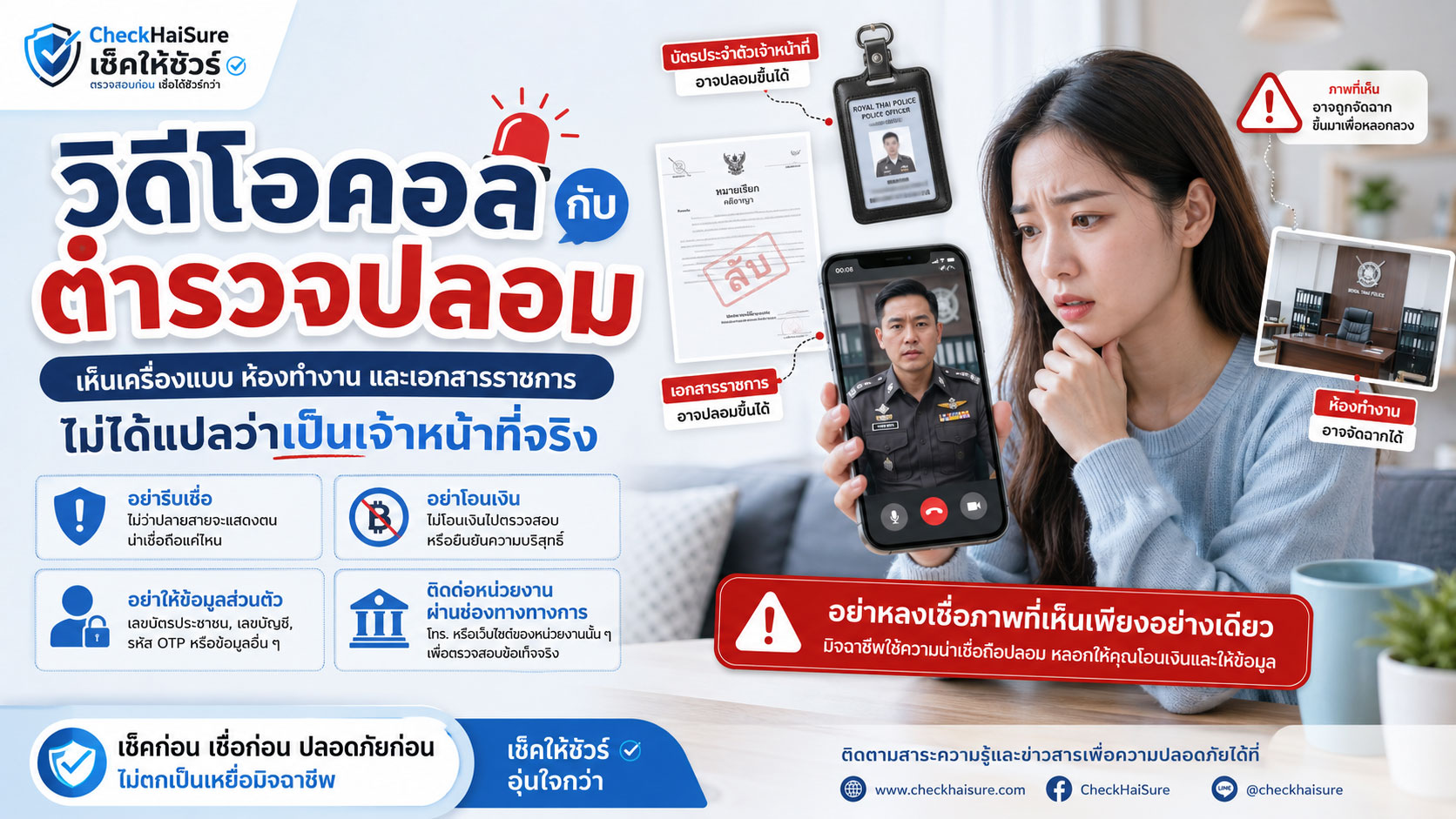
เมื่อก่อนหลายคนอาจคิดว่า ถ้าเป็นมิจฉาชีพ ก็คงโทรมาแค่เสียงเท่านั้น
แต่ทุกวันนี้ การหลอกลวงไม่ได้หยุดอยู่แค่เสียงปลายสายอีกแล้ว
บางกรณี มิจฉาชีพอาจพาคุณไปคุยผ่านวิดีโอคอล
คุณอาจเห็นคนแต่งเครื่องแบบ
เห็นฉากหลังคล้ายห้องทำงานราชการ
เห็นโต๊ะทำงาน
เห็นป้ายชื่อ
เห็นเอกสารที่ดูเป็นทางการ
เห็นตราครุฑ
เห็นโลโก้หน่วยงาน
หรือเห็นคนพูดด้วยน้ำเสียงจริงจังเหมือนกำลังสอบสวน
ทั้งหมดนี้อาจทำให้หลายคนรู้สึกว่า
“ถ้าเห็นหน้าขนาดนี้ ก็น่าจะเป็นเรื่องจริง”
แต่สิ่งที่ควรจำคือ
วิดีโอคอลไม่ได้เป็นหลักฐานว่าอีกฝ่ายเป็นเจ้าหน้าที่จริง
เพราะสิ่งที่เห็นผ่านหน้าจอ อาจถูกจัดฉาก ปลอมแปลง หรือนำมาใช้เพื่อสร้างความน่าเชื่อถือได้
เครื่องแบบอาจไม่ใช่หลักฐาน
ห้องทำงานอาจเป็นฉาก
เอกสารอาจทำปลอม
ชื่อหน่วยงานอาจถูกแอบอ้าง
และคนที่พูดเหมือนเจ้าหน้าที่ อาจเป็นเพียงคนที่กำลังเล่นบทให้คุณกลัว
ทำไมมิจฉาชีพถึงพาไปวิดีโอคอล
เพราะภาพทำให้คนเชื่อง่ายกว่าเสียง
ถ้าแค่โทรมาแล้วบอกว่าเป็นตำรวจ บางคนอาจไม่เชื่อ
แต่ถ้าเห็นคนใส่เครื่องแบบ นั่งหลังโต๊ะ มีเอกสาร มีฉากหลังที่ดูเหมือนสำนักงาน หลายคนจะเริ่มลังเล
จากเดิมที่คิดว่า “น่าจะเป็นมิจฉาชีพ”
อาจกลายเป็น “หรือว่าจะเป็นเรื่องจริง”
และจาก “ขอตรวจสอบก่อน”
อาจกลายเป็น “ทำตามก่อนดีกว่า กลัวมีปัญหา”
มิจฉาชีพใช้วิดีโอคอลเพื่อทำให้ความสงสัยของคุณอ่อนลง
เขาไม่ได้ต้องการให้คุณตรวจสอบให้ละเอียด
เขาต้องการให้คุณตกใจและเชื่อเร็วขึ้น
เมื่อภาพตรงหน้าดูจริง เสียงจริงจัง และเรื่องที่พูดเกี่ยวข้องกับคดี หลายคนจึงเริ่มรู้สึกว่าตัวเองไม่มีทางเลือก
กลโกงมักเริ่มจากเรื่องที่ทำให้กลัวก่อน
วิดีโอคอลกับตำรวจปลอมมักไม่ได้เริ่มจากการเปิดกล้องทันที
ส่วนใหญ่มักเริ่มจากสายโทรศัพท์หรือข้อความก่อน
เช่น
มีพัสดุของคุณเกี่ยวข้องกับสิ่งผิดกฎหมาย
บัญชีของคุณเกี่ยวข้องกับฟอกเงิน
มีคนใช้บัตรประชาชนของคุณเปิดบัญชีม้า
มีหมายจับหรือหมายเรียกในชื่อคุณ
มีเงินผิดกฎหมายผ่านบัญชีของคุณ
มีคดีออนไลน์ที่โยงมาถึงคุณ
หรือคุณต้องให้ปากคำเพื่อพิสูจน์ว่าไม่เกี่ยวข้อง
เมื่อคุณเริ่มกลัว อีกฝ่ายอาจบอกว่า
“เดี๋ยวโอนสายให้เจ้าหน้าที่”
“ต้องคุยผ่านวิดีโอคอลเพื่อยืนยันตัวตน”
“เจ้าหน้าที่จะสอบสวนผ่านระบบออนไลน์”
“ต้องทำตามขั้นตอนเพื่อแสดงความบริสุทธิ์”
“ห้ามวางสาย เพราะเป็นคดีสำคัญ”
จากนั้นคุณอาจถูกพาไปยังวิดีโอคอลที่ดูเหมือนจริง
แต่ความจริงอาจเป็นเพียงฉากหนึ่งของการหลอกลวง
เครื่องแบบไม่ได้แปลว่าเป็นเจ้าหน้าที่จริง
เครื่องแบบเป็นสิ่งที่ทำให้คนเกรงใจและกลัวได้ง่าย
เมื่อเห็นเครื่องแบบ หลายคนมักลดระดับความสงสัยลงโดยไม่รู้ตัว
เพราะเราถูกสอนมาว่าเจ้าหน้าที่คือคนที่มีอำนาจ และเราควรให้ความร่วมมือ
มิจฉาชีพจึงใช้เครื่องแบบเป็นเครื่องมือสร้างความน่าเชื่อถือ
แต่เครื่องแบบที่เห็นผ่านหน้าจอไม่ใช่หลักฐานเพียงพอ
เราไม่รู้ว่าเสื้อนั้นมาจากไหน
ไม่รู้ว่าคนในจอเป็นใคร
ไม่รู้ว่าฉากหลังจริงหรือจัดขึ้น
ไม่รู้ว่าเอกสารที่ถืออยู่เป็นของจริงหรือไม่
และไม่รู้ว่าสายนี้เชื่อมต่อมาจากหน่วยงานจริงหรือเปล่า
สิ่งสำคัญคือ อย่าเชื่อเพียงเพราะ “ดูเหมือน”
เพราะมิจฉาชีพไม่ได้ต้องการให้คุณตรวจสอบตัวตนของเขา
เขาต้องการให้คุณยอมรับบทบาทของเขาในทันทีว่า “เขาคือเจ้าหน้าที่”
ห้องทำงานและฉากหลังอาจเป็นเพียงฉาก
บางคนอาจเห็นฉากหลังแล้วรู้สึกเชื่อมากขึ้น
เช่น โต๊ะทำงาน
แฟ้มเอกสาร
ธงชาติ
ป้ายหน่วยงาน
โลโก้ตำรวจ
ห้องที่ดูคล้ายสำนักงาน
หรือเสียงคนอื่นทำงานอยู่ด้านหลัง
แต่ฉากหลังเหล่านี้จัดขึ้นได้
บางครั้งอาจเป็นห้องธรรมดาที่จัดให้ดูเหมือนสำนักงาน
บางครั้งอาจใช้ภาพพื้นหลัง
บางครั้งอาจใช้มุมกล้องช่วยให้ดูน่าเชื่อถือ
บางครั้งอาจมีหลายคนร่วมแสดงบทบาทในฉากเดียวกัน
และบางครั้งอาจใช้วิดีโอหรือภาพประกอบเพื่อให้ดูเหมือนอยู่ในสถานที่ราชการจริง
ดังนั้น อย่าใช้ฉากหลังเป็นเหตุผลหลักในการเชื่อ
ถ้าอีกฝ่ายเป็นเจ้าหน้าที่จริง เขาควรยินดีให้คุณวางสาย แล้วติดต่อกลับผ่านช่องทางทางการ
แต่ถ้าเขาพยายามบังคับให้คุณอยู่ในวิดีโอคอลต่อ ห้ามวางสาย ห้ามบอกใคร หรือให้ทำธุรกรรมทันที นั่นไม่ใช่ความน่าเชื่อถือ
นั่นคือสัญญาณอันตราย
เอกสารราชการปลอมทำให้คนกลัวได้มาก
มิจฉาชีพอาจส่งเอกสารให้ดูระหว่างวิดีโอคอลหรือในแชท
เช่น
หมายจับ
หมายเรียก
บันทึกประจำวัน
หนังสืออายัดบัญชี
หนังสือตรวจสอบเส้นทางการเงิน
เอกสารคดีฟอกเงิน
บัตรเจ้าหน้าที่
หรือเอกสารที่มีตราครุฑและโลโก้หน่วยงาน
เอกสารเหล่านี้มักถูกออกแบบให้คนตกใจ
บางฉบับอาจใส่ชื่อคุณ
เลขบัตรบางส่วน
หมายเลขคดี
ชื่อหน่วยงาน
ลายเซ็น
ตราประทับ
หรือข้อความที่ดูเหมือนเป็นภาษาราชการ
แต่เอกสารที่ส่งมาในแชทหรือโชว์ผ่านกล้อง ไม่ได้แปลว่าเป็นเอกสารจริง
เอกสารปลอมสามารถทำให้ดูน่าเชื่อถือได้มากขึ้นเรื่อยๆ
สิ่งที่ควรทำคือ อย่าตรวจสอบเอกสารกับคนที่ส่งเอกสารนั้นมาเอง
ให้หยุดคุย วางสาย และติดต่อหน่วยงานจริงผ่านช่องทางทางการด้วยตัวเอง
วิดีโอคอลอาจถูกใช้เพื่อสอบสวนปลอม
หลังจากสร้างความน่าเชื่อถือแล้ว อีกฝ่ายอาจเริ่มถามข้อมูล
เช่น
ชื่อเต็ม
เลขบัตรประชาชน
วันเดือนปีเกิด
ที่อยู่
ธนาคารที่ใช้
ยอดเงินในบัญชี
รายได้
ข้อมูลครอบครัว
ข้อมูลที่ทำงาน
รูปถ่ายบัตรประชาชน
รูปถ่ายหน้าตรง
หรือข้อมูลการโอนเงินย้อนหลัง
เขาอาจบอกว่าเป็นการ “สอบสวนเบื้องต้น” หรือ “ยืนยันตัวตน”
แต่คำถามเหล่านี้อาจถูกนำไปใช้ต่อได้
บางข้อมูลอาจใช้หลอกคุณต่อ
บางข้อมูลอาจใช้แอบอ้างตัวตน
บางข้อมูลอาจใช้ทำให้เรื่องดูสมจริงขึ้น
และบางข้อมูลอาจถูกนำไปใช้หลอกคนอื่นในอนาคต
จำไว้ว่า การสอบสวนจริงไม่ควรเกิดขึ้นแบบเร่งรีบผ่านวิดีโอคอลจากคนที่คุณยังไม่ได้ตรวจสอบตัวตน
โดยเฉพาะถ้าเขาห้ามคุณวางสายหรือห้ามคุณติดต่อสถานีตำรวจเอง
จุดที่อันตรายที่สุดคือการสั่งให้ทำธุรกรรมระหว่างวิดีโอคอล
หลายคนคิดว่าวิดีโอคอลแค่ทำให้กลัว
แต่ในบางกรณี มิจฉาชีพจะใช้วิดีโอคอลเพื่อควบคุมพฤติกรรมของคุณทีละขั้นตอน
เช่น
ให้เปิดแอปธนาคาร
ให้แจ้งยอดเงิน
ให้โอนเงินไปบัญชีตรวจสอบ
ให้โอนเงินไปบัญชีปลอดภัย
ให้สแกน QR Code
ให้กดตามเมนูที่เขาบอก
ให้เปิดแชร์หน้าจอ
ให้ติดตั้งแอปเพิ่มเติม
หรือให้ยืนยันรายการที่เขาอ้างว่าเป็นการตรวจสอบ
ถ้าคุณอยู่ในวิดีโอคอลและอีกฝ่ายเริ่มพูดถึงการโอนเงิน ให้ถือว่านี่คือจุดที่ต้องหยุดทันที
เจ้าหน้าที่จริงไม่ควรสั่งให้ประชาชนโอนเงินเพื่อพิสูจน์ความบริสุทธิ์ผ่านวิดีโอคอล
ไม่ควรให้คุณย้ายเงินไปบัญชีที่เขาบอก
ไม่ควรขอ OTP
ไม่ควรให้เปิดแอปธนาคารให้ดู
และไม่ควรสั่งให้คุณกดรายการทางการเงินตามคำพูดของเขา
“ห้ามวางสาย” คือสัญญาณที่ควรระวังมาก
ถ้าอีกฝ่ายเป็นเจ้าหน้าที่จริง เขาไม่ควรกลัวว่าคุณจะตรวจสอบ
แต่ถ้าเป็นมิจฉาชีพ เขาจะพยายามไม่ให้คุณออกจากสถานการณ์ที่เขาควบคุมอยู่
จึงมักมีคำพูดแบบนี้
“ห้ามวางสาย”
“ห้ามบอกใคร เพราะเป็นคดีลับ”
“ถ้าออกจากสายจะถือว่าไม่ให้ความร่วมมือ”
“ถ้าบอกคนอื่นจะมีความผิด”
“ต้องทำตอนนี้เท่านั้น”
“เจ้าหน้าที่กำลังรอรับเรื่อง”
“ถ้าไม่ทำตาม จะออกหมายจับทันที”
คำเหล่านี้ไม่ได้ทำให้เขาดูน่าเชื่อถือ
แต่เป็นสัญญาณว่าเขากำลังตัดคุณออกจากความช่วยเหลือภายนอก
เมื่อคุณวางสาย คุณจะมีเวลาคิด
มีโอกาสโทรหาคนในครอบครัว
มีโอกาสติดต่อสถานีตำรวจจริง
มีโอกาสโทรหาธนาคาร
และมีโอกาสรู้ว่าสิ่งที่เกิดขึ้นอาจเป็นการหลอกลวง
มิจฉาชีพจึงพยายามไม่ให้คุณได้เวลานั้น
ถ้าเจอวิดีโอคอลแบบนี้ ควรทำอย่างไร
ถ้ามีคนอ้างว่าเป็นตำรวจหรือเจ้าหน้าที่ แล้วพาคุณไปวิดีโอคอล ให้ตั้งสติก่อน
อย่าให้ข้อมูลส่วนตัวเพิ่ม
อย่าโชว์บัตรประชาชน
อย่าถ่ายรูปหน้าตรงส่งให้
อย่าแจ้งยอดเงินในบัญชี
อย่าเปิดแอปธนาคาร
อย่าแชร์หน้าจอ
อย่าอ่าน OTP
อย่ากดลิงก์
อย่าติดตั้งแอป
อย่าโอนเงิน
และอย่าอยู่ต่อเพราะเขาบอกว่าห้ามวางสาย
คุณสามารถพูดสั้นๆ ว่า
“ขอบคุณค่ะ/ครับ เดี๋ยวจะติดต่อสถานีตำรวจหรือหน่วยงานทางการด้วยตัวเอง”
จากนั้นวางสายทันที
ถ้าเป็นเรื่องจริง คุณยังสามารถตรวจสอบผ่านหน่วยงานจริงได้
แต่ถ้าเป็นเรื่องหลอก การวางสายอาจช่วยหยุดความเสียหายได้ทัน
ตรวจสอบอย่างไรให้ปลอดภัยกว่า
หลังวางสาย ให้ใช้ช่องทางที่คุณหาเอง ไม่ใช่ช่องทางที่อีกฝ่ายให้มา
หากเขาอ้างว่าเป็นตำรวจ ให้ติดต่อสถานีตำรวจใกล้บ้าน หรือช่องทางตำรวจไซเบอร์ที่ตรวจสอบได้
หากเกี่ยวข้องกับบัญชีธนาคาร ให้ติดต่อธนาคารผ่านแอป เว็บไซต์ทางการ เบอร์หลังบัตร หรือสาขา
หากเขาอ้างถึงบริษัทขนส่ง ให้ติดต่อบริษัทขนส่งผ่านเว็บไซต์หรือแอปทางการ
หากเขาส่งเอกสารมา ให้เก็บไว้เป็นหลักฐาน แต่อย่าใช้เอกสารนั้นเป็นเหตุผลในการทำตามทันที
หากมีการขู่คดีหรือบังคับให้โอนเงิน ให้บอกคนใกล้ตัวที่ไว้ใจได้และขอให้ช่วยตรวจสอบ
สิ่งสำคัญคือ อย่าให้คนที่คุณสงสัยเป็นคนกำหนดช่องทางตรวจสอบให้คุณ
ถ้าเผลอส่งข้อมูลหรือโอนเงินไปแล้ว
ถ้าคุณเผลอให้ข้อมูลส่วนตัว ส่งเอกสาร หรือโอนเงินไปแล้ว ให้หยุดทันทีและอย่าโอนเพิ่ม
เก็บหลักฐานทุกอย่าง
เช่น เบอร์โทร
ชื่อบัญชี
เลขบัญชีปลายทาง
สลิปโอนเงิน
แชท
ลิงก์
เอกสารที่ส่งมา
ภาพหน้าจอวิดีโอคอลถ้ามี
ชื่อที่อีกฝ่ายใช้
และเวลาที่เกิดเหตุ
จากนั้นติดต่อธนาคารผ่านช่องทางทางการ หากมีธุรกรรมทางการเงินเกี่ยวข้อง
แจ้งหน่วยงานที่เกี่ยวข้องตามขั้นตอน
เปลี่ยนรหัสผ่านบัญชีสำคัญ หากมีการให้ข้อมูลที่อาจกระทบความปลอดภัย
และขอความช่วยเหลือจากคนใกล้ตัวที่ไว้ใจได้
อย่ากลับไปคุยกับคนเดิมเพราะเขาบอกว่าจะช่วยแก้ปัญหา
เพราะหลังจากเหยื่อเริ่มรู้ตัว มิจฉาชีพอาจหลอกซ้ำด้วยการอ้างว่าจะช่วยปิดคดี ถอนหมายจับ หรือคืนเงินให้
อย่าให้ความกลัวทำให้คุณพิสูจน์ตัวเองผิดวิธี
คนบริสุทธิ์มักอยากอธิบายให้เร็วที่สุด
เมื่อมีคนบอกว่าเราเกี่ยวข้องกับคดี เราอาจรีบบอกข้อมูลเพื่อแสดงว่าเราไม่ได้ทำผิด
แต่การให้ข้อมูลกับคนผิด อาจทำให้ความเสี่ยงเพิ่มขึ้น
การส่งเอกสารให้คนผิด อาจเปิดทางให้ถูกแอบอ้างตัวตน
การโอนเงินให้คนผิด อาจทำให้เสียเงินจริง
และการอยู่ในสายกับคนผิดนานเกินไป อาจทำให้ถูกกดดันจนตัดสินใจพลาด
ความบริสุทธิ์ไม่ควรถูกพิสูจน์ด้วยการทำตามคำสั่งของคนที่คุณยังตรวจสอบไม่ได้
ถ้าเป็นเรื่องจริง ช่องทางจริงยังมีอยู่
แต่ถ้าเป็นเรื่องหลอก การหยุดก่อนคือสิ่งที่ช่วยคุณได้มากที่สุด
ครอบครัวควรคุยกันเรื่อง “วิดีโอคอลเจ้าหน้าที่ปลอม”
หลายคนอาจเตือนกันแค่ว่า “อย่ารับสายแปลกๆ”
แต่ทุกวันนี้อาจต้องคุยกันมากกว่านั้น
เพราะมิจฉาชีพอาจใช้วิดีโอคอล เครื่องแบบ และเอกสารปลอมเพื่อทำให้ดูจริงขึ้น
ในครอบครัวควรตกลงกันง่ายๆ ว่า
ถ้ามีคนอ้างว่าเป็นตำรวจผ่านวิดีโอคอล ให้ไม่โอนเงินทันที
ถ้าเขาห้ามวางสาย ให้ถือว่าน่าสงสัย
ถ้าเขาห้ามบอกครอบครัว ให้ยิ่งต้องบอก
ถ้าเขาให้เปิดแอปธนาคาร ให้หยุดทันที
ถ้าเขาขอ OTP หรือเอกสารส่วนตัว ให้ไม่ให้
ถ้าเขาขู่หมายจับ ให้ไปตรวจสอบกับสถานีตำรวจจริง
และถ้าไม่แน่ใจ ให้โทรหาคนในบ้านก่อนทำอะไรต่อ
ข้อตกลงเล็กๆ แบบนี้อาจช่วยให้คนที่กำลังตกใจไม่ต้องตัดสินใจคนเดียว
ประโยคที่ควรจำ: เห็นเครื่องแบบผ่านจอ ไม่เท่ากับตรวจสอบตัวตนแล้ว
ถ้าต้องจำหนึ่งประโยคจากบทความนี้ ขอให้จำว่า
เห็นเครื่องแบบผ่านจอ ไม่เท่ากับตรวจสอบตัวตนแล้ว
เห็นห้องทำงาน ไม่ได้แปลว่าอยู่ในหน่วยงานจริง
เห็นเอกสาร ไม่ได้แปลว่าเอกสารจริง
เห็นตราราชการ ไม่ได้แปลว่าเป็นช่องทางราชการ
เห็นคนพูดจริงจัง ไม่ได้แปลว่าเขามีอำนาจจริง
และเห็นวิดีโอคอล ไม่ได้แปลว่าคุณต้องทำตามทุกอย่างทันที
การตรวจสอบที่ปลอดภัยต้องเกิดจากช่องทางที่คุณเลือกเอง
ไม่ใช่ช่องทางที่คนปลายสายจัดฉากไว้ให้
สรุป: วิดีโอคอลทำให้ดูจริงได้ แต่ความจริงต้องตรวจสอบจากช่องทางทางการ
วิดีโอคอลกับตำรวจปลอมเป็นกลโกงที่อันตราย เพราะมันใช้ภาพเข้ามาช่วยลดความสงสัย
จากเสียงปลายสาย กลายเป็นหน้าคน
จากคำพูด กลายเป็นเครื่องแบบ
จากการขู่ กลายเป็นเอกสาร
จากความลังเล กลายเป็นความกลัว
และจากความกลัว อาจกลายเป็นการโอนเงินหรือให้ข้อมูลสำคัญ
สิ่งที่ควรทำคือหยุดก่อนเสมอ
อย่าเชื่อเพียงเพราะเห็นเครื่องแบบ
อย่าเชื่อเพียงเพราะเห็นเอกสาร
อย่าเชื่อเพียงเพราะเห็นฉากหลังเหมือนสำนักงาน
อย่าให้ข้อมูลส่วนตัว
อย่าเปิดแอปธนาคาร
อย่าแชร์หน้าจอ
อย่าให้ OTP
อย่าติดตั้งแอป
และอย่าโอนเงินเพื่อพิสูจน์ความบริสุทธิ์
ถ้าอีกฝ่ายอ้างว่าเป็นเจ้าหน้าที่จริง ให้คุณมีสิทธิ์วางสายและตรวจสอบผ่านหน่วยงานจริงด้วยตัวเอง
หากเป็นเรื่องจริง การตรวจสอบผ่านช่องทางทางการยังทำได้
แต่หากเป็นมิจฉาชีพ การวางสายอาจเป็นจุดที่ช่วยหยุดความเสียหายได้ทันเวลา
Video Call with Fake Police: Seeing a Uniform, Office Background, and Official-Looking Documents Does Not Mean They Are Real Officers
In the past, many people may have thought that scammers only called by voice.
But today, scams no longer stop at voice calls.
In some cases, scammers may move the conversation to a video call.
You may see someone wearing a uniform.
You may see a background that looks like a government office.
You may see a work desk.
You may see a nameplate.
You may see official-looking documents.
You may see a government emblem.
You may see an agency logo.
Or you may see someone speaking in a serious tone, as if they are conducting an investigation.
All of this may make many people feel:
“If I can see them this clearly, it must be real.”
But one thing you should remember is this:
A video call is not proof that the other person is a real officer.
What you see through a screen can be staged, forged, or used to create false credibility.
A uniform may not be proof.
An office background may be a set.
A document may be fake.
An agency name may be impersonated.
And a person who speaks like an officer may simply be acting a role to make you afraid.
Why Scammers Use Video Calls
Because images can make people believe more easily than voice alone.
If someone only calls and says they are the police, some people may not believe them.
But if you see a person wearing a uniform, sitting behind a desk, with documents and a background that looks like an office, many people begin to hesitate.
What started as “this is probably a scam”
may become “what if this is real?”
And what started as “I should check first”
may become “maybe I should follow their instructions first because I am afraid of getting into trouble.”
Scammers use video calls to weaken your doubts.
They do not want you to verify carefully.
They want you to panic and believe faster.
When the image looks real, the voice sounds serious, and the story involves a legal case, many people start to feel they have no choice.
The Scam Often Starts with Fear
A video call with fake police usually does not begin with the camera immediately.
It often starts with a phone call or message first.
For example:
A parcel under your name is linked to illegal items.
Your account is linked to money laundering.
Someone used your ID card to open a mule account.
There is an arrest warrant or summons under your name.
Illegal money has passed through your account.
An online crime case is connected to you.
Or you need to give a statement to prove you are not involved.
Once you begin to feel afraid, the caller may say:
“We will connect you to an officer.”
“You need to speak through video call to verify your identity.”
“The officer will investigate you through the online system.”
“You must follow the steps to prove your innocence.”
“Do not hang up, because this is an important case.”
Then you may be moved into a video call that looks real.
But it may simply be another scene in the scam.
A Uniform Does Not Mean They Are a Real Officer
A uniform can easily make people feel respectful, nervous, or afraid.
When people see a uniform, many naturally lower their level of suspicion without realizing it.
We are often taught that officers have authority and that we should cooperate.
Scammers use this reaction as a tool to build credibility.
But a uniform seen through a screen is not enough proof.
You do not know where the uniform came from.
You do not know who the person on the screen really is.
You do not know whether the background is real or staged.
You do not know whether the document they are holding is real.
And you do not know whether the call is actually connected to a real agency.
The key is not to believe something simply because it “looks official.”
Scammers do not want you to verify who they are.
They want you to accept their role immediately: “This person is an officer.”
Office Backgrounds Can Be Staged
Some people may believe more quickly because of the background.
For example:
A work desk
Stacks of files
A national flag
An agency sign
A police logo
A room that looks like an office
Or background noise that sounds like people working
But backgrounds can be arranged.
Sometimes it may be an ordinary room made to look like an office.
Sometimes it may be a virtual background.
Sometimes the camera angle may be used to make the scene look more believable.
Sometimes several people may act together in the same setup.
And sometimes images or videos may be used to make it look like a real official location.
So do not use the background as your main reason to believe them.
If the other person is a real officer, they should allow you to hang up and contact the agency again through official channels.
But if they try to force you to stay in the video call, tell you not to hang up, tell you not to tell anyone, or order you to perform transactions immediately, that is not credibility.
That is a warning sign.
Fake Official Documents Can Create Strong Fear
Scammers may show or send documents during the video call or through chat.
These may include:
Arrest warrants
Summons documents
Police reports
Account freeze notices
Financial investigation documents
Money laundering case documents
Officer ID cards
Or documents with government emblems and agency logos
These documents are designed to make people panic.
Some may include your name.
Part of your ID number.
A case number.
An agency name.
A signature.
A stamp.
Or wording that looks like official language.
But a document shown through a camera or sent in chat does not prove it is real.
Fake documents can be made to look increasingly convincing.
The safer step is not to verify the document with the same person who sent it.
Stop the conversation, hang up, and contact the real agency through official channels yourself.
Video Calls May Be Used for Fake Interrogation
After building credibility, the person may begin asking for information.
For example:
Full name
National ID number
Date of birth
Address
Banks you use
Account balance
Income
Family information
Workplace information
Photo of your ID card
Photo of your face
Or past transfer details
They may call this a “preliminary investigation” or “identity verification.”
But these details may be misused later.
Some information may be used to continue scamming you.
Some may be used for identity impersonation.
Some may be used to make the story sound more real.
And some may be used to scam other people in the future.
Remember: a real investigation should not happen in a rushed video call from someone whose identity you have not verified.
This is especially true if they tell you not to hang up or not to contact a real police station yourself.
The Most Dangerous Point Is When They Tell You to Perform Transactions During the Video Call
Many people think a video call is only used to scare them.
But in some cases, scammers use the video call to control your actions step by step.
They may tell you to:
Open your banking app
Disclose your account balance
Transfer money to a verification account
Transfer money to a safe account
Scan a QR code
Tap through menus they describe
Share your screen
Install another app
Or confirm a transaction they claim is only for verification
If you are in a video call and the other person starts talking about transferring money, that is the point where you should stop immediately.
Real officers should not ask citizens to transfer money to prove innocence through a video call.
They should not tell you to move money to an account they provide.
They should not ask for your OTP.
They should not ask you to show your banking app.
And they should not tell you to perform financial actions according to their instructions.
“Do Not Hang Up” Is a Major Warning Sign
If the person is a real officer, they should not be afraid of you verifying the situation.
But if they are a scammer, they will try to keep you inside the situation they control.
They may say:
“Do not hang up.”
“Do not tell anyone, because this is a confidential case.”
“If you leave the call, it will count as non-cooperation.”
“If you tell others, you may be breaking the law.”
“This must be done now.”
“The officer is waiting for your response.”
“If you do not follow the instructions, an arrest warrant will be issued immediately.”
These words do not make them more credible.
They are signs that someone is trying to cut you off from outside help.
When you hang up, you have time to think.
You can call a family member.
You can contact a real police station.
You can call your bank.
And you can realize that what is happening may be a scam.
That is why scammers try not to give you that time.
What Should You Do If You Face This Kind of Video Call?
If someone claims to be police or an officer and moves you into a video call, pause first.
Do not provide more personal information.
Do not show your ID card.
Do not send a face photo.
Do not disclose your account balance.
Do not open your banking app.
Do not share your screen.
Do not read out an OTP.
Do not click links.
Do not install apps.
Do not transfer money.
And do not stay just because they say you must not hang up.
You can simply say:
“Thank you. I will contact the police station or official agency myself.”
Then hang up immediately.
If the matter is real, you can still verify it through the real agency.
But if it is a scam, hanging up may stop the damage in time.
How to Verify More Safely
After hanging up, use a channel you find yourself, not a channel provided by the caller.
If they claim to be the police, contact a nearby police station or a verified cyber police channel.
If it involves your bank account, contact your bank through the official app, official website, the number on the back of your card, or a branch.
If they claim to be from a delivery company, contact the delivery company through its official website or app.
If they sent documents, save them as evidence, but do not use them as a reason to follow instructions immediately.
If they threatened you with a case or pressured you to transfer money, tell someone you trust and ask them to help verify.
The important rule is this:
Do not let the person you suspect choose the verification channel for you.
If You Already Shared Information or Transferred Money
If you already shared personal information, sent documents, or transferred money, stop immediately and do not transfer more.
Save all evidence.
For example:
Phone number
Account name
Destination account number
Transfer slip
Chat messages
Links
Documents they sent
Screenshots of the video call, if any
The name they used
And the time of the incident
Then contact your bank through official channels if any financial transaction was involved.
Report the incident through the relevant official process.
Change passwords for important accounts if you shared information that may affect security.
And ask someone you trust for help.
Do not return to the same person just because they say they can help fix the problem.
Once victims start realizing what happened, scammers may try to scam them again by claiming they can close the case, cancel the arrest warrant, or recover the money.
Do Not Let Fear Make You Prove Yourself the Wrong Way
Innocent people often want to explain themselves as quickly as possible.
When someone says we are involved in a case, we may rush to provide information to show that we did nothing wrong.
But giving information to the wrong person can increase the risk.
Sending documents to the wrong person may open the door to identity misuse.
Transferring money to the wrong person can cause real financial loss.
And staying too long in the wrong call can give scammers more time to pressure you into making a mistake.
Your innocence should not be proven by following instructions from someone you have not verified.
If the matter is real, real channels still exist.
But if it is a scam, stopping first may protect you the most.
Families Should Talk About Fake Officer Video Calls
Many people warn their families only by saying, “Do not answer strange calls.”
But today, families may need to talk about more than that.
Scammers may use video calls, uniforms, and fake documents to make the situation look more real.
Families can agree on simple rules:
If someone claims to be police through video call, do not transfer money immediately.
If they tell you not to hang up, treat it as suspicious.
If they tell you not to tell your family, tell your family immediately.
If they ask you to open your banking app, stop immediately.
If they ask for an OTP or personal documents, do not provide them.
If they threaten you with an arrest warrant, verify it with a real police station.
And if you are unsure, call someone in the family before doing anything else.
Small agreements like these can help someone who is panicking avoid making decisions alone.
A Sentence to Remember: Seeing a Uniform on Screen Does Not Mean You Have Verified Their Identity
If you remember one sentence from this article, remember this:
Seeing a uniform on screen does not mean you have verified their identity.
Seeing an office does not mean they are inside a real agency.
Seeing a document does not mean the document is real.
Seeing an official symbol does not mean the channel is official.
Seeing someone speak seriously does not mean they have real authority.
And being on a video call does not mean you must follow everything immediately.
Safe verification must happen through a channel you choose yourself.
Not through a staged channel prepared by the person on the call.
Conclusion: Video Calls Can Make Things Look Real, but the Truth Must Be Checked Through Official Channels
A video call with fake police is dangerous because it uses visuals to reduce doubt.
A voice call becomes a visible person.
Words become a uniform.
Threats become documents.
Hesitation becomes fear.
And fear may lead to money transfers or the sharing of sensitive information.
The right response is always to stop first.
Do not believe just because you see a uniform.
Do not believe just because you see documents.
Do not believe just because the background looks like an office.
Do not share personal information.
Do not open your banking app.
Do not share your screen.
Do not provide an OTP.
Do not install apps.
And do not transfer money to prove your innocence.
If the other person claims to be a real officer, you have the right to hang up and verify through the real agency yourself.
If the matter is real, official channels can still help you check.
But if it is a scam, hanging up may stop the damage in time.

Leave a Reply
You must be logged in to post a comment.