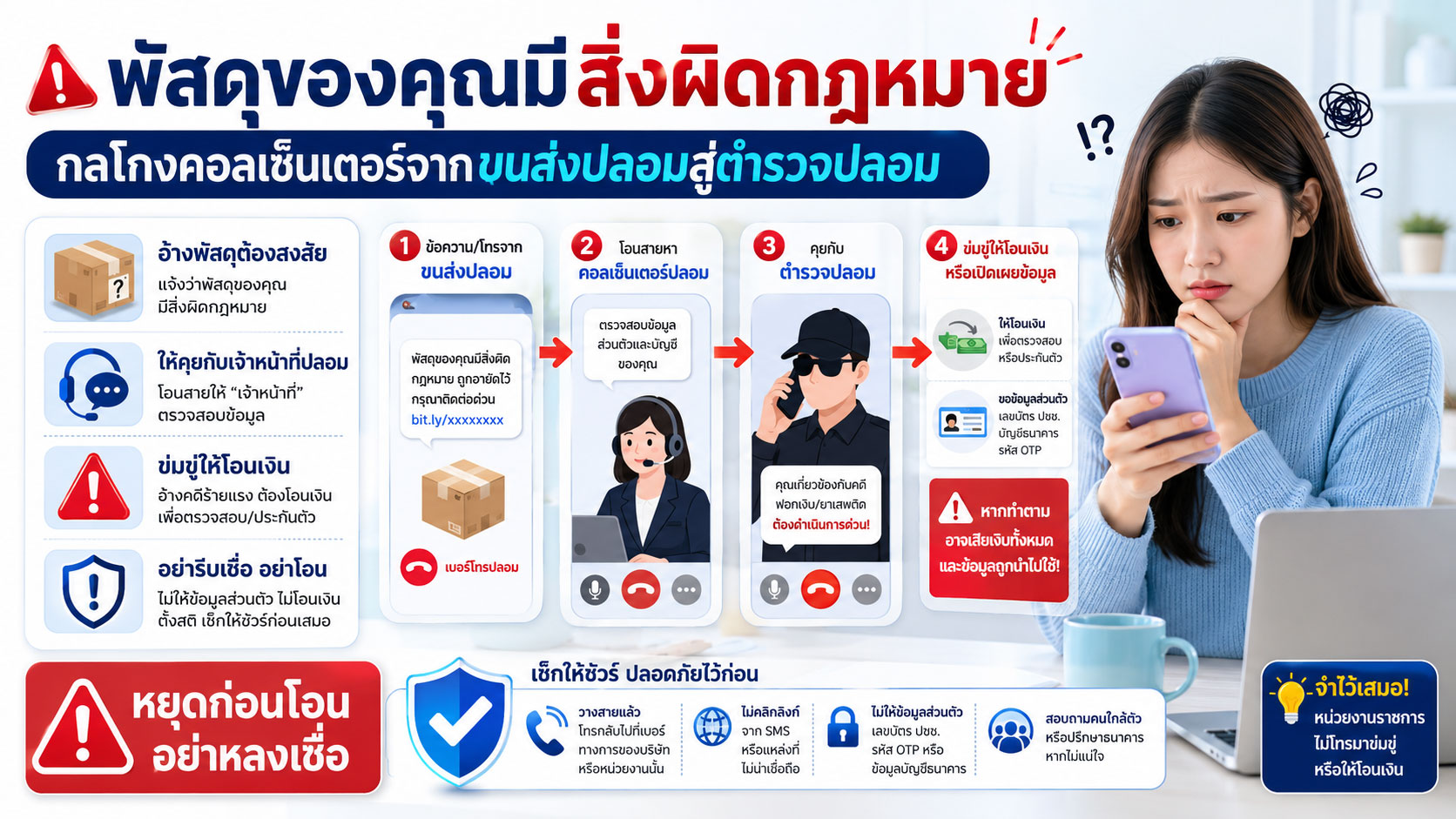
“สวัสดีค่ะ โทรจากบริษัทขนส่งนะคะ พัสดุของคุณมีปัญหา”
ประโยคแบบนี้อาจฟังดูธรรมดาในยุคที่หลายคนสั่งของออนไลน์เป็นประจำ
บางคนสั่งของทุกสัปดาห์
บางคนกำลังรอพัสดุจริง
บางคนเคยส่งเอกสารหรือของให้คนอื่น
บางคนอาจจำไม่ได้ด้วยซ้ำว่าเคยกดสั่งอะไรไว้บ้าง
มิจฉาชีพจึงใช้ “พัสดุ” เป็นจุดเริ่มต้นที่ทำให้คนฟังรู้สึกว่า เรื่องนี้อาจเกี่ยวกับตัวเองจริง
แต่หลังจากนั้น เรื่องจะค่อยๆ ถูกพาไปไกลกว่าเดิม
จากพัสดุตกค้าง
กลายเป็นพัสดุมีสิ่งผิดกฎหมาย
จากเจ้าหน้าที่ขนส่ง
กลายเป็นตำรวจ
จากการตรวจสอบข้อมูล
กลายเป็นการขู่คดี
และจากความตกใจ
อาจจบลงด้วยการโอนเงิน ให้ข้อมูลส่วนตัว หรือทำตามคำสั่งของคนที่ไม่ใช่เจ้าหน้าที่จริง
นี่คือหนึ่งในรูปแบบของคอลเซ็นเตอร์สแกมที่อันตรายมาก เพราะไม่ได้หลอกด้วยคำว่า “ได้เงินรางวัล” หรือ “ได้สิทธิพิเศษ”
แต่หลอกด้วยความกลัวว่าเราอาจเกี่ยวข้องกับคดี
กลโกงเริ่มจากเรื่องเล็กๆ ที่ดูเหมือนเป็นไปได้
มิจฉาชีพอาจเริ่มต้นด้วยการอ้างว่าเป็นบริษัทขนส่ง
เขาอาจบอกว่า มีพัสดุที่ใช้ชื่อคุณส่งออกไปต่างจังหวัด
มีพัสดุถูกตีกลับ
มีของผิดกฎหมายอยู่ในกล่อง
มีเอกสารปลอม ยาเสพติด บัตรประชาชน หรือบัญชีธนาคารเกี่ยวข้องกับคุณ
หรือมีการใช้ชื่อและเบอร์ของคุณเปิดส่งพัสดุ
ช่วงแรกของบทสนทนามักไม่ได้เริ่มด้วยการขอเงินทันที
แต่เริ่มด้วยการทำให้คุณรู้สึกว่า “ต้องฟังต่อ”
เพราะถ้าฟังแค่ประโยคแรก คุณอาจยังไม่เชื่อ
แต่ถ้าอีกฝ่ายพูดชื่อคุณ เบอร์โทรบางส่วน หรือข้อมูลที่ดูคล้ายจริง คุณอาจเริ่มลังเล
และถ้าคุณกำลังรอพัสดุอยู่พอดี ความลังเลนั้นอาจเปลี่ยนเป็นความกังวลได้ง่ายมาก
จุดอันตรายคือ มิจฉาชีพไม่ได้ต้องการให้คุณเชื่อทั้งหมดตั้งแต่วินาทีแรก
เขาแค่ต้องการให้คุณไม่วางสาย
จากขนส่งปลอม สู่การโอนสายไป “ตำรวจปลอม”
เมื่อคุณเริ่มกังวล อีกฝ่ายอาจบอกว่าเรื่องนี้เกินอำนาจของบริษัทขนส่ง
จากนั้นจะเสนอว่า
“เดี๋ยวโอนสายให้เจ้าหน้าที่ตำรวจนะคะ”
“ต้องคุยกับเจ้าหน้าที่เพื่อยืนยันว่าไม่เกี่ยวข้อง”
“ถ้าไม่ดำเนินการตอนนี้ อาจมีหมายเรียกหรือหมายจับ”
“กรุณาอย่าวางสาย เพราะเป็นขั้นตอนทางกฎหมาย”
ตรงนี้คือจุดเปลี่ยนสำคัญ
เพราะจากเรื่องพัสดุธรรมดา คุณถูกดึงเข้าสู่บทสนทนาที่มีคำว่า “คดี” “ตำรวจ” “เอกสารราชการ” หรือ “การสอบสวน”
หลายคนไม่ได้เชื่อเพราะโลภ
แต่เชื่อเพราะกลัว
กลัวว่าชื่อของตัวเองจะไปเกี่ยวกับของผิดกฎหมาย
กลัวพ่อแม่หรือที่ทำงานรู้
กลัวถูกออกหมายจับ
กลัวว่าถ้าไม่รีบอธิบาย จะถูกมองว่าเป็นผู้กระทำผิด
กลัวว่าความเงียบจะกลายเป็นการยอมรับผิด
มิจฉาชีพเข้าใจความกลัวนี้ดี
และใช้มันเป็นเครื่องมือควบคุมบทสนทนา
ทำไมคำว่า “พัสดุผิดกฎหมาย” ถึงทำให้คนพลาดง่าย
คำว่า “พัสดุผิดกฎหมาย” มีพลังมากกว่าที่คิด
เพราะมันแตะหลายความกลัวพร้อมกัน
กลัวเรื่องกฎหมาย
กลัวตำรวจ
กลัวประวัติเสีย
กลัวถูกเข้าใจผิด
กลัวถูกนำชื่อไปใช้
กลัวว่ามีคนแอบอ้างตัวตน
และกลัวว่าจะเดือดร้อนทั้งที่ไม่ได้ทำอะไร
มิจฉาชีพจึงมักไม่พูดให้คุณมีเวลาคิดมากนัก
เขาจะพูดเร็ว
ให้รายละเอียดเยอะ
ใช้น้ำเสียงจริงจัง
บอกว่าคดีนี้สำคัญ
บอกว่ามีเจ้าหน้าที่รอรับเรื่อง
และทำให้คุณรู้สึกว่าต้องรีบพิสูจน์ความบริสุทธิ์
แต่ในชีวิตจริง การพิสูจน์ความบริสุทธิ์ไม่ควรเริ่มจากการทำตามคำสั่งคนแปลกหน้าทางโทรศัพท์
และเจ้าหน้าที่จริงไม่ควรบังคับให้คุณอยู่ในสายเดียว ห้ามบอกใคร หรือทำธุรกรรมตามคำสั่งทันที
สัญญาณเตือนว่าอาจเป็นคอลเซ็นเตอร์สแกม
ถ้าคุณได้รับสายเกี่ยวกับพัสดุที่บอกว่ามีสิ่งผิดกฎหมาย ให้ระวังเป็นพิเศษเมื่อเจอพฤติกรรมเหล่านี้
อีกฝ่ายบอกว่าคุณเกี่ยวข้องกับพัสดุผิดกฎหมาย ทั้งที่คุณไม่รู้เรื่อง
อ้างว่าจะโอนสายไปตำรวจหรือหน่วยงานรัฐทันที
บอกให้คุณคุยผ่าน LINE หรือวิดีโอคอลกับเจ้าหน้าที่
ส่งเอกสารราชการ หมายจับ หรือบันทึกคดีผ่านแชท
ห้ามวางสาย
ห้ามบอกคนในครอบครัว
ห้ามติดต่อสถานีตำรวจเอง
บอกให้คุณยืนยันตัวตนด้วยเลขบัตรประชาชน
ขอให้ถ่ายรูปบัตรประชาชนหรือหน้าตรง
ให้โอนเงินไปบัญชีที่อ้างว่าเป็นบัญชีตรวจสอบ
บอกให้ย้ายเงินไปบัญชีปลอดภัย
ขอ OTP หรือรหัสใดๆ
ให้ติดตั้งแอปเพื่อให้เจ้าหน้าที่ตรวจสอบเครื่อง
หรือขู่ว่าถ้าไม่ทำตาม จะถูกดำเนินคดีทันที
ถ้ามีข้อใดข้อหนึ่งเกิดขึ้น ให้หยุดทันที
เพราะนี่ไม่ใช่รูปแบบการติดต่อที่ปลอดภัย
ตำรวจจริงจะให้คุณโอนเงินเพื่อพิสูจน์ความบริสุทธิ์หรือไม่
คำตอบที่ควรจำให้ชัดคือ
ไม่ควรมีใครขอให้คุณโอนเงินเพื่อพิสูจน์ความบริสุทธิ์ผ่านโทรศัพท์
ไม่ว่าจะอ้างว่าเป็นตำรวจ
อัยการ
ศาล
ธนาคาร
ปปง.
บริษัทขนส่ง
หรือหน่วยงานรัฐใดๆ
การโอนเงินไปยังบัญชีที่อีกฝ่ายให้มา ไม่ได้ทำให้คุณปลอดภัยขึ้น
ในหลายกรณี นั่นคือเป้าหมายหลักของมิจฉาชีพ
เขาอาจเรียกชื่อบัญชีปลายทางว่า
บัญชีตรวจสอบ
บัญชีกลาง
บัญชีปลอดภัย
บัญชีสำนักงาน
บัญชีพักเงิน
หรือบัญชีสำหรับตรวจสอบเส้นทางการเงิน
แต่ไม่ว่าจะใช้ชื่ออะไร หากมีคนแปลกหน้าบอกให้คุณโอนเงินออกจากบัญชีของตัวเองเพื่อแก้คดี ให้ถือว่าอันตรายมาก
เรื่องกฎหมายจริงไม่ควรถูกจัดการด้วยการให้ประชาชนโอนเงินไปบัญชีที่คนปลายสายบอก
อย่าให้ “เอกสารปลอม” ทำให้เชื่อเร็วเกินไป
มิจฉาชีพอาจส่งเอกสารให้ดูระหว่างคุย
เช่น หมายเรียก
หมายจับ
บันทึกประจำวัน
หนังสือราชการ
บัตรเจ้าหน้าที่
รูปหน้าสถานีตำรวจ
โลโก้หน่วยงาน
หรือภาพที่ดูเหมือนเอกสารลับ
เอกสารเหล่านี้อาจทำให้คนตกใจ เพราะดูเป็นทางการ
แต่เอกสารที่ส่งมาในแชทไม่ได้แปลว่าเป็นเอกสารจริง
โลโก้สามารถคัดลอกได้
แบบฟอร์มสามารถทำปลอมได้
ลายเซ็นสามารถใส่ภาพได้
ตราครุฑสามารถนำไปใช้ผิดได้
และรูปเจ้าหน้าที่สามารถถูกแอบอ้างได้
สิ่งที่ควรทำคือ อย่าตรวจสอบเอกสารจากคนที่ส่งเอกสารนั้นมาเอง
ให้วางสาย แล้วติดต่อหน่วยงานจริงผ่านช่องทางทางการที่คุณหาเอง
ถ้าเป็นคดีจริง หน่วยงานจริงควรตรวจสอบให้คุณได้ผ่านช่องทางที่ถูกต้อง
ถ้าเป็นเอกสารปลอม การวางสายคือการตัดวงจรทันที
วิดีโอคอลกับ “ตำรวจ” ก็ยังไม่ใช่หลักฐานว่าจริง
บางกรณี มิจฉาชีพอาจพาไปวิดีโอคอล
คุณอาจเห็นคนแต่งเครื่องแบบ
เห็นฉากหลังคล้ายสถานีตำรวจ
เห็นโต๊ะทำงาน
เห็นเอกสาร
หรือเห็นคนพูดด้วยน้ำเสียงเข้มงวด
สิ่งเหล่านี้ทำให้หลายคนยิ่งกลัว
แต่ภาพที่เห็นผ่านวิดีโอคอลไม่ใช่หลักฐานเพียงพอว่าเป็นเจ้าหน้าที่จริง
เครื่องแบบสามารถใส่ได้
ฉากหลังสามารถจัดได้
เอกสารสามารถปลอมได้
ชื่อสามารถแอบอ้างได้
และในยุคที่เทคโนโลยีภาพและเสียงพัฒนาเร็วขึ้น สิ่งที่เห็นผ่านหน้าจอยิ่งต้องตรวจสอบมากกว่าเดิม
เจ้าหน้าที่จริงไม่ควรกดดันให้คุณโอนเงิน อ่าน OTP ติดตั้งแอป หรือห้ามวางสายเพียงเพราะอยู่ในวิดีโอคอล
เห็นหน้าไม่ได้แปลว่าปลอดภัย
เห็นเครื่องแบบไม่ได้แปลว่าเป็นเจ้าหน้าที่จริง
ถ้าได้รับสายแบบนี้ ควรทำอย่างไร
ถ้ามีคนโทรมาบอกว่าพัสดุของคุณมีสิ่งผิดกฎหมาย ให้ตั้งหลักก่อน
อย่ารีบตอบข้อมูลส่วนตัว
อย่าให้เลขบัตรประชาชนเต็ม
อย่าอ่าน OTP
อย่ากดลิงก์ที่ส่งมา
อย่าเพิ่ม LINE เจ้าหน้าที่
อย่าติดตั้งแอป
อย่าโอนเงิน
อย่าอยู่ในสายต่อเพราะเขาบอกว่าห้ามวาง
ให้พูดสั้นๆ ว่า
“ขอบคุณค่ะ/ครับ เดี๋ยวจะติดต่อบริษัทขนส่งหรือหน่วยงานที่เกี่ยวข้องผ่านช่องทางทางการเอง”
จากนั้นวางสาย
ถ้าคุณกังวลว่าพัสดุมีอยู่จริง ให้ติดต่อบริษัทขนส่งจากเว็บไซต์หรือแอปทางการของบริษัทนั้นเอง
ถ้าอีกฝ่ายอ้างว่าเป็นตำรวจ ให้ติดต่อสถานีตำรวจหรือช่องทางตำรวจไซเบอร์ที่เป็นทางการด้วยตัวเอง
ถ้าเกี่ยวข้องกับเงิน ให้ติดต่อธนาคารผ่านช่องทางทางการทันที
อย่าใช้เบอร์ที่คนปลายสายให้มา
อย่าใช้ลิงก์ที่เขาส่งมา
และอย่าให้เขาเป็นคนเลือกช่องทางตรวจสอบแทนคุณ
ถ้าเผลอคุยไปแล้ว ควรทำอะไรต่อ
ถ้าคุณเผลอคุยกับมิจฉาชีพไปแล้ว อย่าเพิ่งตกใจจนหยุดทุกอย่าง
ให้เริ่มจากประเมินว่าได้ให้ข้อมูลอะไรไปบ้าง
ถ้าให้เลขบัตรประชาชนไป
ให้เก็บหลักฐานและระวังการถูกนำข้อมูลไปใช้ต่อ
ถ้าให้ OTP หรือรหัสผ่านไป
ให้รีบติดต่อธนาคารหรือบริการที่เกี่ยวข้องทันที
ถ้าโอนเงินไปแล้ว
ให้รีบติดต่อธนาคารผ่านช่องทางทางการ แจ้งรายละเอียดธุรกรรม และสอบถามขั้นตอนต่อไป
ถ้าติดตั้งแอปที่อีกฝ่ายส่งมา
ให้ตัดอินเทอร์เน็ต ปิดสิทธิ์ที่น่าสงสัย ถอนการติดตั้งหากทำได้ และขอความช่วยเหลือจากผู้เชี่ยวชาญหรือศูนย์บริการที่เชื่อถือได้
ถ้าให้ remote เข้าเครื่อง
ให้ถือว่าอุปกรณ์และบัญชีสำคัญอาจมีความเสี่ยง ควรเปลี่ยนรหัสผ่านจากอุปกรณ์อื่นที่ปลอดภัย และตรวจสอบบัญชีการเงินทันที
จากนั้นเก็บหลักฐาน เช่น เบอร์โทร แชท ลิงก์ เอกสารที่ส่งมา ชื่อบัญชีปลายทาง และช่วงเวลาที่เกิดเหตุ
อย่าโทษตัวเองจนไม่กล้าขอความช่วยเหลือ
มิจฉาชีพออกแบบบทสนทนาให้คนตกใจและทำตามอยู่แล้ว
สิ่งสำคัญคือหยุดความเสียหายให้เร็วที่สุดเมื่อรู้ตัว
ถ้าถูกขู่ว่าจะมีหมายจับ ควรทำอย่างไร
คำว่า “หมายจับ” ทำให้หลายคนกลัวมาก
แต่ถ้ามีคนโทรมาขู่เรื่องหมายจับผ่านโทรศัพท์ แล้วห้ามคุณวางสายหรือบอกให้โอนเงิน นั่นเป็นสัญญาณที่ต้องระวังอย่างยิ่ง
อย่าพยายามพิสูจน์ตัวเองกับคนปลายสาย
อย่าให้เขาสอบสวนคุณผ่านโทรศัพท์
อย่าส่งรูปตัวเองหรือเอกสารส่วนตัวให้เขา
อย่าเซ็นเอกสารใดๆ ที่ส่งมาในแชท
และอย่าโอนเงินเพื่อให้เรื่องจบ
ให้วางสาย แล้วตรวจสอบกับหน่วยงานจริง
หากกังวลจริงๆ ให้ปรึกษาคนใกล้ตัวที่ไว้ใจได้ หรือไปติดต่อสถานีตำรวจด้วยตัวเอง
เรื่องที่สำคัญทางกฎหมายไม่ควรถูกจัดการแบบรีบๆ ผ่าน LINE หรือโทรศัพท์จากคนที่คุณไม่รู้จัก
ทำไมมิจฉาชีพถึงไม่อยากให้คุณวางสาย
เพราะเมื่อคุณวางสาย คุณได้เวลาคิด
คุณอาจค้นหาข้อมูล
คุณอาจโทรหาคนในครอบครัว
คุณอาจเปิดเว็บไซต์ทางการ
คุณอาจติดต่อบริษัทขนส่งจริง
คุณอาจโทรหาธนาคาร
คุณอาจไปสถานีตำรวจ
และคุณอาจเจอว่าทั้งหมดเป็นเรื่องหลอก
มิจฉาชีพจึงมักใช้คำพูดควบคุม เช่น
“ห้ามวางสาย”
“ถ้าวางสาย ระบบจะถือว่าไม่ให้ความร่วมมือ”
“ห้ามบอกใคร เพราะเป็นคดีลับ”
“ถ้าคุยกับคนอื่นจะทำให้คดีเสียหาย”
“ต้องทำตอนนี้เท่านั้น”
“เจ้าหน้าที่กำลังรออยู่”
คำพูดเหล่านี้ไม่ได้ทำให้เขาดูน่าเชื่อถือขึ้น
แต่เป็นสัญญาณว่าเขากำลังพยายามตัดคุณออกจากความช่วยเหลือภายนอก
ถ้าใครห้ามคุณวางสาย ห้ามคุณตรวจสอบ หรือห้ามคุณปรึกษาคนอื่น ให้สงสัยไว้ก่อน
ครอบครัวควรคุยเรื่องนี้กันก่อนเกิดเหตุ
คอลเซ็นเตอร์สแกมแบบพัสดุผิดกฎหมายไม่ได้เลือกเฉพาะคนสูงอายุ
คนทำงานก็เจอได้
นักศึกษาก็เจอได้
คนที่สั่งของออนไลน์บ่อยก็เจอได้
คนที่ไม่เคยมีคดีก็ยังตกใจได้
และคนที่คิดว่าตัวเองระวังแล้วก็ยังอาจพลาดได้ถ้าอยู่ในจังหวะที่กลัว
ครอบครัวจึงควรมีข้อตกลงง่ายๆ ร่วมกัน
ถ้ามีคนโทรมาบอกว่าเกี่ยวกับคดี ให้ห้ามโอนเงินทันที
ถ้ามีคนอ้างเป็นตำรวจ ให้ขอวางสายแล้วโทรกลับช่องทางทางการ
ถ้ามีคนห้ามบอกครอบครัว ให้ถือว่าน่าสงสัย
ถ้ามีคนขอ OTP หรือให้ติดตั้งแอป ให้หยุดทันที
ถ้ามีเรื่องเกี่ยวกับบัญชีธนาคาร ให้โทรหาธนาคารเอง
และถ้าไม่แน่ใจ ให้โทรหาคนในบ้านก่อนทำรายการใดๆ
การคุยกันไว้ก่อน อาจช่วยให้ในวันที่เกิดเหตุจริง คนในบ้านกล้าขอความช่วยเหลือเร็วขึ้น
ประโยคที่ควรจำ: พัสดุที่เราไม่รู้จัก ไม่ควรพาเราไปโอนเงิน
ถ้ามีคนโทรมาบอกว่าพัสดุของคุณมีสิ่งผิดกฎหมาย ให้จำไว้ว่า
คุณมีสิทธิ์วางสาย
คุณมีสิทธิ์ตรวจสอบเอง
คุณมีสิทธิ์ติดต่อบริษัทขนส่งจริง
คุณมีสิทธิ์ติดต่อหน่วยงานจริง
คุณมีสิทธิ์ปรึกษาครอบครัว
และคุณไม่จำเป็นต้องพิสูจน์ความบริสุทธิ์ด้วยการโอนเงินให้ใคร
พัสดุที่คุณไม่รู้จัก ไม่ควรพาคุณไปโอนเงิน
พัสดุที่คุณไม่รู้จัก ไม่ควรทำให้คุณส่ง OTP
พัสดุที่คุณไม่รู้จัก ไม่ควรทำให้คุณติดตั้งแอปแปลกๆ
และพัสดุที่คุณไม่รู้จัก ไม่ควรทำให้คุณยอมให้คนแปลกหน้าควบคุมชีวิตคุณผ่านโทรศัพท์
สรุป: จากพัสดุปลอมถึงตำรวจปลอม จุดที่ต้องหยุดคือก่อนโอนเงินและก่อนให้ข้อมูล
คอลเซ็นเตอร์สแกมแบบ “พัสดุมีสิ่งผิดกฎหมาย” อันตรายเพราะมันไม่ได้เริ่มจากการขอเงินทันที
แต่มันเริ่มจากการทำให้เราตกใจ
ทำให้เรารู้สึกว่าอาจเกี่ยวกับคดี
ทำให้เรากลัวตำรวจ
ทำให้เรากลัวเสียประวัติ
และทำให้เราคิดว่าต้องรีบทำตามเพื่อพิสูจน์ความบริสุทธิ์
แต่สิ่งที่ควรทำจริงคือหยุดและตรวจสอบ
อย่าโอนเงิน
อย่าให้ OTP
อย่ากดลิงก์
อย่าติดตั้งแอป
อย่าเพิ่ม LINE เจ้าหน้าที่ปลอม
อย่าส่งเอกสารส่วนตัว
อย่าอยู่ในสายเพราะถูกสั่งว่าห้ามวาง
และอย่าใช้ช่องทางที่คนปลายสายเตรียมไว้ให้
ให้ติดต่อบริษัทขนส่ง ธนาคาร หรือหน่วยงานที่เกี่ยวข้องผ่านช่องทางทางการด้วยตัวเอง
หากมีการโอนเงินหรือเกิดความเสียหายแล้ว ให้รีบเก็บหลักฐาน ติดต่อธนาคาร และแจ้งเหตุผ่านหน่วยงานที่เกี่ยวข้อง
อย่าให้คำว่า “พัสดุผิดกฎหมาย” ทำให้คุณรีบเชื่อคนที่คุณไม่รู้จัก
เพราะบางครั้ง พัสดุที่ถูกพูดถึงอาจไม่มีอยู่จริงตั้งแต่แรก
แต่ความเสียหายจากการเชื่อสายโทรศัพท์นั้น อาจเกิดขึ้นจริงในไม่กี่นาที
“Your Parcel Contains Illegal Items”: A Call Center Scam That Starts with a Fake Delivery Company and Leads to Fake Police
“Hello, we are calling from the delivery company. There is a problem with your parcel.”
A sentence like this may sound ordinary today, especially when many people order things online regularly.
Some people order items every week.
Some are actually waiting for a parcel.
Some have sent documents or items to someone else.
Some may not even remember exactly what they ordered recently.
Scammers use “parcels” as an easy starting point because it makes the listener feel that the call could genuinely involve them.
But after that, the story slowly moves further and further away from a simple delivery issue.
A delayed parcel becomes a parcel containing illegal items.
A delivery company officer becomes a police officer.
A request to verify information becomes a legal threat.
And fear may lead someone to transfer money, share personal information, or follow instructions from someone who is not a real officer.
This is one of the most dangerous forms of call center scam because it does not begin with “you won a prize” or “you received a special benefit.”
It begins with fear — the fear that your name may be involved in a criminal case.
The Scam Starts with a Small Story That Feels Possible
The scammer may begin by claiming to be from a delivery company.
They may say that a parcel was sent using your name.
A parcel has been returned.
Illegal items were found inside the package.
Fake documents, drugs, ID cards, or bank accounts are linked to you.
Or your name and phone number were used to send a suspicious parcel.
At the beginning, they usually do not ask for money immediately.
They start by making you feel that you need to keep listening.
If you hear only the first sentence, you may not believe it.
But if the caller mentions your name, part of your phone number, or details that sound familiar, you may start to hesitate.
And if you are actually waiting for a parcel, that hesitation can quickly turn into concern.
The dangerous part is that scammers do not need you to fully believe them in the first few seconds.
They only need you not to hang up.
From Fake Delivery Company to “Fake Police”
Once you start feeling worried, the caller may say that the issue is beyond the delivery company’s authority.
Then they may offer to “transfer” you to the police.
They may say:
“We will connect you to a police officer.”
“You need to speak with an officer to confirm that you are not involved.”
“If you do not handle this now, there may be a summons or arrest warrant.”
“Please do not hang up. This is part of the legal process.”
This is the turning point.
A simple parcel issue suddenly becomes a conversation involving words like “case,” “police,” “official documents,” and “investigation.”
Many victims do not believe because they are greedy.
They believe because they are afraid.
Afraid that their name may be linked to illegal goods.
Afraid that their family or workplace may find out.
Afraid of an arrest warrant.
Afraid that if they do not explain quickly, they will look guilty.
Afraid that silence may be seen as admitting guilt.
Scammers understand this fear very well.
And they use it to control the conversation.
Why the Phrase “Illegal Items in Your Parcel” Makes People Vulnerable
The phrase “illegal items in your parcel” is more powerful than it sounds.
It touches several fears at once.
Fear of the law.
Fear of the police.
Fear of damaging your record.
Fear of being misunderstood.
Fear that someone used your identity.
Fear of getting into trouble even though you did nothing wrong.
That is why scammers often do not give you much time to think.
They speak quickly.
They provide many details.
They use a serious tone.
They say the case is urgent.
They say an officer is waiting.
And they make you feel that you must prove your innocence immediately.
But in real life, proving your innocence should not begin by following instructions from a stranger on the phone.
And real officers should not force you to stay on one call, stop you from telling anyone, or make you perform transactions immediately.
Warning Signs That It May Be a Call Center Scam
If you receive a call saying that your parcel contains illegal items, be especially careful if you notice any of these behaviors:
The caller says you are involved with an illegal parcel even though you know nothing about it.
They claim they will immediately transfer you to the police or a government agency.
They ask you to speak through LINE or video call with an officer.
They send official-looking documents, arrest warrants, or case records through chat.
They tell you not to hang up.
They tell you not to tell your family.
They tell you not to contact the police station yourself.
They ask you to verify your identity with your national ID number.
They ask you to take a photo of your ID card or your face.
They ask you to transfer money to an account they call a verification account.
They tell you to move your money to a safe account.
They ask for an OTP or any verification code.
They tell you to install an app so an officer can check your device.
Or they threaten that you will face immediate legal action if you do not follow their instructions.
If any of these happen, stop immediately.
This is not a safe or normal way to handle a real legal matter.
Would Real Police Ask You to Transfer Money to Prove Your Innocence?
The answer you should remember clearly is:
No one should ask you to transfer money to prove your innocence over the phone.
Not someone claiming to be the police.
Not a prosecutor.
Not a court officer.
Not a bank officer.
Not an anti-money laundering officer.
Not a delivery company.
And not any government agency.
Transferring money to an account provided by the caller does not make you safer.
In many cases, that is the scammer’s main goal.
They may call the destination account many things:
Verification account
Central account
Safe account
Office account
Temporary holding account
Or financial investigation account
But no matter what name they use, if a stranger tells you to move money out of your own account to solve a legal problem, treat it as extremely dangerous.
A real legal matter should not be handled by asking a citizen to transfer money to an account named by someone on the phone.
Do Not Let “Fake Documents” Make You Believe Too Quickly
Scammers may send documents while talking to you.
These may include:
Summons documents
Arrest warrants
Police reports
Official letters
Officer ID cards
Photos of a police station
Government logos
Or images that look like confidential documents
These documents can be frightening because they appear official.
But a document sent through chat does not prove that it is real.
Logos can be copied.
Forms can be forged.
Signatures can be added as images.
Official symbols can be misused.
And officer photos can be impersonated.
Do not verify a document by asking the same person who sent it to you.
Hang up and contact the real agency through an official channel you find yourself.
If the case is real, the real agency should be able to help you verify it properly.
If the document is fake, hanging up breaks the scam immediately.
A Video Call with the “Police” Is Still Not Proof
In some cases, scammers may move the conversation to a video call.
You may see someone wearing a uniform.
You may see a background that looks like a police station.
You may see an office desk.
You may see documents.
Or you may hear someone speaking in a strict, official tone.
These things can make victims even more afraid.
But what you see through a video call is not enough proof that the person is a real officer.
Uniforms can be worn.
Backgrounds can be arranged.
Documents can be forged.
Names can be impersonated.
And as image and voice technology becomes more advanced, anything seen through a screen should be checked even more carefully.
A real officer should not pressure you to transfer money, read out an OTP, install an app, or stay on the call just because they appear on video.
Seeing a face does not mean it is safe.
Seeing a uniform does not mean the person is real.
What Should You Do If You Receive This Kind of Call?
If someone calls and says your parcel contains illegal items, pause first.
Do not rush to provide personal information.
Do not give your full national ID number.
Do not read out an OTP.
Do not click any link they send.
Do not add a LINE account claiming to be an officer.
Do not install an app.
Do not transfer money.
Do not stay on the line just because they say you must not hang up.
You can simply say:
“Thank you. I will contact the delivery company or the relevant authority through official channels myself.”
Then hang up.
If you are worried that the parcel may be real, contact the delivery company through its official website or official app.
If the caller claims to be the police, contact a police station or the official cyber police channel yourself.
If money is involved, contact your bank through official channels immediately.
Do not use the phone number given by the caller.
Do not use the link they send.
And do not let the caller choose the verification channel for you.
What If You Already Talked to Them?
If you already talked to the scammer, do not panic so much that you stop taking action.
Start by checking what information you may have shared.
If you shared your national ID number, save the evidence and watch out for possible misuse of your information.
If you shared an OTP or password, contact your bank or the related service immediately.
If you transferred money, contact your bank through official channels, report the transaction details, and ask what to do next.
If you installed an app sent by the caller, disconnect from the internet, remove suspicious permissions, uninstall the app if possible, and seek help from a trusted expert or service center.
If you allowed remote access to your device, treat your device and important accounts as potentially at risk. Change passwords from another safe device and check your financial accounts immediately.
Then save evidence such as the phone number, chat messages, links, documents sent to you, destination account details, and the time of the incident.
Do not blame yourself so much that you are afraid to ask for help.
Scammers design the conversation to make people panic and follow instructions.
The most important thing is to stop the damage as quickly as possible once you realize what is happening.
What If They Threaten You with an Arrest Warrant?
The words “arrest warrant” can make many people extremely afraid.
But if someone threatens you with an arrest warrant over the phone, tells you not to hang up, or asks you to transfer money, treat it as a serious warning sign.
Do not try to prove yourself to the caller.
Do not let them interrogate you over the phone.
Do not send photos of yourself or personal documents.
Do not sign any document sent through chat.
And do not transfer money to make the issue “go away.”
Hang up and verify with the real authority.
If you are genuinely worried, speak with someone you trust or go to a police station yourself.
A serious legal matter should not be handled in a rushed LINE chat or phone call from someone you do not know.
Why Scammers Do Not Want You to Hang Up
Because once you hang up, you have time to think.
You may search for information.
You may call your family.
You may open an official website.
You may contact the real delivery company.
You may call your bank.
You may go to a police station.
And you may realize that the whole story is fake.
That is why scammers often use controlling phrases such as:
“Do not hang up.”
“If you hang up, the system will record that you are not cooperating.”
“Do not tell anyone because this is a confidential case.”
“If you talk to other people, it may damage the case.”
“This must be done now.”
“The officer is waiting.”
These words do not make the caller more credible.
They are signs that the caller is trying to cut you off from outside help.
If someone tells you not to hang up, not to verify, or not to speak with anyone else, be suspicious.
Families Should Talk About This Before It Happens
Parcel-related call center scams do not only target elderly people.
Working adults can receive them.
Students can receive them.
Frequent online shoppers can receive them.
People with no criminal record can still panic.
And even people who think they are careful can make mistakes if they are caught at the wrong moment.
Families should agree on a few simple rules in advance.
If someone calls about a criminal case, do not transfer money.
If someone claims to be the police, hang up and call back through official channels.
If someone tells you not to tell your family, treat it as suspicious.
If someone asks for an OTP or tells you to install an app, stop immediately.
If the issue involves a bank account, contact the bank yourself.
And if you are unsure, call someone in the family before taking any action.
Talking about these rules before anything happens may help family members ask for help faster when a real call arrives.
A Sentence to Remember: A Parcel You Do Not Know Should Not Lead You to Transfer Money
If someone calls and says your parcel contains illegal items, remember this:
You have the right to hang up.
You have the right to verify it yourself.
You have the right to contact the real delivery company.
You have the right to contact the real authority.
You have the right to speak with your family.
And you do not need to prove your innocence by transferring money to anyone.
A parcel you do not know should not lead you to transfer money.
A parcel you do not know should not make you send an OTP.
A parcel you do not know should not make you install a strange app.
And a parcel you do not know should not make you allow a stranger to control your life through a phone call.
Conclusion: From Fake Parcel to Fake Police, the Point to Stop Is Before You Transfer Money or Share Information
The “parcel containing illegal items” call center scam is dangerous because it does not begin by asking for money immediately.
It begins by making you panic.
It makes you feel connected to a case.
It makes you afraid of the police.
It makes you afraid of damaging your record.
And it makes you feel that you must act quickly to prove your innocence.
But the right response is to stop and verify.
Do not transfer money.
Do not give an OTP.
Do not click links.
Do not install apps.
Do not add fake officer accounts on LINE.
Do not send personal documents.
Do not stay on the line because someone ordered you not to hang up.
And do not use the channel prepared by the caller.
Contact the delivery company, your bank, or the relevant authority through official channels yourself.
If money has already been transferred or damage has already occurred, save the evidence, contact your bank, and report the incident through the relevant official channels.
Do not let the words “illegal parcel” make you trust a stranger on the phone too quickly.
Sometimes, the parcel they mention may not even exist.
But the damage caused by believing the call can become very real within minutes.

Leave a Reply
You must be logged in to post a comment.